


Fig. 9.
Download original image
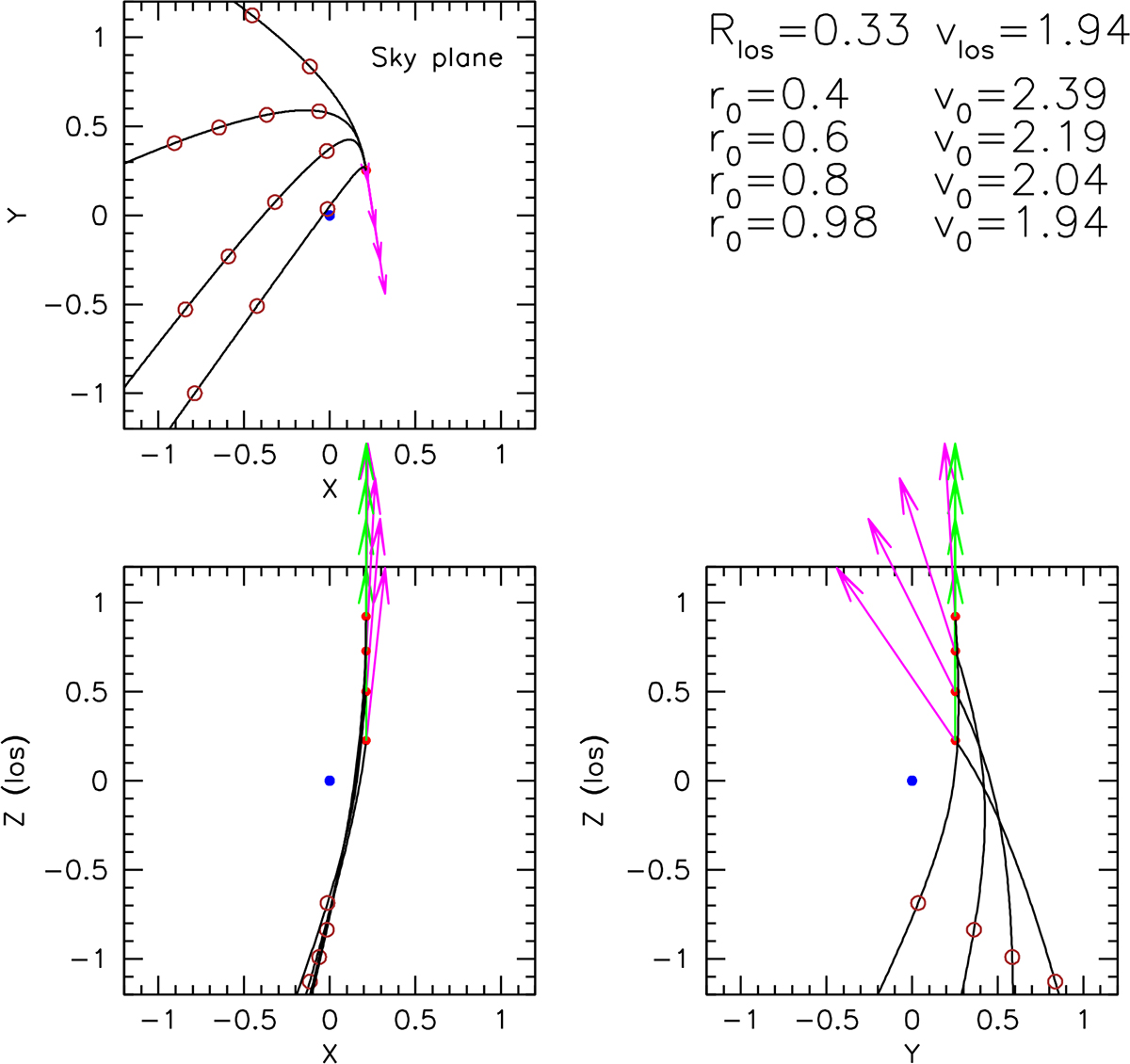
Sample trajectories of a marginally bound point mass (NGC 1265) in a static NFW potential. Three projections are shown. Here, X and Y are the coordinates in the sky plane, and Z is along the line of sight. The distances and velocities are in A426 virial units, 1.79 Mpc and 1263 km s−1, respectively. The blue and red dots mark the positions of the cluster center and the galaxy (current location), respectively. Brown circles mark the galaxy position n×Gyr ago (n = 1, 2, ...). The current projected distance and the LOS velocities are fixed at the observed values. Also fixed is the current direction of the projected velocity, which is guessed from the morphology of the radio emission near the core. Therefore, all trajectories shown have the same sky-plane velocity direction but different 3D distances from the core (r0) and 3D velocities (v0). For the largest 3D distance shown, r0 = 0.98, the galaxy is currently moving almost along the lines of sight (v0 ≃ v1.o.s.), and its trajectory goes through the very core (in projection). No attempt to further fine-tune the orbital parameters was made. If the observed radio tail global shift (to the east of the galaxy) reflects the overall geometry of the orbit, the location of NGC1265, further away from us than NGC1275, is more promising. The green arrows show the LOS velocities, while the magenta arrows show the projections of the full 3D velocity on the corresponding planes.
Current usage metrics show cumulative count of Article Views (full-text article views including HTML views, PDF and ePub downloads, according to the available data) and Abstracts Views on Vision4Press platform.
Data correspond to usage on the plateform after 2015. The current usage metrics is available 48-96 hours after online publication and is updated daily on week days.
Initial download of the metrics may take a while.