


Fig. 2.
Download original image
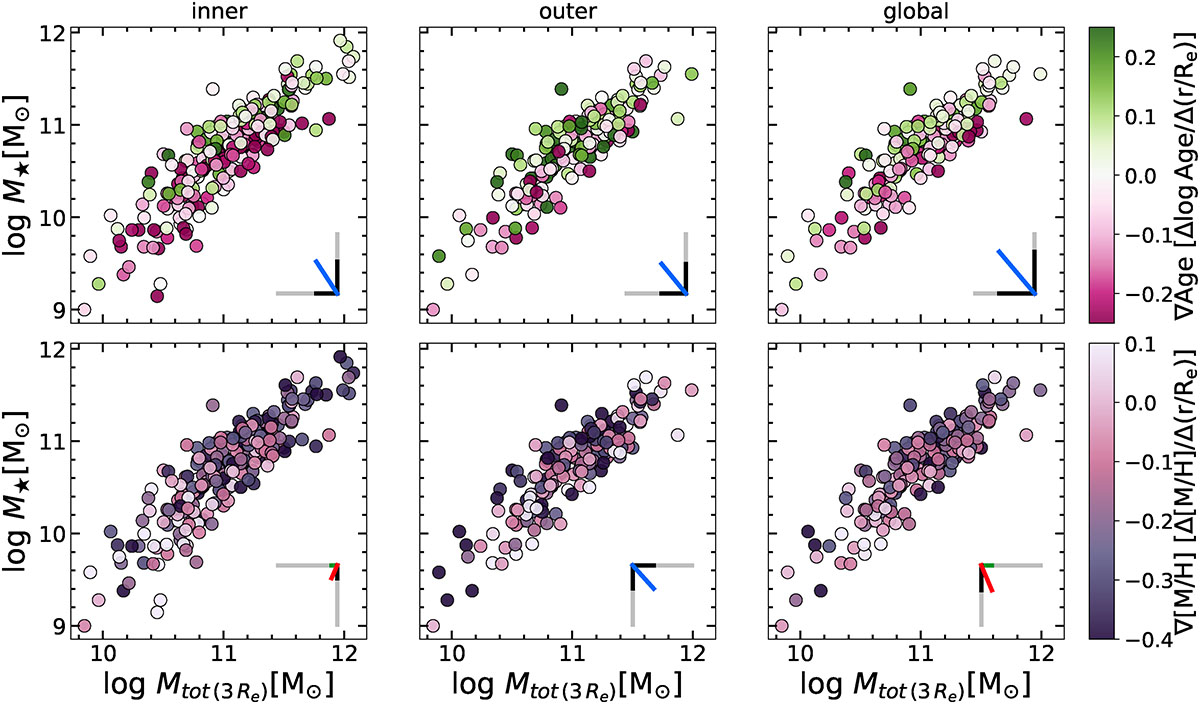
Stellar population gradients across stellar-to-total dynamical mass relation. Galaxies are shown as circles color-coded by age gradient, ∇logAge, (upper panels), and metallicity gradient, ∇[M/H], (lower panels). Inner gradient (left panels), outer gradient (middle panels), and global gradient (right panels). Partial correlation coefficient strengths are shown in the bottom right corner (solid black or green lines) between the ∇logAge/∇[M/H] and M★ (vertical) and Mtot (horizontal). Black (green) lines correspond to statistically (not) significant partial correlation coefficients. Solid gray lines have a length that corresponds to a correlation coefficient of 0.6 for reference. The direction of maximal increase of the stellar population parameters (see text) is indicated as a solid blue line when both partial correlation coefficients are significant, while a red line is used if at least one of the two is not significant.
Current usage metrics show cumulative count of Article Views (full-text article views including HTML views, PDF and ePub downloads, according to the available data) and Abstracts Views on Vision4Press platform.
Data correspond to usage on the plateform after 2015. The current usage metrics is available 48-96 hours after online publication and is updated daily on week days.
Initial download of the metrics may take a while.