


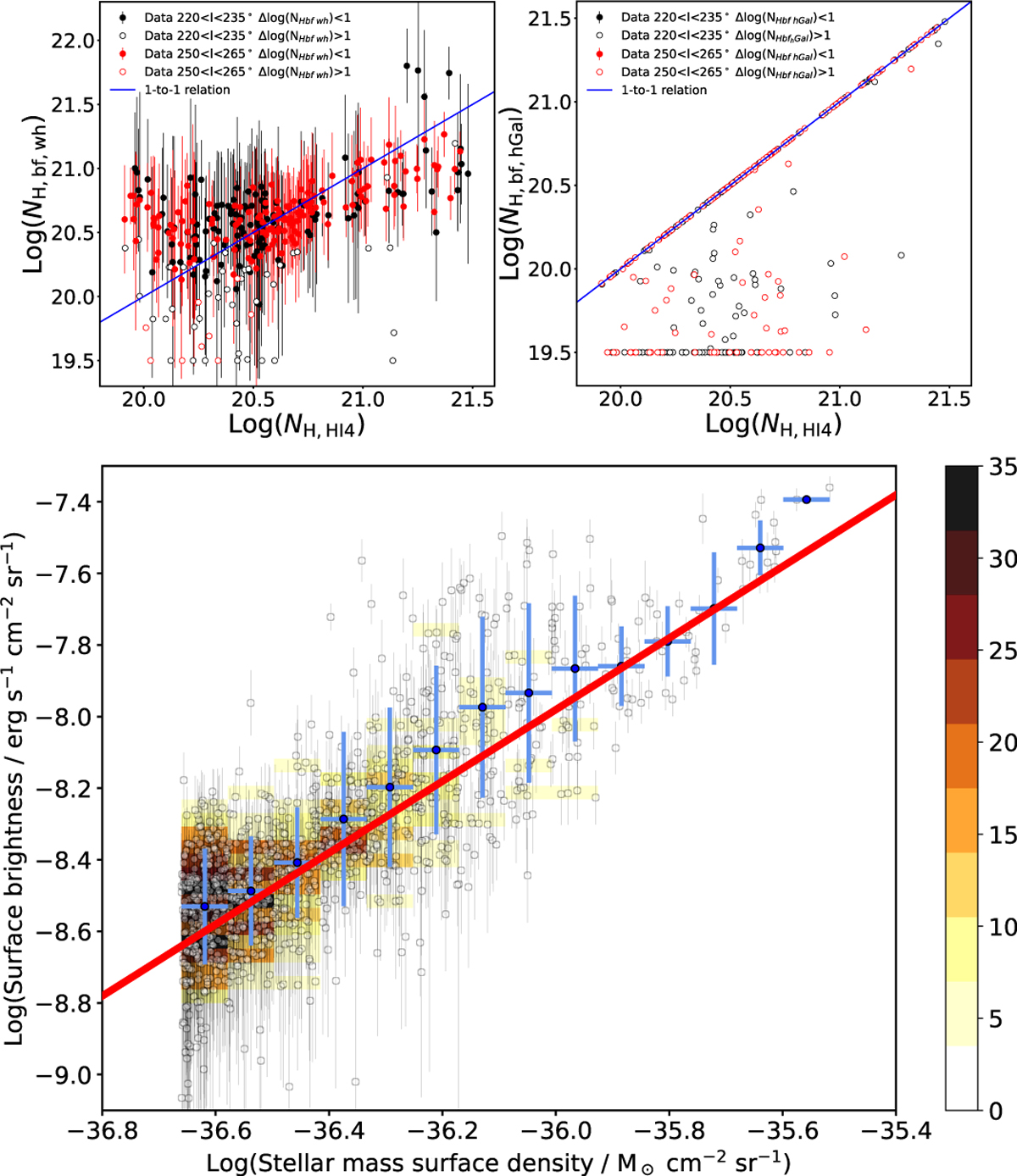
Fig. B.2
Download original image
Effects of different absorption models on the best-fit results. Top-left and top-right panels: Column density of neutral absorption of the warm-hot (left) and 0.7 keV (right) components in the multiple-layer model. Same colours and symbols as in the top-right panel of Fig. B.1. The column density of the 0.7 keV component is unconstrained and often pegged at very low values or the total Galactic column density. Bottom panel: Correlation for the multilayer absorption model. Despite the unconstrained column density of the 0.7 keV component inducing a larger scatter in the best-fit surface brightness of the 0.7 keV emission, the correlation with the stellar mass surface density persists with a correlation coefficient (L/M) consistent with the single-layer model.
Current usage metrics show cumulative count of Article Views (full-text article views including HTML views, PDF and ePub downloads, according to the available data) and Abstracts Views on Vision4Press platform.
Data correspond to usage on the plateform after 2015. The current usage metrics is available 48-96 hours after online publication and is updated daily on week days.
Initial download of the metrics may take a while.