


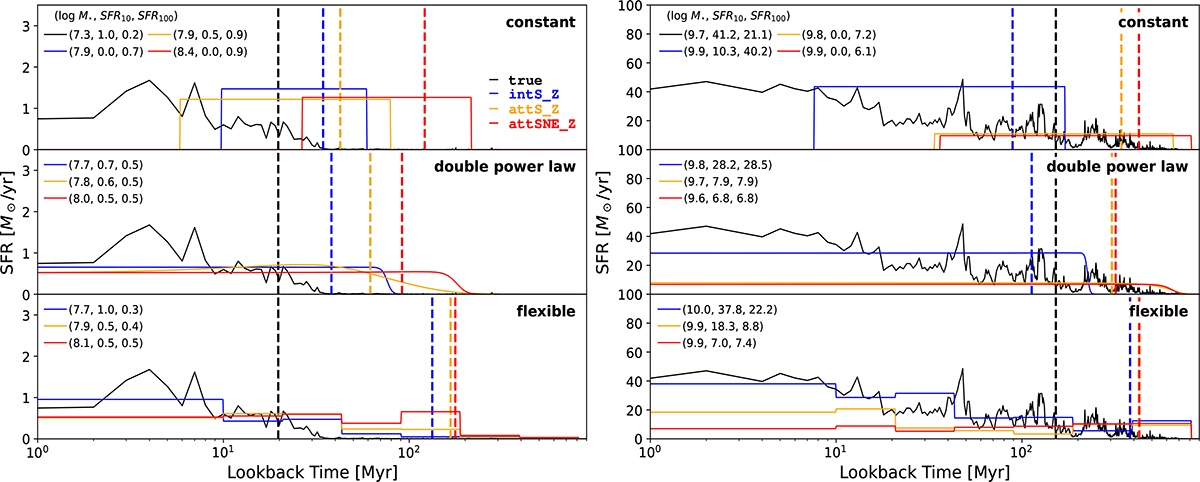
Fig. 4.
Download original image
Posterior SFHs corresponding to the median SFR100 values are displayed together with the true SFH (solid black line) for two representative galaxies: one low-mass (log M★/M⊙ = 7.32, left panels) and one high-mass (log M★/M⊙ = 9.67, right panels). Each row corresponds to a different SFH model used in the fitting, and each coloured line denotes a separate fitting configuration (blue: intS_Z, orange: attS_Z, red: attSNE_Z), with the SMC attenuation law applied when a dust model is included. Dashed vertical lines indicate the mass-weighted age. Under intS_Z, the constant SFH model generates the fewest young stars (< 10 Myr) among all models and yields the lowest mass-weighted age. Consequently, its strongest underestimation is SFR10 and it also overestimates SFR100, as most of the stellar mass is concentrated in intermediate-age populations. When dust and nebular components are added, all three SFH models predict larger old stellar populations, increasing the mass-weighted age and leading to an underestimation of SFR100, particularly in high-mass galaxies.
Current usage metrics show cumulative count of Article Views (full-text article views including HTML views, PDF and ePub downloads, according to the available data) and Abstracts Views on Vision4Press platform.
Data correspond to usage on the plateform after 2015. The current usage metrics is available 48-96 hours after online publication and is updated daily on week days.
Initial download of the metrics may take a while.