


Fig. 7
Download original image
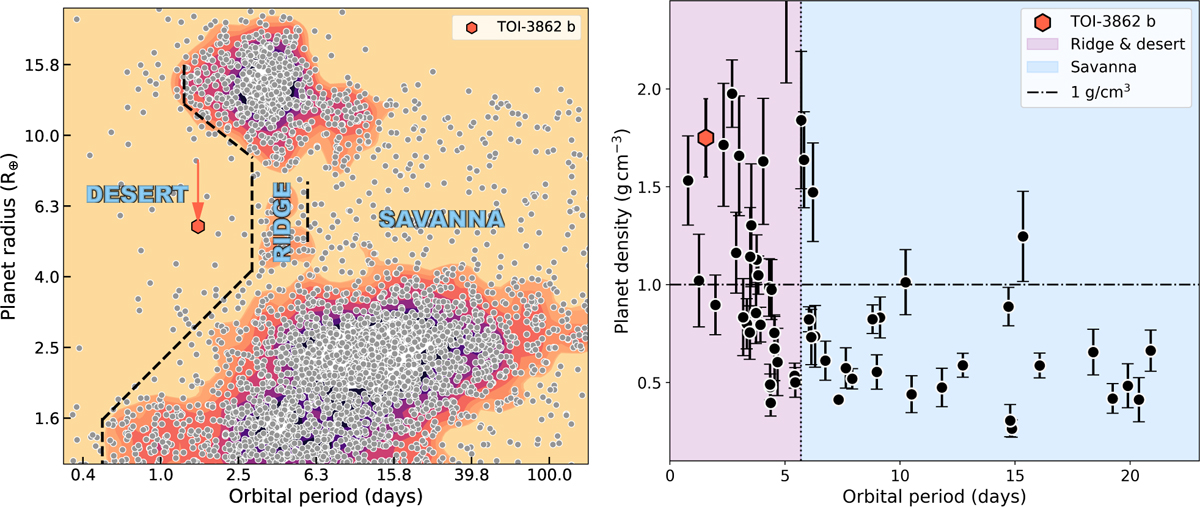
Left: planet radius vs. orbital period for all known exoplanets, highlighting the hot Neptune desert, ridge, and savanna derived by Castro-González et al. (2024a). We note that this updated definition of the hot Neptune desert is much stricter than the original one by Mazeh et al. (2016), with less than 10% as many planets in it. The arrows represent the evolution of the planet’ radius from the initial value to the current value. Right: density–period diagram of all planets with radii between 4.5 and 8.5 R⊕ and densities constrained to precisions better than 33%, with the hot Neptune desert planet, TOI-3862b, overplotted. These plots were generated with nep-des (https://github.com/castro-gzlz/nep-des).
Current usage metrics show cumulative count of Article Views (full-text article views including HTML views, PDF and ePub downloads, according to the available data) and Abstracts Views on Vision4Press platform.
Data correspond to usage on the plateform after 2015. The current usage metrics is available 48-96 hours after online publication and is updated daily on week days.
Initial download of the metrics may take a while.