


Fig. 7
Download original image
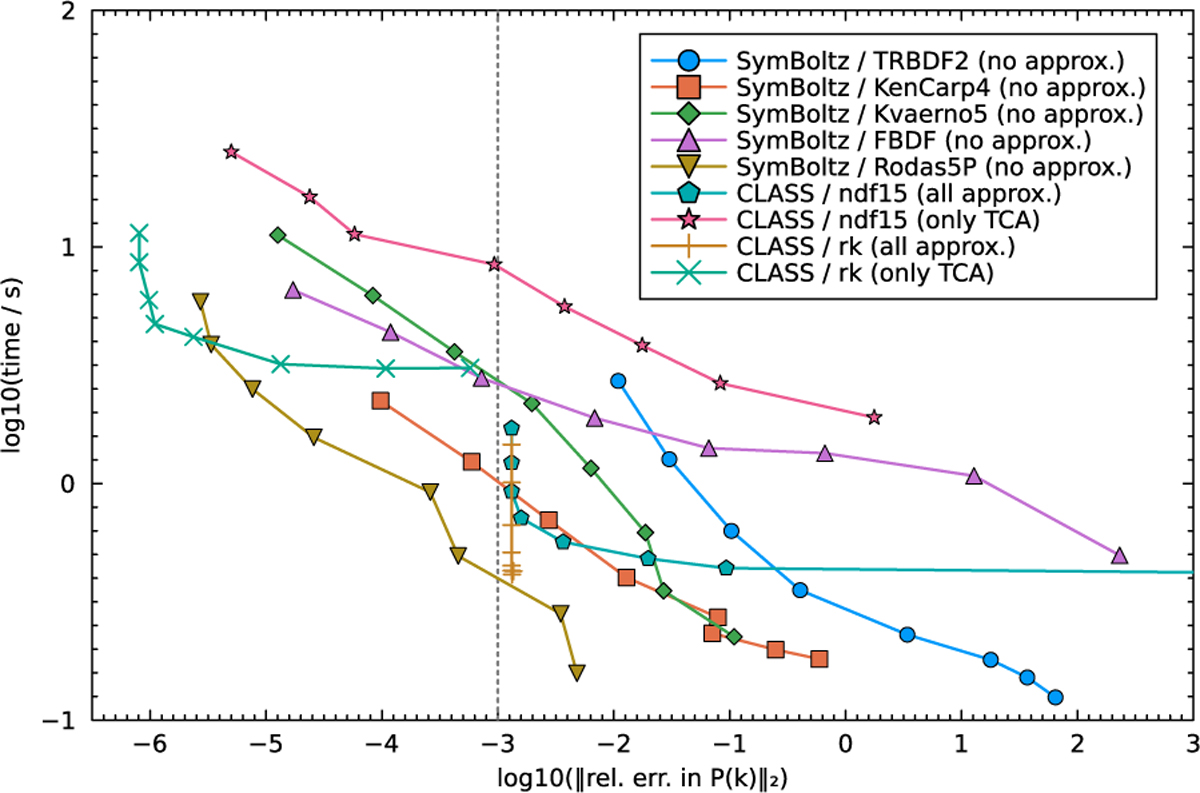
Work versus precision for computing the matter power spectrum P(k) with SymBoltz and CLASS. SymBoltz is approximation-free and run with several implicit ODE solvers. CLASS is run with approximations on/off, its implicit/explicit evolvers ndf15/rk, and precision settings in Appendix B, but tight coupling is always approximated. For each setup, P(k) is computed by integrating perturbation k-modes with ODE solver tolerances 10−2-10−9 that controls the adaptive stepping. For each tolerance, we record the best of 3 runtimes and the L2-compressed error  relative to high-precision spectra P(k) from both codes with approximations off, tolerance 10−10, and FBDF/ndf15. Both codes solve a w0waCDM model with equal parameters, N = 114 equal wavenumbers ki, multipole cutoff lmax = 16 for all species, default sampling of massive neutrino momenta, and parallelization over k. Times are from a Linux laptop with an Intel i7-12800H CPU.
Current usage metrics show cumulative count of Article Views (full-text article views including HTML views, PDF and ePub downloads, according to the available data) and Abstracts Views on Vision4Press platform.
Data correspond to usage on the plateform after 2015. The current usage metrics is available 48-96 hours after online publication and is updated daily on week days.
Initial download of the metrics may take a while.