


Fig. 4.
Download original image
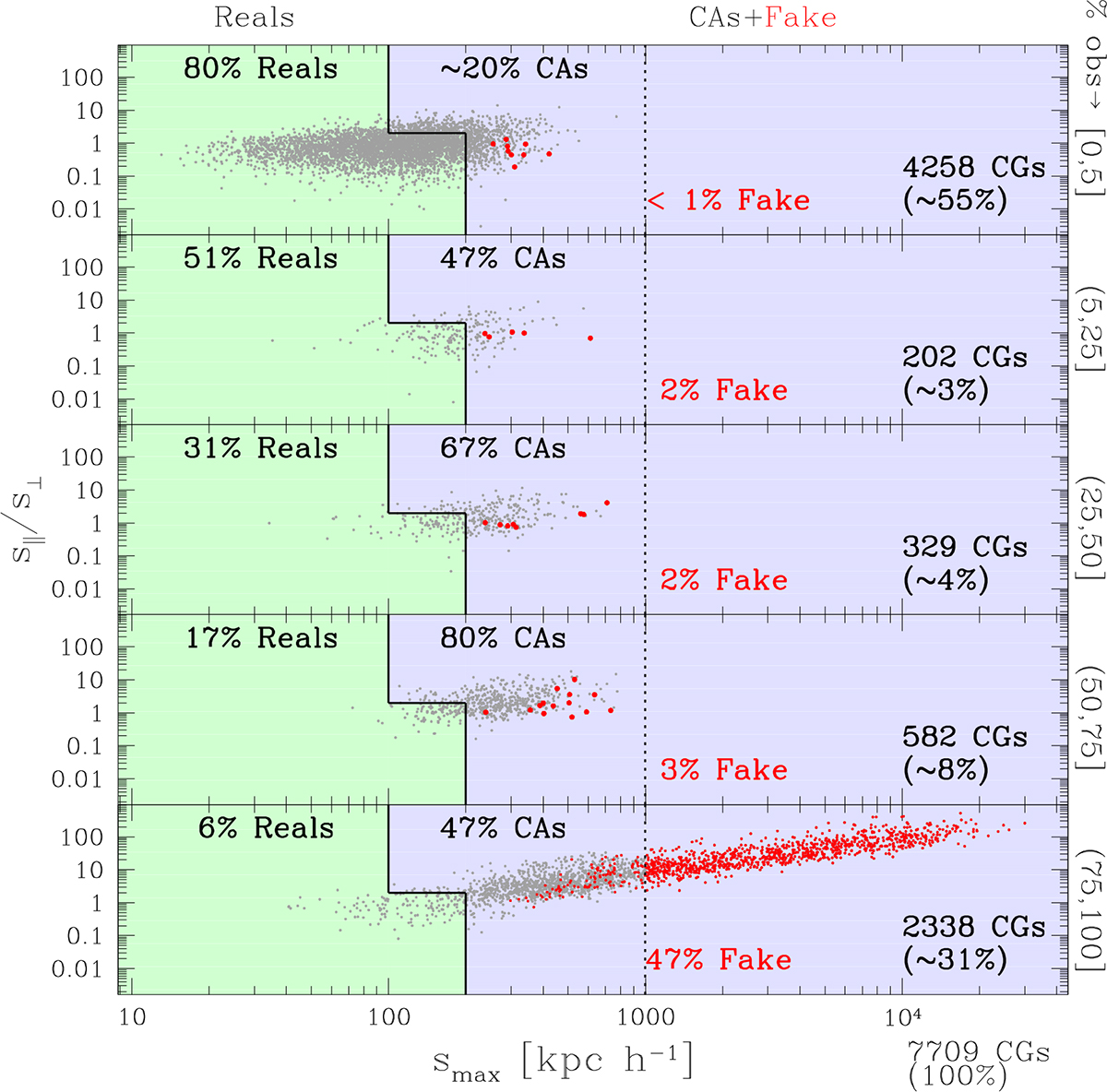
Scatter plot of the largest 3D real space separation in the CG (smax) for the three (in the case of triplets) or four (for the remaining CGs) closest galaxies and the original line-of-sight elongation, features used to classify into Reals and CAs (Díaz-Giménez & Mamon 2010). The light green region corresponds to Real CGs, while outside that region, CGs are classified as chance alignments (CAs). Within the CA class, we have also classified CGs as ‘Fake’ if the maximum 3D separation is larger than 1 h−1 Mpc (dotted vertical line) or the minimum 3D separation is larger than 200 h−1 kpc (red dots). The top panel shows the distribution of CGs that satisfy the compactness criterion, almost regardless of the position of the observer (for more than 95% of them). The remaining panels display the samples where some observers (more than 5%) lose the CG because they no longer achieve the compactness criterion from their points of view. From the second row to the bottom, the panels display the CGs when the percentage of random observers who lose the CG is between 5 and 25; 25 and 50; 50 and 75; and 75 and 100.
Current usage metrics show cumulative count of Article Views (full-text article views including HTML views, PDF and ePub downloads, according to the available data) and Abstracts Views on Vision4Press platform.
Data correspond to usage on the plateform after 2015. The current usage metrics is available 48-96 hours after online publication and is updated daily on week days.
Initial download of the metrics may take a while.