


Fig. 8.
Download original image
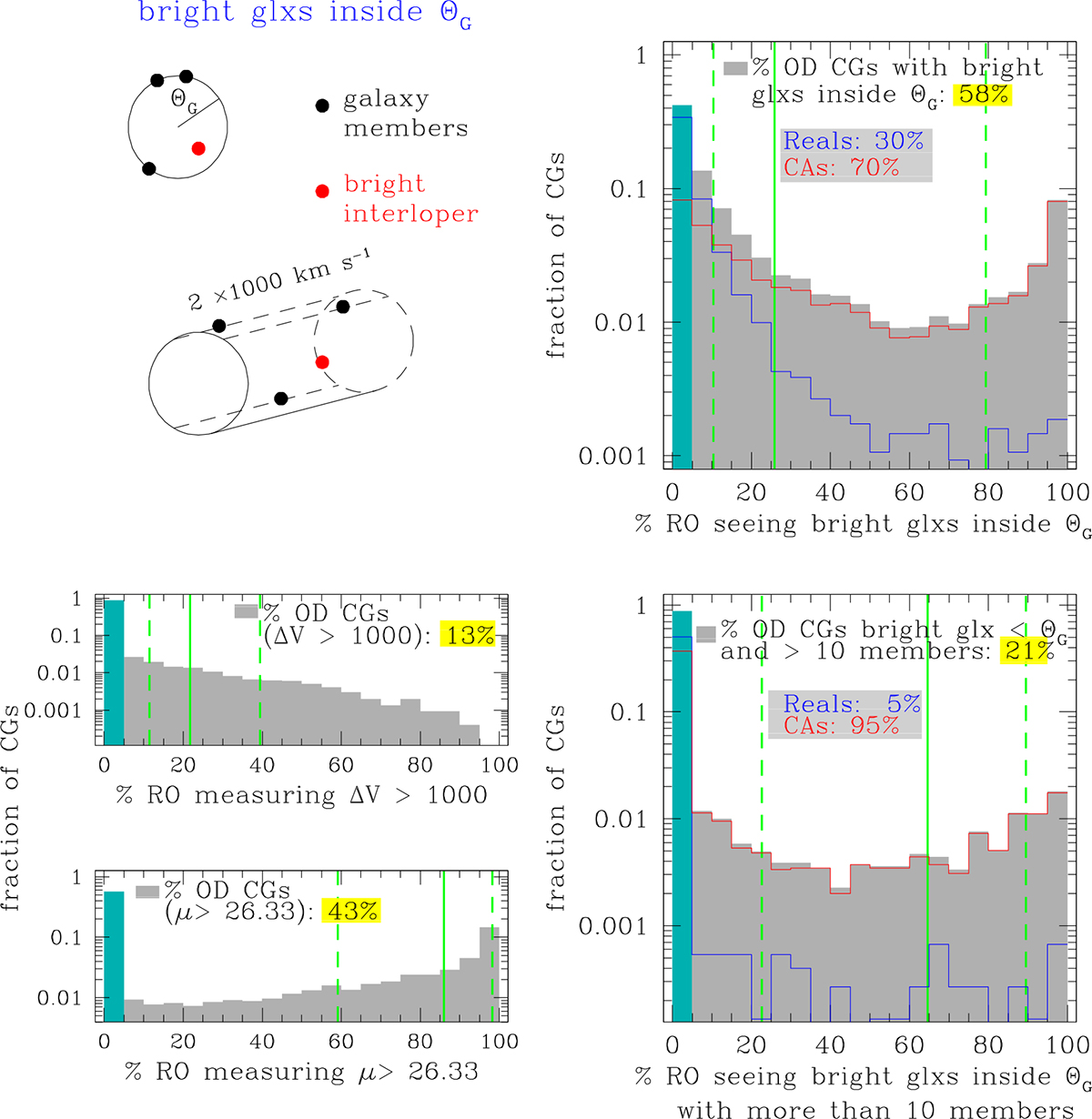
Bright galaxy interlopers inside CGs for different random observers. Top-left panel: Schematic representation of a bright interloper (red) detected by a random observer inside the radius of the CG members (black) and within the ±1000 km/s cylinder. Top-right panel: Distribution among the 7488 CGs of percentages of random observers (RO) who detect bright interlopers. The inset legends quote the percentages of observer-dependent (OD) CGs due to the detection of bright interlopers within the system radius. Vertical green lines represent the medians (solid) and the 25th and 75th percentiles (dashed) of the distribution for observer-dependent CGs (grey histograms). The teal bar between 0 and 5% represents the fraction of CGs considered robust. The blue and red histograms correspond to the distributions for CGs classified as Reals and CAs+Fake, respectively. Bottom-right panel: Same as top-right panel, but only for those CGs with numerous bright interlopers within ΘG, which leads the number of galaxy members to exceed the maximum (ten) of the population criterion. Bottom-left panels: Same as Fig. 2 but recalculated for all CGs now including bright interlopers.
Current usage metrics show cumulative count of Article Views (full-text article views including HTML views, PDF and ePub downloads, according to the available data) and Abstracts Views on Vision4Press platform.
Data correspond to usage on the plateform after 2015. The current usage metrics is available 48-96 hours after online publication and is updated daily on week days.
Initial download of the metrics may take a while.