


Fig. 4.
Download original image
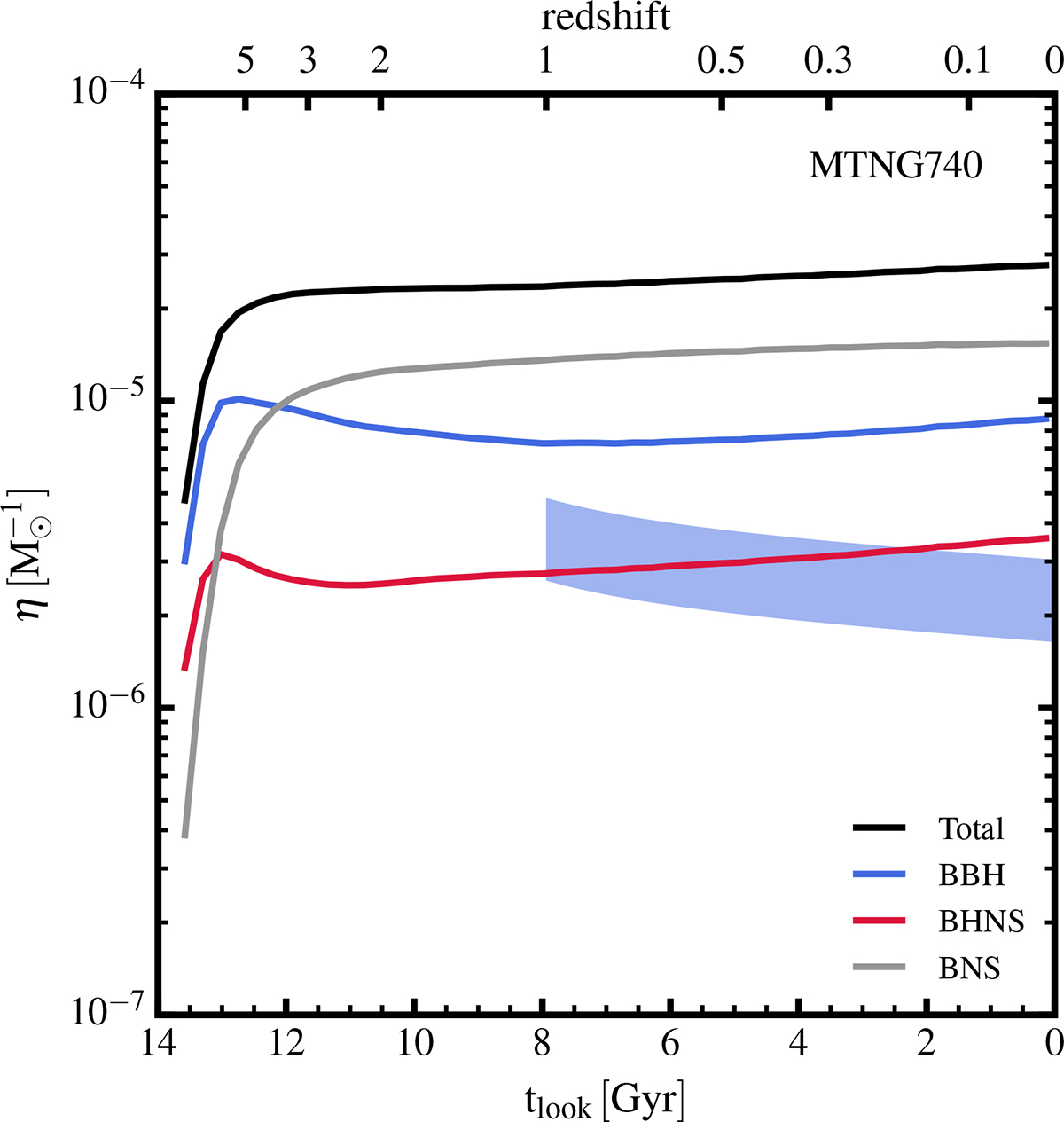
Merger efficiency of compact binary objects per unit of stellar mass formed as a function of time and redshift in the simulation MTNG740. The total merger efficiency, along with the contributions from different merger channels, is displayed as indicated in the legend. The shaded region represents constraints on the evolution of BBH merger efficiency at low redshifts (z ≲ 1) derived by extrapolating the LVK collaboration limits shown in Fig. 3. This extrapolation assumes a redshift evolution of the form (1 + z)3.2 (LVK25) and adopts the SFRD evolution given by Madau & Dickinson (2014), as reported in Fig. 2.
Current usage metrics show cumulative count of Article Views (full-text article views including HTML views, PDF and ePub downloads, according to the available data) and Abstracts Views on Vision4Press platform.
Data correspond to usage on the plateform after 2015. The current usage metrics is available 48-96 hours after online publication and is updated daily on week days.
Initial download of the metrics may take a while.