


Fig. 5.
Download original image
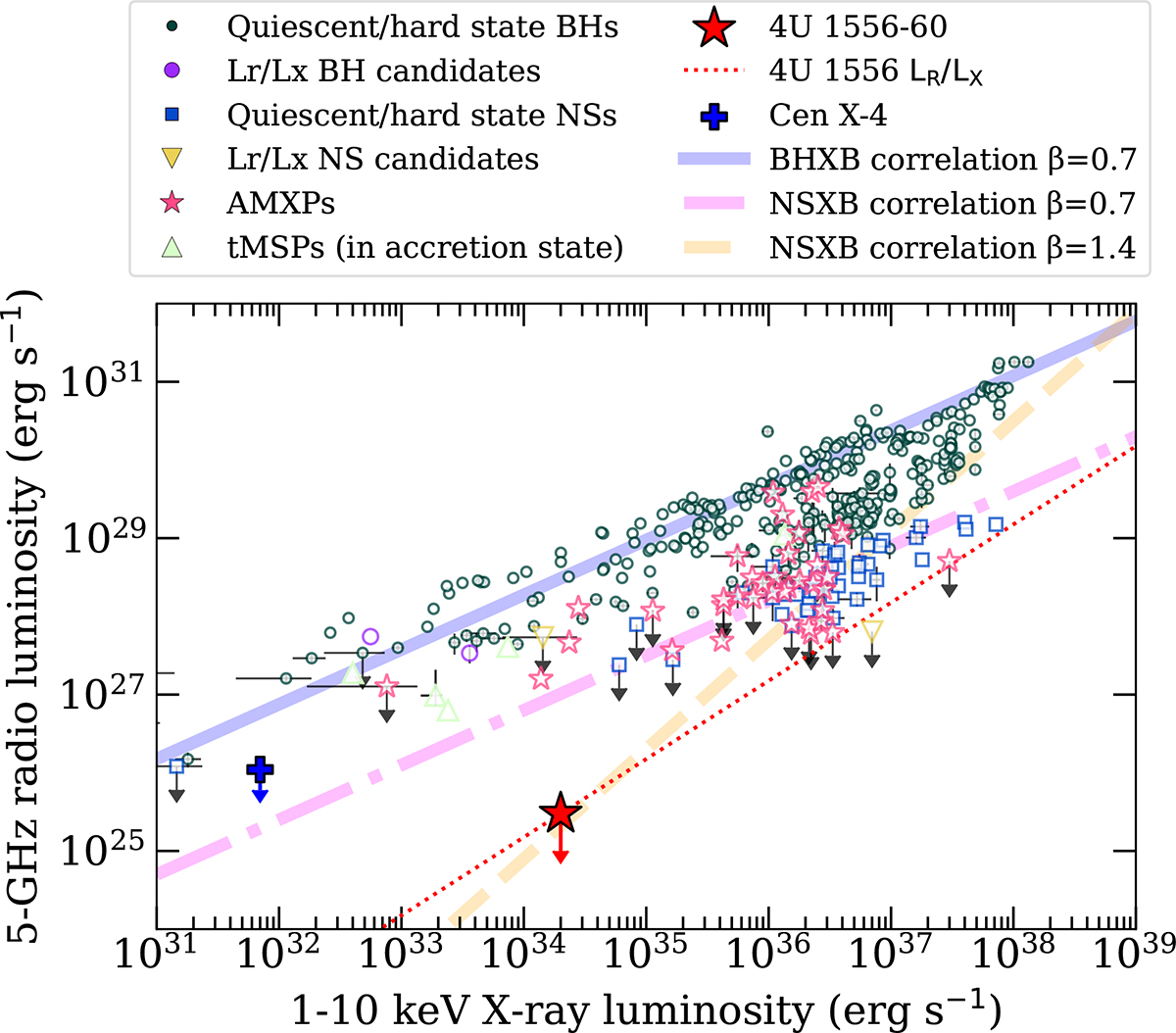
Plot of X-ray binary radio and X-ray luminosities from Bahramian & Rushton (2022), with our radio nondetection of 4U 1556–60 indicated with a red star and a line of constant LR/LX plotted for reference at other source distances. Three correlation lines are plotted for visual reference: solid blue for BHXBs; dash-dot magenta for NSXBs with β = 0.7; and dashed orange for NSXBs with β = 1.4. AMXPs are accreting millisecond pulsars with stronger magnetic fields than general NSXBs, and tMSPs are transitional millisecond pulsars whose radio emission during their XRB-like state is thought to not arise from a jet alone. The very low upper limit of 4U 1556–60’s radio emission for its X-ray luminosity is strongly indicative of a neutron star accretor, as it is about 1000 times fainter than expected for a black hole accretor. The previous deepest upper limit in radio luminosity for a NSXB, Cen X–4 in quiescence at ∼1.2 kpc (van den Eijnden et al. 2022), is also shown as a blue plus sign.
Current usage metrics show cumulative count of Article Views (full-text article views including HTML views, PDF and ePub downloads, according to the available data) and Abstracts Views on Vision4Press platform.
Data correspond to usage on the plateform after 2015. The current usage metrics is available 48-96 hours after online publication and is updated daily on week days.
Initial download of the metrics may take a while.