


Table 2.
Criteria values from Kokorev et al. (2024) and Kocevski et al. (2025) computed for the tLRD.
| Criterion | Value |
|---|---|
| Kokorev+24 | |
| F115W − F150W < 0.8 mag | 0.13 mag |
| F200W − F277W > 0.7 mag | 1.00 mag |
| F200W − F356W > 1.0 mag | 0.36 mag |
| bd : F115W − F200W > −0.5 mag | 0.24 mag |
| ff444w(0.5″)/ff444w(0.3″) < 1.7 | 1.33 |
| Kocevski+24 | |
| S/NF444W > 12 | 249 |
| βopt > 0 | −1.36 |
| −2.8 < βUV < −0.37 | −1.59 |
| rh < 1.5rh, stars | 1.72 pix |
| βF277W − F356W > −1 | −4.35 |
| βF277W − F410M > −1 | 0.26 |
| Optical slope from spec is −0.41* | |
Notes. The numbers in bold highlight the criteria that tLRD does not satisfy; these are related to its optical emission. The Kokorev et al. (2024) compactness criterion refers to the ratio between the flux measured in 0.4″ and 0.2″ apertures. The symbol bd indicates brown dwarf; rh is the half-light radius measured in the F444W of Kocevski et al. (2025). In this case 1.5rh, stars ∼ 2.6 pix. In the Kocevski et al. (2025) criteria, 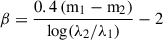 . Following Table 2 in that paper, the UV filters correspond to F115W, F150W, and F200W, and the optical filters to F277W, F356W, and F444W. Although βopt < 0 when derived using F277W and F444W, βopt = 2.1 when using F356W and F444W. We also include the βopt value estimated directly from the spectrum. * This is the only reliable measurement of the optical slope, given that F277W, F410M, and F444W are contaminated by strong emission lines.
Current usage metrics show cumulative count of Article Views (full-text article views including HTML views, PDF and ePub downloads, according to the available data) and Abstracts Views on Vision4Press platform.
Data correspond to usage on the plateform after 2015. The current usage metrics is available 48-96 hours after online publication and is updated daily on week days.
Initial download of the metrics may take a while.