


Fig. 8
Download original image
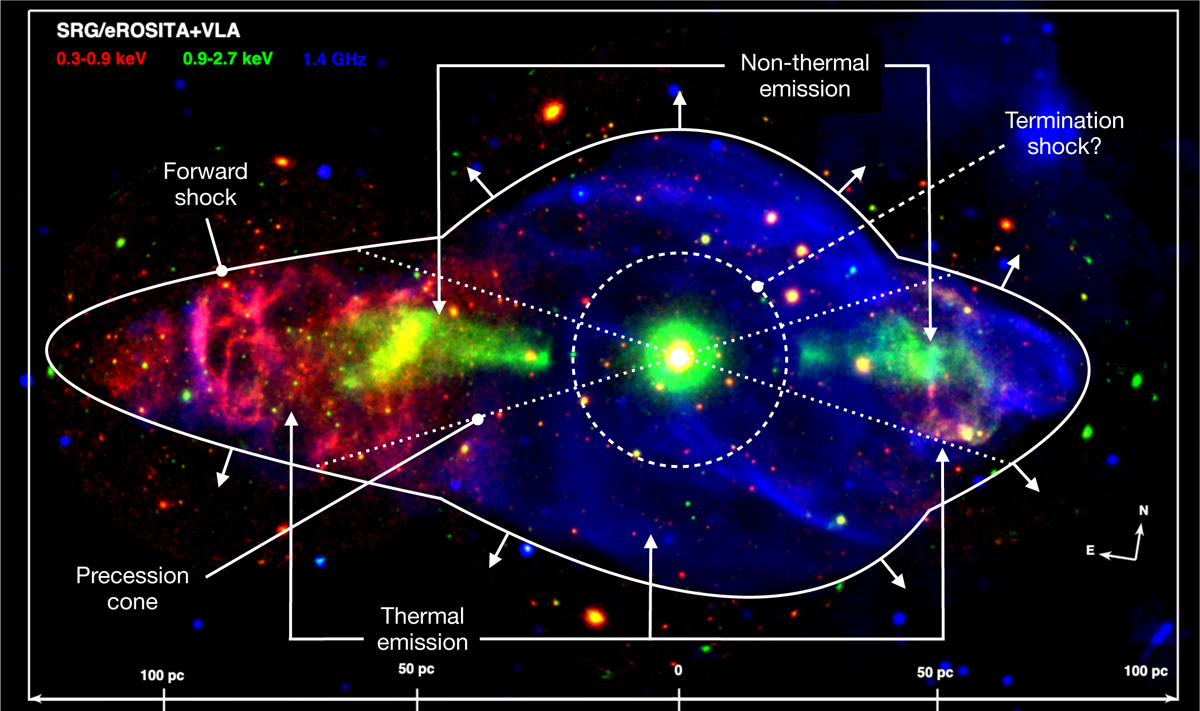
A schematic summary picture of the W50 nebula presented on top of the composite X-ray (red and green) and radio (VLA at 1.4 GHz by Dubner et al. 1998, blue) image. While radio emission most likely arises at the outer shell-like boundary of the nebula, the soft X-ray emission (0.3−0.9 keV) trace shock heated ISM gas behind it which fills almost entire interior of the nebula, and harder X-ray emission (0.9−2.7 keV in this case) is of non-thermal (synchrotron) nature and is produced by ultrarelativistic electrons accelerated at shocks in the axial outflows from the system (e.g., Churazov et al. 2024). The central-most part of the nebula, within ∼ 25 pc from SS 433 (dashed circle) is likely of very low density and could be a wind-blown cavity created by an almost spherically symmetric outflow with close to Eddington kinetic luminosity. The impact of narrow baryonic jets launched by the central source in the current epoch is not clearly visible, given that no indications of interaction are observed along the sky projection of the jet’s current precession cone (dotted lines).
Current usage metrics show cumulative count of Article Views (full-text article views including HTML views, PDF and ePub downloads, according to the available data) and Abstracts Views on Vision4Press platform.
Data correspond to usage on the plateform after 2015. The current usage metrics is available 48-96 hours after online publication and is updated daily on week days.
Initial download of the metrics may take a while.