


Fig. 13.
Download original image
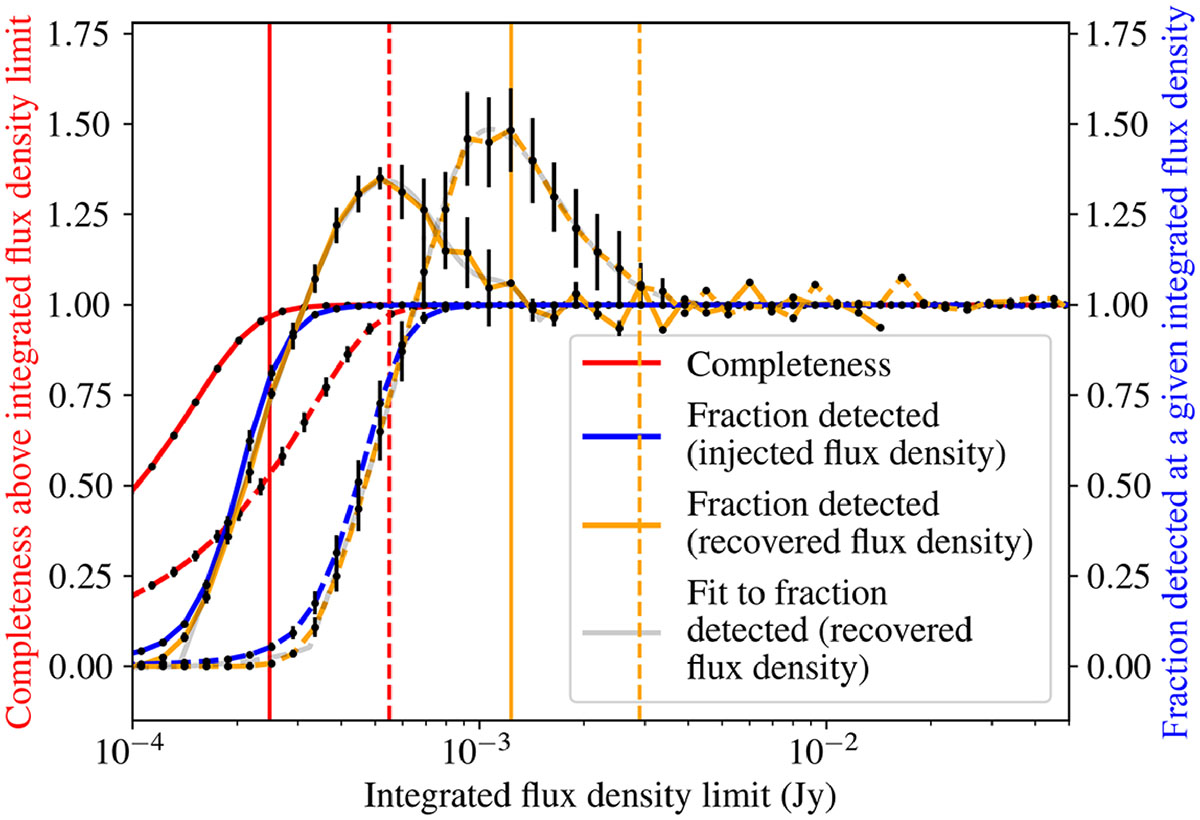
Completeness as a function of integrated flux density and the fraction of sources detected at a given flux density, derived from mosaic simulations that include smearing and astrometric uncertainties. The results are based on 100 different simulated customised mosaic images (each with 10 runs), with error bars showing the standard deviation between the different mosaics simulated. In the simulations shown we have assumed PYBDSF is able to recover the full integrated flux density of sources in the presence of smearing and astrometric errors. Solid curves correspond to the 14.3 deg2 region with noise levels of 27–31 μJy beam−1, while dashed curves represent the 85.0 deg2 region with noise levels of 64–74 μJy beam−1. The fraction of sources detected with a measured flux within given flux density range, relative to the number injected in that range, is modelled using a normalised sigmoid function modulated by a damped sine wave. The yellow vertical lines mark the highest integrated flux density where the model exceeds unity by more than 5%, corresponding to 1.2 mJy and 2.9 mJy for the two noise bins and typically about 45 times the lower limit of the noise value for that bin. Above these thresholds the simulated source flux density distribution matches the recovered one. The red vertical lines indicate the integrated flux density where the completeness above the integrated flux density limit is 0.95, at 0.25 mJy and 0.55 mJy for these two noise bins – typically 9 times the lower limit of the noise value for each bin.
Current usage metrics show cumulative count of Article Views (full-text article views including HTML views, PDF and ePub downloads, according to the available data) and Abstracts Views on Vision4Press platform.
Data correspond to usage on the plateform after 2015. The current usage metrics is available 48-96 hours after online publication and is updated daily on week days.
Initial download of the metrics may take a while.