


Fig. 5.
Download original image
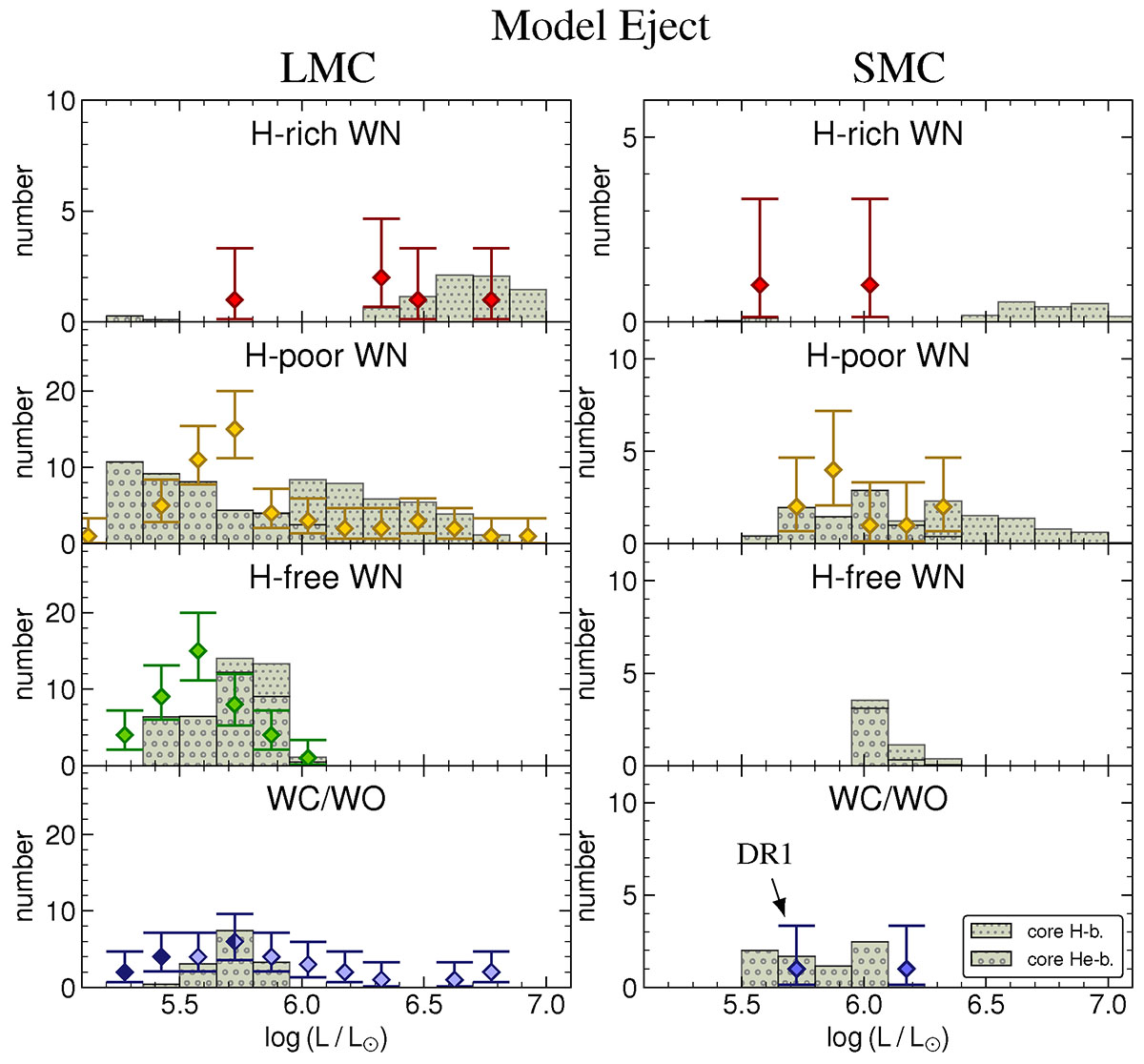
Empirical luminosity distributions for the different WR subtypes (diamonds) in the LMC (left) and SMC (right) compared to the predictions from the Model Eject population (hatched bins). The error margins mark the 84% confidence intervals of a Poissonian distribution accounting for small numbers (Israel 1968). In the synthetic population, we differentiate between core H-burning (light dotted bins) and core He-burning stars (bold dotted bins). For definitions of the individual WR subtypes, refer to Appendix D. The Of/WN stars are not included in the H-rich WR subtype, as they do not meet the criteria used in our models to identify the WR phase. For the LMC’s WC/WO population, not all stars have been studied in detail using stellar atmosphere models, and for a large set of the WCs, we had to estimate their luminosity from their V-band photometry (see Section 4 of Pauli et al. 2022). Bins containing only luminosities derived from a detailed spectral analysis are marked by dark blue diamonds, those only containing luminosities derived from the V-band photometry are marked by light blue diamonds, and those containing both are marked by half dark and half light blue diamonds. Since some of these stars might be binaries, the luminosities estimated from the V-band should be treated with caution and considered as upper limits. In the SMC’s WC/WO population, we added the WO star DR1 from IC 1613 (Tramper et al. 2013).
Current usage metrics show cumulative count of Article Views (full-text article views including HTML views, PDF and ePub downloads, according to the available data) and Abstracts Views on Vision4Press platform.
Data correspond to usage on the plateform after 2015. The current usage metrics is available 48-96 hours after online publication and is updated daily on week days.
Initial download of the metrics may take a while.