


Fig. 4
Download original image
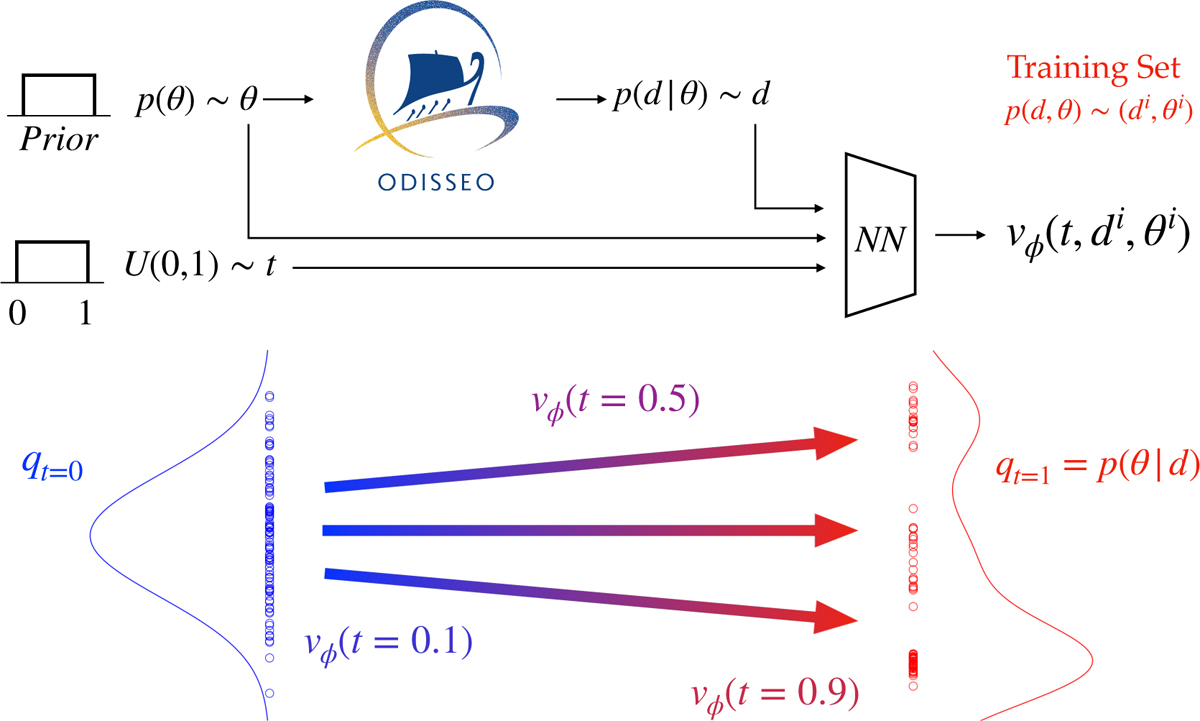
Schematic of flow matching for posterior estimation with ODISSEO. The training set was generated by sampling i = 0,..., N parameters θi from the prior p(θ) and then forward modeled using ODISSEO to obtain the observation di ~ p(d | θ). Following the flow described in Sect. 2.4, we sampled t ~ U(0,1) to train a neural network to approximate the vector field vφ(t, di, θi). In the lower section, we report a simplified flow matching objective for a 1D case. The neural network is called for different t to regress the vector field that governs the ODE in order to transform the sampling distribution qt=0 = N(0,I) into the posterior distribution qt=1 = p(θ | d). Note that in this schematic, we refer to θ1 described in Sect. 2.4 as θ.
Current usage metrics show cumulative count of Article Views (full-text article views including HTML views, PDF and ePub downloads, according to the available data) and Abstracts Views on Vision4Press platform.
Data correspond to usage on the plateform after 2015. The current usage metrics is available 48-96 hours after online publication and is updated daily on week days.
Initial download of the metrics may take a while.