


Fig. 1
Download original image
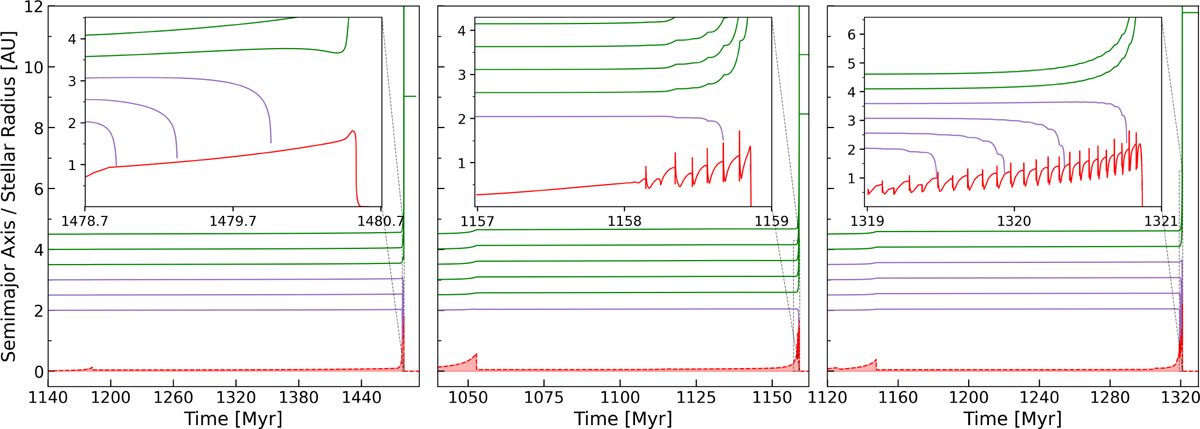
Orbital evolution of a 1 MJ gas-giant planet orbiting a 2 M⊙ star with Z = 0.0187, comparing calculations performed with SSE (left), the MESA default test suite (middle), for which the AGB mass-loss efficiency is set to η = 0.7, and MESA assuming a more realistic mass-loss efficiency (η = 0.02; right). The orbits are assumed to be circular, and initial separations range from 2 to 4.5 au, with a step size of 0.5 au. The red filled area corresponds to the stellar radius, while purple and green lines denote the orbital separation of the engulfed and surviving planets, respectively. The insets show zoomed-in views of the thermal pulse phase of the AGB and highlight its critical role in planetary engulfment. SSE does not account for the thermal pulses (left). For a large mass-loss efficiency (middle), most planets survive because the orbit expansion caused by stellar mass loss dominates. In the most realistic scenario assuming a small efficiency (right), the star evolves through more thermal pulses and reaches a larger radius, which causes most planets to be engulfed.
Current usage metrics show cumulative count of Article Views (full-text article views including HTML views, PDF and ePub downloads, according to the available data) and Abstracts Views on Vision4Press platform.
Data correspond to usage on the plateform after 2015. The current usage metrics is available 48-96 hours after online publication and is updated daily on week days.
Initial download of the metrics may take a while.