


Fig. 13
Download original image
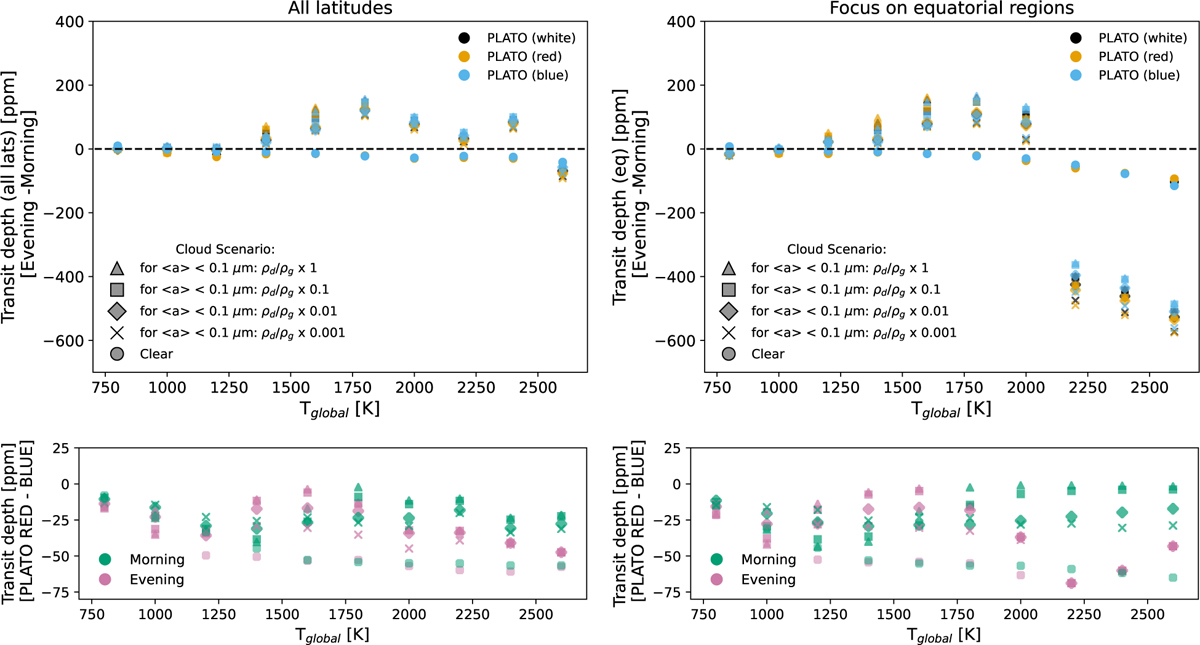
Transit asymmetry calculations from different cloud scenarios for PLATO. Top: differences between the individual evening and morning transit depths (transit asymmetries) for tidally locked planets with Tglobal = 800 K… 2600 K orbiting G main sequence stars (left: all latitudes are used, right: only equatorial information is used). Results for clear atmosphere calculations are indicated by circles. Cloudy scenarios with different cloud mass loads, ρg/ρd(z), in atmospheric layers where 〈a〉 < 0.1 μm are denoted by different markers (crosses: 10−3ρg/ρd(z), diamonds: 10−2ρg/ρd(z), squares: 0.1ρg/ρd(z)). Triangles denote Fe-free results with full ρg/ρd(z). Colors denote different PLATO observation modes (black: PLATO’s white band, golden: PLATO’s red filter, blue: PLATO’s blue filter). Bottom: evening-morning transit depth differences between PLATO fast cameras’ red and blue filter (red symbols/green symbols).
Current usage metrics show cumulative count of Article Views (full-text article views including HTML views, PDF and ePub downloads, according to the available data) and Abstracts Views on Vision4Press platform.
Data correspond to usage on the plateform after 2015. The current usage metrics is available 48-96 hours after online publication and is updated daily on week days.
Initial download of the metrics may take a while.