


Fig. 18
Download original image
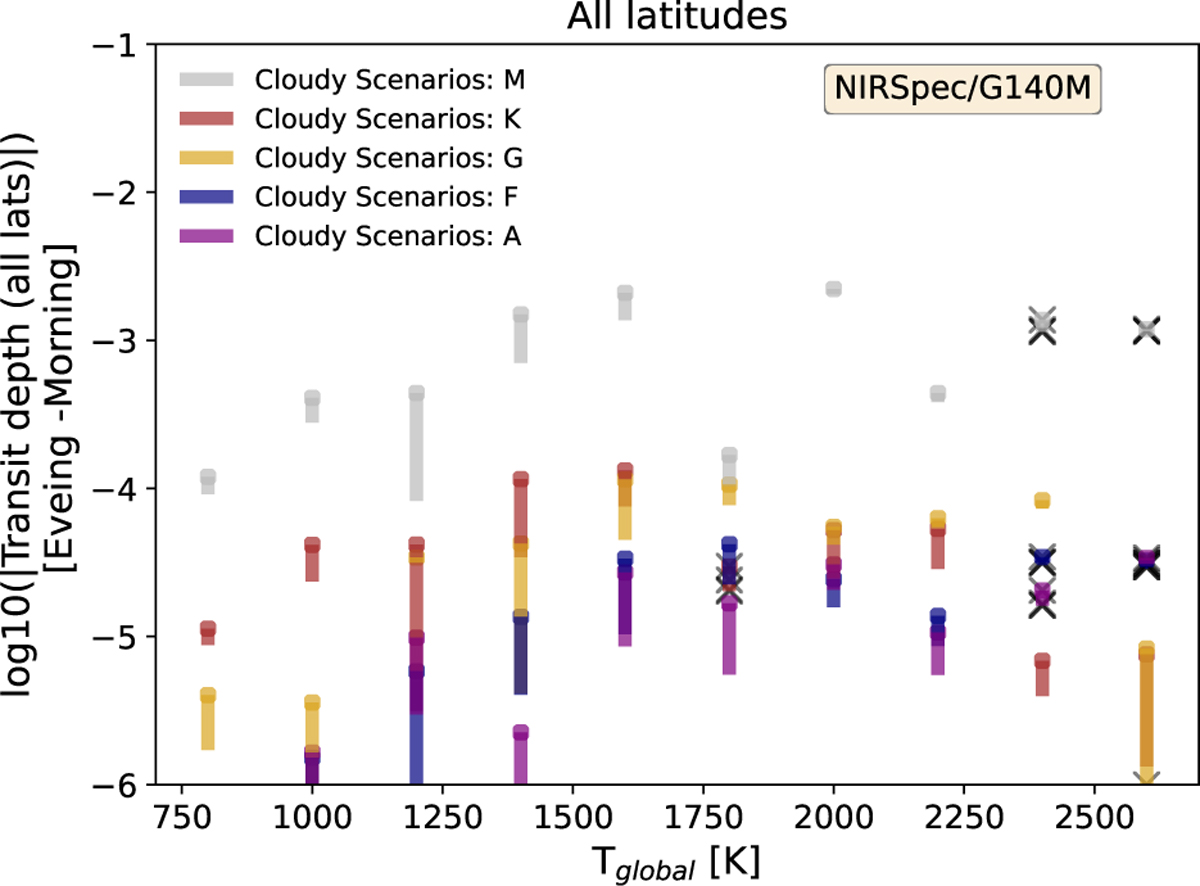
Transit asymmetry calculations for planets around diverse host stars in the near-infrared. Differences between the individual evening and morning transit depths (transit asymmetries) of cloudy atmosphere scenarios for observation in the integrated NIRSpec/G140M wavelength range for tidally locked planets with Tglobal = 800 K… 2600 K (left: only equatorial information is used, right: all latitudes are used). Colored stripes indicate the range for cloud scenarios (with cloud mass load, ρg/ρd(z) for atmospheric layers, where 〈a〉 < 0.1 μm is scaled by values between 1 and 10−3) around different main sequence host stars (purple: A, dark blue: F, golden: G, orange: K, gray: M). Circles denote the maximum values and crosses indicate negative evening-morning transit asymmetries for clarity.
PLATO transit depth asymmetry observations for Tglobal = 800 … 1200 K and ultrahot Jupiters should thus be examined for this population. Here, in particular the transition between hot to ultrahot Jupiters (Tglobal = 1800 → 2000 K) is of interest: The jump from positive evening to morning transit depth difference to negative difference for a clear evening limb scenario (Fig. 17 top right: orange bar) is an ideal smoking gun to constrain not only cloud scenarios but even the latitudinal extent of evening limb clouds. The expected large transit asymmetry signal of −1000 ppm is large already for a conservative, 1RJup-sized planets.
Current usage metrics show cumulative count of Article Views (full-text article views including HTML views, PDF and ePub downloads, according to the available data) and Abstracts Views on Vision4Press platform.
Data correspond to usage on the plateform after 2015. The current usage metrics is available 48-96 hours after online publication and is updated daily on week days.
Initial download of the metrics may take a while.