


Fig. B.1.
Download original image
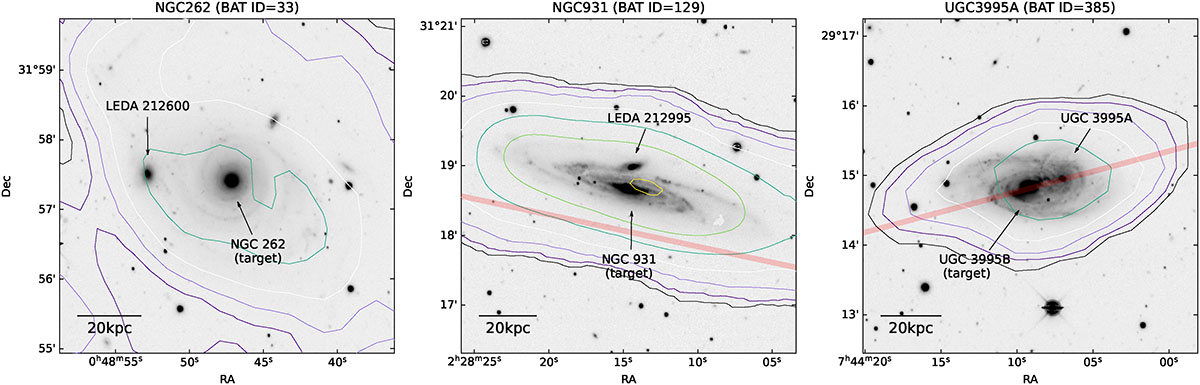
DECaLS r-band images of redshift-confirmed close galaxy companions sharing common H I gas envelopes with our targets. The H I contours are identical to those presented in Figures 2 and A.1. The red lines mark the locations of the position–velocity diagram (PVD) cuts displayed in Figure C.1. NGC 262 and its companion LEDA 212600 are considered to form an interacting but largely undisturbed system (e.g., Simkin et al. 1987; Antón et al. 2002), with a projected separation of 22 kpc (Koss et al. 2010). NGC 931 and LEDA 212995 constitute a pair with a projected separation of ∼6 kpc (Koss et al. 2012). Although the spatial resolution of the H I beam is insufficient to fully resolve the system, the PVD reveals a gas component distinct from the main H I disk (see Figure C.1). UGC 3995A and UGC 3995B are a close interacting galaxy pair separated by ∼50km s−1 in radial velocity (Holwerda & Keel 2013). However, the absence of strong tidal distortions suggests that the system is likely in an early stage of interaction (e.g., Marziani et al. 1999).
Current usage metrics show cumulative count of Article Views (full-text article views including HTML views, PDF and ePub downloads, according to the available data) and Abstracts Views on Vision4Press platform.
Data correspond to usage on the plateform after 2015. The current usage metrics is available 48-96 hours after online publication and is updated daily on week days.
Initial download of the metrics may take a while.