


Fig. 16
Download original image
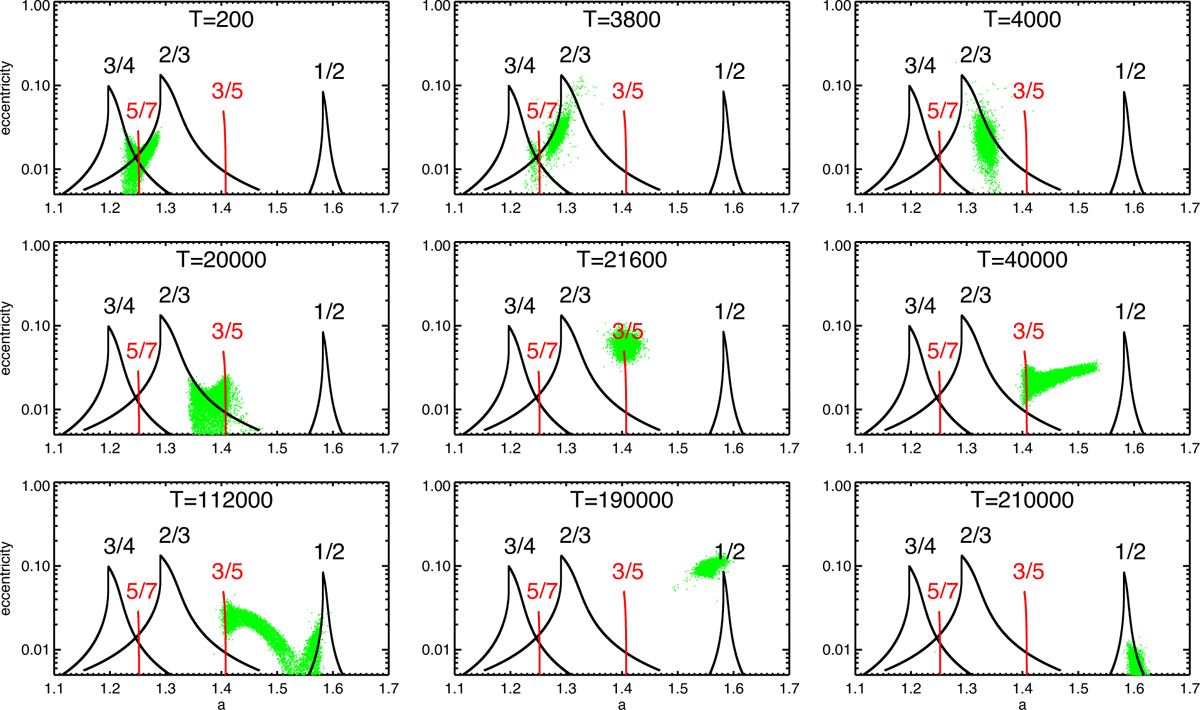
Eccentricities e of particles vs. semimajor axis a. Unlike in Fig. 7, here we do not use the quantity ā because its definition depends on the particular resonance considered (Eq. (2)). However, because e remains small, this choice does not change the interpretation of this figure taken from the run shown in Fig. 15. We note that at time T = 21 600, the narrow second-order 3/5 SOR is able to significantly perturb the ring, in spite of the fact that the first-order 2/3 SOR is still expected to exert a nonnegligible perturbation, amounting to 10% of the eccentricity forced by the 3/5 SOR. At time T = 112 000, we see the damping effect of collisions as the ring evolves between the 3/5 and 1/2 SORs. The run is stopped at T=249 720 Chariklo’s rotations, corresponding to about 200 years. We note that third-order resonances, for example the 4/7 SOR at a=1.45, have no effect on the migration. Two movies generated from snapshots stored every 360 Chariklo rotations (about 105 days) are available online:
Movie6displays the time evolution of eccentricity versus semi-major axis and
Movie7shows the ring migration in a cartesian frame rotating with Chariklo.
Current usage metrics show cumulative count of Article Views (full-text article views including HTML views, PDF and ePub downloads, according to the available data) and Abstracts Views on Vision4Press platform.
Data correspond to usage on the plateform after 2015. The current usage metrics is available 48-96 hours after online publication and is updated daily on week days.
Initial download of the metrics may take a while.