


Fig. 17
Download original image
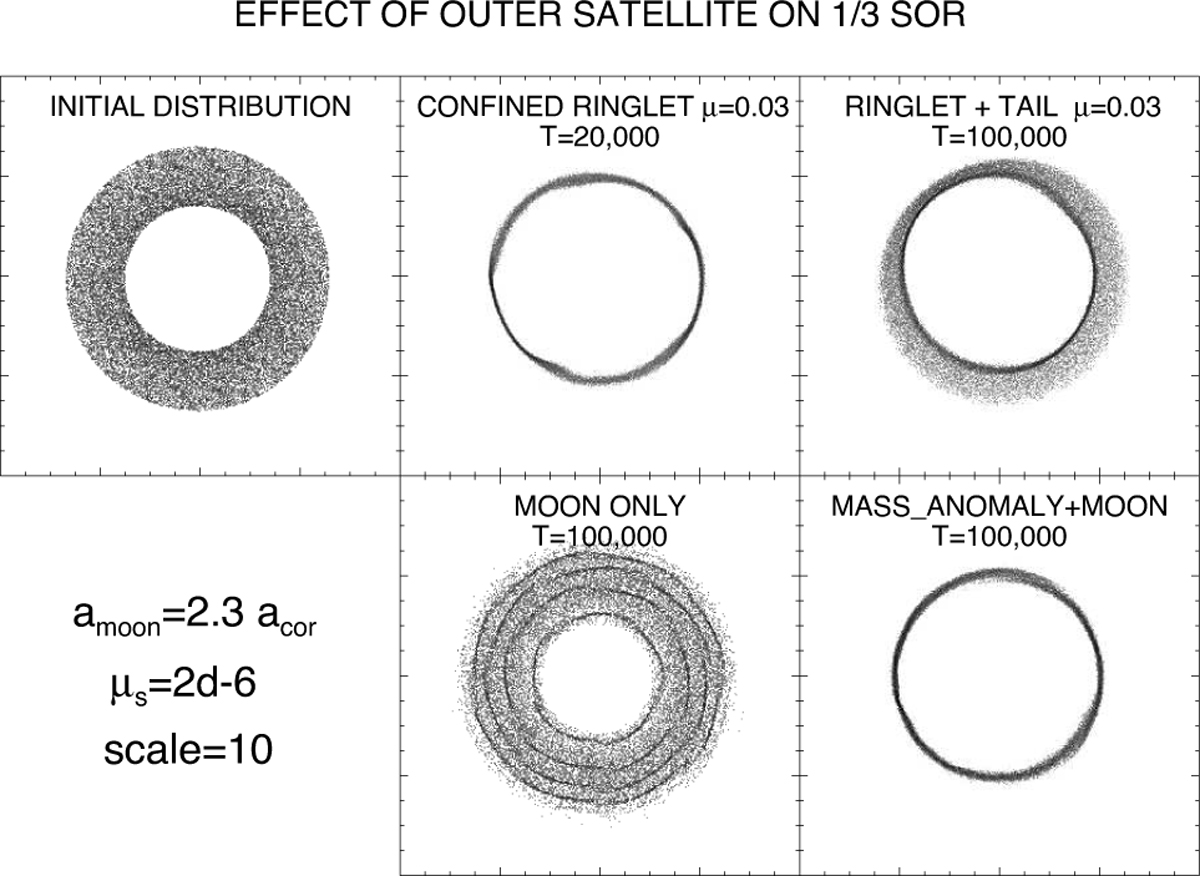
Upper row: long-term evolution of a 1/3 SOR ringlet perturbed by a mass anomaly µ = 0.03, using 30 000 particles with radius R = 5 × 10⁻⁴ (corresponds to 100 m for Chariklo rings). Although the ringlet maintains a well-defined core, a slow outward leakage of particles appears, forming a faint tail. For better viewing, the width of the ring has been expanded by a factor of 10. Lower left panel: effect of a satellite located at 2.3 ≈ 1.1a1/3, with a mass µs = 2 × 10⁻⁶ relative to the central body. Without the 1/3 SOR, the ring spreads inward under the effects of spiral density perturbations forced by Lindblad resonances, shown here at T=100 000. Lower right panel: when both the satellite and the 1/3 SOR are present, the outward leakage of particles is prevented by the 8/7 Lindblad resonance with the satellite. Two movies generated from simulation snapshots stored every 360 Chariklo rotations (about 105 days) are available online.
Movie8displays the evolution of eccentricity versus semi-major axis in the simulation without an external satellite: after T ∼ 60 000 (about 50 years for Chariklo), the particles start to leak outwards due to a small torque associated with the 1/3 SOR.
Movie9shows the same for the simulation with the moonlet: the leakage observed when only the 1/3 SOR is acting on the ring is prevented, and the ring ends up being confined between the 1/3 SOR and the 8/7 inner Lindblad resonance with the satellite.
Current usage metrics show cumulative count of Article Views (full-text article views including HTML views, PDF and ePub downloads, according to the available data) and Abstracts Views on Vision4Press platform.
Data correspond to usage on the plateform after 2015. The current usage metrics is available 48-96 hours after online publication and is updated daily on week days.
Initial download of the metrics may take a while.