


Fig. C.2
Download original image
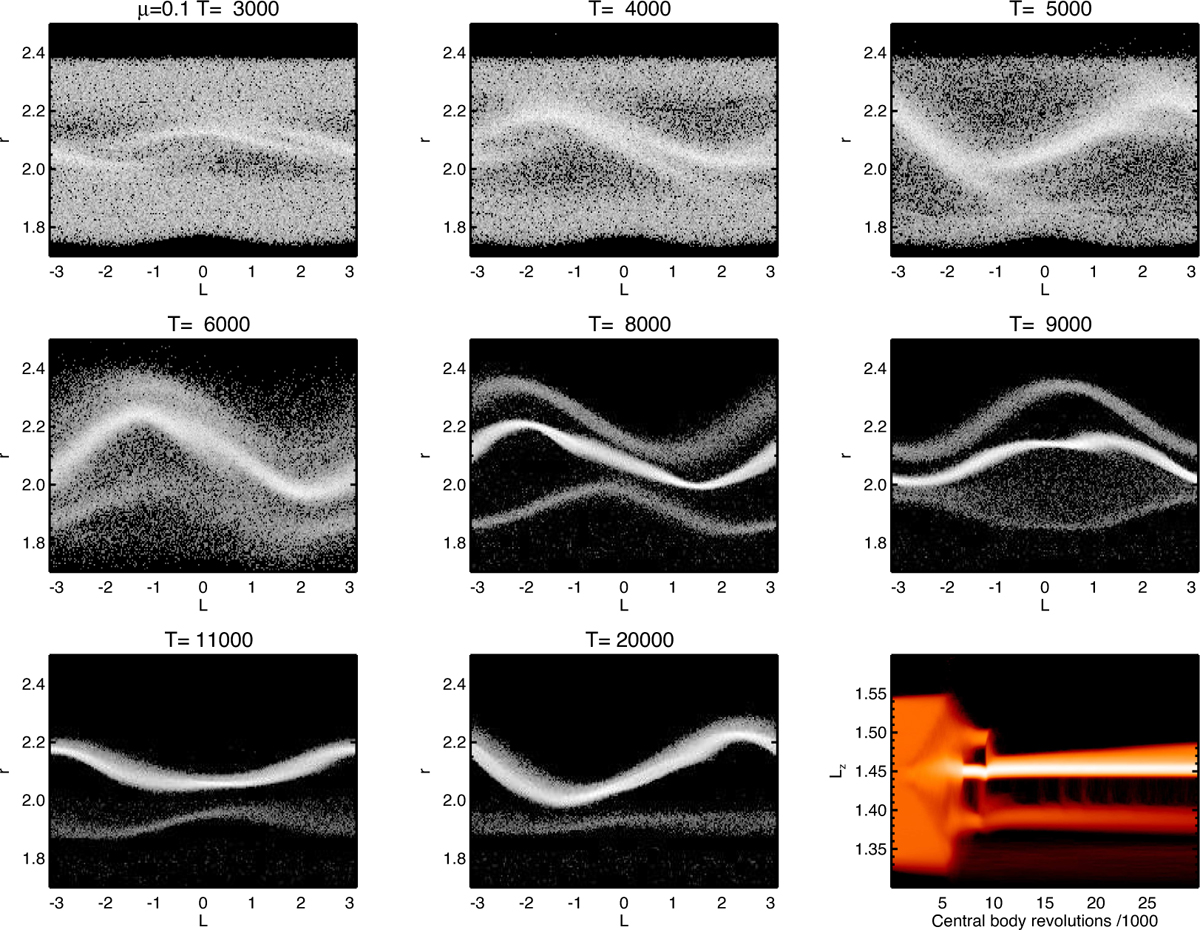
Time evolution of a ring perturbed by a large mass anomaly µ = 0.1, to be compared with Fig. 6. The ring is initially centered around 1/3 resonance distance a0 with a full width of 0.6. This is slightly larger than the theoretical maximum of epicyclic excursions, a0epeak ≈ 0.27 and over a factor of 10 larger than the width of the resonance zone, Wres ≈ 0.026. Particle size R = 0.001 corresponds to 200 m for Chariklo’s rings. The three upper panels show the self-intersecting streamline forced by the 1/3 SOR. This self-crossing disappears around T = 6 000 to form a streamline dominated by a m = 1 azimuthal mode. In contrast to the case of narrower initial rings (Fig. 6), two supplementary rings form both interior and exterior to the main ring at T = 6 000–8 000. However, the outer ringlet is rapidly swallowed by the main ringlet (at T ≈ 10 000), while the inner ringlet survives until the end of the simulation. The last panel on the lower right (red color palette) shows the time evolution of the Lz distribution until the end of the simulation at T = 30 000.
Current usage metrics show cumulative count of Article Views (full-text article views including HTML views, PDF and ePub downloads, according to the available data) and Abstracts Views on Vision4Press platform.
Data correspond to usage on the plateform after 2015. The current usage metrics is available 48-96 hours after online publication and is updated daily on week days.
Initial download of the metrics may take a while.