


Fig. C.1
Download original image
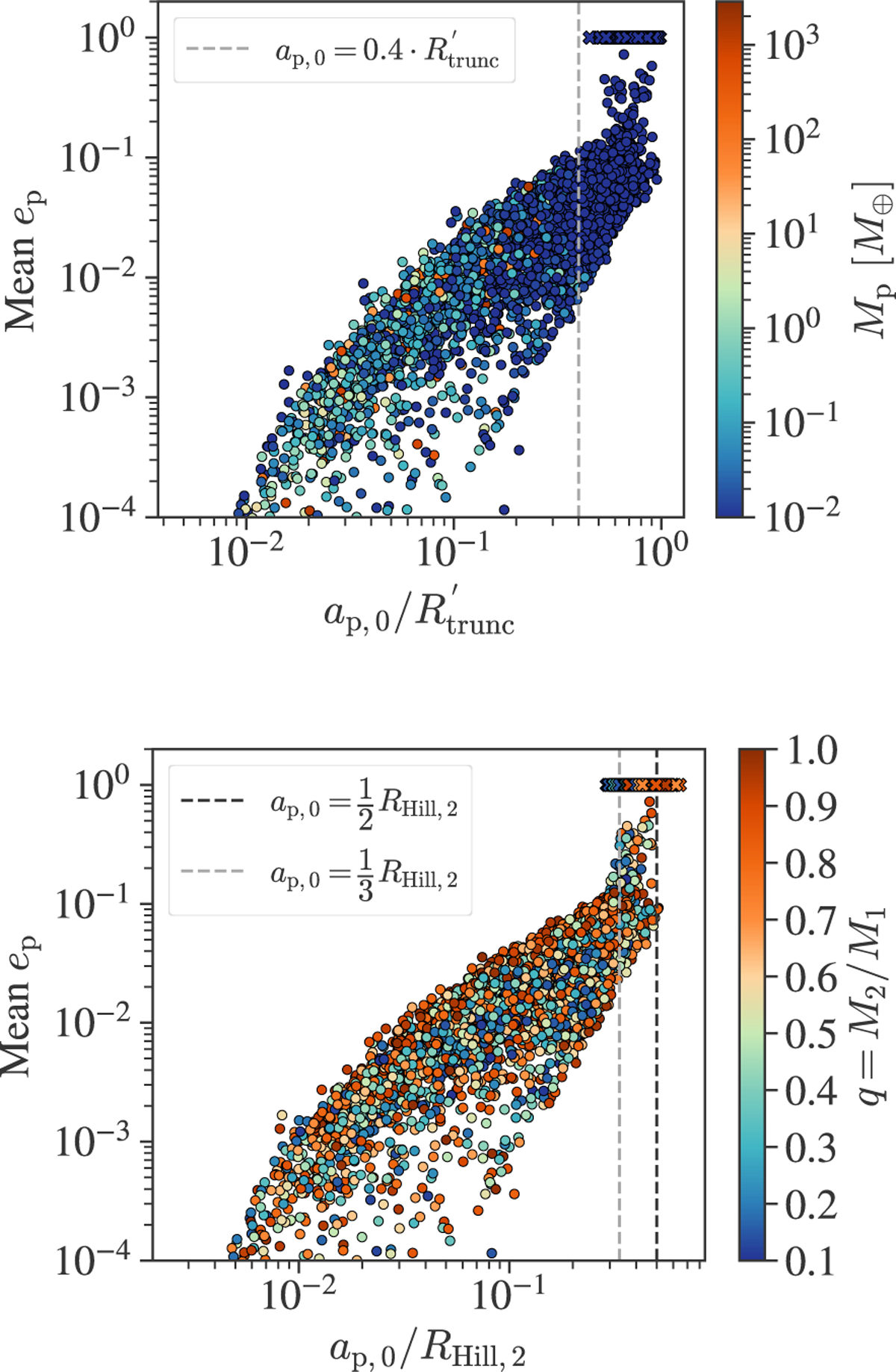
Circumsecondary in situ formation: Initial planet location relative to the disk truncation radius (![Mathematical equation: $\[a_{\mathrm{p}, 0} / R_{\text {trunc}}^{\prime}\]$](/articles/aa/full_html/2026/04/aa57244-25/aa57244-25-eq39.png) , top), the primary star’s Hill radius (ap,0/RHill,2, bottom). Top panel: Color bar shows the final planet mass and the gray dashed line marks
, top), the primary star’s Hill radius (ap,0/RHill,2, bottom). Top panel: Color bar shows the final planet mass and the gray dashed line marks ![Mathematical equation: $\[0.4 \cdot R_{\text {trunc}}^{\prime}\]$](/articles/aa/full_html/2026/04/aa57244-25/aa57244-25-eq40.png) . Bottom panel: Color bar shows the binary mass ratio and the gray and black dashed lines mark 1/3 and 1/2 · RHill,2. Circles denote surviving planets, while crosses indicate planets lost by ejection or instability from close encounters with the central star.
. Bottom panel: Color bar shows the binary mass ratio and the gray and black dashed lines mark 1/3 and 1/2 · RHill,2. Circles denote surviving planets, while crosses indicate planets lost by ejection or instability from close encounters with the central star.
Current usage metrics show cumulative count of Article Views (full-text article views including HTML views, PDF and ePub downloads, according to the available data) and Abstracts Views on Vision4Press platform.
Data correspond to usage on the plateform after 2015. The current usage metrics is available 48-96 hours after online publication and is updated daily on week days.
Initial download of the metrics may take a while.