


Fig. 7.
Download original image
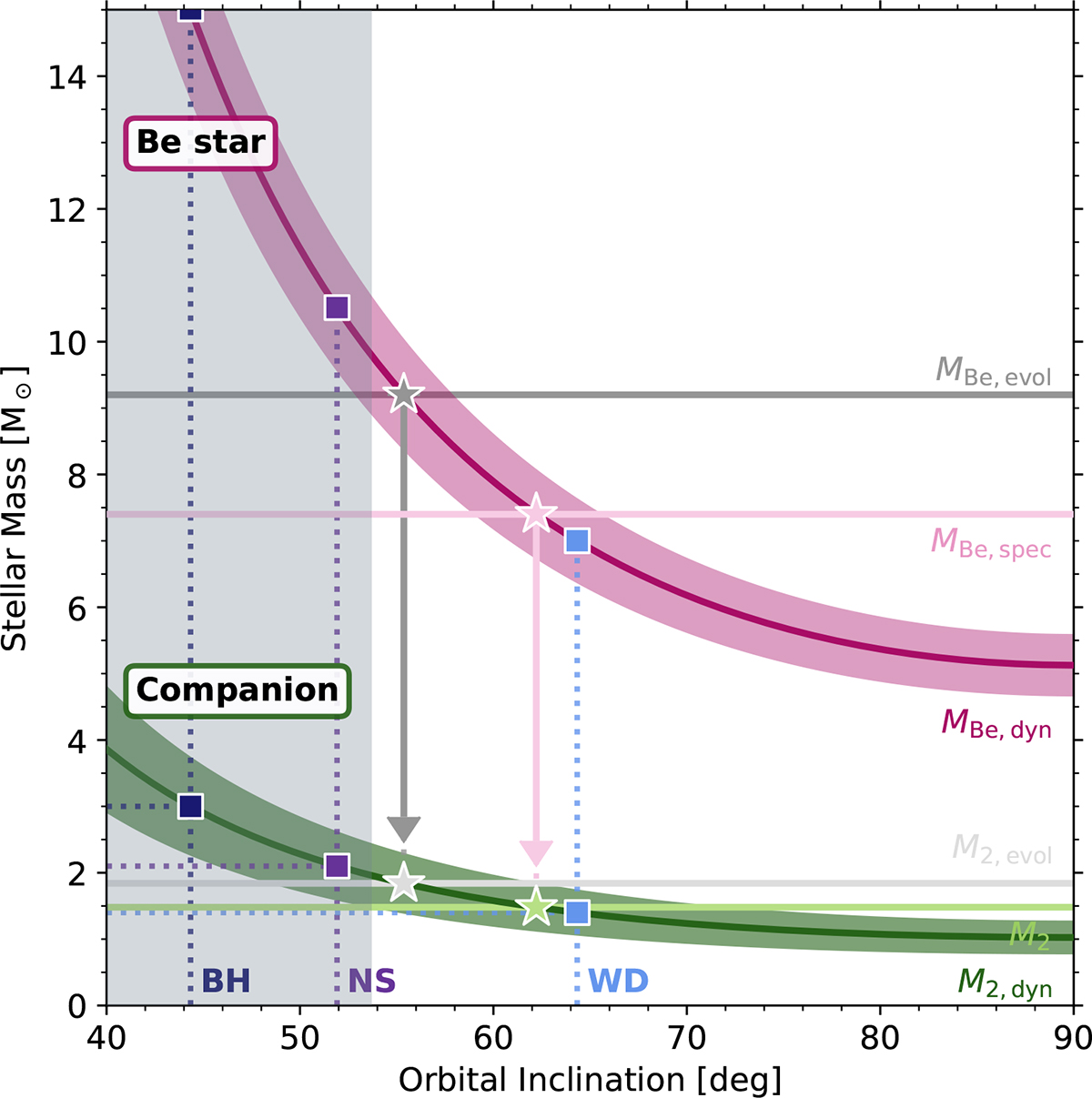
Stellar mass constraints for the Be star in MWC 656 and its companion. Dynamical mass constraints are shown as a function of orbital inclination for the Be star (magenta curve) and its companion (green curve) with shaded regions indicating 1σ uncertainties. Horizontal lines mark independent mass estimates: the Be star’s evolutionary mass  (grey; upper limit), and spectroscopic mass estimate; MBe, spec = 7.4 ± 2.7 M⊙ (solid pink line). The companion mass estimates,
  and M2, evol = 1.84 ± 0.13 M⊙, inferred from combining the dynamical mass ratio with spectroscopic and evolutionary estimates of the Be star mass, are shown in light green and light grey, respectively. The grey hatched region indicates inclinations where the dynamical Be star mass would exceed its evolutionary upper limit by more than 1σ, marking improbable configurations. Dotted lines denote the minimum inclinations required for different companion types: 1.4 M⊙ for a white dwarf (light blue), 2.1 M⊙ for a neutron star (purple), and 3.0 M⊙ for a BH (navy). A BH companion would require i ≲ 45° and Be star masses > 15 M⊙, which is strongly disfavoured. The intersection of constraints confines the likely companion mass to 1.0–1.9 M⊙.
Current usage metrics show cumulative count of Article Views (full-text article views including HTML views, PDF and ePub downloads, according to the available data) and Abstracts Views on Vision4Press platform.
Data correspond to usage on the plateform after 2015. The current usage metrics is available 48-96 hours after online publication and is updated daily on week days.
Initial download of the metrics may take a while.