


Fig. 4.
Download original image
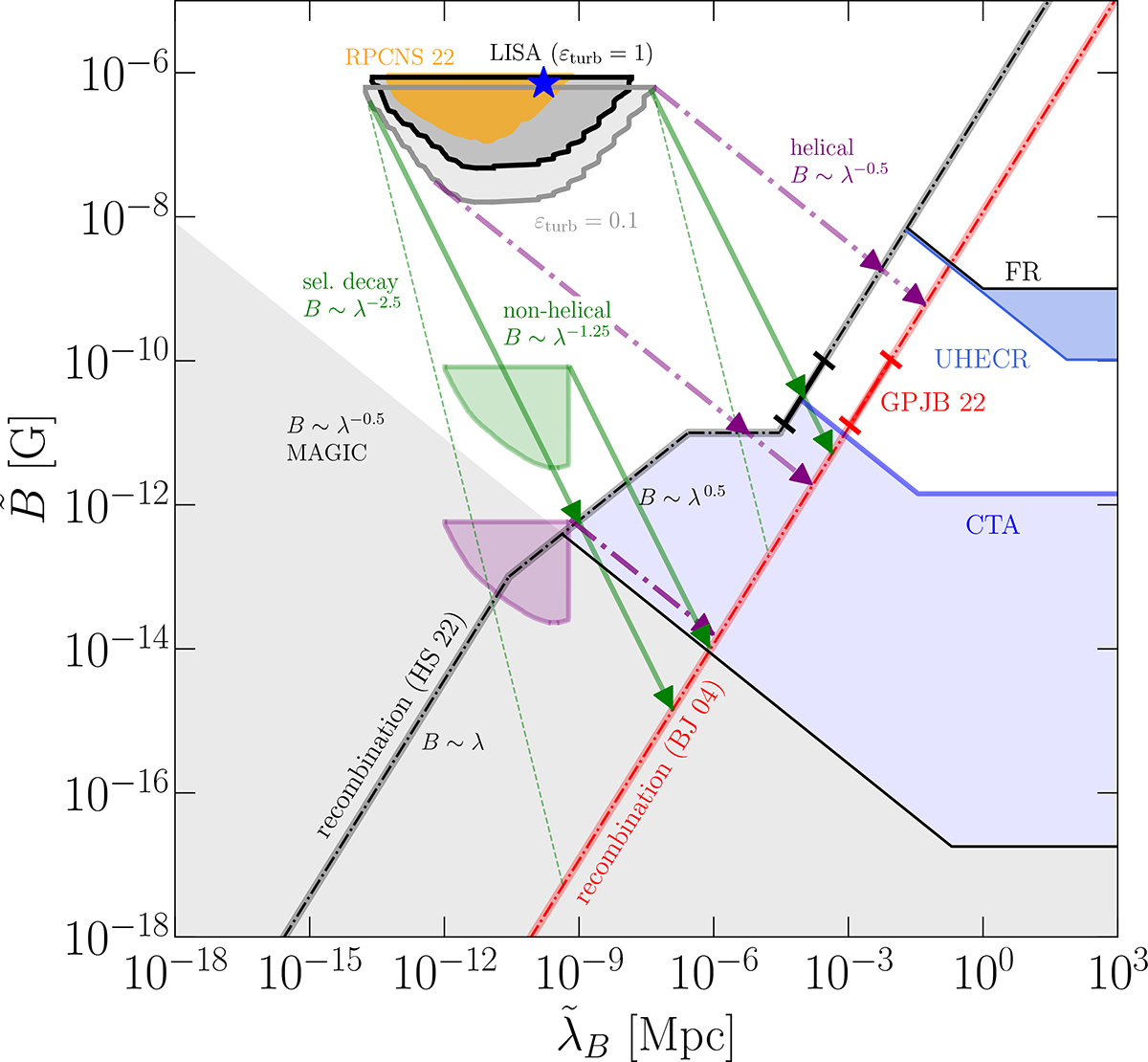
Expected initial and final comoving strength and correlation length of a cosmological magnetic field generated at a first-order phase transition with parameters leading to an SGWB detectable by LISA. The black and grey contours in the upper left corner of the figure show the parameter space of initial conditions if one assumes that, respectively, the totality (εturb = 1) and 10% (εturb = 0.1) of the sound-wave kinetic energy is eventually transferred to MHD turbulence (i.e., magnetic and vortical kinetic energy) at the time of nonlinearities development. The orange-shaded region is the one found in Roper Pol et al. (2022a), RPCNS 22), assuming that the SGWB is sourced exclusively by MHD turbulence. The blue star corresponds to the phase transition parameters for which the SGWB spectrum is shown in Fig. 1, considered for illustrative purposes. The inclined arrows show the envelopes of the evolutionary tracks. The dash-dotted purple arrows apply to helical fields, B ∼ λ−0.5, as given in Banerjee & Jedamzik (2004); the solid green arrows apply to non-helical fields, B ∼ λ−1.25, as given in Hosking & Schekochihin (2023); the dashed green arrows correspond to the hypothesis of selective decay of short-range modes for non-helical fields, B ∼ λ−2.5 (Banerjee & Jedamzik 2004). The dash-dotted black and red lines show the possible endpoints of the magnetic field evolution, corresponding to the IGMF present in the voids today, assuming respectively that the reconnection timescale dominates the magnetic field dynamics (Hosking & Schekochihin 2023) (HS 22) and that the Alfvénic timescale dominates the magnetic field dynamics (Banerjee & Jedamzik 2004) (BJ 04). The gray-shaded region at the bottom left of the plot is excluded by the lower bound on the IGMF established by the MAGIC γ-ray observatory (Acciari et al. 2023). The thin dark blue and black lines show the upper limit on the IGMF from, respectively, ultra-high-energy cosmic rays (Neronov et al. 2023) and Faraday rotation measures (Pshirkov et al. 2016). The blue-shaded area shows the range of IGMF parameters that will be probed by the γ-ray observatory CTA (Korochkin et al. 2021). The red and black ticks over the BJ 04 and HS 22 recombination lines correspond to the range of magnetic field strengths obtained in Galli et al. (2022), which would induce enough baryon clumping to help alleviate the Hubble tension, as proposed in Jedamzik & Pogosian (2020). The green and purple areas denote, respectively, the range of non-helical and helical magnetic field parameters that would arise from a first-order phase transition occurring at T* ∼ 100 GeV and sourcing a SGWB detectable by LISA, fixing the smallest possible value εturb while still satisfying MAGIC’s lower bound. These values of εturb are 𝒪 (10−9) (non-helical) and 𝒪 (10−13) (helical).
Current usage metrics show cumulative count of Article Views (full-text article views including HTML views, PDF and ePub downloads, according to the available data) and Abstracts Views on Vision4Press platform.
Data correspond to usage on the plateform after 2015. The current usage metrics is available 48-96 hours after online publication and is updated daily on week days.
Initial download of the metrics may take a while.