


Fig. 6.
Download original image
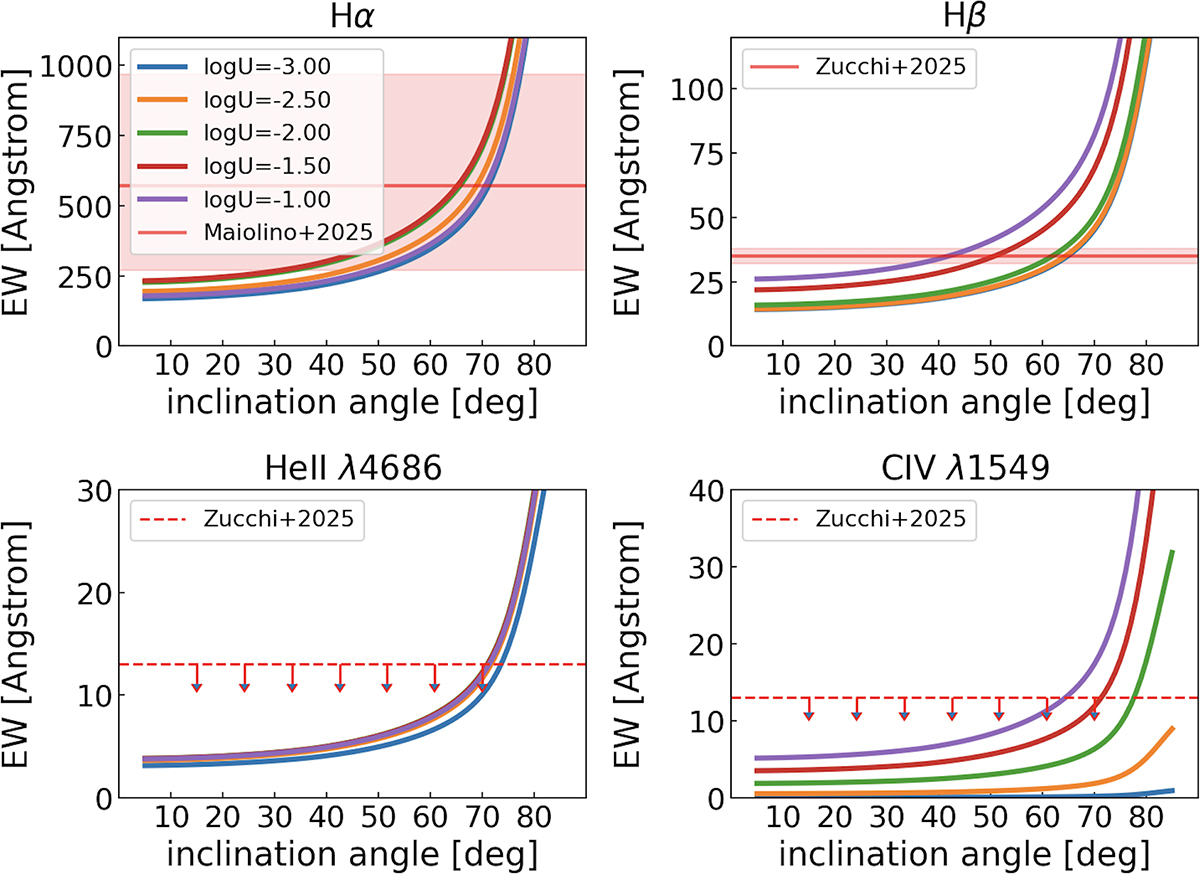
Predicted rest-frame EWs of broad Hα, Hβ, He IIλ4686, and C IVλ1549 emission lines as a function of observer inclination angle. The curves represent photoionization calculations performed with CLOUDY using the input SED of Model B (corresponding to ṁ = 12.4) for a range of ionization parameters (log U = −3.0 to −1.0, as labeled). The models assume a BLR gas distribution concentrated near the disk plane – where it is shielded from the full funnel radiation field – and a global covering factor of CBLR = 15%. All calculations adopt a metallicity of 0.1 Z⊙ and a gas density of log(nH/cm−3) = 10, and are stopped at a total hydrogen column of log(NH/cm−2) = 23. The horizontal red line and shaded red region in the top left panel indicate the median EW (570 Å) and the 95% confidence interval for the z > 4 BLAGN sample from Maiolino et al. (2025). Measurements with 1σ uncertainties and 3σ upper limits for broad Hβ, He II, and C IV are from the stacked spectra of z > 5 JWST blue BLAGNs of Zucchi et al. (2026). The sharp decrease in EWs at low inclination angles arises from the geometric collimation of the super-Eddington continuum: face-on observers see an isotropic-equivalent continuum that is significantly brighter than the one ionizing the BLR, resulting in the dilution of line features.
Current usage metrics show cumulative count of Article Views (full-text article views including HTML views, PDF and ePub downloads, according to the available data) and Abstracts Views on Vision4Press platform.
Data correspond to usage on the plateform after 2015. The current usage metrics is available 48-96 hours after online publication and is updated daily on week days.
Initial download of the metrics may take a while.