


Fig. 2.
Download original image
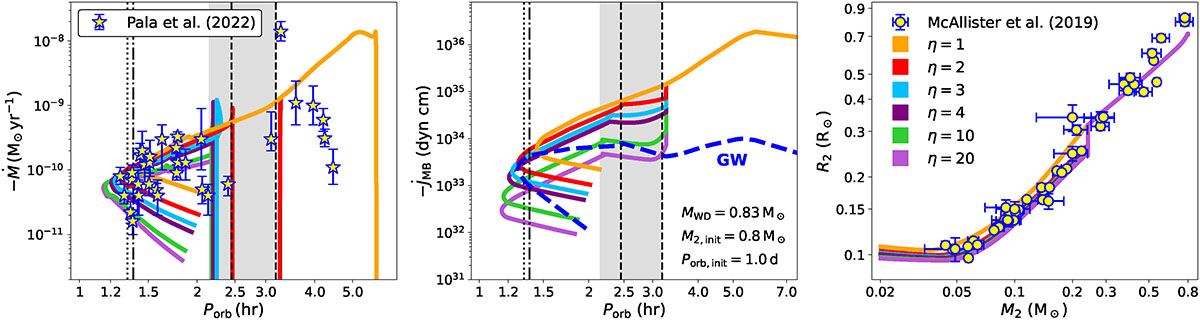
Mass-transfer rates (left) and angular momentum loss rates (middle) as a function of orbital period and the mass-radius relation (right) predicted by our model for a fixed value of the boosting parameter (K = 20) and different values for disruption (1 ≤ η ≤ 20). The tracks have been calculated assuming typical parameters, i.e., an initial donor mass and period of M2 = 0.8 M⊙ and Porb = 1 day, respectively, and a constant white dwarf mass of MWD = 0.83 M⊙. The mass-radius relation derived from observations (McAllister et al. 2019) is reasonably well reproduced regardless of the value of η (right), but the fit improves for η = 2 − 3 according to a χ2 test (see text). This moderate disruption is also required to generate a detached phase as an explanation for the orbital period gap (Knigge et al. 2011; Schreiber et al. 2024, shaded region and dashed vertical lines in the left and middle panels). These values of η also predict a period minimum similar to that derived from observations (Knigge et al. 2011; McAllister et al. 2019, dotted and dashed-dotted vertical lines). This mild disruption is very different to (almost) fully turning magnetic braking off as assumed in the standard scenario of CV evolution. By fitting the mass-radius relation (right panel), we predict mass-transfer rates above the gap that exceed those measured from white dwarf temperatures on average (Pala et al. 2022, left panel).
Current usage metrics show cumulative count of Article Views (full-text article views including HTML views, PDF and ePub downloads, according to the available data) and Abstracts Views on Vision4Press platform.
Data correspond to usage on the plateform after 2015. The current usage metrics is available 48-96 hours after online publication and is updated daily on week days.
Initial download of the metrics may take a while.