


Fig. 4
Download original image
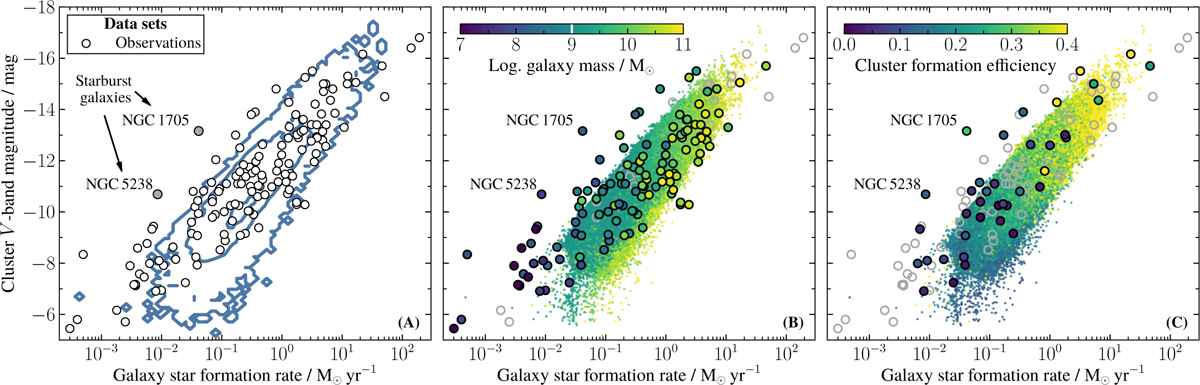
Absolute V-band magnitude of the youngest and most massive star cluster versus the galaxy-averaged SFR. The galaxy sample is limited to disk-dominated galaxies that have a bulge-to-total stellar mass ratio of B/T < 0.2. We compare our results to various observations of nearby disk-dominated galaxies (see main text for details). For both the simulated data and the observations, we set an age cut of τc ≤ 0.3 Gyr on the star clusters. Panel A: full observational and simulated data samples. For the simulated data, we show the 1σ, 2σ, and 3σ intervals using blue solid lines. Panel B: same as in the first panel but with all data points colour-coded according to the host galaxy’s stellar mass. If no stellar mass estimate is available for observational data points, we show them with grey symbols. Panel C: same as the central panel but the data points are colour-coded by the cluster formation efficiency, which is a combination of the bound fraction of star formation and the ‘cruel cradle effect’ (Kruijssen & Cooper 2012; Kruijssen 2012) that takes the interaction of a proto-star cluster with its natal environment and nearby GMCs into account. Note that the two outliers, NGC 1705 and NGC 5238, are starburst galaxies and that their massive star clusters were previously classified as nuclear star clusters (Pechetti et al. 2020; Hoyer et al. 2021). Nuclear star clusters often exhibit complex formation histories (e.g. Spengler et al. 2017; Kacharov et al. 2018; Fahrion et al. 2021) and cannot easily be compared to our simulated star clusters.
Current usage metrics show cumulative count of Article Views (full-text article views including HTML views, PDF and ePub downloads, according to the available data) and Abstracts Views on Vision4Press platform.
Data correspond to usage on the plateform after 2015. The current usage metrics is available 48-96 hours after online publication and is updated daily on week days.
Initial download of the metrics may take a while.