


Fig. 5.
Download original image
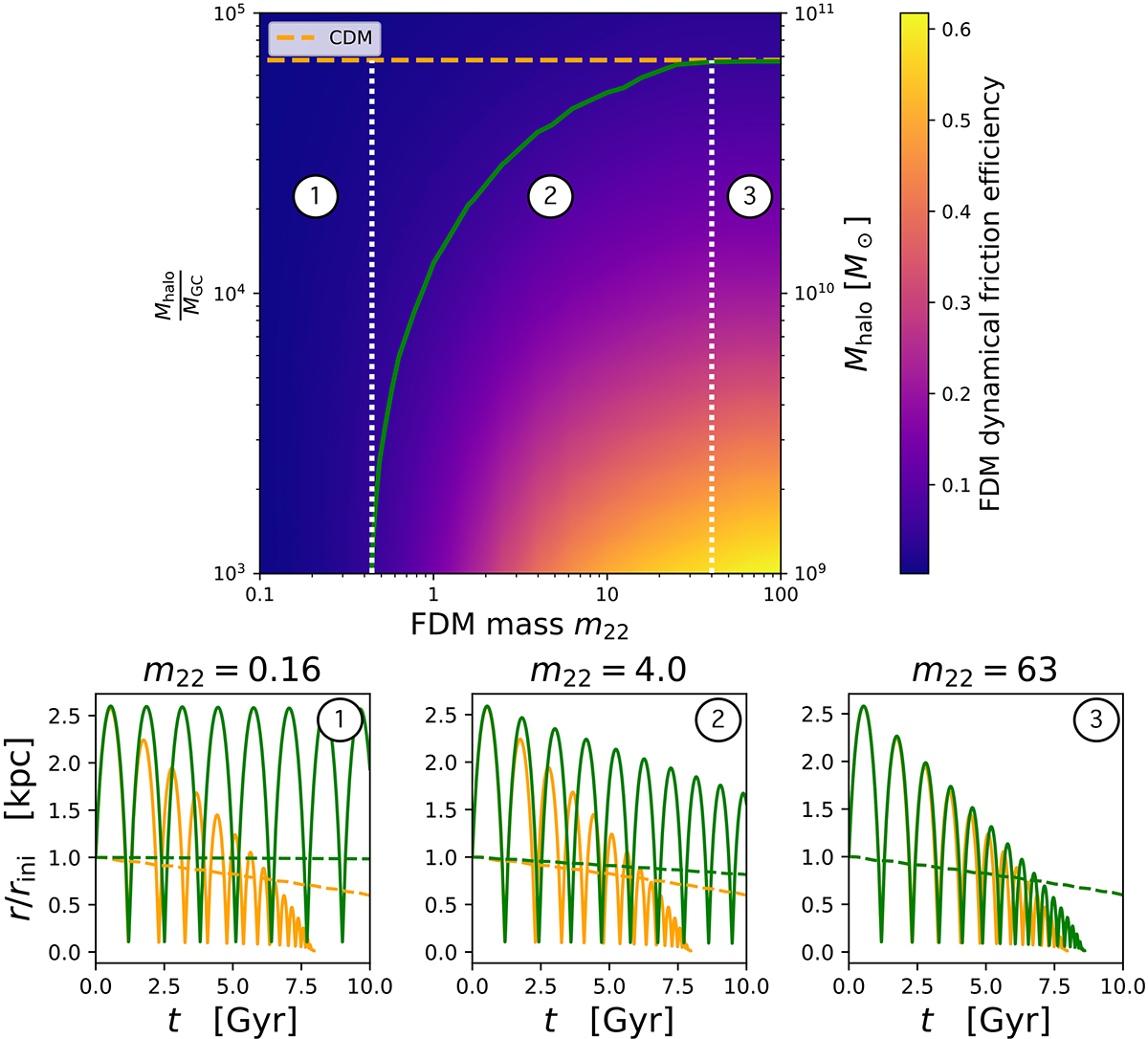
Top panel: DF efficiency map for the FDM-DF-only model with halo-to-GC mass ratios between 103 and 105, and FDM particle masses m22 ranging from 0.1 to 100. The secondary axis shows the corresponding halo mass assuming MGC = 106 M⊙. The map is computed on a 16 × 16 grid, where each point corresponds to a NFW halo of a given mass and a DF force derived for a specific FDM particle mass. For each combination of halo-to-GC mass ratio and FDM particle mass, the DF efficiency is evaluated using 1000 orbits in order to limit computational cost. There were uniformly distributed in logarithmic space between 0.1 and 10 rs. The orange dashed and green solid lines indicate the 5% efficiency frontier for CDM and FDM-DF-only models, respectively. Bottom panels: Orbital radius normalized to its initial value as a function of time, for GCs integrated over 10 Gyr in a 109 M⊙ NFW halo with classical DF (orange curves) and FDM DF (green curves) for m22 = 0.16, 4, and 63. For each case, both radial and circular orbits are shown. Dashed white lines separate the three regimes of FDM DF: (1) absence of friction inducing orbital stalling, (2) reduced friction, and (3) the classical regime.
Current usage metrics show cumulative count of Article Views (full-text article views including HTML views, PDF and ePub downloads, according to the available data) and Abstracts Views on Vision4Press platform.
Data correspond to usage on the plateform after 2015. The current usage metrics is available 48-96 hours after online publication and is updated daily on week days.
Initial download of the metrics may take a while.