


Fig. 2.
Download original image
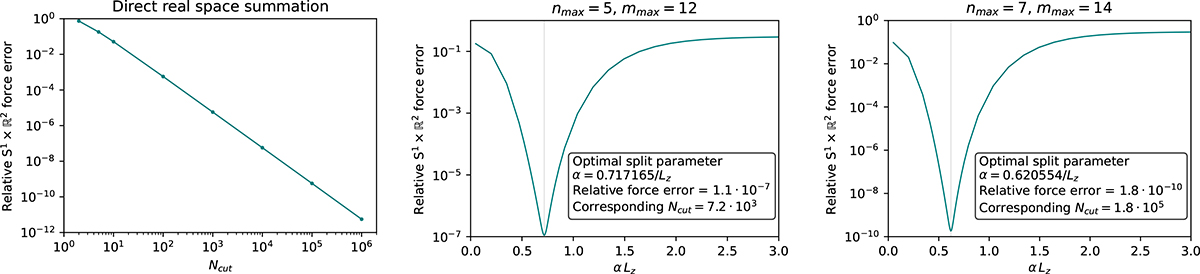
Accuracy of S1 × ℝ2 periodic summation methods. For all tests, the correction lookup table D(ρ, z) was computed on a 144 × 128 grid, varying the truncation parameter Ncut or the Ewald parameters α, nmax, and mmax. Using these tables, we reconstructed the full periodic force field FS1 × ℝ2(ρ, z) = Fℝ3(ρ, z)+D(ρ, z) and compared it against a reference field. This reference field was generated via direct summation using Ncut = 107 periodic images, requiring approximately 104 s of computation time. Left: Mean force errors of direct periodic real-space summation as a function of Ncut. Although summation occurs only along a single direction (the z-axis), convergence remains exceptionally slow. Center: S1 × ℝ2 Ewald summation force accuracy as a function of the Ewald splitting parameter α with fixed nmax = 5 and mmax = 12 values. Using only 5 periodic images in real space and 12 modes in reciprocal space is sufficient to achieve single-precision (32-bit) floating-point accuracy when the optimal splitting parameter is applied. Right: Same as the center panel, but with fixed nmax = 7 and mmax = 14. Increasing both nmax and mmax by two improves the force accuracy by nearly three orders of magnitude (a factor of ∼600).
Current usage metrics show cumulative count of Article Views (full-text article views including HTML views, PDF and ePub downloads, according to the available data) and Abstracts Views on Vision4Press platform.
Data correspond to usage on the plateform after 2015. The current usage metrics is available 48-96 hours after online publication and is updated daily on week days.
Initial download of the metrics may take a while.