<!DOCTYPE html PUBLIC "-//W3C//DTD XHTML 1.0 Transitional//EN">
<html xmlns:xlink="http://www.w3.org/1999/xlink" xmlns:mml="http://www.w3.org/1998/Math/MathML">
<link rel="stylesheet" type="text/css" href="../../../CSS_FULL/edps_full.css">
<body><div id="contenu_olm">

<!-- DOI: 10.1051/0004-6361:200810930 -->

<h2 class="sec">Online Material</h2>

<p>

<h2 class="sec"><a name="SECTION000100000000000000000"></a>&#160; <A NAME="on-line_dust_model_construction"></A>
Appendix A: <TT>RADEX</TT> - construction of a dust model
</h2>

<p>
In order to relate the molecular column densities, <I>N</I>(<I>x</I>) of species <I>x</I>, to fractional abundances, <I>X</I>(<I>x</I>)&nbsp;= 
<!-- MATH: $N({x})/N({\rm H}_2)$ -->
<IMG
 WIDTH="71" HEIGHT="26" ALIGN="MIDDLE" BORDER="0"
 SRC="img137.gif"
 ALT="$N({x})/N({\rm H}_2)$">,
a uniform, homogeneous sphere of diameter <I>L</I>&nbsp;=&nbsp;
<!-- MATH: $N({\rm H}_2)/n({\rm H}_2)$ -->
<IMG
 WIDTH="76" HEIGHT="26" ALIGN="MIDDLE" BORDER="0"
 SRC="img138.gif"
 ALT="$N({\rm H}_2)/n({\rm H}_2)$">
is assumed here. The adopted physical diameter of the PDR corresponding to an angular diameter of 120
<!-- MATH: $^{\prime\prime}$ -->
<IMG
 WIDTH="11" HEIGHT="14" ALIGN="BOTTOM" BORDER="0"
 SRC="img5.gif"
 ALT="$^{\prime \prime }$">
(Sect.&nbsp;<a href="/articles/aa/full_html/2009/05/aa10930-08/aa10930-08.html#Section_results">3</a>) at a distance of 910&nbsp;pc is 0.53&nbsp;pc. This is assumed to be equal to the line-of-sight depth.

<p>
The observed intensity of the continuum is used to estimate the internal radiation field sensed by
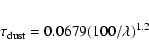
the molecules. We construct a simple model of the broad-band spectrum at submm and far-infrared wavelengths in order both to characterise the internal radiation and to estimate the total 
column densities of dust and   hydrogen. <a href="/articles/aa/full_html/2009/05/aa10930-08/aa10930-08.html#1983ApJ...271..625S">Thronson et&nbsp;al. (1983)</a> measured the far-infrared emission of S140 and found a peak flux density of the order of 10<sup>4</sup>&nbsp;Jy slightly shortward of <IMG
 WIDTH="10" HEIGHT="26" ALIGN="MIDDLE" BORDER="0"
 SRC="img122.gif"
 ALT="$\lambda$">100&nbsp;<IMG
 WIDTH="11" HEIGHT="26" ALIGN="MIDDLE" BORDER="0"
 SRC="img123.gif"
 ALT="$\mu$">m  in a 49
<!-- MATH: $^{\prime\prime}$ -->
<IMG
 WIDTH="11" HEIGHT="14" ALIGN="BOTTOM" BORDER="0"
 SRC="img5.gif"
 ALT="$^{\prime \prime }$">&nbsp;beam. <a href="/articles/aa/full_html/2009/05/aa10930-08/aa10930-08.html#1995AetA...298..894M.Minchin.etal">Minchin et&nbsp;al. (1995)</a> presented total broad-band fluxes in a 
<!-- MATH: $1\hbox{$.\mkern-4mu^\prime$ }5$ -->
<IMG
 WIDTH="26" HEIGHT="26" ALIGN="MIDDLE" BORDER="0"
 SRC="img139.gif"
 ALT="$1\hbox{$.\mkern-4mu^\prime$ }5$">&nbsp;<IMG
 WIDTH="13" HEIGHT="26" ALIGN="MIDDLE" BORDER="0"
 SRC="img9.gif"
 ALT="$\times $">

<!-- MATH: $1\hbox{$.\mkern-4mu^\prime$ }5$ -->
<IMG
 WIDTH="26" HEIGHT="26" ALIGN="MIDDLE" BORDER="0"
 SRC="img139.gif"
 ALT="$1\hbox{$.\mkern-4mu^\prime$ }5$">&nbsp;box. We represent the latter results with a 
two-component model of thermal emission by dust over a solid angle of 
<!-- MATH: $\Omega = 1.9$ -->
<IMG
 WIDTH="47" HEIGHT="26" ALIGN="MIDDLE" BORDER="0"
 SRC="img140.gif"
 ALT="$\Omega = 1.9$">&nbsp;<IMG
 WIDTH="13" HEIGHT="26" ALIGN="MIDDLE" BORDER="0"
 SRC="img9.gif"
 ALT="$\times $">
10<sup>-7</sup>&nbsp;sr. The main component has a dust temperature 
<!-- MATH: $T_{\rm dust}$ -->
<IMG
 WIDTH="29" HEIGHT="26" ALIGN="MIDDLE" BORDER="0"
 SRC="img121.gif"
 ALT="$T_{\rm dust}$">&nbsp;= 40&nbsp;K and a long-wavelength (
<!-- MATH: $\lambda > 40~\mu$ -->
<IMG
 WIDTH="53" HEIGHT="26" ALIGN="MIDDLE" BORDER="0"
 SRC="img141.gif"
 ALT="$\lambda > 40~\mu$">m) form of the opacity&nbsp;law 
<br><p></p>
<DIV ALIGN="CENTER">
<IMG
 WIDTH="149" HEIGHT="56"
 SRC="img142.gif"
 ALT="\begin{eqnarray*}\tau_{\rm dust} = 0.0679 (100/\lambda)^{1.2}
\end{eqnarray*}">
</DIV><p></p><BR CLEAR="ALL">where <IMG
 WIDTH="10" HEIGHT="26" ALIGN="MIDDLE" BORDER="0"
 SRC="img122.gif"
 ALT="$\lambda$">
is the wavelength in <IMG
 WIDTH="11" HEIGHT="26" ALIGN="MIDDLE" BORDER="0"
 SRC="img123.gif"
 ALT="$\mu$">m. The opacity law is smoothly matched to a standard interstellar extinction law at shorter wavelengths, which is also used to describe the second component at 
<!-- MATH: $T_{\rm dust}$ -->
<IMG
 WIDTH="29" HEIGHT="26" ALIGN="MIDDLE" BORDER="0"
 SRC="img121.gif"
 ALT="$T_{\rm dust}$">&nbsp;= 140&nbsp;K. The opacity of the first dust component corresponds to a
visual extinction <IMG
 WIDTH="20" HEIGHT="26" ALIGN="MIDDLE" BORDER="0"
 SRC="img135.gif"
 ALT="$A_{\rm V}$">&nbsp;= 58.8&nbsp;mag. The second component has a smaller optical depth <IMG
 WIDTH="20" HEIGHT="26" ALIGN="MIDDLE" BORDER="0"
 SRC="img135.gif"
 ALT="$A_{\rm V}$">&nbsp;= 0.023&nbsp;mag, but is assumed to cover the same solid angle. In addition, the mid-infrared measurements of <a href="/articles/aa/full_html/2009/05/aa10930-08/aa10930-08.html#Ney">Ney &amp; Merrill (1980)</a>  have been adapted in order to specify the radiation field at 
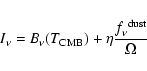
even shorter wavelengths. In the calculations, the molecules are assumed to be exposed
to an average intensity of continuous radiation 
<br><p></p>
<DIV ALIGN="CENTER">
<IMG
 WIDTH="147" HEIGHT="71"
 SRC="img143.gif"
 ALT="\begin{eqnarray*}I_{\nu} = B_{\nu}(T_{\rm CMB}) + \eta {{f_{\nu}^{~ \rm dust}}\over
{\Omega}}
\end{eqnarray*}">
</DIV><p></p><BR CLEAR="ALL">where <IMG
 WIDTH="17" HEIGHT="26" ALIGN="MIDDLE" BORDER="0"
 SRC="img144.gif"
 ALT="$B_{\nu}$">
is the Planck function, 
<!-- MATH: $T_{\rm CMB}$ -->
<IMG
 WIDTH="34" HEIGHT="26" ALIGN="MIDDLE" BORDER="0"
 SRC="img145.gif"
 ALT="$T_{\rm CMB}$">&nbsp;= 2.73&nbsp;K is the  temperature of the cosmic background radiation, 
<!-- MATH: $f_{\nu}^{~ \rm dust}$ -->
<IMG
 WIDTH="31" HEIGHT="30" ALIGN="MIDDLE" BORDER="0"
 SRC="img146.gif"
 ALT="$f_{\nu}^{~ \rm dust}$">&nbsp;is the flux density of the 2-component dust model, 
<IMG
 WIDTH="14" HEIGHT="13" ALIGN="BOTTOM" BORDER="0"
 SRC="img147.gif"
 ALT="$\Omega$">&nbsp;= 1.9&nbsp;<IMG
 WIDTH="13" HEIGHT="26" ALIGN="MIDDLE" BORDER="0"
 SRC="img9.gif"
 ALT="$\times $">&nbsp;10<sup>-7</sup>&nbsp;sr, and <IMG
 WIDTH="10" HEIGHT="26" ALIGN="MIDDLE" BORDER="0"
 SRC="img148.gif"
 ALT="$\eta$">&nbsp;=&nbsp;0.72 is a dilution factor to scale the brightness of the dust source to the larger beam area of the Odin measurements. It is important to keep in
mind that we observe this strong far-infrared radiation; therefore, the co-extensive molecules must sense it also.

<p>
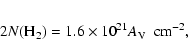
For the adopted interstellar extinction law and a standard gas/extinction ratio, 
<br><p></p>
<DIV ALIGN="CENTER">
<IMG
 WIDTH="188" HEIGHT="56"
 SRC="img149.gif"
 ALT="\begin{eqnarray*}2 N({\rm H}_2) = 1.6\times 10^{21} A_{\rm V} ~~{\rm cm}^{-2},
\end{eqnarray*}">
</DIV><p></p><BR CLEAR="ALL">the adopted dust model implies 
<!-- MATH: $N({\rm H}_2)$ -->
<IMG
 WIDTH="38" HEIGHT="26" ALIGN="MIDDLE" BORDER="0"
 SRC="img60.gif"
 ALT="$N({\rm H_2})$">&nbsp;= 4.7&nbsp;<IMG
 WIDTH="13" HEIGHT="26" ALIGN="MIDDLE" BORDER="0"
 SRC="img9.gif"
 ALT="$\times $">&nbsp;10<sup>22</sup>&nbsp;cm<sup>-2</sup> and an average density 

<!-- MATH: $n({\rm H}_2)$ -->
<IMG
 WIDTH="36" HEIGHT="26" ALIGN="MIDDLE" BORDER="0"
 SRC="img53.gif"
 ALT="$n({\rm H}_2)$">&nbsp;= 2.9&nbsp;<IMG
 WIDTH="13" HEIGHT="26" ALIGN="MIDDLE" BORDER="0"
 SRC="img9.gif"
 ALT="$\times $">&nbsp;10<sup>4</sup>&nbsp;cm<sup>-3</sup> over the source size <I>L</I>&nbsp;= 0.53&nbsp;pc. This average density is, however, inconsistent with the observed molecular line emission in large beams 
(
<!-- MATH: $\theta \geq 1'$ -->
<IMG
 WIDTH="37" HEIGHT="26" ALIGN="MIDDLE" BORDER="0"
 SRC="img150.gif"
 ALT="$\theta \geq 1'$">). Although a uniform <TT>RADEX</TT>&nbsp;model can be constructed based
upon this density, the  line-centre optical depths of the pure rotational lines of H<SUB>2</SUB>O
and NH<SUB>3</SUB> would be of the order of 200 and&nbsp;100, respectively. Such large opacities would imply significant line broadening through saturation of the emission, which conflicts with the
observed narrow profiles of&nbsp;<IMG
 WIDTH="12" HEIGHT="14" ALIGN="BOTTOM" BORDER="0"
 SRC="img12.gif"
 ALT="$\sim$">3&nbsp;km&nbsp;s<sup>-1</sup>. 

<p>

<p>

<h2 class="sec"><a name="SECTION000110000000000000000"></a>
Appendix B: Figures and tables
</h2>

<p>
<div class="inset-old">
<table>
<tr><td><!-- init Label --><A NAME="spectrum_h2o18">&#160;</A><!-- end Label--><A NAME="2421"></A><A NAME="figure2037"
 HREF="img151.gif"><IMG
 WIDTH="91" HEIGHT="63" SRC="Timg151.gif"
 ALT="\begin{figure}
\par\includegraphics[width=8cm,clip]{0930fig8.eps}
\end{figure}"></A><!-- HTML Figure number: 8 --></td>
<td class="img-txt"><span class="bold">Figure B.1:</span><p>
Odin observations of H<SUB>2</SUB><sup>18</sup>O in the central position.</p></td>
</tr><tr><td colspan="2"><a href="http://dexter.edpsciences.org/applet.php?pdf_id=8&DOI=10.1051/0004-6361:200810930" target="DEXTER">Open with DEXTER</a></td></tr>

</table></div><div class="inset-old">
<table>
<tr><td><!-- init Label --><A NAME="Rotdiagram_13co_outflow">&#160;</A><!-- end Label--><A NAME="2422"></A><A NAME="figure2043"
 HREF="img152.gif"><IMG
 WIDTH="92" HEIGHT="71" SRC="Timg152.gif"
 ALT="\begin{figure}
\includegraphics[width=8cm,clip]{0930fig9.eps}
\end{figure}"></A><!-- HTML Figure number: 9 --></td>
<td class="img-txt"><span class="bold">Figure B.2:</span><p>
Rotation diagram of  the broad component  of <sup>13</sup>CO(1-0) with the Onsala 20-m telescope, <I>J</I>&nbsp;= 2-1 and  <I>J</I>&nbsp;= 3-2 from <a href="/articles/aa/full_html/2009/05/aa10930-08/aa10930-08.html#1993AetA...277..595M.Minchin.etal">Minchin et&nbsp;al. (1993)</a>, and  <I>J</I>&nbsp;= 5-4 with Odin, producing 
<!-- MATH: $T_{\rm ROT}$ -->
<IMG
 WIDTH="31" HEIGHT="26" ALIGN="MIDDLE" BORDER="0"
 SRC="img6.gif"
 ALT="$T_{\rm ROT}$">&nbsp;= 24&nbsp;<IMG
 WIDTH="13" HEIGHT="13" ALIGN="BOTTOM" BORDER="0"
 SRC="img7.gif"
 ALT="$\pm $">
2&nbsp;K and 
<!-- MATH: $N_{\rm ROT}$ -->
<IMG
 WIDTH="32" HEIGHT="26" ALIGN="MIDDLE" BORDER="0"
 SRC="img8.gif"
 ALT="$N_{\rm ROT}$">&nbsp;= (2.5&nbsp;<IMG
 WIDTH="13" HEIGHT="13" ALIGN="BOTTOM" BORDER="0"
 SRC="img7.gif"
 ALT="$\pm $">&nbsp;0.4)&nbsp;<IMG
 WIDTH="13" HEIGHT="26" ALIGN="MIDDLE" BORDER="0"
 SRC="img9.gif"
 ALT="$\times $">&nbsp;10<sup>16</sup>&nbsp; cm<sup>-2</sup>.</p></td>
</tr><tr><td colspan="2"><a href="http://dexter.edpsciences.org/applet.php?pdf_id=9&DOI=10.1051/0004-6361:200810930" target="DEXTER">Open with DEXTER</a></td></tr>

</table></div><div class="inset-old">
<table>
<tr><td><!-- init Label --><A NAME="Rotdiagram_13co_4_lines_PDR">&#160;</A><!-- end Label--><A NAME="2423"></A><A NAME="figure2053"
 HREF="img153.gif"><IMG
 WIDTH="92" HEIGHT="70" SRC="Timg153.gif"
 ALT="\begin{figure}
\includegraphics[width=8cm,clip]{0930fg10.eps}
\end{figure}"></A><!-- HTML Figure number: 10 --></td>
<td class="img-txt"><span class="bold">Figure B.3:</span><p>
Rotation diagram of  the narrow component  of <sup>13</sup>CO(2-1) and  <I>J</I>&nbsp;= 3-2 from <a href="/articles/aa/full_html/2009/05/aa10930-08/aa10930-08.html#1993AetA...277..595M.Minchin.etal">Minchin et&nbsp;al. (1993)</a>,  <I>J</I>&nbsp;= 5-4 
with Odin, and <I>J</I>&nbsp;= 6-5  from <a href="/articles/aa/full_html/2009/05/aa10930-08/aa10930-08.html#1993ApJ...405..249Graf">Graf et&nbsp;al. (1993)</a>, producing 
<!-- MATH: $T_{\rm ROT}$ -->
<IMG
 WIDTH="31" HEIGHT="26" ALIGN="MIDDLE" BORDER="0"
 SRC="img6.gif"
 ALT="$T_{\rm ROT}$">&nbsp;= 69&nbsp;<IMG
 WIDTH="13" HEIGHT="13" ALIGN="BOTTOM" BORDER="0"
 SRC="img7.gif"
 ALT="$\pm $">
27&nbsp;K and 
<!-- MATH: $N_{\rm ROT}$ -->
<IMG
 WIDTH="32" HEIGHT="26" ALIGN="MIDDLE" BORDER="0"
 SRC="img8.gif"
 ALT="$N_{\rm ROT}$">&nbsp;= (3.2&nbsp;<IMG
 WIDTH="13" HEIGHT="13" ALIGN="BOTTOM" BORDER="0"
 SRC="img7.gif"
 ALT="$\pm $">
1.8)&nbsp;<IMG
 WIDTH="13" HEIGHT="26" ALIGN="MIDDLE" BORDER="0"
 SRC="img9.gif"
 ALT="$\times $">&nbsp;10<sup>16</sup>&nbsp; cm<sup>-2</sup>. <I>J</I>&nbsp;= 1-0  is    not included in the&nbsp;fit.</p></td>
</tr><tr><td colspan="2"><a href="http://dexter.edpsciences.org/applet.php?pdf_id=10&DOI=10.1051/0004-6361:200810930" target="DEXTER">Open with DEXTER</a></td></tr>

</table></div>
<p>
<div class="inset-old">
<table>
<tr><td><!-- init Label --><A NAME="13co_5-4_center_2_Gauss">&#160;</A><!-- end Label--><A NAME="2424"></A><A NAME="figure2064"
 HREF="img154.gif"><IMG
 WIDTH="79" HEIGHT="53" SRC="Timg154.gif"
 ALT="\begin{figure}
\par\includegraphics[width=6.9cm,clip]{0930fg11.eps}
\end{figure}"></A><!-- HTML Figure number: 11 --></td>
<td class="img-txt"><span class="bold">Figure B.4:</span><p>
Gaussian fits to  <sup>13</sup>CO(5-4) at the central  position. The widths, amplitudes and centre velocities are 3.2&nbsp; km&nbsp;s<sup>-1</sup> and 8.2&nbsp; km&nbsp;s<sup>-1</sup>;   6.610&nbsp;K and 0.612&nbsp;K; -7.3&nbsp; km&nbsp;s<sup>-1</sup> and -6.8&nbsp; km&nbsp;s<sup>-1</sup>, respectively.</p></td>
</tr><tr><td colspan="2"><a href="http://dexter.edpsciences.org/applet.php?pdf_id=11&DOI=10.1051/0004-6361:200810930" target="DEXTER">Open with DEXTER</a></td></tr>

</table></div><div class="inset-old">
<table>
<tr><td><!-- init Label --><A NAME="13co_1-0_2_Gauss">&#160;</A><!-- end Label--><A NAME="2425"></A><A NAME="figure2070"
 HREF="img155.gif"><IMG
 WIDTH="79" HEIGHT="53" SRC="Timg155.gif"
 ALT="\begin{figure}\includegraphics[width=6.9cm,clip]{0930fg12.eps}
\end{figure}"></A><!-- HTML Figure number: 12 --></td>
<td class="img-txt"><span class="bold">Figure B.5:</span><p>
Gaussian fits to the convolved (to the Odin 126
<!-- MATH: $^{\prime\prime}$ -->
<IMG
 WIDTH="11" HEIGHT="14" ALIGN="BOTTOM" BORDER="0"
 SRC="img5.gif"
 ALT="$^{\prime \prime }$">&nbsp;beam) spectra of <sup>13</sup>CO(1-0) at  position&nbsp;1. The widths, amplitudes and centre velocities are 2.7&nbsp; km&nbsp;s<sup>-1</sup> and 8.6&nbsp; km&nbsp;s<sup>-1</sup>; 6.982&nbsp;K and 0.395&nbsp;K; -7.6&nbsp; km&nbsp;s<sup>-1</sup> and -8.0&nbsp; km&nbsp;s<sup>-1</sup>, respectively.</p></td>
</tr><tr><td colspan="2"><a href="http://dexter.edpsciences.org/applet.php?pdf_id=12&DOI=10.1051/0004-6361:200810930" target="DEXTER">Open with DEXTER</a></td></tr>

</table></div><div class="inset-old">
<table>
<tr><td><!-- init Label --><A NAME="h2o_center_2_Gauss">&#160;</A><!-- end Label--><A NAME="2426"></A><A NAME="figure2076"
 HREF="img156.gif"><IMG
 WIDTH="79" HEIGHT="52" SRC="Timg156.gif"
 ALT="\begin{figure}\includegraphics[width=6.9cm,clip]{0930fg13.eps}
\end{figure}"></A><!-- HTML Figure number: 13 --></td>
<td class="img-txt"><span class="bold">Figure B.6:</span><p>
Gaussian fits to H<SUB>2</SUB>O at the central position. The widths, amplitudes and centre velocities are 3.1&nbsp; km&nbsp;s<sup>-1</sup> and 8.8&nbsp; km&nbsp;s<sup>-1</sup>; 416&nbsp;mK and 213&nbsp;mK; -7.1&nbsp; km&nbsp;s<sup>-1</sup> and -6.1&nbsp; km&nbsp;s<sup>-1</sup>, respectively.</p></td>
</tr><tr><td colspan="2"><a href="http://dexter.edpsciences.org/applet.php?pdf_id=13&DOI=10.1051/0004-6361:200810930" target="DEXTER">Open with DEXTER</a></td></tr>

</table></div><div class="inset-old">
<table>
<tr><td><!-- init Label --><A NAME="nh3_center_2_Gauss">&#160;</A><!-- end Label--><A NAME="2427"></A><A NAME="figure2081"
 HREF="img157.gif"><IMG
 WIDTH="79" HEIGHT="52" SRC="Timg157.gif"
 ALT="\begin{figure}\includegraphics[width=6.9cm,clip]{0930fg14.eps}
\end{figure}"></A><!-- HTML Figure number: 14 --></td>
<td class="img-txt"><span class="bold">Figure B.7:</span><p>
Gaussian fits to NH<SUB>3</SUB> at the central position. The widths, amplitudes and centre velocities are 3.3&nbsp; km&nbsp;s<sup>-1</sup> and 8.5&nbsp; km&nbsp;s<sup>-1</sup>; 487&nbsp;mK and 100&nbsp;mK; -7.6&nbsp; km&nbsp;s<sup>-1</sup> and -6.4&nbsp; km&nbsp;s<sup>-1</sup>, respectively.</p></td>
</tr><tr><td colspan="2"><a href="http://dexter.edpsciences.org/applet.php?pdf_id=14&DOI=10.1051/0004-6361:200810930" target="DEXTER">Open with DEXTER</a></td></tr>

</table></div>
<p>
<A NAME="Odin_table"></A><p class="inset-old"><a href="/articles/aa/full_html/2009/05/aa10930-08/tableB.1.html"><span class="bold">Table B.1:</span></a>&#160;&#160;
Observed transitions and their parameters<sup><I>a</I></sup> in S140 with the Odin satellite in a five point NE-SW strip.</p><A NAME="result_tableCO"></A><p class="inset-old"><a href="/articles/aa/full_html/2009/05/aa10930-08/tableB.2.html"><span class="bold">Table B.2:</span></a>&#160;&#160;
<sup> </sup>13CO Gaussian fits<sup><I>a</I></sup>.  <IMG
 WIDTH="17" HEIGHT="26" ALIGN="MIDDLE" BORDER="0"
 SRC="img10.gif"
 ALT="$T_{\rm b}$">
uses a source size for the PDR (narrow component) of 120
<!-- MATH: $^{\prime\prime}$ -->
<IMG
 WIDTH="11" HEIGHT="14" ALIGN="BOTTOM" BORDER="0"
 SRC="img5.gif"
 ALT="$^{\prime \prime }$">&nbsp;
<!-- MATH: $\rightarrow \eta_{\rm bf}$ -->
<IMG
 WIDTH="37" HEIGHT="26" ALIGN="MIDDLE" BORDER="0"
 SRC="img11.gif"
 ALT="$\rightarrow \eta _{\rm bf}$">&nbsp;= 2, and  a source size for the broad outflow component of 85
<!-- MATH: $^{\prime\prime}$ -->
<IMG
 WIDTH="11" HEIGHT="14" ALIGN="BOTTOM" BORDER="0"
 SRC="img5.gif"
 ALT="$^{\prime \prime }$">&nbsp;
<!-- MATH: $\rightarrow \eta_{\rm bf}$ -->
<IMG
 WIDTH="37" HEIGHT="26" ALIGN="MIDDLE" BORDER="0"
 SRC="img11.gif"
 ALT="$\rightarrow \eta _{\rm bf}$">&nbsp;=&nbsp;3.</p><A NAME="result_tableh2o"></A><p class="inset-old"><a href="/articles/aa/full_html/2009/05/aa10930-08/tableB.3.html"><span class="bold">Table B.3:</span></a>&#160;&#160;
H<SUB>2</SUB>O Gaussian fits<sup><I>a</I></sup>. <IMG
 WIDTH="17" HEIGHT="26" ALIGN="MIDDLE" BORDER="0"
 SRC="img10.gif"
 ALT="$T_{\rm b}$">(PDR) uses a source size of 120
<!-- MATH: $^{\prime\prime}$ -->
<IMG
 WIDTH="11" HEIGHT="14" ALIGN="BOTTOM" BORDER="0"
 SRC="img5.gif"
 ALT="$^{\prime \prime }$">&nbsp;
<!-- MATH: $\rightarrow \eta_{\rm bf}$ -->
<IMG
 WIDTH="37" HEIGHT="26" ALIGN="MIDDLE" BORDER="0"
 SRC="img11.gif"
 ALT="$\rightarrow \eta _{\rm bf}$">&nbsp;= 2, while <IMG
 WIDTH="17" HEIGHT="26" ALIGN="MIDDLE" BORDER="0"
 SRC="img10.gif"
 ALT="$T_{\rm b}$">(outflow) uses a source size of 85
<!-- MATH: $^{\prime\prime}$ -->
<IMG
 WIDTH="11" HEIGHT="14" ALIGN="BOTTOM" BORDER="0"
 SRC="img5.gif"
 ALT="$^{\prime \prime }$">&nbsp;
<!-- MATH: $\rightarrow \eta_{\rm bf}$ -->
<IMG
 WIDTH="37" HEIGHT="26" ALIGN="MIDDLE" BORDER="0"
 SRC="img11.gif"
 ALT="$\rightarrow \eta _{\rm bf}$">&nbsp;=&nbsp;3.</p><A NAME="result_tablenh3"></A><p class="inset-old"><a href="/articles/aa/full_html/2009/05/aa10930-08/tableB.4.html"><span class="bold">Table B.4:</span></a>&#160;&#160;
NH<SUB>3</SUB> Gaussian fits<sup><I>a</I></sup>. <IMG
 WIDTH="17" HEIGHT="26" ALIGN="MIDDLE" BORDER="0"
 SRC="img10.gif"
 ALT="$T_{\rm b}$">(PDR) uses a source size of 120
<!-- MATH: $^{\prime\prime}$ -->
<IMG
 WIDTH="11" HEIGHT="14" ALIGN="BOTTOM" BORDER="0"
 SRC="img5.gif"
 ALT="$^{\prime \prime }$">&nbsp;
<!-- MATH: $\rightarrow \eta_{\rm bf}$ -->
<IMG
 WIDTH="37" HEIGHT="26" ALIGN="MIDDLE" BORDER="0"
 SRC="img11.gif"
 ALT="$\rightarrow \eta _{\rm bf}$">&nbsp;= 2, while <IMG
 WIDTH="17" HEIGHT="26" ALIGN="MIDDLE" BORDER="0"
 SRC="img10.gif"
 ALT="$T_{\rm b}$">(outflow) uses a source size of 85
<!-- MATH: $^{\prime\prime}$ -->
<IMG
 WIDTH="11" HEIGHT="14" ALIGN="BOTTOM" BORDER="0"
 SRC="img5.gif"
 ALT="$^{\prime \prime }$">&nbsp;
<!-- MATH: $\rightarrow \eta_{\rm bf}$ -->
<IMG
 WIDTH="37" HEIGHT="26" ALIGN="MIDDLE" BORDER="0"
 SRC="img11.gif"
 ALT="$\rightarrow \eta _{\rm bf}$">&nbsp;=&nbsp;3.</p>
<p>
<br>

</div></body></html>