<!DOCTYPE html PUBLIC "-//W3C//DTD XHTML 1.0 Transitional//EN">
<html xmlns:xlink="http://www.w3.org/1999/xlink" xmlns:mml="http://www.w3.org/1998/Math/MathML">
<link rel="stylesheet" type="text/css" href="../../../CSS_FULL/edps_full.css">
<body><div id="contenu_olm">

<!-- DOI: 10.1051/0004-6361:200811228 -->

<h2 class="sec">Online Material</h2>

<p>

<p>

<h2 class="sec"><a name="SECTION00090000000000000000"></a>
Appendix A: Derivation of gas to ice ratios
</h2>

<p>
The gas to ice ratio for a particular species in a protostellar envelope can be estimated by assuming a steady-state between photodesorption and freeze-out:

<p>
<br>
<DIV ALIGN="CENTER">

<!-- MATH: \begin{eqnarray}
%
&& Y_{\rm pd}\times I_{\rm UV} \times \sigma_{\rm gr}\times f_{\rm x} = 4.57\times 10^4 \times \left(\frac{T}{m_{\rm x}}\right)^{\frac{1}{2}}\times \sigma_{\rm gr} \times n^g_{\rm x}\\
&& f_{\rm x} = \frac{n^{\rm i}_{\rm x}}{n^{\rm i}}
\end{eqnarray} -->

<TABLE ALIGN="CENTER" CELLPADDING="0" WIDTH="100%">
<TR VALIGN="MIDDLE"><TD NOWRAP ALIGN="RIGHT">&nbsp;</td>
<td>&nbsp;</td>
<TD ALIGN="CENTER" NOWRAP><IMG
 WIDTH="335" HEIGHT="63" ALIGN="MIDDLE" BORDER="0"
 SRC="img26.gif"
 ALT="$\displaystyle Y_{\rm pd}\times I_{\rm UV} \times \sigma_{\rm gr}\times f_{\rm x...
...rac{T}{m_{\rm x}}\right)^{\frac{1}{2}}\times \sigma_{\rm gr} \times n^g_{\rm x}$"></td>
<TD WIDTH=10 ALIGN="RIGHT">
(A.1)</td></tr>
<TR VALIGN="MIDDLE"><TD NOWRAP ALIGN="RIGHT">&nbsp;</td>
<td>&nbsp;</td>
<TD ALIGN="CENTER" NOWRAP><IMG
 WIDTH="52" HEIGHT="55" ALIGN="MIDDLE" BORDER="0"
 SRC="img27.gif"
 ALT="$\displaystyle f_{\rm x} = \frac{n^{\rm i}_{\rm x}}{n^{\rm i}}$"></td>
<TD WIDTH=10 ALIGN="RIGHT">
(A.2)</td></tr>
</TABLE></DIV><BR CLEAR="ALL"><p></p>
where 
<!-- MATH: $Y_{\rm pd}$ -->
<IMG
 WIDTH="21" HEIGHT="26" ALIGN="MIDDLE" BORDER="0"
 SRC="img28.gif"
 ALT="$Y_{\rm pd}$">
is the photodesorption yield set to be (1-3)&nbsp;<IMG
 WIDTH="13" HEIGHT="26" ALIGN="MIDDLE" BORDER="0"
 SRC="img3.gif"
 ALT="$\times $">
10<sup>-3</sup>&nbsp;photon<sup>-1</sup> from our experiments, 
<!-- MATH: $I_{\rm UV}$ -->
<IMG
 WIDTH="23" HEIGHT="26" ALIGN="MIDDLE" BORDER="0"
 SRC="img29.gif"
 ALT="$I_{\rm UV}$">&nbsp;is the cosmic-ray-induced UV&nbsp;field of 10<sup>4</sup>&nbsp;photons&nbsp;cm<sup>-2</sup>&nbsp;s<sup>-1</sup> and 
<!-- MATH: $\sigma_{\rm gr}$ -->
<IMG
 WIDTH="21" HEIGHT="26" ALIGN="MIDDLE" BORDER="0"
 SRC="img30.gif"
 ALT="$\sigma_{\rm gr}$">
is the grain cross section. The cosmic-ray-induced UV flux assumes a cosmic&nbsp;ray ionization rate of 1.3&nbsp;<IMG
 WIDTH="13" HEIGHT="26" ALIGN="MIDDLE" BORDER="0"
 SRC="img3.gif"
 ALT="$\times $">
10<sup>-17</sup>&nbsp;s<sup>-1</sup>. Because photodesorption is a surface process, the photodesorption rate of species&nbsp;x depends on the fractional ice abundance <IMG
 WIDTH="15" HEIGHT="26" ALIGN="MIDDLE" BORDER="0"
 SRC="img31.gif"
 ALT="$f_{\rm x}$">,
which is defined to be the ratio of the number density of species&nbsp;x in the ice, 
<!-- MATH: $n^{\rm i}_{\rm x}$ -->
<IMG
 WIDTH="15" HEIGHT="30" ALIGN="MIDDLE" BORDER="0"
 SRC="img32.gif"
 ALT="$n^{\rm i}_{\rm x}$">,
to the total ice number density, <IMG
 WIDTH="14" HEIGHT="30" ALIGN="MIDDLE" BORDER="0"
 SRC="img33.gif"
 ALT="$n^{\rm i}$">.
The freeze-out rate of species&nbsp;x depends on the gas temperature&nbsp;<I>T</I>, which is set to 15&nbsp;K, the molecular weight&nbsp;<IMG
 WIDTH="18" HEIGHT="26" ALIGN="MIDDLE" BORDER="0"
 SRC="img34.gif"
 ALT="$m_{\rm x}$">,
and the gas number density&nbsp;
<!-- MATH: $n^{\rm g}_{\rm x}$ -->
<IMG
 WIDTH="16" HEIGHT="30" ALIGN="MIDDLE" BORDER="0"
 SRC="img35.gif"
 ALT="$n^{\rm g}_{\rm x}$">.
For an average molecular weight of&nbsp;32, this results in a gas phase abundance&nbsp;
<!-- MATH: $n^{\rm g}_{\rm x}/n_{\rm H}$ -->
<IMG
 WIDTH="36" HEIGHT="30" ALIGN="MIDDLE" BORDER="0"
 SRC="img36.gif"
 ALT="$n^{\rm g}_{\rm x}/n_{\rm H}$">
of (3-9)&nbsp;<IMG
 WIDTH="13" HEIGHT="26" ALIGN="MIDDLE" BORDER="0"
 SRC="img3.gif"
 ALT="$\times $">

<!-- MATH: $10^{-4}f_{\rm x}/n_{\rm H}$ -->
<IMG
 WIDTH="62" HEIGHT="30" ALIGN="MIDDLE" BORDER="0"
 SRC="img37.gif"
 ALT="$10^{-4}f_{\rm x}/n_{\rm H}$">.
From this and an average total ice abundance 
<!-- MATH: $n^{\rm i}/n_{\rm H}$ -->
<IMG
 WIDTH="34" HEIGHT="30" ALIGN="MIDDLE" BORDER="0"
 SRC="img38.gif"
 ALT="$n^{\rm i}/n_{\rm H}$">
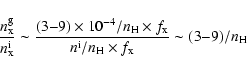
of&nbsp;10<sup>-4</sup>, the predicted gas to ice phase abundance ratio&nbsp;is:
<br><p></p>
<DIV ALIGN="CENTER">

<!-- MATH: \begin{equation}
%
\frac{n^{\rm g}_{\rm x}}{n^{\rm i}_{\rm x}}\sim \frac{(3{-}9)\times 10^{-4}/n_{\rm H}\times f_{\rm x}}{n^{\rm i}/n_{\rm H}\times f_{\rm x}}\sim (3{-}9)/n_{\rm H}
\end{equation} -->

<TABLE WIDTH="100%" ALIGN="CENTER">
<TR VALIGN="MIDDLE"><TD ALIGN="CENTER" NOWRAP><IMG
 WIDTH="247" HEIGHT="73"
 SRC="img39.gif"
 ALT="\begin{displaymath}%
\frac{n^{\rm g}_{\rm x}}{n^{\rm i}_{\rm x}}\sim \frac{(3{-}...
...x}}{n^{\rm i}/n_{\rm H}\times f_{\rm x}}\sim (3{-}9)/n_{\rm H}
\end{displaymath}"></td>
<TD WIDTH=10 ALIGN="RIGHT">
(A.3)</td></tr>
</TABLE>
</DIV><BR CLEAR="ALL"><p></p>
<p>
For a typical envelope density of 10<sup>4</sup> cm<sup>-3</sup>, ice photodesorption hence predicts a gas to ice ratio of 
<!-- MATH: $10^{-4}{-}10^{-3}$ -->
10<sup>-4</sup>-10<sup>-3</sup>. The derivation of a gas to ice ratio from observed cold gas emission
lines and ice absorption features in the same line of sight is complicated by the fact that different regions can contribute by varying amounts.  The emission features trace gas in the envelope and cloud both in front and behind the protostar, while the ice absorption features only trace envelope material directly in front of the protostar. The column is hence twice as long for the gas observations. This is probably more than compensated for by using beam averaged gas column densities, as is done in this study, because the large beam traces on average less dense material compared to the pencil beam of the ice absorption observations. Note also that the CH<SUB>3</SUB>OH&nbsp;ice abundance may vary between lower and higher density regions. To quantify a conversion factor between the observed and true gas to ice ratio requires detailed modeling of each source which is outside the scope of this study. Instead we here assume that the observed ratio is a lower limit to the true ratio.

<p>

<p>
<br>

</div></body></html>