Online Material
Appendix A: Selection of the best-fit and the accuracy of the parameter values
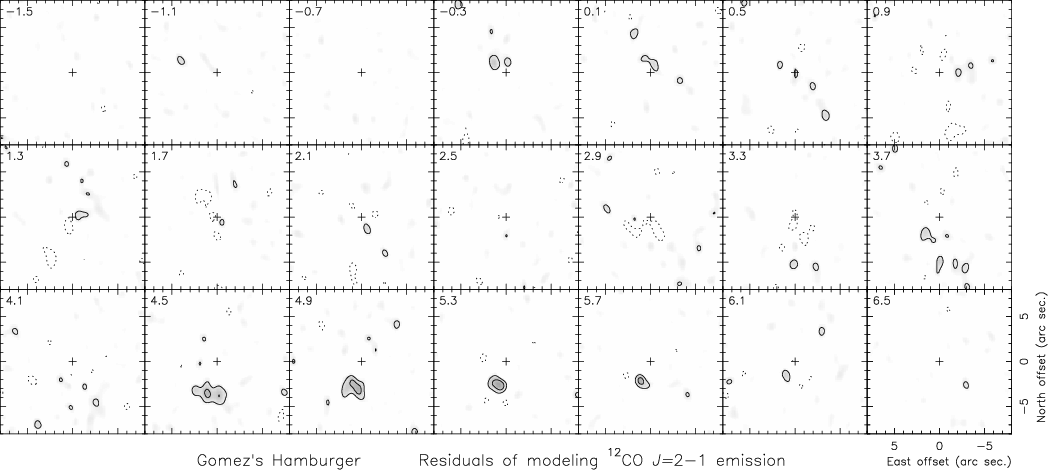 |
Figure A.1: Residuals (observations minus synthetic maps) of the 12CO J = 2-1 line brightness from our best model fitting for the GoHam disk. The spatial scale and contours are the same as in the observations and predictions, Figs. 1, 6. |
| Open with DEXTER | |
A.1 Criteria for acceptable models
The general criterion we chose to select acceptable models was the comparison of the predicted images with the observed ones. Some authors (e.g., Dutrey el al. 2007; Pety et al. 2006; Isella et al. 2007) perform such a comparison in the Fourier transformed plane of the visibilities. The selected model parameters are then those yielding the smallest residuals, after considering `blind' variations of the parameter values. Their method has the advantage of being objective and that uncertainties introduced by the cleaning process are avoided. Other authors (Fuente et al. 2006; Mannings & Sargent 2000,1997) follow, however, a more intuitive approach, comparing directly the images.
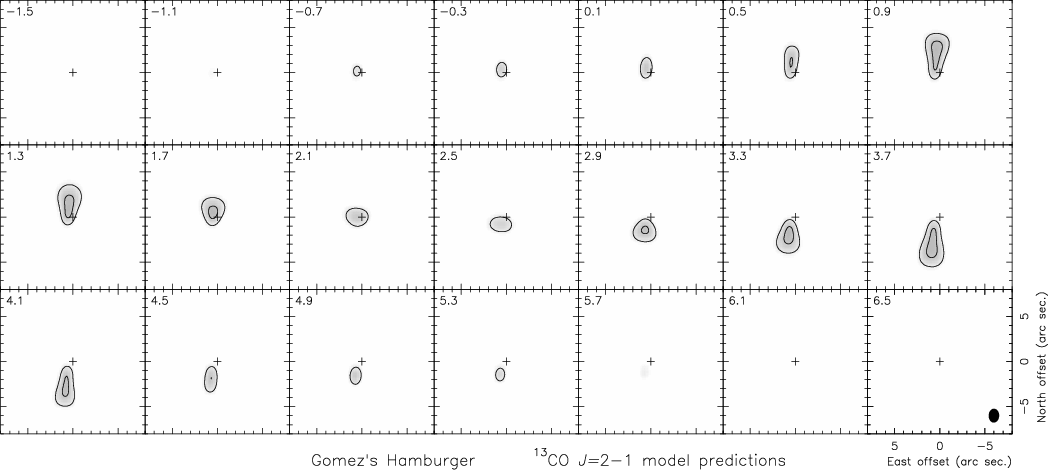 |
Figure A.2: Predictions of the 13CO J = 2-1 line brightness from our best model fitting for the GoHam disk. The spatial scale and contours are the same as in the observations, Fig. 2. |
| Open with DEXTER | |
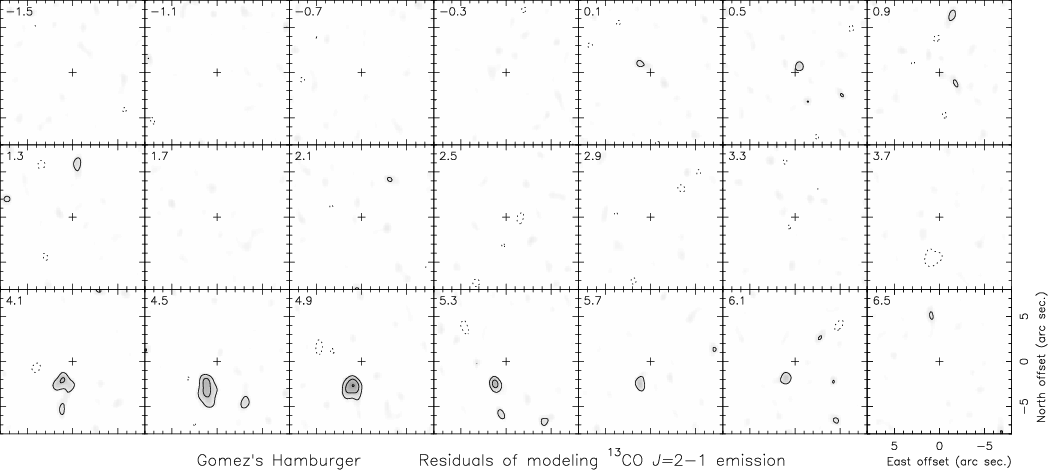 |
Figure A.3: Residuals (observations minus synthetic maps) of the 13CO J = 2-1 line brightness from our best model fitting for the GoHam disk. The spatial scale and contours are the same as in the observations and predictions, Figs. 2, A.2. |
| Open with DEXTER | |
In our case, the high number of free parameters prevents a blind analysis of the resulting residuals for any combination of parameter values, which would imply an exceedingly high amount of calculations. Even the definition of ``free parameter'' in this complex structure is difficult, and it is unclear at what extent we can vary all the disk properties. Even if theoretical constraints on our model parameters are taken into account (see Sect. 3), we continue to have more than 15 (more or less free) model parameters: 5 defining the geometry, 2 for the dynamics, 5 for the temperature, 3 for the density, and finally the 12CO/13CO/C17O abundance ratio. It is difficult to decrease such a high number of parameters because of the different components identified in the maps: the hotter and less dense fringes separated from the equator, an outer less dense region, the cold central part of the disk, and the central hotter region.
On the other hand, our procedure allows an intuitive analysis of the relevance of the different parameters. We can infer that some parameters are not so relevant in fitting some observational properties, and that certain observational features are related to only one or two model parameters. For instance, the total size of the disk is selected to match the total extent of the image, which depends weakly on, e.g., the rotational velocity.
It has been argued that in sources comparable in angular size to the telescope resolution, the comparison performed in the image plane is inaccurate. This is untrue in our case, since GoHam occupies an area about 30 square arcseconds, almost a factor of 20 larger than the beam of our 12CO J = 2-1 data. The cleaning process always introduces noise, but, besides numerical noise, it is mostly due to uncertainties in the calibration of the complex visibilities, i.e., the true beam shape not being exactly equal to the theoretical beam function (for the uv coverage of the observation). Subtraction of the convolved `clean components' and the subsequent convolution to obtain the final image introduces then spurious features, mainly when the uv sampling is poor. However, such unavoidable uncertainties in the amplitude and phase calibration also appear if the fitting is performed in the uv plane, and the limitation in the dynamic range of the observations due to them applies to both the sky plane and the Fourier transformed plane. On the other hand, we also note that Fourier transformation of the predicted brightness (which must be calculated for a finite grid of points in space coordinates from the standard radiative transfer equation) also introduces numerical noise.
As we see below in actual cases, it is practically impossible to define a single best-fit model in our case, because of the complex data set and model. Instead, we adopt criteria to consider whether a set of parameter values is acceptable and, when they are not satisfied, provide limits to these values. This process will only be detailed for the most representative parameters: radius and width of the disk, central mass (i.e., rotational velocity law), typical densities and temperatures. There is no significant differences among the acceptable models, both in their predictions and in values of the relevant disk properties; one of them was chosen as our best-fit model.
To select the acceptable models, we basically use the comparison of the predictions with the observations of the 12CO and 13CO J = 2-1 lines, in which S/N and the spatial and spectral resolutions are particularly high. We checked that the predictions for the J = 3-2 lines are also satisfactory. The criteria used to select acceptable models are:
c1) The differential image, i.e., the difference between observed
and synthetic
velocity channels, must have, in the regions of each channel where
emission is present, an rms noise not exceeding  1.5 times
that present in adjacent regions with no emission. Those regions, of
noise not higher than 1.5 times that found in adjacent ones, are only
slightly noticeable in the differential maps.
1.5 times
that present in adjacent regions with no emission. Those regions, of
noise not higher than 1.5 times that found in adjacent ones, are only
slightly noticeable in the differential maps.
c2) In the differential J = 2-1 image, the residuals must be
smaller than 2 times the spurious contours (due to noise) seen in
adjacent regions (0.6 Jy/beam, two contours, in our 12CO J = 2-1 images), and no residual  0.3 Jy/beam must appear systematically,
i.e., in the same spatial offsets for several velocity channels. We
note that one can identify noise features more intense than 0.3 Jy/beam
in the observed 12CO J = 2-1 maps, so residuals not exceeding the above
limits are again not clearly different than the observation noise.
0.3 Jy/beam must appear systematically,
i.e., in the same spatial offsets for several velocity channels. We
note that one can identify noise features more intense than 0.3 Jy/beam
in the observed 12CO J = 2-1 maps, so residuals not exceeding the above
limits are again not clearly different than the observation noise.
These conditions are relaxed for velocities around 4.5-5.5 km s-1 LSR,
which present a strong emission clump with no counterpart in the
equivalent blue-shifted emission.
This excess cannot be due to opacity or excitation effects, since it is
more prominent in the 13CO J = 2-1 maps than in the 12CO J = 2-1 ones and much more than for 12CO J = 3-2. The excess is also clear in
the C17O J = 3-2 maps. The fact that this excess is so remarkable in
the less optically thick 13CO emission strongly suggests that it is
mainly due to the presence of a gas condensation, rotating at about
2.5 km s-1 at a distance of about
 cm from the star. Our
model shows axial symmetry and therefore cannot explain this excess; we
chose to fit mainly the emission from the rest of the nebula. A
tentative model fitting of this feature is presented in A.3, and the
consequences and possible origins of the presence of this condensation
are discussed in Sect. 4.1.
cm from the star. Our
model shows axial symmetry and therefore cannot explain this excess; we
chose to fit mainly the emission from the rest of the nebula. A
tentative model fitting of this feature is presented in A.3, and the
consequences and possible origins of the presence of this condensation
are discussed in Sect. 4.1.
In Fig. A.1, we present the residuals of our fitting of the 12CO J = 2-1 maps. Predictions and residuals for 13CO J = 2-1 are shown in Figs. A.2 and A.3. Except for the velocities around 5 km s-1, the typical rms noise outside the emitting regions is about 0.1-0.11 Jy/beam (slightly less for 13CO J = 2-1), and does not exceed 1.5-1.7 Jy/beam in the regions with emission. We see that the largest residuals in the differential images do not reach two contours (noise reaching one level is also seen out of the emitting regions).
Table A.1: Relative range of acceptable values, around those given in Table 1, of the main parameters defining the model disk in Gomez's Hamburger.
Of course, between 4.5 and 5.5 km s-1, the situation is worse, reflecting
the asymmetry in the disk density mentioned above. We can notice some
other minor features in the images that are not accounted for by our
model. For instance, the 13CO line emission at 3.7 km s-1 is less
extended than expected, which is not the case at 4.1 km s-1. We also note
in our 13CO maps a weak extent towards the north at about 1.3 km s-1,
but practically at the noise level. In 12CO J = 2-1, we see a similar
protrusion, but not exactly at the same position. We finally note in
some observed panels that the emission from regions close to the star
(see, e.g., the 13CO J = 2-1 emission at 0.5 km s-1 and the
12CO emission at 3.7 km s-1) is more extended than the predictions. The
width of our disk is given mainly by the equation of hydrostatics
(Sect. 3), under the standard theory of massive flaring disks; it is
possible that these usual theoretical requirements are not fully
satisfied in the innermost regions of the disks, although further
analysis of this phenomenon obviously requires higher-quality
observations.
A.2 Uncertainty in the fitted parameters
We estimated the uncertainties in derived values of the model
parameters by varying the values of each one (while the others remain
unchanged) and checking the values for which the above conditions, c1 and c2, were clearly not satisfied. This procedure was
completed for the main, most representative parameters, for instance,
the disk radius
 ,
the characteristic density, etc. The
results are summarized in Table 1. We also present below some cases in
which the uncertainty in the derived parameters requires some
discussion.
,
the characteristic density, etc. The
results are summarized in Table 1. We also present below some cases in
which the uncertainty in the derived parameters requires some
discussion.
We did not attempt to consider fully the parameter uncertainties when two or more parameters are allowed to vary. For example, the density range is slightly larger than that given in the table if we allow the temperature also to vary, since both variations are in some way compensated. In general, however, the ranges do not differ very much from our standard uncertainty brackets. The density is mostly fixed by the emission of 13CO and that of 12CO J = 2-1 from outer regions, while the temperature law is mainly given by the 12CO J = 2-1 and J = 3-2 maps.
We note the uncertain determination of the density in the outer disk
(
 ), which is only given by the 12CO emission,
since 13CO is not detected in this region (see Table A.1). We also
recall that the assumption of level population thermalization may
be invalid for these diffuse regions, which may imply that the density in
them is higher than the values given here, perhaps closer to
), which is only given by the 12CO emission,
since 13CO is not detected in this region (see Table A.1). We also
recall that the assumption of level population thermalization may
be invalid for these diffuse regions, which may imply that the density in
them is higher than the values given here, perhaps closer to
 cm-3.
cm-3.
Important problems with the thermalization assumption are unexpected
for the relatively high densities of the remaining nebula and the
analyzed transitions (Sect. 3). The J=6-5 transition is significantly
more sensitive to these effects, due to the relatively high Einstein
coefficients of high-J transitions. We also expect underpopulation of
the J=6 and J=5 levels in the high-z low-density regions, with
 cm-3, leading to 6-5 brightness temperatures
of under 10 K. This line would mainly come from this high temperature
surface, and we think that this phenomenon is responsible for the
non-detection of 12CO J=6-5 in our observations. Any further
discussion is impossible because of the lack of accurate information
about the J=6-5 emission. This relative underpopulation of high-Jlevels in the layers at high absolute values of z may lead to a
relative overpopulation of the J=2 level, and therefore to more
emission than expected in J = 2-1. This effect could lead to slightly
smaller jumps of the temperature, perhaps closer to factor 2.
cm-3, leading to 6-5 brightness temperatures
of under 10 K. This line would mainly come from this high temperature
surface, and we think that this phenomenon is responsible for the
non-detection of 12CO J=6-5 in our observations. Any further
discussion is impossible because of the lack of accurate information
about the J=6-5 emission. This relative underpopulation of high-Jlevels in the layers at high absolute values of z may lead to a
relative overpopulation of the J=2 level, and therefore to more
emission than expected in J = 2-1. This effect could lead to slightly
smaller jumps of the temperature, perhaps closer to factor 2.
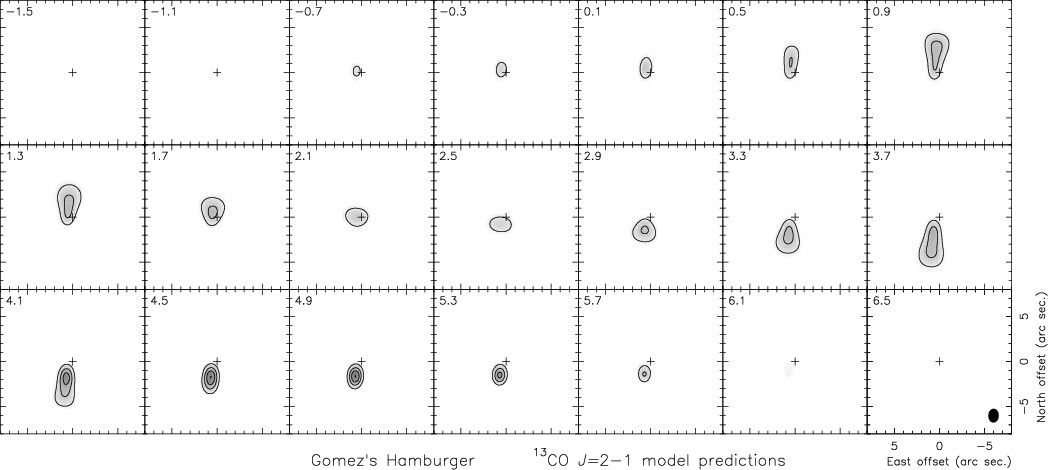 |
Figure A.4: Predictions of the 13CO J = 2-1 line brightness from our best model fitting for the GoHam disk, including the increase in temperature and density in a southern clump, as described in Appendix A.3. The spatial scale and contours are the same as in the observations, Fig. 2, and our standard model predictions, Fig. A.2. |
| Open with DEXTER | |
Some parameter pairs are quite dependent each on other. This is
particularly true for the density and CO total abundance,
since we assume LTE and then the line opacity depends on the product
of the density and the relative abundance. Both parameters can
therefore vary freely, provided that their product remains constant. The
indetermination is solved assuming a relative 12CO abundance of
10-4. This is also the case for parameters that we have not
considered separately in this uncertainty analysis, such as the
temperature at a given point, T(R0), and the slope of the
temperature law,  ;
instead, as mentioned, we discuss
the uncertainty in the characteristic temperature. Finally, we note the
case of the rotation velocity and the conditions in the hot and dense
center of the disk. Strong emission from these regions could mimic the
emission of a faster rotating disk in the extreme velocity
channels. So, the rotation velocity is mainly determined from the
emission extent in the channels at moderate velocities, the emission at
the extreme channels depending on both the Keplerian velocity and the
emissivity of the central regions. In general, the uncertainty in the
parameters defining the inner, denser region (
;
instead, as mentioned, we discuss
the uncertainty in the characteristic temperature. Finally, we note the
case of the rotation velocity and the conditions in the hot and dense
center of the disk. Strong emission from these regions could mimic the
emission of a faster rotating disk in the extreme velocity
channels. So, the rotation velocity is mainly determined from the
emission extent in the channels at moderate velocities, the emission at
the extreme channels depending on both the Keplerian velocity and the
emissivity of the central regions. In general, the uncertainty in the
parameters defining the inner, denser region (
 )
is high, because this clump is not resolved and the
number of independent observational constraints is small (as also
concluded in Paper I). We can say that an inner region of higher
density and temperature is necessary to attain our strong requirements
on the fitting quality and that it must be smaller than about
1016 cm, but we cannot provide details of this region.
)
is high, because this clump is not resolved and the
number of independent observational constraints is small (as also
concluded in Paper I). We can say that an inner region of higher
density and temperature is necessary to attain our strong requirements
on the fitting quality and that it must be smaller than about
1016 cm, but we cannot provide details of this region.
The outer hot region, for high values of z, is hardly resolved in our 12CO maps. Therefore, we could also reproduce our data assuming that this region is significantly thinner and brighter (in general, hotter) than in our standard model. However, those disk models are less probable than our standard one, since the jump in temperature we found is already quite high (see Sect. 3). Moreover, for very high temperatures in the high-z rim, we should also increase the typical density significantly (to be able to reproduce 12CO J = 2-1 data, which, for the assumed dependence of density on z, is only moderately opaque in the high-z regions). This would then imply too low values of X(13CO), when attempting to reproduce the 13CO J = 2-1 data, leading to improbably high values of X(12CO)/X(13CO), of significantly over 100. In any case, we note that the properties of this high-z bright rim depend on the relative calibration of the J = 2-1 and J = 3-2 lines; allowing 15% variations in the relative calibrations, we can fit the data with temperature jumps ranging between 2 and 5 (and hot-layer widths that do not differ significantly from our standard value).
A.3 Model (tentative) fitting of the southern brightness maximum
We mentioned that there is a relative maximum in the southern part of the disk that has no counterpart in the north. This maximum is seen in all our maps, but is more prominent in the 13CO emission, which is mostly optically thin, as well as in the C17O line. Therefore, this brightness maximum must be due mainly to an increase in the density of some southern regions, although an increase in temperature is also necessary to explain the excess observed in 12CO J = 2-1.
In our standard model analysis, we mostly tried to fit the emission from the rest of the nebula (Sects. 3, A1, A2). Any attempt to fit the emission excess from this southern clump is very uncertain, because of the lack of previous experience in trying to study condensations of this kind, including the lack of theoretical modeling, and because of the poor information contained in our observations, which scarcely resolve its extent.
Nevertheless, we note that this emission excess can be detected over a
remarkable range of velocities, between about 4.1 and 5.7 km s-1 LSR. This means that the emitting condensation cannot be very small,
the projected velocity dispersion being caused by gas emission from
different distances from the star or from regions showing a significant
variation in the velocity projection along the line of sight. In both
cases, we expect typical sizes
cm
(1
 for the adopted distance). We can also assume that the
condensation occurs in the equatorial disk regions in which 13CO J = 2-1 emission originates, because the maximum is so prominent in this
line. We have assumed that the emission comes from a region defined by
for the adopted distance). We can also assume that the
condensation occurs in the equatorial disk regions in which 13CO J = 2-1 emission originates, because the maximum is so prominent in this
line. We have assumed that the emission comes from a region defined by
 cm, and zs/r < 0.6, where
zs is the distance between a given point and the plane containing
the star and perpendicular to the equator that gives the extreme
projections for the rotation velocity. We assume that the temperature
and density of this region vary with respect to the standard laws
assumed for the rest of the nebula.
cm, and zs/r < 0.6, where
zs is the distance between a given point and the plane containing
the star and perpendicular to the equator that gives the extreme
projections for the rotation velocity. We assume that the temperature
and density of this region vary with respect to the standard laws
assumed for the rest of the nebula.
To explain the (moderate) emission excess found in 12CO J = 2-1, we
estimate that we must assume an increase in temperature in the
southern condensation of a factor 1.5, with respect to our
standard laws for nearby regions. Finally, we estimate the
excess density in the condensation by comparing the model
results with the intensity of 13CO J = 2-1. Since the 13CO J = 2-1 emission from these inner regions is not fully optically thin and the
beam dilution is not negligible, a
significant density increase, of a factor 10, is necessary. A total
mass increase of about

 is deduced.
The resulting brightness distribution is shown in Fig. A.4. We can see that the brightness excess of 13CO J = 2-1 in this southern clump is reasonably well reproduced, but the location of the predicted maximum is slightly closer to the star than the observed one. This cannot be avoided assuming a larger distance from the star for the clump, because then the velocity of the feature would be less positive. The velocity field in this region must then also be disturbed. See discussion on the interpretation of this emission excess in Sect. 4.1.