<!DOCTYPE html PUBLIC "-//W3C//DTD XHTML 1.0 Transitional//EN">
<html xmlns:xlink="http://www.w3.org/1999/xlink" xmlns:mml="http://www.w3.org/1998/Math/MathML">
<link rel="stylesheet" type="text/css" href="../../../CSS_FULL/edps_full.css">
<body><div id="contenu_olm">

<!-- DOI: 10.1051/0004-6361/200912250 -->

<h2 class="sec">Online Material</h2>
 
                                                                     
<A NAME="table:1"></A><p class="inset-old"><a href="/articles/aa/full_html/2009/28/aa12250-09/table1.html"><span class="bold">Table 1:</span></a>&#160;&#160;
Summary of previous high angular resolution studies of 6.7&nbsp;GHz methanol masers.</p>

<p>

  
<A NAME="table:2"></A><p class="inset-old"><a href="/articles/aa/full_html/2009/28/aa12250-09/table2.html"><span class="bold">Table 2:</span></a>&#160;&#160;
Sample of methanol masers observed with the EVN. The names
are the Galactic coordinates of the brightest spot of each target
obtained in post-processing EVN data. The dates of each observing run
are listed in Table <a href="/articles/aa/full_html/2009/28/aa12250-09/aa12250-09.html#table:4">4</a>. The phase-calibrator names and
angular separations from the targets are given.</p>

<p>

<A NAME="table:3"></A><p class="inset-old"><a href="/articles/aa/full_html/2009/28/aa12250-09/table3.html"><span class="bold">Table 3:</span></a>&#160;&#160;
Targets not detected with the MERLIN single baseline. The
source names, coordinates, and peak flux velocities are taken from
Szymczak et&nbsp;al. (<a href="/articles/aa/full_html/2009/28/aa12250-09/aa12250-09.html#szymczak02">2002</a>).</p> 

<p>

<A NAME="table:6"></A><p class="inset-old"><a href="/articles/aa/full_html/2009/28/aa12250-09/table6.html"><span class="bold">Table 6:</span></a>&#160;&#160;
Maser clusters towards 31 sources.  If a spectrum of a maser 
cluster does not show a Gaussian profile we enter the sign - in the 
Cols. of <I> FWHM</I> and 
<!-- MATH: $S_{\rm amp}$ -->
<IMG
 WIDTH="29" HEIGHT="26" ALIGN="MIDDLE" BORDER="0"
 SRC="img6.png"
 ALT="$S_{\rm amp}$">.</p>         

<p>

   <div class="inset-old">
<table>
<tr><td><!-- init Label --><A NAME="fig9a">&#160;</A><!-- end Label--><A NAME="1076"></A><A NAME="figure914"
 HREF="img68.png"><IMG
 WIDTH="182" HEIGHT="186" SRC="Timg68.png"
 ALT="\begin{figure}\par\includegraphics[scale=0.9]{12250f10.eps}
\end{figure}"></A><!-- HTML Figure number: 12 --></td>
<td class="img-txt"><span class="bold">Figure 3:</span><p>
The 8.4&nbsp;GHz continuum emission detected using VLA on 2007 August&nbsp;18.
      The names of radio continuum sources (RC) are the Galactic coordinates of 
      peak fluxes. The peak and integrated fluxes as well as the levels of rms
       (1
<!-- MATH: $\sigma_{{\rm rms}}$ -->
<IMG
 WIDTH="29" HEIGHT="26" ALIGN="MIDDLE" BORDER="0"
 SRC="img1.png"
 ALT="$\sigma _{{\rm rms}}$">)
are given under each map and the beamsizes
       are presented at the left down corners. Contours trace the levels of
       3
<!-- MATH: $\sigma_{{\rm rms}}$ -->
<IMG
 WIDTH="29" HEIGHT="26" ALIGN="MIDDLE" BORDER="0"
 SRC="img1.png"
 ALT="$\sigma _{{\rm rms}}$">&nbsp;<IMG
 WIDTH="12" HEIGHT="26" ALIGN="MIDDLE" BORDER="0"
 SRC="img2.png"
 ALT="$\times $">&nbsp;(1, 2, 4, 8, 16, 32, 64, ...).</p></td>
</tr><tr><td colspan="2"><a href="http://dexter.edpsciences.org/applet.php?pdf_id=12&DOI=10.1051/0004-6361/200912250" target="DEXTER">Open with DEXTER</a></td></tr>

</table></div>

<p>
<div class="inset-old">
<table>
<tr><td><!-- init Label --><A NAME="fig12">&#160;</A><!-- end Label--><A NAME="1039"></A><A NAME="figure923"
 HREF="img69.png"><IMG
 WIDTH="165" HEIGHT="186" SRC="Timg69.png"
 ALT="\begin{figure}
\par\includegraphics{12250f13.eps}
\end{figure}"></A><!-- HTML Figure number: 13 --></td>
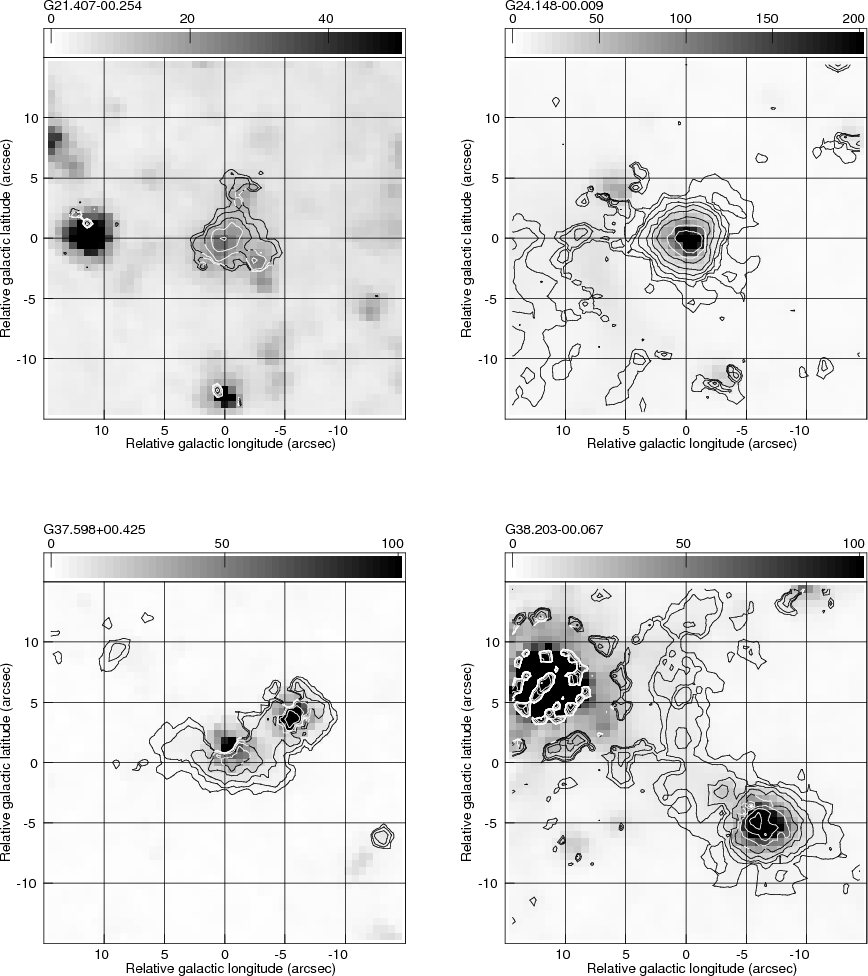
<td class="img-txt"><span class="bold">Figure 6:</span><p>
<I> Spitzer</I> IRAC 4.5&nbsp;<IMG
 WIDTH="11" HEIGHT="26" ALIGN="MIDDLE" BORDER="0"
 SRC="img3.png"
 ALT="$\mu $">m (grey) and
   4.5&nbsp;<IMG
 WIDTH="11" HEIGHT="26" ALIGN="MIDDLE" BORDER="0"
 SRC="img3.png"
 ALT="$\mu $">m-3.6&nbsp;<IMG
 WIDTH="11" HEIGHT="26" ALIGN="MIDDLE" BORDER="0"
 SRC="img3.png"
 ALT="$\mu $">m (contour) images centered on selected
   methanol sources
   (at coordinates taken from Table&nbsp;<a href="/articles/aa/full_html/2009/28/aa12250-09/aa12250-09.html#table:5">5</a>). The grey scale in
   MJy&nbsp;sr<sup>-1</sup> is indicated in the horizontal bar and contour
   levels are 1&nbsp;MJy&nbsp;sr
<!-- MATH: $^{-1}\times$ -->
<IMG
 WIDTH="24" HEIGHT="30" ALIGN="MIDDLE" BORDER="0"
 SRC="img7.png"
 ALT="$^{-1}\times $">&nbsp;(1, 2, 4, 8, 16, 32, 64,
   128). The methanol maser <B> G21.407</B>-<B>00.254</B> coincides exactly 
   with the brightest pixel in the 4.5&nbsp;<IMG
 WIDTH="11" HEIGHT="26" ALIGN="MIDDLE" BORDER="0"
 SRC="img3.png"
 ALT="$\mu $">m-3.6&nbsp;<IMG
 WIDTH="11" HEIGHT="26" ALIGN="MIDDLE" BORDER="0"
 SRC="img3.png"
 ALT="$\mu $">m image, at
   the map origin, which is offset from the 4.5&nbsp;<IMG
 WIDTH="11" HEIGHT="26" ALIGN="MIDDLE" BORDER="0"
 SRC="img3.png"
 ALT="$\mu $">m peak. There
   are at least two other nearby MIR sources with 4.5&nbsp;<IMG
 WIDTH="11" HEIGHT="26" ALIGN="MIDDLE" BORDER="0"
 SRC="img3.png"
 ALT="$\mu $">m emission
   excesses. Note the absence of further sources with extended
   4.5&nbsp;<IMG
 WIDTH="11" HEIGHT="26" ALIGN="MIDDLE" BORDER="0"
 SRC="img3.png"
 ALT="$\mu $">m-3.6&nbsp;<IMG
 WIDTH="11" HEIGHT="26" ALIGN="MIDDLE" BORDER="0"
 SRC="img3.png"
 ALT="$\mu $">m emission excess in this 30
<!-- MATH: $^{\prime\prime}$ -->
<IMG
 WIDTH="10" HEIGHT="14" ALIGN="BOTTOM" BORDER="0"
 SRC="img8.png"
 ALT="$^{\prime \prime }$">&nbsp;<IMG
 WIDTH="12" HEIGHT="26" ALIGN="MIDDLE" BORDER="0"
 SRC="img2.png"
 ALT="$\times $">&nbsp;30
<!-- MATH: $^{\prime\prime}$ -->
<IMG
 WIDTH="10" HEIGHT="14" ALIGN="BOTTOM" BORDER="0"
 SRC="img8.png"
 ALT="$^{\prime \prime }$">&nbsp; field.  The maser source <B> G24.148</B>-<B>00.009</B>
   coincides with the peaks of emission both at 4.5&nbsp;<IMG
 WIDTH="11" HEIGHT="26" ALIGN="MIDDLE" BORDER="0"
 SRC="img3.png"
 ALT="$\mu $">m and for the
   4.5&nbsp;<IMG
 WIDTH="11" HEIGHT="26" ALIGN="MIDDLE" BORDER="0"
 SRC="img3.png"
 ALT="$\mu $">m-3.6&nbsp;<IMG
 WIDTH="11" HEIGHT="26" ALIGN="MIDDLE" BORDER="0"
 SRC="img3.png"
 ALT="$\mu $">m excess.  The maser <B> G37.598</B>+<B>00.425</B>
   is offset from the brightest 4.5&nbsp;<IMG
 WIDTH="11" HEIGHT="26" ALIGN="MIDDLE" BORDER="0"
 SRC="img3.png"
 ALT="$\mu $">m emission. Note the highly
   asymmetric morphology of the extended 4.5&nbsp;<IMG
 WIDTH="11" HEIGHT="26" ALIGN="MIDDLE" BORDER="0"
 SRC="img3.png"
 ALT="$\mu $">m-3.6&nbsp;<IMG
 WIDTH="11" HEIGHT="26" ALIGN="MIDDLE" BORDER="0"
 SRC="img3.png"
 ALT="$\mu $">m excess
    emission and the coincidence of the maser emission with a maximum of
   this excess. In the case of <B> G38.203</B>-<B>00.067</B>, the maser
   emission does not coincide with either of the two brightest sources
   but is close (<IMG
 WIDTH="13" HEIGHT="14" ALIGN="BOTTOM" BORDER="0"
 SRC="img9.png"
 ALT="$\sim $">1
<!-- MATH: $.\!\!^{\prime\prime}$ -->
<IMG
 WIDTH="10" HEIGHT="26" ALIGN="MIDDLE" BORDER="0"
 SRC="img11.png"
 ALT="$.\!\!^{\prime\prime}$">7) to a weak bump of
   4.5&nbsp;<IMG
 WIDTH="11" HEIGHT="26" ALIGN="MIDDLE" BORDER="0"
 SRC="img3.png"
 ALT="$\mu $">m-3.6&nbsp;<IMG
 WIDTH="11" HEIGHT="26" ALIGN="MIDDLE" BORDER="0"
 SRC="img3.png"
 ALT="$\mu $">m excess located in a very extended arc
   (<IMG
 WIDTH="13" HEIGHT="14" ALIGN="BOTTOM" BORDER="0"
 SRC="img9.png"
 ALT="$\sim $">25
<!-- MATH: $^{\prime\prime}$ -->
<IMG
 WIDTH="10" HEIGHT="14" ALIGN="BOTTOM" BORDER="0"
 SRC="img8.png"
 ALT="$^{\prime \prime }$">)
of diffuse 4.5&nbsp;<IMG
 WIDTH="11" HEIGHT="26" ALIGN="MIDDLE" BORDER="0"
 SRC="img3.png"
 ALT="$\mu $">m emission. Further
   inspection of IRAC images at 5.8&nbsp;<IMG
 WIDTH="11" HEIGHT="26" ALIGN="MIDDLE" BORDER="0"
 SRC="img3.png"
 ALT="$\mu $">m suggests that this bump
   could be a weak MIR object.</p></td>
</tr><tr><td colspan="2"><a href="http://dexter.edpsciences.org/applet.php?pdf_id=13&DOI=10.1051/0004-6361/200912250" target="DEXTER">Open with DEXTER</a></td></tr>

</table></div>
<p>
<br>

</div></body></html>