<!DOCTYPE html PUBLIC "-//W3C//DTD XHTML 1.0 Transitional//EN">
<html xmlns:xlink="http://www.w3.org/1999/xlink" xmlns:mml="http://www.w3.org/1998/Math/MathML">
<link rel="stylesheet" type="text/css" href="../../../CSS_FULL/edps_full.css">
<body><div id="contenu_olm">

<!-- DOI: 10.1051/0004-6361/200912620 -->

<h2 class="sec">Online Material</h2>

<p>

<p>

<h2 class="sec"><a name="SECTION000100000000000000000"></a><A NAME="sec:fuvlumi"></A>Appendix A: The FUV luminosity
</h2>

<p>
For the modeling in Sect.&nbsp;<a href="/articles/aa/full_html/2009/32/aa12620-09/aa12620-09.html#sec:chemmod">4</a>, the FUV luminosity 
<!-- MATH: $L_{\rm FUV}$ -->
<IMG
 WIDTH="32" HEIGHT="26" ALIGN="MIDDLE" BORDER="0"
 SRC="img41.png"
 ALT="$L_{\rm FUV}$">
is required. Assuming the protostar to emit a blackbody spectrum, this quantity depends on the bolometric luminosity 
<!-- MATH: $L_{\rm bol}$ -->
<IMG
 WIDTH="24" HEIGHT="26" ALIGN="MIDDLE" BORDER="0"
 SRC="img60.png"
 ALT="$L_{\rm bol}$">
and the effective temperature 
<!-- MATH: $T_{\rm eff}$ -->
<IMG
 WIDTH="23" HEIGHT="26" ALIGN="MIDDLE" BORDER="0"
 SRC="img3.png"
 ALT="$T_{\rm eff}$">.
While 
<!-- MATH: $L_{\rm bol}$ -->
<IMG
 WIDTH="24" HEIGHT="26" ALIGN="MIDDLE" BORDER="0"
 SRC="img60.png"
 ALT="$L_{\rm bol}$">
of the embedded protostar can be determined relatively well from photometry in the IR and is assumed to be given in the following, only rough estimations of 
<!-- MATH: $T_{\rm eff}$ -->
<IMG
 WIDTH="23" HEIGHT="26" ALIGN="MIDDLE" BORDER="0"
 SRC="img3.png"
 ALT="$T_{\rm eff}$">
are available, since photons are absorbed or redistributed to longer wavelengths by the high dust and gas column density toward the source. 

<p>
<div class="inset-old">
<table>
<tr><td><!-- init Label --><A NAME="fig:fuvlumi">&#160;</A><!-- end Label--><A NAME="899"></A><A NAME="figure732"
 HREF="img61.png"><IMG
 WIDTH="81" HEIGHT="64" SRC="Timg61.png"
 ALT="\begin{figure}
\par\includegraphics[width=7.3cm,clip]{12620fg4.eps}
\end{figure}"></A><!-- HTML Figure number: 4 --></td>
<td class="img-txt"><span class="bold">Figure A.1:</span><p>
Luminosity in the FUV band depending on 
<!-- MATH: $T_{\rm eff}$ -->
<IMG
 WIDTH="23" HEIGHT="26" ALIGN="MIDDLE" BORDER="0"
 SRC="img3.png"
 ALT="$T_{\rm eff}$">
for 
<!-- MATH: $L_{\rm bol}=L_\odot$ -->
<IMG
 WIDTH="56" HEIGHT="26" ALIGN="MIDDLE" BORDER="0"
 SRC="img4.png"
 ALT="$L_{\rm bol}=L_\odot $">.
The spectral classification is indicated by red circles.</p></td>
</tr><tr><td colspan="2"><a href="http://dexter.edpsciences.org/applet.php?pdf_id=4&DOI=10.1051/0004-6361/200912620" target="DEXTER">Open with DEXTER</a></td></tr>

</table></div>
<p>
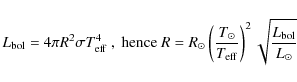
The Stefan-Boltzmann law requires 
<br><p></p>
<DIV ALIGN="CENTER">

<!-- MATH: \begin{equation}
L_{\rm bol}=4\pi R^2 \sigma T_{\rm eff}^4\ ,\ {\rm hence}\ R=R_\odot \left(\frac{T_\odot}{T_{\rm eff}} \right)^2 \sqrt{\frac{L_{\rm bol}}{L_\odot}}
\end{equation} -->

<TABLE WIDTH="100%" ALIGN="CENTER">
<TR VALIGN="MIDDLE"><TD ALIGN="CENTER" NOWRAP><A NAME="eq:stefbolz"></A><IMG
 WIDTH="297" HEIGHT="82"
 SRC="img62.png"
 ALT="\begin{displaymath}L_{\rm bol}=4\pi R^2 \sigma T_{\rm eff}^4\ ,\ {\rm hence}\ R=...
...dot}{T_{\rm eff}} \right)^2 \sqrt{\frac{L_{\rm bol}}{L_\odot}}
\end{displaymath}"></td>
<TD WIDTH=10 ALIGN="RIGHT">
(A.1)</td></tr>
</TABLE>
</DIV><BR CLEAR="ALL"><p></p>
with the source radius <I>R</I>, the Stefan-Boltzmann constant <IMG
 WIDTH="13" HEIGHT="26" ALIGN="MIDDLE" BORDER="0"
 SRC="img1.png"
 ALT="$\sigma $">,
and the solar temperature, radius, and luminosity (<IMG
 WIDTH="19" HEIGHT="26" ALIGN="MIDDLE" BORDER="0"
 SRC="img63.png"
 ALT="$T_\odot$">,
<IMG
 WIDTH="18" HEIGHT="26" ALIGN="MIDDLE" BORDER="0"
 SRC="img64.png"
 ALT="$R_\odot$">,
and&nbsp;<IMG
 WIDTH="18" HEIGHT="26" ALIGN="MIDDLE" BORDER="0"
 SRC="img44.png"
 ALT="$L_\odot$">). The   FUV&nbsp;band is limited by the Ly<IMG
 WIDTH="12" HEIGHT="26" ALIGN="MIDDLE" BORDER="0"
 SRC="img27.png"
 ALT="$\alpha$">
edge (13.6&nbsp;eV, 
<!-- MATH: $\lambda_{\rm min}=912$ -->
<IMG
 WIDTH="65" HEIGHT="26" ALIGN="MIDDLE" BORDER="0"
 SRC="img65.png"
 ALT="$\lambda_{\rm min}=912$">&nbsp;&#197;) at short wavelengths and the average dust  working  function at long wavelengths (6&nbsp;eV, 
<!-- MATH: $\lambda_{\rm max}=2067$ -->
<IMG
 WIDTH="72" HEIGHT="26" ALIGN="MIDDLE" BORDER="0"
 SRC="img66.png"
 ALT="$\lambda_{\rm max}=2067$">&nbsp;&#197;). For temperatures between 
<!-- MATH: $2.4\times 10^4$ -->
<IMG
 WIDTH="56" HEIGHT="30" ALIGN="MIDDLE" BORDER="0"
 SRC="img67.png"
 ALT="$2.4\times 10^4$">&nbsp;K and 
<!-- MATH: $5.6\times 10^4$ -->
<IMG
 WIDTH="55" HEIGHT="30" ALIGN="MIDDLE" BORDER="0"
 SRC="img68.png"
 ALT="$5.6\times 10^4$">&nbsp;K, the peak of the blackbody intensity 
<!-- MATH: $B_\lambda(T_{\rm eff})$ -->
<IMG
 WIDTH="48" HEIGHT="26" ALIGN="MIDDLE" BORDER="0"
 SRC="img69.png"
 ALT="$B_\lambda(T_{\rm eff})$">
is within the FUV band (Wien's displacement law, 
<!-- MATH: $\lambda_{\rm max} [\textrm{\AA}] = 5.1 \times 10^7 / (T [K])$ -->
<IMG
 WIDTH="161" HEIGHT="32" ALIGN="MIDDLE" BORDER="0"
 SRC="img70.png"
 ALT="$\lambda_{\rm max} [\textrm{\AA}] = 5.1 \times 10^7 / (T [K])$">). The FUV luminosity 
<!-- MATH: $L_{\rm FUV}$ -->
<IMG
 WIDTH="32" HEIGHT="26" ALIGN="MIDDLE" BORDER="0"
 SRC="img41.png"
 ALT="$L_{\rm FUV}$">
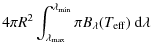
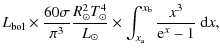
is obtained from integrating 
<!-- MATH: $B_\lambda(T_{\rm eff})$ -->
<IMG
 WIDTH="48" HEIGHT="26" ALIGN="MIDDLE" BORDER="0"
 SRC="img69.png"
 ALT="$B_\lambda(T_{\rm eff})$">
between 
<!-- MATH: $\lambda_{\rm min}$ -->
<IMG
 WIDTH="27" HEIGHT="26" ALIGN="MIDDLE" BORDER="0"
 SRC="img71.png"
 ALT="$\lambda_{\rm min}$">
and&nbsp;
<!-- MATH: $\lambda_{\rm max}$ -->
<IMG
 WIDTH="28" HEIGHT="26" ALIGN="MIDDLE" BORDER="0"
 SRC="img72.png"
 ALT="$\lambda_{\rm max}$">&nbsp;by
<br>
<DIV ALIGN="CENTER"><A NAME="eq:lumi1">&#160;</A><A NAME="eq:lumi2"></A>
<!-- MATH: \begin{eqnarray}
L_{\rm FUV} &=& 4 \pi R^2 \int_{\lambda_{\rm max}}^{\lambda_{\rm min}} \pi B_\lambda(T_{\rm eff}) ~ {\rm d}\lambda\\
&=& L_{\rm bol} \times \frac{60\sigma}{\pi^3} \frac{R_\odot^2 T_\odot^4}{L_\odot} \times \int_{x_{\rm a}}^{x_{\rm b}} \frac{x^3}{{\rm e}^{x}-1} ~ {\rm d}x,
\end{eqnarray} -->

<TABLE ALIGN="CENTER" CELLPADDING="0" WIDTH="100%">
<TR VALIGN="MIDDLE"><TD NOWRAP ALIGN="RIGHT">&nbsp;&nbsp;&nbsp;&nbsp;&nbsp;&nbsp;&nbsp;&nbsp;&nbsp;&nbsp;&nbsp;&nbsp;&nbsp;&nbsp;&nbsp;&nbsp;&nbsp;&nbsp;&nbsp;&nbsp;&nbsp;&nbsp;&nbsp;&nbsp;&nbsp;<IMG
 WIDTH="34" HEIGHT="30" ALIGN="MIDDLE" BORDER="0"
 SRC="img73.png"
 ALT="$\displaystyle L_{\rm FUV}$"></td>
<TD ALIGN="CENTER" NOWRAP>=</td>
<TD ALIGN="LEFT" NOWRAP><IMG
 WIDTH="152" HEIGHT="57" ALIGN="MIDDLE" BORDER="0"
 SRC="img74.png"
 ALT="$\displaystyle 4 \pi R^2 \int_{\lambda_{\rm max}}^{\lambda_{\rm min}} \pi B_\lambda(T_{\rm eff}) ~ {\rm d}\lambda$"></td>
<TD WIDTH=10 ALIGN="RIGHT">
(A.2)</td></tr>
<TR VALIGN="MIDDLE"><TD NOWRAP ALIGN="RIGHT">&nbsp;</td>
<TD ALIGN="CENTER" NOWRAP>=</td>
<TD ALIGN="LEFT" NOWRAP><IMG
 WIDTH="220" HEIGHT="56" ALIGN="MIDDLE" BORDER="0"
 SRC="img75.png"
 ALT="$\displaystyle L_{\rm bol} \times \frac{60\sigma}{\pi^3} \frac{R_\odot^2 T_\odot...
...odot} \times \int_{x_{\rm a}}^{x_{\rm b}} \frac{x^3}{{\rm e}^{x}-1} ~ {\rm d}x,$"></td>
<TD WIDTH=10 ALIGN="RIGHT">
(A.3)</td></tr>
</TABLE></DIV><BR CLEAR="ALL"><p></p>
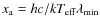
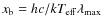
with 
<!-- MATH: $x_{\rm a}=hc/kT_{\rm eff} \lambda_{\rm min}$ -->
<IMG
 WIDTH="100" HEIGHT="26" ALIGN="MIDDLE" BORDER="0"
 SRC="img76.png"
 ALT="$x_{\rm a}=hc/kT_{\rm eff} \lambda_{\rm min}$">
and 
<!-- MATH: $x_{\rm b}=hc/kT_{\rm eff} \lambda_{\rm max}$ -->
<IMG
 WIDTH="103" HEIGHT="26" ALIGN="MIDDLE" BORDER="0"
 SRC="img77.png"
 ALT="$x_{\rm b}=hc/kT_{\rm eff} \lambda_{\rm max}$">.
For 
<!-- MATH: $x_{\rm a}=0$ -->
<IMG
 WIDTH="38" HEIGHT="26" ALIGN="MIDDLE" BORDER="0"
 SRC="img78.png"
 ALT="$x_{\rm a}=0$">
and 
<!-- MATH: $x_{\rm b} \rightarrow \infty$ -->
<IMG
 WIDTH="49" HEIGHT="26" ALIGN="MIDDLE" BORDER="0"
 SRC="img79.png"
 ALT="$x_{\rm b} \rightarrow \infty$">,
the integral in Eq.&nbsp;(<a href="/articles/aa/full_html/2009/32/aa12620-09/aa12620-09.html#eq:lumi2">A.3</a>) is <IMG
 WIDTH="36" HEIGHT="30" ALIGN="MIDDLE" BORDER="0"
 SRC="img80.png"
 ALT="$\pi^4/15$">,
and Stefan-Boltzmanns law is recovered. In Fig.&nbsp;<a href="/articles/aa/full_html/2009/32/aa12620-09/aa12620-09.html#fig:fuvlumi">A.1</a>, the FUV luminosity depending on 
<!-- MATH: $T_{\rm eff}$ -->
<IMG
 WIDTH="23" HEIGHT="26" ALIGN="MIDDLE" BORDER="0"
 SRC="img3.png"
 ALT="$T_{\rm eff}$">
is given for 
<!-- MATH: $L_{\rm bol}=L_\odot$ -->
<IMG
 WIDTH="56" HEIGHT="26" ALIGN="MIDDLE" BORDER="0"
 SRC="img4.png"
 ALT="$L_{\rm bol}=L_\odot $">.
At a temperature of 
<!-- MATH: $2.7\times 10^4$ -->
<IMG
 WIDTH="56" HEIGHT="30" ALIGN="MIDDLE" BORDER="0"
 SRC="img81.png"
 ALT="$2.7\times 10^4$">&nbsp;K, where 
<!-- MATH: $L_{\rm FUV}$ -->
<IMG
 WIDTH="32" HEIGHT="26" ALIGN="MIDDLE" BORDER="0"
 SRC="img41.png"
 ALT="$L_{\rm FUV}$">
peaks, the ratio 
<!-- MATH: $L_{\rm FUV} / L_{\rm bol}$ -->
<IMG
 WIDTH="59" HEIGHT="26" ALIGN="MIDDLE" BORDER="0"
 SRC="img82.png"
 ALT="$L_{\rm FUV} / L_{\rm bol}$">
is 0.55. Considering temperatures below this peak, the FUV luminosity is within a factor of 3 for 
<!-- MATH: $T_{\rm eff} > 1.2\times 10^4$ -->
<IMG
 WIDTH="92" HEIGHT="30" ALIGN="MIDDLE" BORDER="0"
 SRC="img83.png"
 ALT="$T_{\rm eff} > 1.2\times 10^4$">&nbsp;K and a factor of 10 for 
<!-- MATH: $T_{\rm eff} > 9\times 10^3$ -->
<IMG
 WIDTH="81" HEIGHT="30" ALIGN="MIDDLE" BORDER="0"
 SRC="img84.png"
 ALT="$T_{\rm eff} > 9\times 10^3$">&nbsp;K. We note that this is valid independently of 
<!-- MATH: $L_{\rm bol}$ -->
<IMG
 WIDTH="24" HEIGHT="26" ALIGN="MIDDLE" BORDER="0"
 SRC="img60.png"
 ALT="$L_{\rm bol}$">,
since 
<!-- MATH: $L_{\rm FUV} \propto L_{\rm bol}$ -->
<IMG
 WIDTH="70" HEIGHT="26" ALIGN="MIDDLE" BORDER="0"
 SRC="img85.png"
 ALT="$L_{\rm FUV} \propto L_{\rm bol}$">.

<p>
How does this temperature dependence affect the results of the models in Sect.&nbsp;<a href="/articles/aa/full_html/2009/32/aa12620-09/aa12620-09.html#sec:chemmod">4</a>? In the absence of any attenuation, 
<!-- MATH: $L_{\rm FUV} > 6 \times 10^{35}$ -->
<IMG
 WIDTH="94" HEIGHT="30" ALIGN="MIDDLE" BORDER="0"
 SRC="img86.png"
 ALT="$L_{\rm FUV} > 6 \times 10^{35}$">&nbsp;erg&nbsp;s<sup>-1</sup> is required to provide the necessary FUV field of 
<!-- MATH: $3 \times 10^{3}$ -->
<IMG
 WIDTH="45" HEIGHT="30" ALIGN="MIDDLE" BORDER="0"
 SRC="img57.png"
 ALT="$3 \times 10^{3}$">
ISRF at position B for heating. Assuming the bolometric luminosity to be correct, the temperature needs to be higher than 6800&nbsp;K. For a temperature of 
<!-- MATH: $1.5 \times 10^4$ -->
<IMG
 WIDTH="56" HEIGHT="30" ALIGN="MIDDLE" BORDER="0"
 SRC="img87.png"
 ALT="$1.5 \times 10^4$">&nbsp;K instead of 
<!-- MATH: $3\times 10^4$ -->
<IMG
 WIDTH="44" HEIGHT="30" ALIGN="MIDDLE" BORDER="0"
 SRC="img88.png"
 ALT="$3\times 10^4$">&nbsp;K, the FUV luminosity decreases by a factor of 2 and the required column density for attenuation (Sect.&nbsp;<a href="/articles/aa/full_html/2009/32/aa12620-09/aa12620-09.html#sec:chemmod">4</a>) reduces to <IMG
 WIDTH="44" HEIGHT="26" ALIGN="MIDDLE" BORDER="0"
 SRC="img89.png"
 ALT="$\tau=3.5$">.
We conclude that the modeling results are not affected by 
<!-- MATH: $T_{\rm eff}$ -->
<IMG
 WIDTH="23" HEIGHT="26" ALIGN="MIDDLE" BORDER="0"
 SRC="img3.png"
 ALT="$T_{\rm eff}$">
as long as the temperature exceeds about 10<sup>4</sup>&nbsp;K.

<p>
<br>

</div></body></html>