<!DOCTYPE html PUBLIC "-//W3C//DTD XHTML 1.0 Transitional//EN">
<html xmlns:xlink="http://www.w3.org/1999/xlink" xmlns:mml="http://www.w3.org/1998/Math/MathML">
<link rel="stylesheet" type="text/css" href="../../../CSS_FULL/edps_full.css">
<body><div id="contenu_olm">

<!-- DOI: 10.1051/0004-6361/200809945 -->

<h2 class="sec">Online Material</h2>


<h2 class="sec"><a name="SECTION000100000000000000000"></a>
<A NAME="s:NP"></A>
Appendix A: The inverse problem
</h2>


<h3 class="sec2"><a name="SECTION000101000000000000000"></a>
A.1 The model
</h3>

<p>
As argued in the main text, (Sect.&nbsp;2.1)
the formal equation  relating the number of counts of galaxies  
<!-- MATH: $\mathcal{N}(\lambda_i,S_k)$ -->
<IMG
 WIDTH="57" HEIGHT="26" ALIGN="MIDDLE" BORDER="0"
 SRC="img61.png"
 ALT="$\mathcal{N}(\lambda_i,S_k)$">
with the flux <I>S</I><SUB><I>k</I></SUB> (within 
<!-- MATH: ${\rm d}{S}$ -->
<IMG
 WIDTH="19" HEIGHT="26" ALIGN="MIDDLE" BORDER="0"
 SRC="img62.png"
 ALT="${\rm d}{S}$">)
at wavelength <IMG
 WIDTH="15" HEIGHT="26" ALIGN="MIDDLE" BORDER="0"
 SRC="img63.png"
 ALT="$\lambda_i$">
(within 
<!-- MATH: ${\rm d}{\lambda}$ -->
<IMG
 WIDTH="17" HEIGHT="26" ALIGN="MIDDLE" BORDER="0"
 SRC="img64.png"
 ALT="${\rm d}{\lambda}$">)
to the  number of counts of galaxies, 
<!-- MATH: $N(z,L_{\rm IR})$ -->
<IMG
 WIDTH="53" HEIGHT="26" ALIGN="MIDDLE" BORDER="0"
 SRC="img65.png"
 ALT="$N(z,L_{\rm IR})$">,
at redshift <I>z</I> (within 
<!-- MATH: ${\rm d}{z}$ -->
<IMG
 WIDTH="15" HEIGHT="26" ALIGN="MIDDLE" BORDER="0"
 SRC="img66.png"
 ALT="${\rm d}{z}$">)
and IR luminosity 
<!-- MATH: $L_{\rm IR}$ -->
<IMG
 WIDTH="22" HEIGHT="26" ALIGN="MIDDLE" BORDER="0"
 SRC="img5.png"
 ALT="$L_{\rm IR}$">
(within 
<!-- MATH: ${\rm d}{L_{\rm IR}}$ -->
<IMG
 WIDTH="29" HEIGHT="26" ALIGN="MIDDLE" BORDER="0"
 SRC="img67.png"
 ALT="${\rm d}{L_{\rm IR}} $">)
is given by 

<p></p>
<DIV ALIGN="CENTER">

<!-- MATH: \begin{equation}
\mathcal{N}(\lambda_i,S_k) = \!\!\int\!\!\!\int\!\delta_{\rm D}\!\left[
S_k-F(\lambda_i,z,L_{\rm IR}{})\right]\!N(z,L_{\rm IR}){\rm d}{z}~ {\rm d}{L_{\rm IR}} ,
\end{equation} -->

<TABLE WIDTH="100%" ALIGN="CENTER">
<TR VALIGN="MIDDLE"><TD ALIGN="CENTER" NOWRAP><A NAME="e:defNN"></A><IMG
 WIDTH="335" HEIGHT="69"
 SRC="img68.png"
 ALT="\begin{displaymath}\mathcal{N}(\lambda_i,S_k) = \!\!\int\!\!\!\int\!\delta_{\rm ...
...R}{})\right]\!N(z,L_{\rm IR}){\rm d}{z}~ {\rm d}{L_{\rm IR}} ,
\end{displaymath}"></td>
<TD WIDTH=10 ALIGN="RIGHT">
(A.1)</td></tr>
</TABLE>
</DIV><BR CLEAR="ALL"><p></p>
where 
<!-- MATH: $\delta_{\rm D}$ -->
<IMG
 WIDTH="18" HEIGHT="26" ALIGN="MIDDLE" BORDER="0"
 SRC="img69.png"
 ALT="$\delta_{\rm D}$">
is the standard Dirac function,
 <I>F</I> the flux observed in a photometric band centered on
wavelength <IMG
 WIDTH="15" HEIGHT="26" ALIGN="MIDDLE" BORDER="0"
 SRC="img63.png"
 ALT="$\lambda_i$">
of a galaxy at redshift <I>z</I> with a 
<!-- MATH: $L_{\rm IR}$ -->
<IMG
 WIDTH="22" HEIGHT="26" ALIGN="MIDDLE" BORDER="0"
 SRC="img5.png"
 ALT="$L_{\rm IR}$">
luminosity:
<p></p>
<DIV ALIGN="CENTER">

<!-- MATH: \begin{equation}
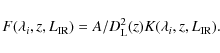
F(\lambda_i,z,L_{\rm IR}{})= A / D_{\rm L}^2(z)  K(\lambda_i,z,L_{\rm IR}{}).
\end{equation} -->

<TABLE WIDTH="100%" ALIGN="CENTER">
<TR VALIGN="MIDDLE"><TD ALIGN="CENTER" NOWRAP><IMG
 WIDTH="220" HEIGHT="53"
 SRC="img70.png"
 ALT="\begin{displaymath}F(\lambda_i,z,L_{\rm IR}{})= A / D_{\rm L}^2(z) K(\lambda_i,z,L_{\rm IR}{}).
\end{displaymath}"></td>
<TD WIDTH=10 ALIGN="RIGHT">
(A.2)</td></tr>
</TABLE>
</DIV><BR CLEAR="ALL"><p></p>
Here, 
<!-- MATH: $D_{\rm L}(z)$ -->
<IMG
 WIDTH="36" HEIGHT="26" ALIGN="MIDDLE" BORDER="0"
 SRC="img71.png"
 ALT="$D_{\rm L}(z)$">
is the luminosity distance for an object at redshift <I>z</I>with the standard cosmology used in this paper, <I>A</I> is the
solid angle corresponding to one square degree, and <I>K</I> corresponds to 
 the k-corrections:
<p></p>
<DIV ALIGN="CENTER">

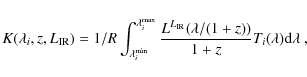
<!-- MATH: \begin{equation}
K(\lambda_i,z,L_{\rm IR}{})= 1/R
\int_{\lambda_i^{\rm min}}^{\lambda_i^{\rm max}}
\frac{L^{L_{\rm IR}{}} (\lambda/(1+z))}{1+z} T_i(\lambda)
  {\rm d}\lambda~,

\end{equation} -->

<TABLE WIDTH="100%" ALIGN="CENTER">
<TR VALIGN="MIDDLE"><TD ALIGN="CENTER" NOWRAP><IMG
 WIDTH="307" HEIGHT="77"
 SRC="img72.png"
 ALT="\begin{displaymath}K(\lambda_i,z,L_{\rm IR}{})= 1/R
\int_{\lambda_i^{\rm min}}^...
...rm IR}{}} (\lambda/(1+z))}{1+z} T_i(\lambda)
{\rm d}\lambda~,
\end{displaymath}"></td>
<TD WIDTH=10 ALIGN="RIGHT">
(A.3)</td></tr>
</TABLE>
</DIV><BR CLEAR="ALL"><p></p>
where 
<!-- MATH: $T_i(\lambda)$ -->
<IMG
 WIDTH="32" HEIGHT="26" ALIGN="MIDDLE" BORDER="0"
 SRC="img73.png"
 ALT="$T_i(\lambda)$">
is the
transmission curve for the filter centered on <IMG
 WIDTH="15" HEIGHT="26" ALIGN="MIDDLE" BORDER="0"
 SRC="img63.png"
 ALT="$\lambda_i$">,

<!-- MATH: $R=\int_{\lambda_i^{\rm min}}^{\lambda_i^{\rm max}}
T_i(\lambda)  {\rm d}\lambda$ -->
<IMG
 WIDTH="101" HEIGHT="38" ALIGN="MIDDLE" BORDER="0"
 SRC="img74.png"
 ALT="$R=\int_{\lambda_i^{\rm min}}^{\lambda_i^{\rm max}}
T_i(\lambda) {\rm d}\lambda$">,
and

<!-- MATH: $L^{L_{\rm IR}{}}(\lambda)$ -->
<IMG
 WIDTH="43" HEIGHT="30" ALIGN="MIDDLE" BORDER="0"
 SRC="img75.png"
 ALT="$L^{L_{\rm IR}{}}(\lambda)$">
is the underlying library of SEDs
(CE01) for which the SED  of a galaxy depends only on its
total luminosity 
<!-- MATH: $L_{\rm IR}$ -->
<IMG
 WIDTH="22" HEIGHT="26" ALIGN="MIDDLE" BORDER="0"
 SRC="img5.png"
 ALT="$L_{\rm IR}$">.

<p>
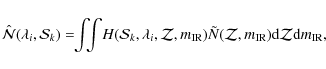
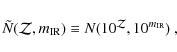
As mentioned in the main text, from the point of view of the conditioning of the inverse problem, it is preferable to reformulate  Eq.&nbsp;(<a href="/articles/aa/full_html/2009/36/aa09945-08/aa09945-08.html#e:defNN">A.1</a>)
in terms of 
<!-- MATH: $\mathcal{Z}\equiv \log_{10}(1+z)$ -->
<IMG
 WIDTH="97" HEIGHT="27" ALIGN="MIDDLE" BORDER="0"
 SRC="img76.png"
 ALT="$\mathcal{Z}\equiv \log_{10}(1+z)$">,

<!-- MATH: $\mathcal{S}\equiv \log_{10}(S)$ -->
<IMG
 WIDTH="77" HEIGHT="27" ALIGN="MIDDLE" BORDER="0"
 SRC="img77.png"
 ALT="$\mathcal{S}\equiv \log_{10}(S)$">
and 
<!-- MATH: $m_{\rm IR}\equiv\log_{10} L_{\rm IR}{}$ -->
<IMG
 WIDTH="89" HEIGHT="26" ALIGN="MIDDLE" BORDER="0"
 SRC="img78.png"
 ALT="$m_{\rm IR}\equiv\log_{10} L_{\rm IR}{}$">:
<p></p>
<DIV ALIGN="CENTER">

<!-- MATH: \begin{equation}
{\hat \mathcal{N}}(\lambda_i,\mathcal{S}_k) = \!\!\int\!\!\!\int\! H(\mathcal{S}_k,\lambda_i,\mathcal{Z},m_{\rm IR}){\tilde N}(\mathcal{Z},m_{\rm IR}){\rm d}{ \mathcal{Z}} {\rm d}{m_{\rm IR}},
\end{equation} -->

<TABLE WIDTH="100%" ALIGN="CENTER">
<TR VALIGN="MIDDLE"><TD ALIGN="CENTER" NOWRAP><A NAME="e:defNN2"></A><IMG
 WIDTH="326" HEIGHT="69"
 SRC="img79.png"
 ALT="\begin{displaymath}{\hat \mathcal{N}}(\lambda_i,\mathcal{S}_k) = \!\!\int\!\!\!\...
...thcal{Z},m_{\rm IR}){\rm d}{ \mathcal{Z}} {\rm d}{m_{\rm IR}},
\end{displaymath}"></td>
<TD WIDTH=10 ALIGN="RIGHT">
(A.4)</td></tr>
</TABLE>
</DIV><BR CLEAR="ALL"><p></p>
where the kernel of Eq.&nbsp;(<a href="/articles/aa/full_html/2009/36/aa09945-08/aa09945-08.html#e:defNN2">A.4</a>) reads
<p></p>
<DIV ALIGN="CENTER">
<!-- MATH: \begin{displaymath}
H(\mathcal{S},\lambda,\mathcal{Z},m_{\rm IR})\equiv 10^{2.5 \mathcal{S}+\mathcal{Z} +m_{\rm IR}}\delta_{\rm D}\!\left[S-F(\lambda,10^\mathcal{Z},10^{m_{\rm IR}})\right]
\end{displaymath} -->


<IMG
 WIDTH="344" HEIGHT="58"
 SRC="img80.png"
 ALT="\begin{displaymath}H(\mathcal{S},\lambda,\mathcal{Z},m_{\rm IR})\equiv 10^{2.5 \...
... D}\!\left[S-F(\lambda,10^\mathcal{Z},10^{m_{\rm IR}})\right]
\end{displaymath}">
</DIV><BR CLEAR="ALL">
<p></p>
with
<p></p>
<DIV ALIGN="CENTER">

<!-- MATH: \begin{equation}
{\tilde N}(\mathcal{Z},m_{\rm IR})\equiv  N(10^\mathcal{Z},10^{m_{\rm IR}})~,
\end{equation} -->

<TABLE WIDTH="100%" ALIGN="CENTER">
<TR VALIGN="MIDDLE"><TD ALIGN="CENTER" NOWRAP><IMG
 WIDTH="177" HEIGHT="52"
 SRC="img81.png"
 ALT="\begin{displaymath}{\tilde N}(\mathcal{Z},m_{\rm IR})\equiv N(10^\mathcal{Z},10^{m_{\rm IR}})~,
\end{displaymath}"></td>
<TD WIDTH=10 ALIGN="RIGHT">
(A.5)</td></tr>
</TABLE>
</DIV><BR CLEAR="ALL"><p></p><p></p>
<DIV ALIGN="CENTER">

<!-- MATH: \begin{equation}
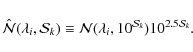
{\hat \mathcal{N}}(\lambda_i,\mathcal{S}_k)\equiv{\mathcal{N}}(\lambda_i,10^{\mathcal{S}_k}) 10^{2.5 \mathcal{S}_k}.
\end{equation} -->

<TABLE WIDTH="100%" ALIGN="CENTER">
<TR VALIGN="MIDDLE"><TD ALIGN="CENTER" NOWRAP><IMG
 WIDTH="193" HEIGHT="52"
 SRC="img82.png"
 ALT="\begin{displaymath}{\hat \mathcal{N}}(\lambda_i,\mathcal{S}_k)\equiv{\mathcal{N}}(\lambda_i,10^{\mathcal{S}_k}) 10^{2.5 \mathcal{S}_k}.
\end{displaymath}"></td>
<TD WIDTH=10 ALIGN="RIGHT">
(A.6)</td></tr>
</TABLE>
</DIV><BR CLEAR="ALL"><p></p>
Here we have introduced the Euclidian-normalized number count, 
<!-- MATH: ${\hat \mathcal{N}}$ -->
<IMG
 WIDTH="16" HEIGHT="32" ALIGN="MIDDLE" BORDER="0"
 SRC="img83.png"
 ALT="${\hat \mathcal{N}}$">,
by multiplying the number count by the expected <I>S</I><sup>2.5</sup> power
law.

<p>

<h3 class="sec2"><a name="SECTION000102000000000000000"></a>
A.2 Discretization
</h3>

<p>
Let us  project 
<!-- MATH: ${\tilde N}(\mathcal{Z},m_{\rm IR})$ -->
<IMG
 WIDTH="61" HEIGHT="30" ALIGN="MIDDLE" BORDER="0"
 SRC="img84.png"
 ALT="${\tilde N}(\mathcal{Z},m_{\rm IR})$">
onto a complete basis of 
<!-- MATH: $p \times q$ -->
<IMG
 WIDTH="34" HEIGHT="26" ALIGN="MIDDLE" BORDER="0"
 SRC="img85.png"
 ALT="$p \times q$">
functions
 <p></p>
<DIV ALIGN="CENTER">
<!-- MATH: \begin{displaymath}
\{e_k(\mathcal{Z})   e_l(m_{\rm IR})\}_{  j=1,\ldots,p   \  l=1,\ldots,q}~,
\end{displaymath} -->


<IMG
 WIDTH="174" HEIGHT="51"
 SRC="img86.png"
 ALT="\begin{displaymath}\{e_k(\mathcal{Z}) e_l(m_{\rm IR})\}_{ j=1,\ldots,p \ l=1,\ldots,q}~,\end{displaymath}">
</DIV><BR CLEAR="ALL">
<p></p>
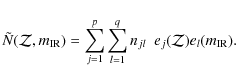
of  finite
(asymptotically  zero) support, which  are chosen here to be piecewise constant step functions:
<p></p>
<DIV ALIGN="CENTER">

<!-- MATH: \begin{equation}
{\tilde N}(\mathcal{Z},m_{\rm IR}) =  \sum_{j=1}^{p} \sum_{l=1}^{q}   n_{jl}  ~  ~ e_{j}(\mathcal{Z})
e_{l}(m_{\rm IR}).
\end{equation} -->

<TABLE WIDTH="100%" ALIGN="CENTER">
<TR VALIGN="MIDDLE"><TD ALIGN="CENTER" NOWRAP><A NAME="e:decomp"></A><IMG
 WIDTH="236" HEIGHT="83"
 SRC="img87.png"
 ALT="\begin{displaymath}{\tilde N}(\mathcal{Z},m_{\rm IR}) = \sum_{j=1}^{p} \sum_{l=1}^{q} n_{jl} ~ ~ e_{j}(\mathcal{Z})
e_{l}(m_{\rm IR}).
\end{displaymath}"></td>
<TD WIDTH=10 ALIGN="RIGHT">
(A.7)</td></tr>
</TABLE>
</DIV><BR CLEAR="ALL"><p></p>
<p>
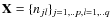
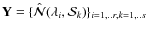
The parameters  to  fit  are  the  weights <I>n</I><SUB><I>jl</I></SUB>.
Calling&nbsp;
<!-- MATH: ${\mathbf{X}}=\{ n_{jl}\}_{j=1,..p,l=1,..q}$ -->
<IMG
 WIDTH="111" HEIGHT="26" ALIGN="MIDDLE" BORDER="0"
 SRC="img88.png"
 ALT="${\mathbf{X}}=\{ n_{jl}\}_{j=1,..p,l=1,..q}$">(the   <IMG
 WIDTH="34" HEIGHT="26" ALIGN="MIDDLE" BORDER="0"
 SRC="img85.png"
 ALT="$p \times q$">
parameters)  and&nbsp;
<!-- MATH: ${\mathbf{Y}}=\{ {\hat \mathcal{N}}(\lambda_i,\mathcal{S}_k)\}_{i=1,..r,k=1,..s}$ -->
<IMG
 WIDTH="148" HEIGHT="32" ALIGN="MIDDLE" BORDER="0"
 SRC="img89.png"
 ALT="${\mathbf{Y}}=\{ {\hat \mathcal{N}}(\lambda_i,\mathcal{S}_k)\}_{i=1,..r,k=1,..s}$">
(the  
<!-- MATH: $r \times s$ -->
<IMG
 WIDTH="30" HEIGHT="26" ALIGN="MIDDLE" BORDER="0"
 SRC="img90.png"
 ALT="$r \times s$">
measurements), Eq.&nbsp;(<a href="/articles/aa/full_html/2009/36/aa09945-08/aa09945-08.html#e:defNN2">A.4</a>) 
then becomes formally
<p></p>
<DIV ALIGN="CENTER">

<!-- MATH: \begin{equation}
{\mathbf{Y}}= {\mathbf{M}}\cdot {\mathbf{X}},
\end{equation} -->

<TABLE WIDTH="100%" ALIGN="CENTER">
<TR VALIGN="MIDDLE"><TD ALIGN="CENTER" NOWRAP><A NAME="e:yax"></A><IMG
 WIDTH="71" HEIGHT="48"
 SRC="img91.png"
 ALT="\begin{displaymath}{\mathbf{Y}}= {\mathbf{M}}\cdot {\mathbf{X}},
\end{displaymath}"></td>
<TD WIDTH=10 ALIGN="RIGHT">
(A.8)</td></tr>
</TABLE>
</DIV><BR CLEAR="ALL"><p></p>
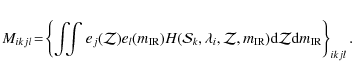
where 
<!-- MATH: ${\mathbf{M}}$ -->
<B>M</B> is a 
<!-- MATH: $(r,s)\times (p,q)$ -->
<IMG
 WIDTH="74" HEIGHT="26" ALIGN="MIDDLE" BORDER="0"
 SRC="img92.png"
 ALT="$(r,s)\times (p,q)$">
matrix with entries given by
<p></p>
<DIV ALIGN="CENTER">
<A NAME="e:eqnNP">&#160;</A><A NAME="e:eqnNP"></A><IMG
 WIDTH="352" HEIGHT="75"
 SRC="img93.png"
 ALT="\begin{eqnarray*}M_{i k j l}\! = \! \left\{ {\int \!\!\! {\int} ~ e_{j}(\mathcal...
...R}) {\rm d}{\mathcal{Z}}{\rm d}{m_{\rm IR}}}
\right\}_{i k j l}.
\end{eqnarray*}">
</DIV><p></p><BR CLEAR="ALL">
<p>

<h3 class="sec2"><a name="SECTION000103000000000000000"></a>
A.3 Penalties
</h3>

<p>
Assuming  that  the noise  in   
<!-- MATH: ${\hat \mathcal{N}}$ -->
<IMG
 WIDTH="16" HEIGHT="32" ALIGN="MIDDLE" BORDER="0"
 SRC="img83.png"
 ALT="${\hat \mathcal{N}}$">
can  be
approximated to be Normal, we can estimate the error between the measured
counts and the non-parametric  model by

<p></p>
<DIV ALIGN="CENTER">

<!-- MATH: \begin{equation}
{\mathit{L}}_{\mathit{}}({\mathbf{X}}) \equiv \chi^2({\mathbf{X}}) =
{({{\mathbf{Y}}} - {\mathbf{M}}\!\cdot\!{\mathbf{X}})}^\bot \!\cdot\!{\mathbf{W}}
		\!\cdot\!({{\mathbf{Y}}} - {\mathbf{M}}\!\cdot\!{\mathbf{X}}),
\end{equation} -->

<TABLE WIDTH="100%" ALIGN="CENTER">
<TR VALIGN="MIDDLE"><TD ALIGN="CENTER" NOWRAP><A NAME="e:Lquad"></A><IMG
 WIDTH="282" HEIGHT="52"
 SRC="img94.png"
 ALT="\begin{displaymath}{\mathit{L}}_{\mathit{}}({\mathbf{X}}) \equiv \chi^2({\mathbf...
...\!\cdot\!({{\mathbf{Y}}} - {\mathbf{M}}\!\cdot\!{\mathbf{X}}),
\end{displaymath}"></td>
<TD WIDTH=10 ALIGN="RIGHT">
(A.9)</td></tr>
</TABLE>
</DIV><BR CLEAR="ALL"><p></p>
where 
the weight  matrix 
<!-- MATH: ${\mathbf{W}}$ -->
<B>W</B> is  the inverse of  the covariance matrix  of the
data (which is diagonal for  uncorrelated noise with diagonal elements equal
to one over the data variance).
Since we are interested here in a non-parametric inversion,
the  decomposition in  Eq.&nbsp;(<a href="/articles/aa/full_html/2009/36/aa09945-08/aa09945-08.html#e:decomp">A.7</a>) typically  involves many  more parameters
than  constraints,  such that  each  parameter  controls  the shape  of  the
function, 
<!-- MATH: ${\tilde N}$ -->
<IMG
 WIDTH="14" HEIGHT="30" ALIGN="MIDDLE" BORDER="0"
 SRC="img95.png"
 ALT="${\tilde N}$">,
only   locally. 
As mentioned in the main text, some trade-off must therefore be found between the
level of  smoothness imposed  on the  solution in order  to deal  with  the 
artefacts induced by the ill-conditioning, on the one hand, and the level of fluctuations consistent with the
amount of  information in the  counts, on  the other hand. Between  two solutions yielding equivalent likelihood, the
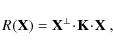
smoothest  is  chosen on the basis of the quadratic penalty:
<p></p>
<DIV ALIGN="CENTER">

<!-- MATH: \begin{equation}
{\mathit{R}}_{\mathit{}}({\mathbf{X}}) = {{{{\mathbf{X}}}}^{\bot}} \!\cdot\!{\mathbf{K}} \!\cdot\!{\mathbf{X}}~,
\end{equation} -->

<TABLE WIDTH="100%" ALIGN="CENTER">
<TR VALIGN="MIDDLE"><TD ALIGN="CENTER" NOWRAP><A NAME="e:Pquad"></A><IMG
 WIDTH="113" HEIGHT="50"
 SRC="img96.png"
 ALT="\begin{displaymath}{\mathit{R}}_{\mathit{}}({\mathbf{X}}) = {{{{\mathbf{X}}}}^{\bot}} \!\cdot\!{\mathbf{K}} \!\cdot\!{\mathbf{X}}~,
\end{displaymath}"></td>
<TD WIDTH=10 ALIGN="RIGHT">
(A.10)</td></tr>
</TABLE>
</DIV><BR CLEAR="ALL"><p></p>
where 
<!-- MATH: ${\mathbf{K}}$ -->
<B>K</B> is a positive definite matrix, which is chosen 
so that <I>R</I> in Eq.&nbsp;(<a href="/articles/aa/full_html/2009/36/aa09945-08/aa09945-08.html#e:Pquad">A.10</a>) should be non zero when 
<!-- MATH: ${\mathbf{X}}$ -->
<B>X</B> is strongly varying as a function
of its indices. In practice, we use a square Laplacian penalization D2
norm as defined by Eq.&nbsp;(30) of <a href="/articles/aa/full_html/2009/36/aa09945-08/aa09945-08.html#OcvPicLan06">Ocvirk et&nbsp;al. (2006b)</a>. Indeed, a Tikhonov
penalization does not explicitly enforce smoothness of the solution,
and a square gradient penalization favors flat solutions that are
unphysical in our problem.  

<p>
As mentioned in the main text, for a range of redshifts, a direct
measurement, 
<!-- MATH: $\mathbf{X}_0$ -->
<B>X</B><SUB>0</SUB>, which can be used as a prior for <IMG
 WIDTH="14" HEIGHT="30" ALIGN="MIDDLE" BORDER="0"
 SRC="img95.png"
 ALT="${\tilde N}$">,
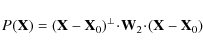
is available. We may therefore
 add as a supplementary constraint that
<p></p>
<DIV ALIGN="CENTER">

<!-- MATH: \begin{equation}
{\mathit{P}}_{\mathit{}}({\mathbf{X}}) =
{({{\mathbf{X}}} - {\mathbf{X}}_0)}^\bot \!\cdot\!{\mathbf{W}}_2
		\!\cdot\!({{\mathbf{X}}} -  {\mathbf{X}}_0)
\end{equation} -->

<TABLE WIDTH="100%" ALIGN="CENTER">
<TR VALIGN="MIDDLE"><TD ALIGN="CENTER" NOWRAP><A NAME="e:Lquad2"></A><IMG
 WIDTH="203" HEIGHT="50"
 SRC="img97.png"
 ALT="\begin{displaymath}{\mathit{P}}_{\mathit{}}({\mathbf{X}}) =
{({{\mathbf{X}}} -...
...ot\!{\mathbf{W}}_2
\!\cdot\!({{\mathbf{X}}} - {\mathbf{X}}_0)
\end{displaymath}"></td>
<TD WIDTH=10 ALIGN="RIGHT">
(A.11)</td></tr>
</TABLE>
</DIV><BR CLEAR="ALL"><p></p>
should remain small,
where 
the weight  matrix, 
<!-- MATH: ${\mathbf{W}}_2$ -->
<B>W</B><SUB>2</SUB>, is  the inverse of  the covariance matrix  of the
prior, 
<!-- MATH: ${\mathbf{X}}_0$ -->
<B>X</B><SUB>0</SUB>, and should be non zero over the appropriate redshift range.
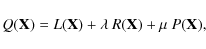
In  short,  the penalized non-parametric  solution 
 of  Eq.&nbsp;(<a href="/articles/aa/full_html/2009/36/aa09945-08/aa09945-08.html#e:yax">A.8</a>)  accounting for both penalties  is found  by
minimizing the so-called objective function
<p></p>
<DIV ALIGN="CENTER">

<!-- MATH: \begin{equation}
Q({\mathbf{X}})=L({\mathbf{X}})+\lambda~R({\mathbf{X}})+\mu~P({\mathbf{X}}),
\end{equation} -->

<TABLE WIDTH="100%" ALIGN="CENTER">
<TR VALIGN="MIDDLE"><TD ALIGN="CENTER" NOWRAP><A NAME="e:objectif"></A><IMG
 WIDTH="206" HEIGHT="49"
 SRC="img98.png"
 ALT="\begin{displaymath}Q({\mathbf{X}})=L({\mathbf{X}})+\lambda~R({\mathbf{X}})+\mu~P({\mathbf{X}}),
\end{displaymath}"></td>
<TD WIDTH=10 ALIGN="RIGHT">
(A.12)</td></tr>
</TABLE>
</DIV><BR CLEAR="ALL"><p></p>
where 
<!-- MATH: $L({\mathbf{X}})$ -->
<I>L</I>(<B>X</B>), 
<!-- MATH: $R({\mathbf{X}})$ -->
<I>R</I>(<B>X</B>), and 
<!-- MATH: $P({\mathbf{X}})$ -->
<I>P</I>(<B>X</B>) are the  likelihood and  regularization terms given  by Eqs.&nbsp;(<a href="/articles/aa/full_html/2009/36/aa09945-08/aa09945-08.html#e:Lquad">A.9</a>)-&nbsp;(<a href="/articles/aa/full_html/2009/36/aa09945-08/aa09945-08.html#e:Lquad2">A.11</a>),
respectively.
The  Lagrange  multipliers  
<!-- MATH: $\lambda, \mu\geq0$ -->
<IMG
 WIDTH="48" HEIGHT="26" ALIGN="MIDDLE" BORDER="0"
 SRC="img99.png"
 ALT="$\lambda, \mu\geq0$">
allow  us  to  tune  the  level  of
smoothness of the solution (in practice, we set 
<!-- MATH: $\lambda=0.02$ -->
<IMG
 WIDTH="51" HEIGHT="26" ALIGN="MIDDLE" BORDER="0"
 SRC="img100.png"
 ALT="$\lambda=0.02$">
for the reasons given below) and the requirement that 
<!-- MATH: ${\mathbf{X}}$ -->
<B>X</B> should remain close to its prior 
for the range of redshifts for which data is available.  
The introduction  of the  Lagrange multipliers  is
formally justified by our wanting to minimize  the objective function 

<!-- MATH: $Q({\mathbf{X}})$ -->
<I>Q</I>(<B>X</B>), subject
to   the    constraint   that   
<!-- MATH: $L({\mathbf{X}})$ -->
<I>L</I>(<B>X</B>) and 
<!-- MATH: $P({\mathbf{X}})$ -->
<I>P</I>(<B>X</B>) should   fall  in   the   range

<!-- MATH: $N_{\mathit{\rm data}}\pm\sqrt{2~N_{\mathit{\rm data}}}$ -->
<IMG
 WIDTH="95" HEIGHT="31" ALIGN="MIDDLE" BORDER="0"
 SRC="img101.png"
 ALT="$N_{\mathit{\rm data}}\pm\sqrt{2~N_{\mathit{\rm data}}}$">
and

<!-- MATH: $N_{\mathit{\rm param}}\pm\sqrt{2~N_{\mathit{\rm param}}}$ -->
<IMG
 WIDTH="111" HEIGHT="32" ALIGN="MIDDLE" BORDER="0"
 SRC="img102.png"
 ALT="$N_{\mathit{\rm param}}\pm\sqrt{2~N_{\mathit{\rm param}}}$">,
respectively.

<p>
The minimum of the objective function, 
<!-- MATH: $Q({\mathbf{X}})$ -->
<I>Q</I>(<B>X</B>),  given by Eq.&nbsp;(<a href="/articles/aa/full_html/2009/36/aa09945-08/aa09945-08.html#e:objectif">A.12</a>)
  reads formally as
<p></p>
<DIV ALIGN="CENTER">
<A NAME="e:Q-quad-solution">&#160;</A><A NAME="e:Q-quad-solution"></A><IMG
 WIDTH="353" HEIGHT="59"
 SRC="img103.png"
 ALT="\begin{eqnarray*}\hat {\mathbf{X}} = ({{{{\mathbf{M}}}}^{\bot}} \!\cdot\!{\mathb...
...{\mathbf{Y}}\!+\mu {\mathbf{W}}_2\!\cdot\!{\mathbf{X}}_0\right).
\end{eqnarray*}">
</DIV><p></p><BR CLEAR="ALL">This equation clearly shows that the solution tends towards 
<!-- MATH: ${\mathbf{X}}_0$ -->
<B>X</B><SUB>0</SUB>when 
<!-- MATH: $\mu \rightarrow \infty$ -->
<IMG
 WIDTH="43" HEIGHT="26" ALIGN="MIDDLE" BORDER="0"
 SRC="img104.png"
 ALT="$\mu \rightarrow \infty$">,
while the smoothing Lagrange  multiplier, <IMG
 WIDTH="11" HEIGHT="26" ALIGN="MIDDLE" BORDER="0"
 SRC="img1.png"
 ALT="$\lambda $">,
damps counterparts of  the components of 
<!-- MATH: ${\mathbf{Y}}$ -->
<B>Y</B> corresponding to the
higher singular vectors of 
<!-- MATH: ${\mathbf{M}}$ -->
<B>M</B> (<a href="/articles/aa/full_html/2009/36/aa09945-08/aa09945-08.html#OcvPicLan06">Ocvirk et&nbsp;al.  2006b</a>). 
When  dealing with  noisy datasets,  the non-parametric  inversion technique
may  produce negative  coefficients  for 
the  reconstructed luminosity  function.  To  avoid  such effects,
positivity is imposed  on those coefficients <I>n</I><SUB><I>jl</I></SUB> in Eq.&nbsp;(<a href="/articles/aa/full_html/2009/36/aa09945-08/aa09945-08.html#e:decomp">A.7</a>),
see for instance <a href="/articles/aa/full_html/2009/36/aa09945-08/aa09945-08.html#OcvPicLan06">Ocvirk et&nbsp;al. (2006b)</a> or <a href="/articles/aa/full_html/2009/36/aa09945-08/aa09945-08.html#PicSieBie02">Pichon et&nbsp;al. (2002)</a>. In practice, the minimum of the objective 
function is found iteratively, using <TT>optimpack</TT> (<a href="/articles/aa/full_html/2009/36/aa09945-08/aa09945-08.html#Thi05">Thi&#233;baut  2005</a>).
The relative weight on the likelihood and the two penalties is chosen
so that the three quantities have a comparable contribution
to the total likelihood after convergence. This corresponds to a
reasonably smooth variation in the LF both in redshift and 
<!-- MATH: $L_{\rm IR}$ -->
<IMG
 WIDTH="22" HEIGHT="26" ALIGN="MIDDLE" BORDER="0"
 SRC="img5.png"
 ALT="$L_{\rm IR}$">,
and
imposes a solution that is always within 1<IMG
 WIDTH="13" HEIGHT="26" ALIGN="MIDDLE" BORDER="0"
 SRC="img3.png"
 ALT="$\sigma $">
of the observed
low-redshift LF, 
<!-- MATH: ${\mathbf{X}}_0$ -->
<B>X</B><SUB>0</SUB>, when <IMG
 WIDTH="10" HEIGHT="26" ALIGN="MIDDLE" BORDER="0"
 SRC="img2.png"
 ALT="$\mu $">
is not set to zero in Eq.&nbsp;(<a href="/articles/aa/full_html/2009/36/aa09945-08/aa09945-08.html#e:objectif">A.12</a>).

<p>

<h2 class="sec"><a name="SECTION000110000000000000000"></a>
<A NAME="section:robustness"></A>
Appendix B: Test of robustness
</h2>


To quantify the confidence level of the inversion technique,
we test its robustness.  Starting from an arbitrary LF, we produce IR
counts in the bands and flux ranges corresponding to the observations
from this LF. Then, we add some random Gaussian noise to the simulated
counts, using the real uncertainty on the observations as the <IMG
 WIDTH="13" HEIGHT="26" ALIGN="MIDDLE" BORDER="0"
 SRC="img3.png"
 ALT="$\sigma $">of the error distribution for each flux bin. Finally, we apply the
inversion technique described in Sect. 2.1 to these noisy counts and
obtain an output LF.

<p>
The comparison of the input and output LFs is shown in
Fig.&nbsp;<a href="/articles/aa/full_html/2009/36/aa09945-08/aa09945-08.html#figure:lfcomp">B.1</a>. The error on the absolute difference in

<!-- MATH: $\log_{10} LF_{\rm in} - \log_{10} LF_{\rm out}$ -->
<IMG
 WIDTH="136" HEIGHT="26" ALIGN="MIDDLE" BORDER="0"
 SRC="img105.png"
 ALT="$\log_{10} LF_{\rm in} - \log_{10} LF_{\rm out}$">
is represented in
gray levels and contours. The difference is generally less than
0.4&nbsp;dex (factor 2.5) in the range where the LF can be constrained from
the observed counts (range of the <I>z</I>-<I>L</I> plane encompassed by the
dashed lines). A noticeable exception is the very low-redshift range
(<I>z</I>&lt;0.1), which corresponds to bright sources. For such large fluxes,
the considerable noise in the observed counts produces large errors on
the recovered LF. At high redshift, recall that the ultra-luminous
population of galaxies appears as rare and very bright objects, in a
flux range where the number counts are poorly known.

<p>

<div class="inset-old">
<table>
<tr><td><!-- init Label --><A NAME="figure:lfcomp">&#160;</A><!-- end Label--><A NAME="2148"></A><A NAME="figure1880"
 HREF="img106.png"><IMG
 WIDTH="101" HEIGHT="103" SRC="Timg106.png"
 ALT="\begin{figure}
\par\includegraphics[width=9cm,clip]{09945f11.ps}
\end{figure}"></A><!-- HTML Figure number: 11 --></td>
<td class="img-txt"><span class="bold">Figure B.1:</span><p>
Estimated robustness of the LF inversion used in
   this paper. The relative
  difference between the input LF and the recovered LF
  (when a realistic noise is added to the corresponding input counts)  is larger for
  darker parts of the diagram. This difference is relatively small (&lt;0.4&nbsp;dex) 
  in the region
  of the <I>z</I>-<I>L</I> space effectively constrained by observations: the dotted
  and dashed lines correspond to the extreme fluxes considered at 24&nbsp;<IMG
 WIDTH="10" HEIGHT="26" ALIGN="MIDDLE" BORDER="0"
 SRC="img2.png"
 ALT="$\mu $">m
  and 850&nbsp;<IMG
 WIDTH="10" HEIGHT="26" ALIGN="MIDDLE" BORDER="0"
 SRC="img2.png"
 ALT="$\mu $">m, respectively, for this study. See main text for details.</p></td>
</tr><tr><td colspan="2"><a href="http://dexter.edpsciences.org/applet.php?pdf_id=11&DOI=10.1051/0004-6361/200809945" target="DEXTER">Open with DEXTER</a></td></tr>

</table></div>
<p>

<h2 class="sec"><a name="SECTION000120000000000000000"></a> 
<A NAME="section:predictions"></A>
Appendix C: Model predictions for Herschel
</h2>


In Sect.&nbsp;<a href="/articles/aa/full_html/2009/36/aa09945-08/aa09945-08.html#section:results">4</a>, we have inverted the known IR counts to
obtain constraints on the evolving total IR LF. We have seen that the
LF obtained through this inversion is realistic and matches most of
the recent observations (counts, CIRB, Mid-IR LF at low redshift). 
Then, in Sect.&nbsp;<a href="/articles/aa/full_html/2009/36/aa09945-08/aa09945-08.html#section:lfir">5.2</a>, we have shown how we can measure
directly a part of this LF with a good confidence and 
that the LF resulting from the inversion is in good agreement with
this solid measurement, validating the LF obtained by this empirical
modeling approach. In this section, we use the median LF obtained from
the inversions to predict some counts which should be observed with
future observations in the  FIR with Herschel or SCUBA2.

<p>
At the time of publication, several new facilities
are in preparation to observe the Universe in the far-IR to sub-mm
regimes. The differential counts (normalized to Euclidean) at
wavelengths ranging from 16 to 850&nbsp;<IMG
 WIDTH="10" HEIGHT="26" ALIGN="MIDDLE" BORDER="0"
 SRC="img2.png"
 ALT="$\mu $">m, which we derived from the
inversion technique, are presented in Fig.&nbsp;<a href="/articles/aa/full_html/2009/36/aa09945-08/aa09945-08.html#figure:zdists_herschel">C.3</a>. The
separation of the contribution of local, intermediate, and distant
galaxies in different colors illustrates the expected trend that
larger wavelengths are sensitive to higher redshifts, hence the relative
complementarity of all IR wavelengths. There will be a bias towards
more luminous and distant objects with increasing wavelength,
illustrated here for the Herschel passbands (see
Fig.&nbsp;<a href="/articles/aa/full_html/2009/36/aa09945-08/aa09945-08.html#figure:H2">C.4</a>), but this may be used to pre-select the most
distant candidates expected to be detected only at the largest
wavelengths. In the following, we discuss the predictions of the
inversion technique for those instruments, as well as their respective
confusion limits, which is the main limitation of far-IR extragalactic
surveys.

<p>
The ESA satellite Herschel is scheduled to be launched within the next
year, while the next-generation IR astronomical satellite of the
Japanese space agency, SPICA, is scheduled for 2010, with a
contribution by ESA under discussion, including a mid-IR imager named
SAFARI.  Both telescopes share the same diameter of 3.5&nbsp;m, but
the lower telescope temperature of SPICA, combined with projected
competitive sensitivities, will make it possible to reach confusion
around 70&nbsp;<IMG
 WIDTH="10" HEIGHT="26" ALIGN="MIDDLE" BORDER="0"
 SRC="img2.png"
 ALT="$\mu $">m (where Herschel is limited by integration time). The
5<IMG
 WIDTH="13" HEIGHT="26" ALIGN="MIDDLE" BORDER="0"
 SRC="img3.png"
 ALT="$\sigma $">-1hour limits of the instruments SAFARI onboard SPICA
(50&nbsp;<IMG
 WIDTH="10" HEIGHT="26" ALIGN="MIDDLE" BORDER="0"
 SRC="img2.png"
 ALT="$\mu $">Jy, 33-210&nbsp;<IMG
 WIDTH="10" HEIGHT="26" ALIGN="MIDDLE" BORDER="0"
 SRC="img2.png"
 ALT="$\mu $">m, dashed line), PACS (3mJy,
55-210&nbsp;<IMG
 WIDTH="10" HEIGHT="26" ALIGN="MIDDLE" BORDER="0"
 SRC="img2.png"
 ALT="$\mu $">m, light blue line) and SPIRE (2 mJy, 200-670&nbsp;<IMG
 WIDTH="10" HEIGHT="26" ALIGN="MIDDLE" BORDER="0"
 SRC="img2.png"
 ALT="$\mu $">m,
blue line) onboard Herschel are compared in Fig.&nbsp;<a href="/articles/aa/full_html/2009/36/aa09945-08/aa09945-08.html#figure:conf_limit">C.1</a>
to the confusion limits that we derive from the best-fit model of the
inversion, at all wavelengths between 30 and 850&nbsp;<IMG
 WIDTH="10" HEIGHT="26" ALIGN="MIDDLE" BORDER="0"
 SRC="img2.png"
 ALT="$\mu $">m, assuming the
the confusion limit definition given below.

<p>

<div class="inset-old">
<table>
<tr><td><!-- init Label --><A NAME="figure:conf_limit">&#160;</A><!-- end Label--><A NAME="2149"></A><A NAME="figure1895"
 HREF="img107.png"><IMG
 WIDTH="99" HEIGHT="68" SRC="Timg107.png"
 ALT="\begin{figure}
\par\includegraphics[width=9cm,clip]{09945f12.ps}
\end{figure}"></A><!-- HTML Figure number: 12 --></td>
<td class="img-txt"><span class="bold">Figure C.1:</span><p>
Confusion limit for a 3.5&nbsp;m telescope. The
    5<IMG
 WIDTH="13" HEIGHT="26" ALIGN="MIDDLE" BORDER="0"
 SRC="img3.png"
 ALT="$\sigma $">-1&nbsp;h limits of SPICA-SAFARI (50&nbsp;<IMG
 WIDTH="10" HEIGHT="26" ALIGN="MIDDLE" BORDER="0"
 SRC="img2.png"
 ALT="$\mu $">Jy,
    33-210&nbsp;<IMG
 WIDTH="10" HEIGHT="26" ALIGN="MIDDLE" BORDER="0"
 SRC="img2.png"
 ALT="$\mu $">m, dashed line), Herschel PACS (3&nbsp;mJy, 55-210&nbsp;<IMG
 WIDTH="10" HEIGHT="26" ALIGN="MIDDLE" BORDER="0"
 SRC="img2.png"
 ALT="$\mu $">m,
    light blue line) and SPIRE (2&nbsp;mJy, 200-670&nbsp;<IMG
 WIDTH="10" HEIGHT="26" ALIGN="MIDDLE" BORDER="0"
 SRC="img2.png"
 ALT="$\mu $">m, blue line) are
    shown together with their wavelength ranges. The blue part of the
    curve is determined by the source density criterion (i.e. the
    requirement to have less than 30% of the sources closer than
    0.8&nbsp;<IMG
 WIDTH="13" HEIGHT="26" ALIGN="MIDDLE" BORDER="0"
 SRC="img7.png"
 ALT="$\times $">&nbsp;<I>FWHM</I>), the red part is defined by the photometric
    criterion, i.e. sources must be brighter than 5 times the rms due
    to very faint sources below the detection limit.</p></td>
</tr><tr><td colspan="2"><a href="http://dexter.edpsciences.org/applet.php?pdf_id=12&DOI=10.1051/0004-6361/200809945" target="DEXTER">Open with DEXTER</a></td></tr>

</table></div>
<p>
The definition of the confusion limit is not trivial, in particular
because it depends on the level of clustering of galaxies; the
optimum way to define it would be to perform simulations to compute
the photometric error as a function of flux density, and then decide
that the confusion limit is e.g. the depth above which 68% of the
detected sources are measured with a photometric accuracy better than
20%. In the following, we only consider a simpler approach that
involves computing the two sources of confusion that were discussed
in <A NAME="aaref14"></A><a href="/articles/aa/full_html/2009/36/aa09945-08/aa09945-08.html#DolLagPug03">Dole et&nbsp;al. (2003)</a>: 
<UL>
<LI>the photometric confusion noise: the noise produced by sources
fainter than the detection threshold. The photometric criterion corresponds 
to the requirement that sources are detected with an
<I>S</I>/<I>N</I>(photometric)&nbsp;&gt;&nbsp;5;
<LI>the fraction of blended sources: a requirement for the quality of
  the catalog of sources will be that less than <I>N</I>&nbsp;% of the sources
  are closer than 0.8&nbsp;<IMG
 WIDTH="13" HEIGHT="26" ALIGN="MIDDLE" BORDER="0"
 SRC="img7.png"
 ALT="$\times $">&nbsp;<I>FWHM</I>, i.e. close enough to not be
  separated. 
</UL>We tested various levels for <I>N</I> and found that <I>N</I>=30% was
equivalent to the above requirement that 68% of the detected
sources are measured with a photometric accuracy better than 20%
using realistic simulations in the far IR for Herschel. We therefore use the value  <I>N</I>=30%. The confusion limit is then
<I>defined</I> as the flux density above which both criteria are
respected. As a result, it is found that the main limitation is the
fraction of blended sources at 
<!-- MATH: $\lambda=50{-}105$ -->
<IMG
 WIDTH="72" HEIGHT="26" ALIGN="MIDDLE" BORDER="0"
 SRC="img109.png"
 ALT="$\lambda=50{-}105$">&nbsp;<IMG
 WIDTH="10" HEIGHT="26" ALIGN="MIDDLE" BORDER="0"
 SRC="img2.png"
 ALT="$\mu $">m (blue part of
the curve in Fig.&nbsp;<a href="/articles/aa/full_html/2009/36/aa09945-08/aa09945-08.html#figure:conf_limit">C.1</a>) and the photometric confusion
noise below and above this range, i.e. at 
<!-- MATH: $\lambda= 33{-}50$ -->
<IMG
 WIDTH="64" HEIGHT="26" ALIGN="MIDDLE" BORDER="0"
 SRC="img110.png"
 ALT="$\lambda= 33{-}50$">
and

<!-- MATH: $\lambda=105{-}210$ -->
<IMG
 WIDTH="79" HEIGHT="26" ALIGN="MIDDLE" BORDER="0"
 SRC="img111.png"
 ALT="$\lambda=105{-}210$">&nbsp;<IMG
 WIDTH="10" HEIGHT="26" ALIGN="MIDDLE" BORDER="0"
 SRC="img2.png"
 ALT="$\mu $">m (red parts of curve in
Fig.&nbsp;<a href="/articles/aa/full_html/2009/36/aa09945-08/aa09945-08.html#figure:conf_limit">C.1</a>). As a result of their smaller beam, shorter
IR wavelength are more efficient at detecting faint star-forming
galaxies than longer ones (see Fig.&nbsp;<a href="/articles/aa/full_html/2009/36/aa09945-08/aa09945-08.html#figure:Lirz">C.2</a>). This is at the
expense of observing farther away from the peak of the far IR
emission, which implies larger uncertainties on the derivation of the
total IR luminosity due to the uncertain dust temperature.

<p>
<div class="inset-old">
<table>
<tr><td><!-- init Label --><A NAME="figure:Lirz">&#160;</A><!-- end Label--><A NAME="2150"></A><A NAME="figure1912"
 HREF="img112.png"><IMG
 WIDTH="96" HEIGHT="66" SRC="Timg112.png"
 ALT="\begin{figure}
\par\includegraphics[width=8.7cm,clip]{09945f13.ps}
\end{figure}"></A><!-- HTML Figure number: 13 --></td>
<td class="img-txt"><span class="bold">Figure C.2:</span><p>
Detection limits for confusion limited surveys from 70 to
    850&nbsp;<IMG
 WIDTH="10" HEIGHT="26" ALIGN="MIDDLE" BORDER="0"
 SRC="img2.png"
 ALT="$\mu $">m. The curves show the minimum IR luminosity
    (8-1000&nbsp;<IMG
 WIDTH="10" HEIGHT="26" ALIGN="MIDDLE" BORDER="0"
 SRC="img2.png"
 ALT="$\mu $">m), or equivalently SFR (=
<!-- MATH: $L_{\rm
IR}\times1.72 \times 10^{-10}$ -->
<IMG
 WIDTH="107" HEIGHT="30" ALIGN="MIDDLE" BORDER="0"
 SRC="img8.png"
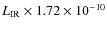
 ALT="$L_{\rm IR}\times 1.72 \times 10^{-10}$">), that can be detected for a star-forming
    galaxy assuming that it has an SED similar to the Chary &amp; Elbaz
    (2001) ones. The 70, 100, 160, 250, 350 and 500&nbsp;<IMG
 WIDTH="10" HEIGHT="26" ALIGN="MIDDLE" BORDER="0"
 SRC="img2.png"
 ALT="$\mu $">m limits
    correspond to a 3.5&nbsp;m telescope diameter, such as Herschel or
    SPICA, while the 400&nbsp;<IMG
 WIDTH="10" HEIGHT="26" ALIGN="MIDDLE" BORDER="0"
 SRC="img2.png"
 ALT="$\mu $">m is for a 12 m class telescope such as
    APEX (e.g. ARTEMIS, we show the average between the two bands at
    350 or 450&nbsp;<IMG
 WIDTH="10" HEIGHT="26" ALIGN="MIDDLE" BORDER="0"
 SRC="img2.png"
 ALT="$\mu $">m to avoid confusion with Herschel) and the
    850&nbsp;<IMG
 WIDTH="10" HEIGHT="26" ALIGN="MIDDLE" BORDER="0"
 SRC="img2.png"
 ALT="$\mu $">m is for a 15&nbsp;m telescope as the JCMT (SCUBA).</p></td>
</tr><tr><td colspan="2"><a href="http://dexter.edpsciences.org/applet.php?pdf_id=13&DOI=10.1051/0004-6361/200809945" target="DEXTER">Open with DEXTER</a></td></tr>

</table></div>
<p>
<A NAME="table:cirb"></A><p class="inset-old"><a href="/articles/aa/full_html/2009/36/aa09945-08/tableC.1.html"><span class="bold">Table C.1:</span></a>&#160;&#160;
Fraction of the CIRB resolved by confusion-limited Herschel
  surveys.</p>We note that the confusion limit for a 3.5&nbsp;m-class telescope, such as
Herschel, is ten times more than the depth it can reach in one hour
(5<IMG
 WIDTH="13" HEIGHT="26" ALIGN="MIDDLE" BORDER="0"
 SRC="img3.png"
 ALT="$\sigma $">). With a source density of 12.8 sources per square degree
at the 500&nbsp;<IMG
 WIDTH="10" HEIGHT="26" ALIGN="MIDDLE" BORDER="0"
 SRC="img2.png"
 ALT="$\mu $">m confusion limit (25 mJy), or equivalently one
source in a field of 17 arcmin on a side, this shows that the best
strategy at this wavelength is to go for very large and moderately
shallow surveys, in order to identify the rare and very luminous distant
galaxies.

<p>
<div class="inset-old">
<table>
<tr><td><!-- init Label --><A NAME="figure:zdists_herschel">&#160;</A><!-- end Label--><A NAME="2153"></A><A NAME="figure1937"
 HREF="img115.png"><IMG
 WIDTH="185" HEIGHT="187" SRC="Timg115.png"
 ALT="\begin{figure}
\par\includegraphics[width=16.5cm,clip]{09945f14.ps}
\end{figure}"></A><!-- HTML Figure number: 14 --></td>
<td class="img-txt"><span class="bold">Figure C.3:</span><p>
Counts predicted  from the inversion in the far-infrared and sub-mm (solid line). The counts are
    decomposed in redshift bins (blue&nbsp;=&nbsp;<I>z</I>&lt;0.5; green&nbsp;=&nbsp;0.5&lt;<I>z</I>&lt;1.5;
    orange&nbsp;=&nbsp;1.5&lt;<I>z</I>&lt;2.5; red&nbsp;=&nbsp;<I>z</I>&gt;2.5). The oblique dashed line corresponds to
    the limit in statistics due to the smallness of a field like GOODS
    North+South or 0.07 square degrees: less than 2&nbsp;galaxies per
    flux bin of width 
<!-- MATH: $\delta \log F=0.1$ -->
<IMG
 WIDTH="76" HEIGHT="26" ALIGN="MIDDLE" BORDER="0"
 SRC="img50.png"
 ALT="$\delta \log F=0.1$">&nbsp;dex are expected below
    this limit.</p></td>
</tr><tr><td colspan="2"><a href="http://dexter.edpsciences.org/applet.php?pdf_id=14&DOI=10.1051/0004-6361/200809945" target="DEXTER">Open with DEXTER</a></td></tr>

</table></div>
<p>
<div class="inset-old">
<table>
<tr><td><!-- init Label --><A NAME="figure:H2">&#160;</A><!-- end Label--><A NAME="2154"></A><A NAME="figure1942"
 HREF="img116.png"><IMG
 WIDTH="185" HEIGHT="186" SRC="Timg116.png"
 ALT="\begin{figure}
\par\includegraphics[width=16.6cm,clip]{09945f15.ps}
\end{figure}"></A><!-- HTML Figure number: 15 --></td>
<td class="img-txt"><span class="bold">Figure C.4:</span><p>
Differential counts predicted from the non-parametric
    inversion for future Herschel observations: PACS 100&nbsp;<IMG
 WIDTH="10" HEIGHT="26" ALIGN="MIDDLE" BORDER="0"
 SRC="img2.png"
 ALT="$\mu $">m (solid
    black), SPIRE 250&nbsp;<IMG
 WIDTH="10" HEIGHT="26" ALIGN="MIDDLE" BORDER="0"
 SRC="img2.png"
 ALT="$\mu $">m (dotted blue),
    SPIRE 350&nbsp;<IMG
 WIDTH="10" HEIGHT="26" ALIGN="MIDDLE" BORDER="0"
 SRC="img2.png"
 ALT="$\mu $">m (dashed green), SPIRE 500&nbsp;<IMG
 WIDTH="10" HEIGHT="26" ALIGN="MIDDLE" BORDER="0"
 SRC="img2.png"
 ALT="$\mu $">m (dot-dashed red) decomposed simultaneously in
    redshift and 
<!-- MATH: $L_{\rm IR}$ -->
<IMG
 WIDTH="22" HEIGHT="26" ALIGN="MIDDLE" BORDER="0"
 SRC="img5.png"
 ALT="$L_{\rm IR}$">.</p></td>
</tr><tr><td colspan="2"><a href="http://dexter.edpsciences.org/applet.php?pdf_id=15&DOI=10.1051/0004-6361/200809945" target="DEXTER">Open with DEXTER</a></td></tr>

</table></div>
<p>
For comparison, we also illustrated the ground-based capacity of
ARTEMIS built by CEA-Saclay which will operate at the ESO 12
m-telescope facility APEX (Atacama Pathfinder EXperiment) at 200, 350
and 450&nbsp;<IMG
 WIDTH="10" HEIGHT="26" ALIGN="MIDDLE" BORDER="0"
 SRC="img2.png"
 ALT="$\mu $">m and SCUBA-2 that will operate at the 15 m telescope
JCMT at 450 and 850&nbsp;<IMG
 WIDTH="10" HEIGHT="26" ALIGN="MIDDLE" BORDER="0"
 SRC="img2.png"
 ALT="$\mu $">m. To avoid confusion between all
instruments, we only show the average wavelength 400&nbsp;<IMG
 WIDTH="10" HEIGHT="26" ALIGN="MIDDLE" BORDER="0"
 SRC="img2.png"
 ALT="$\mu $">m for a 12
m-class telescope and 850&nbsp;<IMG
 WIDTH="10" HEIGHT="26" ALIGN="MIDDLE" BORDER="0"
 SRC="img2.png"
 ALT="$\mu $">m for a 15 m-class telescope
(Fig.&nbsp;<a href="/articles/aa/full_html/2009/36/aa09945-08/aa09945-08.html#figure:conf_limit">C.1</a>). Although the confusion limit in the
850&nbsp;<IMG
 WIDTH="10" HEIGHT="26" ALIGN="MIDDLE" BORDER="0"
 SRC="img2.png"
 ALT="$\mu $">m passband is ten times below that of Herschel at the
longest wavelengths, this band is not competitive with the
<IMG
 WIDTH="13" HEIGHT="14" ALIGN="BOTTOM" BORDER="0"
 SRC="img117.png"
 ALT="$\sim$">400&nbsp;<IMG
 WIDTH="10" HEIGHT="26" ALIGN="MIDDLE" BORDER="0"
 SRC="img2.png"
 ALT="$\mu $">m one, which should be priorities for ARTEMIS and
SCUBA-2 for the study of distant galaxies, or with the 70 and
100&nbsp;<IMG
 WIDTH="10" HEIGHT="26" ALIGN="MIDDLE" BORDER="0"
 SRC="img2.png"
 ALT="$\mu $">m ones for a 3.5 m space experiment such as SPICA and
Herschel, for redshifts below <IMG
 WIDTH="32" HEIGHT="26" ALIGN="MIDDLE" BORDER="0"
 SRC="img118.png"
 ALT="$z\sim5$">.
We also note that only in
these two passbands will the cosmic IR background be resolved with
these future experiments (see Table&nbsp;<a href="/articles/aa/full_html/2009/36/aa09945-08/aa09945-08.html#table:cirb">C.1</a>), which suggests
that a larger telescope size should be considered for a future
experiment to observe the far IR Universe above 100&nbsp;<IMG
 WIDTH="10" HEIGHT="26" ALIGN="MIDDLE" BORDER="0"
 SRC="img2.png"
 ALT="$\mu $">m and below
the wavelength domain of ALMA. We did not mention here ALMA since it
will not be affected by these confusion issue:  due to its very
good spatial resolution, it will be limited to either small ultradeep
survey, hence missing rare objects or follow-ups of fields observed
with single dish instruments, e.g. ARTEMIS. Finally, the JWST that
will operate in the mid IR will be a very powerful instrument for probing
the faintest star-forming galaxies in the distant Universe, but
predictions are difficult to produce at the present stage since it has
already been found that extrapolations from the mid to far IR become less
robust already at <IMG
 WIDTH="33" HEIGHT="26" ALIGN="MIDDLE" BORDER="0"
 SRC="img119.png"
 ALT="$z\sim 2$">
(e.g. <A NAME="tex2html65"
 HREF="#PapRudLeF07">Papovich et&nbsp;al.  2007</A>; <A NAME="tex2html66"
 HREF="#PopChaAle08">Pope et&nbsp;al.  2008</A>; <A NAME="tex2html67"
 HREF="#DadDicMor07">Daddi et&nbsp;al.  2007b</A>).

<p>
<br>

</div></body></html>