<!DOCTYPE html PUBLIC "-//W3C//DTD XHTML 1.0 Transitional//EN">
<html xmlns:xlink="http://www.w3.org/1999/xlink" xmlns:mml="http://www.w3.org/1998/Math/MathML">
<link rel="stylesheet" type="text/css" href="../../../CSS_FULL/edps_full.css">
<body><div id="contenu_olm">

<!-- DOI: 10.1051/0004-6361/200912237 -->

<h2 class="sec">Online Material</h2>

<p>

<p>

<h2 class="sec"><a name="SECTION00090000000000000000"></a><A NAME="calcoli"></A>
Appendix A: Log-parabolic spectra
</h2>

<p>
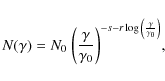
In this Appendix we show how electron populations with a log-parabolic energy distribution of the form expressed by Eq.&nbsp;(<a href="/articles/aa/full_html/2009/36/aa12237-09/aa12237-09.html#logpar1">3</a>), that is,

<br><p></p>
<DIV ALIGN="CENTER">

<!-- MATH: \begin{equation}
N(\gamma)=N_0~{\left({\frac{\gamma}{\gamma_0}}\right)}^{-s-r\log{\left({\frac{\gamma}{\gamma_0}}\right)}},
\end{equation} -->

<TABLE WIDTH="100%" ALIGN="CENTER">
<TR VALIGN="MIDDLE"><TD ALIGN="CENTER" NOWRAP><A NAME="logpar"></A><IMG
 WIDTH="165" HEIGHT="81"
 SRC="img182.png"
 ALT="\begin{displaymath}
N(\gamma)=N_0~{\left({\frac{\gamma}{\gamma_0}}\right)}^{-s-r\log{\left({\frac{\gamma}{\gamma_0}}\right)}},
\end{displaymath}"></td>
<TD WIDTH=10 ALIGN="RIGHT">
(A.1)</td></tr>
</TABLE>
</DIV><BR CLEAR="ALL"><p></p>
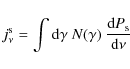
emit log-parabolic spectra via the SSC process. The related particle synchrotron emissivity
<br><p></p>
<DIV ALIGN="CENTER">

<!-- MATH: \begin{equation}
j_\nu^{\rm s} = \int{{\rm d}\gamma~N(\gamma)~\frac{{\rm d}P_{\rm s}}{{\rm d}\nu}}
\end{equation} -->

<TABLE WIDTH="100%" ALIGN="CENTER">
<TR VALIGN="MIDDLE"><TD ALIGN="CENTER" NOWRAP><IMG
 WIDTH="130" HEIGHT="69"
 SRC="img183.png"
 ALT="\begin{displaymath}j_\nu^{\rm s} = \int{{\rm d}\gamma~N(\gamma)~\frac{{\rm d}P_{\rm s}}{{\rm d}\nu}}
\end{displaymath}"></td>
<TD WIDTH=10 ALIGN="RIGHT">
(A.2)</td></tr>
</TABLE>
</DIV><BR CLEAR="ALL"><p></p>
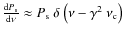
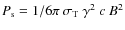
is easily computed on using the close approximation to the single particle emission in the shape of a delta-function (see Rybicki &amp; Lightmann 1979), that is, 
<!-- MATH: $\frac{{\rm d}P_{\rm s}}{{\rm d}\nu}\approx P_{\rm s}~\delta~{\left( {\nu-\gamma^2~\nu_{\rm c}}\right) }$ -->
<IMG
 WIDTH="124" HEIGHT="34" ALIGN="MIDDLE" BORDER="0"
 SRC="img184.png"
 ALT="$\frac{{\rm d}P_{\rm s}}{{\rm d}\nu}\approx P_{\rm s}~\delta~{\left( {\nu-\gamma^2~\nu_{\rm c}}\right) }$">
with 
<!-- MATH: $P_{\rm s}={1}/{6\pi}~\sigma_{\rm T}~\gamma^2~c~{B^2}$ -->
<IMG
 WIDTH="125" HEIGHT="30" ALIGN="MIDDLE" BORDER="0"
 SRC="img185.png"
 ALT="$P_{\rm s}={1}/{6\pi}~\sigma_{\rm T}~\gamma^2~c~{B^2}$">
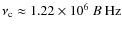
and 
<!-- MATH: $\nu_{\rm c}\approx 1.22\times {10}^6~ B\mbox{ Hz}$ -->
<IMG
 WIDTH="122" HEIGHT="31" ALIGN="MIDDLE" BORDER="0"
 SRC="img186.png"
 ALT="$\nu_{\rm c}\approx 1.22\times {10}^6~ B\mbox{ Hz}$">
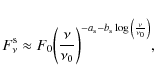
(with <I>B</I> measured in Gauss) is the synchrotron critical frequency. This leads to (<a href="/articles/aa/full_html/2009/36/aa12237-09/aa12237-09.html#massaro1">Massaro et&nbsp;al. 2004a</a>) a log-parabolic differential flux
<br><p></p>
<DIV ALIGN="CENTER">

<!-- MATH: \begin{equation}
F_\nu^{\rm s} \approx F_0{\left( {\frac{\nu}{\nu_0}}\right)}^{-a_{\rm s}-b_{\rm s}\log{\left( {\frac{\nu}{\nu_0}}\right) }},
\end{equation} -->

<TABLE WIDTH="100%" ALIGN="CENTER">
<TR VALIGN="MIDDLE"><TD ALIGN="CENTER" NOWRAP><IMG
 WIDTH="154" HEIGHT="81"
 SRC="img187.png"
 ALT="\begin{displaymath}F_\nu^{\rm s} \approx F_0{\left( {\frac{\nu}{\nu_0}}\right)}^{-a_{\rm s}-b_{\rm s}\log{\left( {\frac{\nu}{\nu_0}}\right) }},
\end{displaymath}"></td>
<TD WIDTH=10 ALIGN="RIGHT">
(A.3)</td></tr>
</TABLE>
</DIV><BR CLEAR="ALL"><p></p>
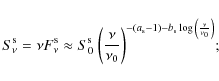
and to a SED again of log-parabolic shape
<br><p></p>
<DIV ALIGN="CENTER">

<!-- MATH: \begin{equation}
S_\nu^{\rm s} =\nu F_\nu^{\rm s}\approx S_0^{\rm s}~{\left( {\frac{\nu}{\nu_0}}\right)}^{-(a_{\rm s}-1)-b_{\rm s}\log{\left( {\frac{\nu}{\nu_0}}\right) }};
\end{equation} -->

<TABLE WIDTH="100%" ALIGN="CENTER">
<TR VALIGN="MIDDLE"><TD ALIGN="CENTER" NOWRAP><IMG
 WIDTH="219" HEIGHT="81"
 SRC="img188.png"
 ALT="\begin{displaymath}S_\nu^{\rm s} =\nu F_\nu^{\rm s}\approx S_0^{\rm s}~{\left( {...
...{\rm s}-1)-b_{\rm s}\log{\left( {\frac{\nu}{\nu_0}}\right) }};
\end{displaymath}"></td>
<TD WIDTH=10 ALIGN="RIGHT">
(A.4)</td></tr>
</TABLE>
</DIV><BR CLEAR="ALL"><p></p>
its slope at the synchrotron reference frequency <IMG
 WIDTH="16" HEIGHT="26" ALIGN="MIDDLE" BORDER="0"
 SRC="img189.png"
 ALT="$\nu_0$">
is given in terms of <I>s</I>, by
<br><p></p>
<DIV ALIGN="CENTER">

<!-- MATH: \begin{equation}
a_{\rm s}\approx\frac{s-1}{2},
\end{equation} -->

<TABLE WIDTH="100%" ALIGN="CENTER">
<TR VALIGN="MIDDLE"><TD ALIGN="CENTER" NOWRAP><IMG
 WIDTH="71" HEIGHT="66"
 SRC="img190.png"
 ALT="\begin{displaymath}a_{\rm s}\approx\frac{s-1}{2},
\end{displaymath}"></td>
<TD WIDTH=10 ALIGN="RIGHT">
(A.5)</td></tr>
</TABLE>
</DIV><BR CLEAR="ALL"><p></p>
the spectral curvature by
<br><p></p>
<DIV ALIGN="CENTER">

<!-- MATH: \begin{equation}
b_{\rm s}\approx\frac{r}{4},
\end{equation} -->

<TABLE WIDTH="100%" ALIGN="CENTER">
<TR VALIGN="MIDDLE"><TD ALIGN="CENTER" NOWRAP><A NAME="curvaturasincro"></A><IMG
 WIDTH="47" HEIGHT="63"
 SRC="img191.png"
 ALT="\begin{displaymath}
b_{\rm s}\approx\frac{r}{4},
\end{displaymath}"></td>
<TD WIDTH=10 ALIGN="RIGHT">
(A.6)</td></tr>
</TABLE>
</DIV><BR CLEAR="ALL"><p></p>
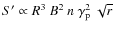
and the peak value 
<!-- MATH: $S'\propto R^3~B^2~n~\gamma_{\rm p}^2~\sqrt{r}$ -->
<IMG
 WIDTH="113" HEIGHT="30" ALIGN="MIDDLE" BORDER="0"
 SRC="img192.png"
 ALT="$S'\propto R^3~B^2~n~\gamma_{\rm p}^2~\sqrt{r}$">
occurs at a frequency 
<!-- MATH: $\xi'\propto B~\gamma_{\rm p}^2\times 10^{\frac{1}{r}}$ -->
<IMG
 WIDTH="93" HEIGHT="34" ALIGN="MIDDLE" BORDER="0"
 SRC="img193.png"
 ALT="$\xi'\propto B~\gamma_{\rm p}^2\times 10^{\frac{1}{r}}$">
(
<!-- MATH: $\gamma_{\rm p}$ -->
<IMG
 WIDTH="17" HEIGHT="26" ALIGN="MIDDLE" BORDER="0"
 SRC="img13.png"
 ALT="$\gamma _{\rm p}$">,
<I>n</I>, <I>B</I> and <I>R</I> are defined in Sect.&nbsp;<a href="/articles/aa/full_html/2009/36/aa12237-09/aa12237-09.html#spectra">2.1</a> of the main text).

<p>
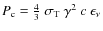
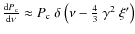
For IC radiation in the Thomson regime we may write to a fair approximation 
<!-- MATH: $\frac{{\rm d}P_{\rm c}}{{\rm d}\nu}\approx P_{\rm c}~\delta~{\left( {\nu-\frac{4}{3}~\gamma^2~\xi'}\right) }$ -->
<IMG
 WIDTH="135" HEIGHT="34" ALIGN="MIDDLE" BORDER="0"
 SRC="img194.png"
 ALT="$\frac{{\rm d}P_{\rm c}}{{\rm d}\nu}\approx P_{\rm c}~\delta~{\left( {\nu-\frac{4}{3}~\gamma^2~\xi'}\right) }$">
(see Rybicky &amp; Lightmann 1979) where 
<!-- MATH: $P_{\rm c}=\frac{4}{3}~\sigma_{\rm T}~\gamma^2~c~\epsilon_\nu$ -->
<IMG
 WIDTH="103" HEIGHT="31" ALIGN="MIDDLE" BORDER="0"
 SRC="img195.png"
 ALT="$P_{\rm c}=\frac{4}{3}~\sigma_{\rm T}~\gamma^2~c~\epsilon_\nu$">
is the  power radiated by a single-particle IC scattering in the Thomson regime, having denoted with 
<!-- MATH: $\epsilon_\nu\propto R~B^2~n~\gamma_{\rm p}^2$ -->
<IMG
 WIDTH="84" HEIGHT="30" ALIGN="MIDDLE" BORDER="0"
 SRC="img196.png"
 ALT="$\epsilon_\nu\propto R~B^2~n~\gamma_{\rm p}^2$">
the synchrotron radiation density<A NAME="tex2html12"
 HREF="#foot2072"><sup><IMG  ALIGN="BOTTOM" BORDER="1" ALT="[*]" SRC="/icons/foot_motif.png"></sup></A> 
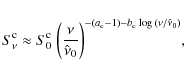
. We obtain once again a log-parabolic SED
<br><p></p>
<DIV ALIGN="CENTER">

<!-- MATH: \begin{equation}
S_\nu^{\rm c} \approx S_0^{\rm c}~{\left( {\frac{\nu}{\hat{\nu}_0}}\right)}^{-(a_{\rm c}-1)-b_{\rm c}\log{\left( {{\nu}/{\hat{\nu}_0}}\right) }},
\end{equation} -->

<TABLE WIDTH="100%" ALIGN="CENTER">
<TR VALIGN="MIDDLE"><TD ALIGN="CENTER" NOWRAP><IMG
 WIDTH="184" HEIGHT="76"
 SRC="img197.png"
 ALT="\begin{displaymath}S_\nu^{\rm c} \approx S_0^{\rm c}~{\left( {\frac{\nu}{\hat{\n...
...rm c}-1)-b_{\rm c}\log{\left( {{\nu}/{\hat{\nu}_0}}\right) }},
\end{displaymath}"></td>
<TD WIDTH=10 ALIGN="RIGHT">
(A.7)</td></tr>
</TABLE>
</DIV><BR CLEAR="ALL"><p></p>
where the slope at the IC reference frequency 
<!-- MATH: $\hat{\nu}_0$ -->
<IMG
 WIDTH="15" HEIGHT="26" ALIGN="MIDDLE" BORDER="0"
 SRC="img198.png"
 ALT="$\hat{\nu}_0$">
is given by
<br><p></p>
<DIV ALIGN="CENTER">

<!-- MATH: \begin{equation}
a_{\rm c}\approx\frac{s-1}{2},
\end{equation} -->

<TABLE WIDTH="100%" ALIGN="CENTER">
<TR VALIGN="MIDDLE"><TD ALIGN="CENTER" NOWRAP><IMG
 WIDTH="71" HEIGHT="66"
 SRC="img199.png"
 ALT="\begin{displaymath}a_{\rm c}\approx\frac{s-1}{2},
\end{displaymath}"></td>
<TD WIDTH=10 ALIGN="RIGHT">
(A.8)</td></tr>
</TABLE>
</DIV><BR CLEAR="ALL"><p></p>
and the spectral curvature reads
<br><p></p>
<DIV ALIGN="CENTER">

<!-- MATH: \begin{equation}
b_{\rm c}\approx\frac{r}{4}\cdot
\end{equation} -->

<TABLE WIDTH="100%" ALIGN="CENTER">
<TR VALIGN="MIDDLE"><TD ALIGN="CENTER" NOWRAP><A NAME="curvaturathomson"></A><IMG
 WIDTH="48" HEIGHT="63"
 SRC="img200.png"
 ALT="\begin{displaymath}
b_{\rm c}\approx\frac{r}{4}\cdot
\end{displaymath}"></td>
<TD WIDTH=10 ALIGN="RIGHT">
(A.9)</td></tr>
</TABLE>
</DIV><BR CLEAR="ALL"><p></p>
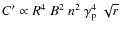
The peak value 
<!-- MATH: $C'\propto R^4~B^2~n^2~\gamma_{\rm p}^4~\sqrt{r}$ -->
<IMG
 WIDTH="120" HEIGHT="30" ALIGN="MIDDLE" BORDER="0"
 SRC="img201.png"
 ALT="$C'\propto R^4~B^2~n^2~\gamma_{\rm p}^4~\sqrt{r}$">
is attained at a frequency 
<!-- MATH: $\epsilon'\propto B~\gamma_{\rm p}^4$ -->
<IMG
 WIDTH="55" HEIGHT="30" ALIGN="MIDDLE" BORDER="0"
 SRC="img202.png"
 ALT="$\epsilon'\propto B~\gamma_{\rm p}^4$">.

<p>
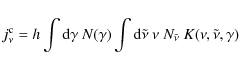
For the Klein-Nishina (KN) regime instead it necessary to consider the convolution
<br><p></p>
<DIV ALIGN="CENTER">

<!-- MATH: \begin{equation}
j_\nu^{\rm c} =h
\int{{\rm d}\gamma~N(\gamma)
\int{{\rm d}\tilde\nu~\nu~N_{\tilde\nu}~K(\nu,\tilde\nu,\gamma)}}
\end{equation} -->

<TABLE WIDTH="100%" ALIGN="CENTER">
<TR VALIGN="MIDDLE"><TD ALIGN="CENTER" NOWRAP><IMG
 WIDTH="239" HEIGHT="69"
 SRC="img203.png"
 ALT="\begin{displaymath}j_\nu^{\rm c} =h
\int{{\rm d}\gamma~N(\gamma)
\int{{\rm d}\tilde\nu~\nu~N_{\tilde\nu}~K(\nu,\tilde\nu,\gamma)}}
\end{displaymath}"></td>
<TD WIDTH=10 ALIGN="RIGHT">
(A.10)</td></tr>
</TABLE>
</DIV><BR CLEAR="ALL"><p></p>
where <IMG
 WIDTH="9" HEIGHT="26" ALIGN="MIDDLE" BORDER="0"
 SRC="img204.png"
 ALT="$\tilde\nu$">
and <IMG
 WIDTH="9" HEIGHT="26" ALIGN="MIDDLE" BORDER="0"
 SRC="img144.png"
 ALT="$\nu$">
are the electron frequencies before and after the scattering, respectively, 
<!-- MATH: $N_{\tilde\nu}$ -->
<IMG
 WIDTH="19" HEIGHT="26" ALIGN="MIDDLE" BORDER="0"
 SRC="img205.png"
 ALT="$N_{\tilde\nu}$">
is the number spectrum of seed photons, and 
<!-- MATH: $K(\nu,\tilde\nu,\gamma)$ -->
<IMG
 WIDTH="54" HEIGHT="26" ALIGN="MIDDLE" BORDER="0"
 SRC="img206.png"
 ALT="$K(\nu,\tilde\nu,\gamma)$">
is the full Compton kernel (<A NAME="aaref21"></A><a href="/articles/aa/full_html/2009/36/aa12237-09/aa12237-09.html#jones">Jones 1968</a>). Only in the extreme KN regime one may again approximate
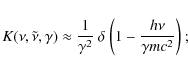
<br><p></p>
<DIV ALIGN="CENTER">

<!-- MATH: \begin{equation}
K(\nu,\tilde\nu,\gamma)\approx\frac{1}{\gamma^2}~\delta~{\left( {1-\frac{h\nu}{\gamma m c^2}}\right) }~;
\end{equation} -->

<TABLE WIDTH="100%" ALIGN="CENTER">
<TR VALIGN="MIDDLE"><TD ALIGN="CENTER" NOWRAP><IMG
 WIDTH="188" HEIGHT="72"
 SRC="img207.png"
 ALT="\begin{displaymath}K(\nu,\tilde\nu,\gamma)\approx\frac{1}{\gamma^2}~\delta~{\left( {1-\frac{h\nu}{\gamma m c^2}}\right) }~;
\end{displaymath}"></td>
<TD WIDTH=10 ALIGN="RIGHT">
(A.11)</td></tr>
</TABLE>
</DIV><BR CLEAR="ALL"><p></p>
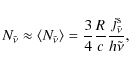
on approximating 
<!-- MATH: $N_{\tilde\nu}$ -->
<IMG
 WIDTH="19" HEIGHT="26" ALIGN="MIDDLE" BORDER="0"
 SRC="img205.png"
 ALT="$N_{\tilde\nu}$">
with its mean value for a homogeneous, spherical optically thin source
<br><p></p>
<DIV ALIGN="CENTER">

<!-- MATH: \begin{equation}
N_{\tilde\nu}\approx \left\langle {N_{\tilde\nu}}\right\rangle =\frac{3}{4}\frac{R}{c}\frac{j_{\tilde\nu}^{\rm s}}{h\tilde\nu},
\end{equation} -->

<TABLE WIDTH="100%" ALIGN="CENTER">
<TR VALIGN="MIDDLE"><TD ALIGN="CENTER" NOWRAP><IMG
 WIDTH="129" HEIGHT="68"
 SRC="img208.png"
 ALT="\begin{displaymath}N_{\tilde\nu}\approx \left\langle {N_{\tilde\nu}}\right\rangl...
...frac{3}{4}\frac{R}{c}\frac{j_{\tilde\nu}^{\rm s}}{h\tilde\nu},
\end{displaymath}"></td>
<TD WIDTH=10 ALIGN="RIGHT">
(A.12)</td></tr>
</TABLE>
</DIV><BR CLEAR="ALL"><p></p>
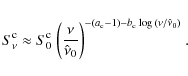
one obtains again a SED with a log-parabolic shape
<br><p></p>
<DIV ALIGN="CENTER">

<!-- MATH: \begin{equation}
S_\nu^{\rm c} \approx S_0^{\rm c}~{\left( {\frac{\nu}{\hat{\nu}_0}}\right)}^{-(a_{\rm c}-1) -b_{\rm c}\log{\left( {{\nu}/{\hat{\nu}_0}}\right) }}~.
\end{equation} -->

<TABLE WIDTH="100%" ALIGN="CENTER">
<TR VALIGN="MIDDLE"><TD ALIGN="CENTER" NOWRAP><IMG
 WIDTH="188" HEIGHT="76"
 SRC="img209.png"
 ALT="\begin{displaymath}S_\nu^{\rm c} \approx S_0^{\rm c}~{\left( {\frac{\nu}{\hat{\n...
... c}-1) -b_{\rm c}\log{\left( {{\nu}/{\hat{\nu}_0}}\right) }}~.
\end{displaymath}"></td>
<TD WIDTH=10 ALIGN="RIGHT">
(A.13)</td></tr>
</TABLE>
</DIV><BR CLEAR="ALL"><p></p>
Now the slope at 
<!-- MATH: $\hat{\nu}_0$ -->
<IMG
 WIDTH="15" HEIGHT="26" ALIGN="MIDDLE" BORDER="0"
 SRC="img198.png"
 ALT="$\hat{\nu}_0$"><br><p></p>
<DIV ALIGN="CENTER">

<!-- MATH: \begin{equation}
a_{\rm c}\approx s,
\end{equation} -->

<TABLE WIDTH="100%" ALIGN="CENTER">
<TR VALIGN="MIDDLE"><TD ALIGN="CENTER" NOWRAP><IMG
 WIDTH="43" HEIGHT="44"
 SRC="img210.png"
 ALT="\begin{displaymath}a_{\rm c}\approx s,
\end{displaymath}"></td>
<TD WIDTH=10 ALIGN="RIGHT">
(A.14)</td></tr>
</TABLE>
</DIV><BR CLEAR="ALL"><p></p>
is <EM>steeper</EM>, and the spectral curvature
<br><p></p>
<DIV ALIGN="CENTER">

<!-- MATH: \begin{equation}
b_{\rm c}\approx r
\end{equation} -->

<TABLE WIDTH="100%" ALIGN="CENTER">
<TR VALIGN="MIDDLE"><TD ALIGN="CENTER" NOWRAP><A NAME="curvaturakn"></A><IMG
 WIDTH="40" HEIGHT="48"
 SRC="img211.png"
 ALT="\begin{displaymath}
b_{\rm c}\approx r
\end{displaymath}"></td>
<TD WIDTH=10 ALIGN="RIGHT">
(A.15)</td></tr>
</TABLE>
</DIV><BR CLEAR="ALL"><p></p>
is <EM>larger</EM> than in the Thomson regime. The peak value 
<!-- MATH: $C'\propto R^4~B~n^2~\sqrt{r}$ -->
<IMG
 WIDTH="97" HEIGHT="30" ALIGN="MIDDLE" BORDER="0"
 SRC="img212.png"
 ALT="$C'\propto R^4~B~n^2~\sqrt{r}$">
occurs at a frequency 
<!-- MATH: $\epsilon'\propto \gamma_{\rm p}\times 10^{-\frac{1}{2r}}$ -->
<IMG
 WIDTH="89" HEIGHT="34" ALIGN="MIDDLE" BORDER="0"
 SRC="img213.png"
 ALT="$\epsilon'\propto \gamma_{\rm p}\times 10^{-\frac{1}{2r}}$">.

<p>
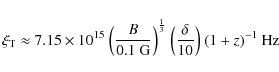
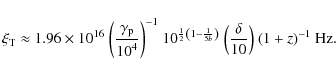
The transition between the two regimes occurs when 
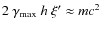
<!-- MATH: $2~\gamma_{\max}~ h~\xi'\approx m c^2$ -->
<IMG
 WIDTH="101" HEIGHT="30" ALIGN="MIDDLE" BORDER="0"
 SRC="img214.png"
 ALT="$2~\gamma_{\max}~ h~\xi'\approx m c^2$">,
where 
<!-- MATH: $\gamma_{\max}=\sqrt{\xi'/\nu_{\rm c}}$ -->
<IMG
 WIDTH="86" HEIGHT="33" ALIGN="MIDDLE" BORDER="0"
 SRC="img215.png"
 ALT="$\gamma_{\max}=\sqrt{\xi'/\nu_{\rm c}}$">,
that is, when
<br><p></p>
<DIV ALIGN="CENTER">

<!-- MATH: \begin{equation}
\xi_{\rm T}\approx 7.15\times 10^{15}~{\left({\frac{B}{0.1\mbox{ G}}}\right)}^{\frac{1}{3}}~
{\left({\frac{\delta}{10}}\right)}~(1+z)^{-1}\mbox{ Hz}
\end{equation} -->

<TABLE WIDTH="100%" ALIGN="CENTER">
<TR VALIGN="MIDDLE"><TD ALIGN="CENTER" NOWRAP><IMG
 WIDTH="279" HEIGHT="72"
 SRC="img216.png"
 ALT="\begin{displaymath}\xi_{\rm T}\approx 7.15\times 10^{15}~{\left({\frac{B}{0.1\mb...
...}{3}}~
{\left({\frac{\delta}{10}}\right)}~(1+z)^{-1}\mbox{ Hz}
\end{displaymath}"></td>
<TD WIDTH=10 ALIGN="RIGHT">
(A.16)</td></tr>
</TABLE>
</DIV><BR CLEAR="ALL"><p></p>
holds, or equivalently
<br><p></p>
<DIV ALIGN="CENTER">

<!-- MATH: \begin{equation}
\xi_{\rm T}\approx 1.96\times 10^{16}~{\left({\frac{\gamma_{\rm p}}{{10}^4}}\right)}^{-1}~
{10}^{\frac{1}{2}\left({1-\frac{1}{5b}}\right)}~
{\left({\frac{\delta}{10}}\right)}~(1+z)^{-1}\mbox{ Hz} .
\end{equation} -->

<TABLE WIDTH="100%" ALIGN="CENTER">
<TR VALIGN="MIDDLE"><TD ALIGN="CENTER" NOWRAP><IMG
 WIDTH="336" HEIGHT="75"
 SRC="img83.png"
 ALT="\begin{displaymath}
\xi_{\rm T}\approx 1.96\times 10^{16}~{\left({\frac{\gamma_{...
...t)}~
{\left({\frac{\delta}{10}}\right)}~(1+z)^{-1}\mbox{ Hz} .
\end{displaymath}"></td>
<TD WIDTH=10 ALIGN="RIGHT">
(A.17)</td></tr>
</TABLE>
</DIV><BR CLEAR="ALL"><p></p>
We close these calculations with two remarks. First, the (primed) quantities used here refer to the rest frame of the emitting region, while the observed (unprimed) quantities must be multiplied by powers of the beaming factor
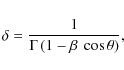
<br><p></p>
<DIV ALIGN="CENTER">

<!-- MATH: \begin{equation}
\delta=\frac{1}{\Gamma \left( {1-\beta~\cos{\theta}}\right)},
\end{equation} -->

<TABLE WIDTH="100%" ALIGN="CENTER">
<TR VALIGN="MIDDLE"><TD ALIGN="CENTER" NOWRAP><IMG
 WIDTH="124" HEIGHT="70"
 SRC="img217.png"
 ALT="\begin{displaymath}\delta=\frac{1}{\Gamma \left( {1-\beta~\cos{\theta}}\right)},
\end{displaymath}"></td>
<TD WIDTH=10 ALIGN="RIGHT">
(A.18)</td></tr>
</TABLE>
</DIV><BR CLEAR="ALL"><p></p><IMG
 WIDTH="11" HEIGHT="14" ALIGN="BOTTOM" BORDER="0"
 SRC="img218.png"
 ALT="$\Gamma$">
being the bulk Lorentz factor of the relativistic electron flow in the emitting region, <IMG
 WIDTH="10" HEIGHT="26" ALIGN="MIDDLE" BORDER="0"
 SRC="img219.png"
 ALT="$\theta$">
the angle between its velocity <IMG
 WIDTH="8" HEIGHT="26" ALIGN="MIDDLE" BORDER="0"
 SRC="img220.png"
 ALT="$\varv$">
and the line of sight, and 
<!-- MATH: $\beta=\varv/c$ -->
<IMG
 WIDTH="45" HEIGHT="26" ALIGN="MIDDLE" BORDER="0"
 SRC="img221.png"
 ALT="$\beta=\varv/c$">;
so we obtain 
<!-- MATH: $S=S'~\delta^4$ -->
<IMG
 WIDTH="57" HEIGHT="30" ALIGN="MIDDLE" BORDER="0"
 SRC="img222.png"
 ALT="$S=S'~\delta^4$">,

<!-- MATH: $C=C'~\delta^4$ -->
<IMG
 WIDTH="59" HEIGHT="30" ALIGN="MIDDLE" BORDER="0"
 SRC="img223.png"
 ALT="$C=C'~\delta^4$">,
and 
<!-- MATH: $\xi=\xi'~\delta$ -->
<IMG
 WIDTH="46" HEIGHT="26" ALIGN="MIDDLE" BORDER="0"
 SRC="img224.png"
 ALT="$\xi=\xi'~\delta$">,

<!-- MATH: $\epsilon=\epsilon'~\delta$ -->
<IMG
 WIDTH="47" HEIGHT="26" ALIGN="MIDDLE" BORDER="0"
 SRC="img225.png"
 ALT="$\epsilon=\epsilon'~\delta$">.
Second, we note that the actual specific powers 
<!-- MATH: $\frac{{\rm d}P}{{\rm d}\nu}$ -->
<IMG
 WIDTH="17" HEIGHT="31" ALIGN="MIDDLE" BORDER="0"
 SRC="img226.png"
 ALT="$\frac{{\rm d}P}{{\rm d}\nu}$">
radiated by a single particle differ from delta-function shape, slightly for the synchrotron emission and considerably for the IC radiation in the Thomson regime (see discussion in Rybicky &amp; Lightmann 1979). However, the above spectral shapes still approximatively apply, as confirmed by numerical simulations (<a href="/articles/aa/full_html/2009/36/aa12237-09/aa12237-09.html#massarotesi">Massaro 2007</a>);  in detail, the convolution with a broader single particle power yields a <EM>less</EM> curved spectrum, so that Eqs.&nbsp;(<a href="/articles/aa/full_html/2009/36/aa12237-09/aa12237-09.html#curvaturasincro">A.6</a>) and&nbsp;(<a href="/articles/aa/full_html/2009/36/aa12237-09/aa12237-09.html#curvaturathomson">A.9</a>) become 
<!-- MATH: $b_{\rm s} \approx r/5$ -->
<IMG
 WIDTH="51" HEIGHT="26" ALIGN="MIDDLE" BORDER="0"
 SRC="img227.png"
 ALT="$b_{\rm s} \approx r/5$">
(<a href="/articles/aa/full_html/2009/36/aa12237-09/aa12237-09.html#massaro3">Massaro et&nbsp;al. 2006</a>) and 
<!-- MATH: $b_{\rm c}\approx r/10$ -->
<IMG
 WIDTH="57" HEIGHT="26" ALIGN="MIDDLE" BORDER="0"
 SRC="img228.png"
 ALT="$b_{\rm c}\approx r/10$">,
respectively.

<p>

<h2 class="sec"><a name="SECTION000100000000000000000"></a><A NAME="accelerazione"></A>
Appendix B: Particle acceleration processes
</h2>

<p>
<div class="inset-old">
<table>
<tr><td><!-- init Label --><A NAME="evolthm">&#160;</A><!-- end Label--><A NAME="2093"></A><A NAME="figure1370"
 HREF="img232.png"><IMG
 WIDTH="99" HEIGHT="139" SRC="Timg232.png"
 ALT="\begin{figure}
\par\includegraphics[width=9cm,clip]{12237fg7.eps}
\end{figure}"></A><!-- HTML Figure number: 7 --></td>
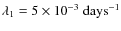
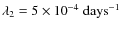
<td class="img-txt"><span class="bold">Figure B.1:</span><p>
Example of time evolution of the 
<!-- MATH: $\gamma^2~N(\gamma)$ -->
<IMG
 WIDTH="47" HEIGHT="30" ALIGN="MIDDLE" BORDER="0"
 SRC="img229.png"
 ALT="$\gamma^2~N(\gamma)$">
distribution (with peak energy 
<!-- MATH: $\gamma_{\rm p}$ -->
<IMG
 WIDTH="17" HEIGHT="26" ALIGN="MIDDLE" BORDER="0"
 SRC="img13.png"
 ALT="$\gamma _{\rm p}$">)
due to stochastic and systematic accelerations (<I> upper panel</I>) with 
<!-- MATH: $\lambda_1 = 5\times {10}^{-3}\mbox{ days}^{-1}$ -->
<IMG
 WIDTH="121" HEIGHT="31" ALIGN="MIDDLE" BORDER="0"
 SRC="img230.png"
 ALT="$\lambda_1 = 5\times {10}^{-3}\mbox{ days}^{-1}$">,

<!-- MATH: $\lambda_2 = 5\times {10}^{-4}\mbox{ days}^{-1}$ -->
<IMG
 WIDTH="122" HEIGHT="31" ALIGN="MIDDLE" BORDER="0"
 SRC="img231.png"
 ALT="$\lambda_2 = 5\times {10}^{-4}\mbox{ days}^{-1}$">
from the initial value 
<!-- MATH: $\gamma_{\rm p}={10}^3$ -->
<IMG
 WIDTH="52" HEIGHT="31" ALIGN="MIDDLE" BORDER="0"
 SRC="img16.png"
 ALT="$\gamma _{\rm p}={10}^3$">,
and of the related evolution for the SSC SEDs (<I> lower panel</I>). In terms of the stochastic acceleration time <IMG
 WIDTH="16" HEIGHT="26" ALIGN="MIDDLE" BORDER="0"
 SRC="img17.png"
 ALT="$\tau _2$">,
the time interval between each pair of lines is 
<!-- MATH: $t_2-t_1={10}^{-2} \tau_2$ -->
<IMG
 WIDTH="91" HEIGHT="31" ALIGN="MIDDLE" BORDER="0"
 SRC="img18.png"
 ALT="$t_2-t_1={10}^{-2} \tau _2$">,
corresponding to an observed time interval of about two days.</p></td>
</tr><tr><td colspan="2"><a href="http://dexter.edpsciences.org/applet.php?pdf_id=7&DOI=10.1051/0004-6361/200912237" target="DEXTER">Open with DEXTER</a></td></tr>

</table></div>
<p>
<div class="inset-old">
<table>
<tr><td><!-- init Label --><A NAME="evolkn">&#160;</A><!-- end Label--><A NAME="2094"></A><A NAME="figure1390"
 HREF="img233.png"><IMG
 WIDTH="100" HEIGHT="140" SRC="Timg233.png"
 ALT="\begin{figure}
\par\includegraphics[width=9cm,clip]{12237fg8.eps}
\end{figure}"></A><!-- HTML Figure number: 8 --></td>
<td class="img-txt"><span class="bold">Figure B.2:</span><p>
Example of time evolution of the 
<!-- MATH: $\gamma^2~N(\gamma)$ -->
<IMG
 WIDTH="47" HEIGHT="30" ALIGN="MIDDLE" BORDER="0"
 SRC="img229.png"
 ALT="$\gamma^2~N(\gamma)$">
distribution (with peak energy 
<!-- MATH: $\gamma_{\rm p}$ -->
<IMG
 WIDTH="17" HEIGHT="26" ALIGN="MIDDLE" BORDER="0"
 SRC="img13.png"
 ALT="$\gamma _{\rm p}$">)
due to stochastic and systematic accelerations (<I> upper panel</I>) with 
<!-- MATH: $\lambda_1 = 5\times {10}^{-3}\mbox{ days}^{-1}$ -->
<IMG
 WIDTH="121" HEIGHT="31" ALIGN="MIDDLE" BORDER="0"
 SRC="img230.png"
 ALT="$\lambda_1 = 5\times {10}^{-3}\mbox{ days}^{-1}$">,

<!-- MATH: $\lambda_2 = 5\times {10}^{-4}\mbox{ days}^{-1}$ -->
<IMG
 WIDTH="122" HEIGHT="31" ALIGN="MIDDLE" BORDER="0"
 SRC="img231.png"
 ALT="$\lambda_2 = 5\times {10}^{-4}\mbox{ days}^{-1}$">
from the initial value 
<!-- MATH: $\gamma_{\rm p}=5\times 10^4$ -->
<IMG
 WIDTH="75" HEIGHT="30" ALIGN="MIDDLE" BORDER="0"
 SRC="img19.png"
 ALT="$\gamma _{\rm p}=5\times 10^4$">,
and of the related evolution for the SSC SEDs (<I> lower panel</I>). In terms of the stochastic acceleration time <IMG
 WIDTH="16" HEIGHT="26" ALIGN="MIDDLE" BORDER="0"
 SRC="img17.png"
 ALT="$\tau _2$">,
the time interval between each pair of lines is 
<!-- MATH: $t_2-t_1={10}^{-2} \tau_2$ -->
<IMG
 WIDTH="91" HEIGHT="31" ALIGN="MIDDLE" BORDER="0"
 SRC="img18.png"
 ALT="$t_2-t_1={10}^{-2} \tau _2$">,
corresponding to an observed time interval of about two days.</p></td>
</tr><tr><td colspan="2"><a href="http://dexter.edpsciences.org/applet.php?pdf_id=8&DOI=10.1051/0004-6361/200912237" target="DEXTER">Open with DEXTER</a></td></tr>

</table></div>
<p>
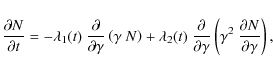
Here we derive a log-parabolic electron energy distribution 
<!-- MATH: $N\left({\gamma ,t}\right)$ -->
<IMG
 WIDTH="42" HEIGHT="26" ALIGN="MIDDLE" BORDER="0"
 SRC="img234.png"
 ALT="$N\left({\gamma ,t}\right)$">
from a kinetic continuity equation of the Fokker-Planck type; following Kardashev (1962), in the jet rest frame this reads
<br><p></p>
<DIV ALIGN="CENTER">

<!-- MATH: \begin{equation}
\frac{\partial N}{\partial t}=-
\lambda_1 (t)~ \frac{\partial}{\partial\gamma}\left({\gamma~N}\right)+
\lambda_2 (t)~ \frac{\partial}{\partial\gamma}\left({\gamma^2~\frac{\partial N}{\partial\gamma}}\right),
\end{equation} -->

<TABLE WIDTH="100%" ALIGN="CENTER">
<TR VALIGN="MIDDLE"><TD ALIGN="CENTER" NOWRAP><A NAME="fp"></A><IMG
 WIDTH="273" HEIGHT="72"
 SRC="img235.png"
 ALT="\begin{displaymath}
\frac{\partial N}{\partial t}=-
\lambda_1 (t)~ \frac{\parti...
...mma}\left({\gamma^2~\frac{\partial N}{\partial\gamma}}\right),
\end{displaymath}"></td>
<TD WIDTH=10 ALIGN="RIGHT">
(B.1)</td></tr>
</TABLE>
</DIV><BR CLEAR="ALL"><p></p>
where 
<!-- MATH: $\gamma~ m~ c^2$ -->
<IMG
 WIDTH="39" HEIGHT="30" ALIGN="MIDDLE" BORDER="0"
 SRC="img114.png"
 ALT="$\gamma~ m~c^2$">
is the particle energy, <I>t</I> denotes time, and <IMG
 WIDTH="16" HEIGHT="26" ALIGN="MIDDLE" BORDER="0"
 SRC="img236.png"
 ALT="$\lambda_1$">
and <IMG
 WIDTH="17" HEIGHT="26" ALIGN="MIDDLE" BORDER="0"
 SRC="img237.png"
 ALT="$\lambda_2$">
describe systematic and stochastic acceleration rates, occurring on timescales 
<!-- MATH: $t_1=1/\lambda_1$ -->
<IMG
 WIDTH="55" HEIGHT="26" ALIGN="MIDDLE" BORDER="0"
 SRC="img138.png"
 ALT="$t_1=1/\lambda_1$">
and 
<!-- MATH: $t_2=1/\lambda_2$ -->
<IMG
 WIDTH="56" HEIGHT="26" ALIGN="MIDDLE" BORDER="0"
 SRC="img139.png"
 ALT="$t_2=1/\lambda_2$">,
respectively. For example, in the picture of Fermi accelerations (e.g., <a href="/articles/aa/full_html/2009/36/aa12237-09/aa12237-09.html#vietri">Vietri 2006</a>),  the accelerations rates <IMG
 WIDTH="16" HEIGHT="26" ALIGN="MIDDLE" BORDER="0"
 SRC="img236.png"
 ALT="$\lambda_1$">
and <IMG
 WIDTH="17" HEIGHT="26" ALIGN="MIDDLE" BORDER="0"
 SRC="img237.png"
 ALT="$\lambda_2$">
can be expressed in terms of physical quantities related to processes occurring in shocks; in this framework a plane shock front of thickness 
<!-- MATH: $\ell_{\rm s}$ -->
<IMG
 WIDTH="13" HEIGHT="26" ALIGN="MIDDLE" BORDER="0"
 SRC="img238.png"
 ALT="$\ell_{\rm s}$">
moves with speed <IMG
 WIDTH="17" HEIGHT="26" ALIGN="MIDDLE" BORDER="0"
 SRC="img239.png"
 ALT="$V_{\rm s}$">
and gas clouds of average size <IMG
 WIDTH="9" HEIGHT="26" ALIGN="MIDDLE" BORDER="0"
 SRC="img240.png"
 ALT="$\ell$">
move downstream of the shock with speed <I>V</I>; it is found that 
<!-- MATH: $\lambda_1=V_{\rm s}/\ell_{\rm s}$ -->
<IMG
 WIDTH="63" HEIGHT="26" ALIGN="MIDDLE" BORDER="0"
 SRC="img241.png"
 ALT="$\lambda_1=V_{\rm s}/\ell_{\rm s}$">
and 
<!-- MATH: $\lambda_2=V^2/2c\ell$ -->
<IMG
 WIDTH="73" HEIGHT="30" ALIGN="MIDDLE" BORDER="0"
 SRC="img242.png"
 ALT="$\lambda_2=V^2/2c\ell$">
hold (see <A NAME="aaref22"></A><a href="/articles/aa/full_html/2009/36/aa12237-09/aa12237-09.html#kaplan">Kaplan 1956</a>; <A NAME="aaref43"></A><a href="/articles/aa/full_html/2009/36/aa12237-09/aa12237-09.html#paggi">Paggi 2007</a>), 
<!-- MATH: $\lambda_2\ll\lambda_1$ -->
<IMG
 WIDTH="50" HEIGHT="26" ALIGN="MIDDLE" BORDER="0"
 SRC="img243.png"
 ALT="$\lambda_2\ll\lambda_1$">.
On the other hand, numerical values of <IMG
 WIDTH="16" HEIGHT="26" ALIGN="MIDDLE" BORDER="0"
 SRC="img236.png"
 ALT="$\lambda_1$">
and <IMG
 WIDTH="17" HEIGHT="26" ALIGN="MIDDLE" BORDER="0"
 SRC="img237.png"
 ALT="$\lambda_2$">
are directly derived from the emitted spectrum as shown later.

<p>
The Fokker-Planck Eq.&nbsp;(<a href="/articles/aa/full_html/2009/36/aa12237-09/aa12237-09.html#fp">B.1</a>) describes the <EM>evolution</EM> of the electron distribution function; with an initially mono-energetic distribution in the form of a delta-function 
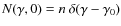
<!-- MATH: $N(\gamma ,0) = n ~\delta(\gamma -\gamma_0)$ -->
<IMG
 WIDTH="121" HEIGHT="26" ALIGN="MIDDLE" BORDER="0"
 SRC="img244.png"
 ALT="$N(\gamma ,0) = n ~\delta(\gamma -\gamma_0)$">
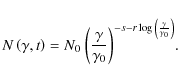
(<I>n</I> is the initial particle number density) the solution at subsequent times <I>t</I> takes the form of the log-parabolic energy distribution assumed in Eq. (<a href="/articles/aa/full_html/2009/36/aa12237-09/aa12237-09.html#logpar1">3</a>) of the main text (see also <a href="/articles/aa/full_html/2009/36/aa12237-09/aa12237-09.html#logpar">A.1</a>), reading
<br><p></p>
<DIV ALIGN="CENTER">

<!-- MATH: \begin{equation}
N\left({\gamma ,t}\right)= N_0~ {\left({\frac{\gamma}{\gamma_0}}\right)}^{-s-r\log{\left({\frac{\gamma}{\gamma_0}}\right)}}.
\end{equation} -->

<TABLE WIDTH="100%" ALIGN="CENTER">
<TR VALIGN="MIDDLE"><TD ALIGN="CENTER" NOWRAP><A NAME="logpar2"></A><IMG
 WIDTH="178" HEIGHT="81"
 SRC="img245.png"
 ALT="\begin{displaymath}
N\left({\gamma ,t}\right)= N_0~ {\left({\frac{\gamma}{\gamma_0}}\right)}^{-s-r\log{\left({\frac{\gamma}{\gamma_0}}\right)}}.
\end{displaymath}"></td>
<TD WIDTH=10 ALIGN="RIGHT">
(B.2)</td></tr>
</TABLE>
</DIV><BR CLEAR="ALL"><p></p>
Here the time depending slope at 
<!-- MATH: $\gamma=\gamma_0$ -->
<IMG
 WIDTH="40" HEIGHT="26" ALIGN="MIDDLE" BORDER="0"
 SRC="img246.png"
 ALT="$\gamma=\gamma_0$">
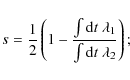
is given by
<br><p></p>
<DIV ALIGN="CENTER">

<!-- MATH: \begin{equation}
s=\frac{1}{2}\left( {1-\frac{\int{{\rm d}t~\lambda_1}}{\int{{\rm d}t~\lambda_2}}}\right);
\end{equation} -->

<TABLE WIDTH="100%" ALIGN="CENTER">
<TR VALIGN="MIDDLE"><TD ALIGN="CENTER" NOWRAP><IMG
 WIDTH="130" HEIGHT="80"
 SRC="img247.png"
 ALT="\begin{displaymath}s=\frac{1}{2}\left( {1-\frac{\int{{\rm d}t~\lambda_1}}{\int{{\rm d}t~\lambda_2}}}\right);
\end{displaymath}"></td>
<TD WIDTH=10 ALIGN="RIGHT">
(B.3)</td></tr>
</TABLE>
</DIV><BR CLEAR="ALL"><p></p>
meanwhile, the curvature of <IMG
 WIDTH="30" HEIGHT="26" ALIGN="MIDDLE" BORDER="0"
 SRC="img248.png"
 ALT="$N(\gamma)$">
driven by the diffusive (stochastic) term in Eq. (<a href="/articles/aa/full_html/2009/36/aa12237-09/aa12237-09.html#fp">B.1</a>), <I>irreversibly</I> decreases in time after
<br><p></p>
<DIV ALIGN="CENTER">

<!-- MATH: \begin{equation}
r=\frac{\ln{10}}{4\int{{\rm d}t~\lambda_2}}
\end{equation} -->

<TABLE WIDTH="100%" ALIGN="CENTER">
<TR VALIGN="MIDDLE"><TD ALIGN="CENTER" NOWRAP><IMG
 WIDTH="83" HEIGHT="74"
 SRC="img249.png"
 ALT="\begin{displaymath}r=\frac{\ln{10}}{4\int{{\rm d}t~\lambda_2}}
\end{displaymath}"></td>
<TD WIDTH=10 ALIGN="RIGHT">
(B.4)</td></tr>
</TABLE>
</DIV><BR CLEAR="ALL"><p></p>
from the large initial values corresponding to the initially mono-energetic distribution. Correspondingly, the time-dependent height at 
<!-- MATH: $\gamma=\gamma_0$ -->
<IMG
 WIDTH="40" HEIGHT="26" ALIGN="MIDDLE" BORDER="0"
 SRC="img246.png"
 ALT="$\gamma=\gamma_0$">
follows
<br><p></p>
<DIV ALIGN="CENTER">

<!-- MATH: \begin{equation}
N_0=\frac{1}{2\sqrt{\pi}}\frac{n}{\gamma_0}\frac{1} {\sqrt{\int{{\rm d}t~\lambda_2}}}~ {\exp{\left[{-\frac{{\left({\int{{\rm d}t~\lambda_1}+\int{{\rm d}t~\lambda_2}}\right)}^2}
{4\int{{\rm d}t~\lambda_2}}}\right]}}\cdot
\end{equation} -->

<TABLE WIDTH="100%" ALIGN="CENTER">
<TR VALIGN="MIDDLE"><TD ALIGN="CENTER" NOWRAP><IMG
 WIDTH="325" HEIGHT="95"
 SRC="img250.png"
 ALT="\begin{displaymath}N_0=\frac{1}{2\sqrt{\pi}}\frac{n}{\gamma_0}\frac{1} {\sqrt{\i...
...mbda_2}}\right)}^2}
{4\int{{\rm d}t~\lambda_2}}}\right]}}\cdot
\end{displaymath}"></td>
<TD WIDTH=10 ALIGN="RIGHT">
(B.5)</td></tr>
</TABLE>
</DIV><BR CLEAR="ALL"><p></p>
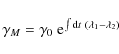
To wit, Eq. (<a href="/articles/aa/full_html/2009/36/aa12237-09/aa12237-09.html#logpar2">B.2</a>) describes the evolution of the electron distribution, growing broader and <EM>broader</EM> under the effect of stochastic acceleration, while its peak <EM>moves</EM> from <IMG
 WIDTH="17" HEIGHT="26" ALIGN="MIDDLE" BORDER="0"
 SRC="img251.png"
 ALT="$\gamma_0$">
to the current position
<br><p></p>
<DIV ALIGN="CENTER">

<!-- MATH: \begin{equation}
\gamma_{M}=\gamma_0~ {\rm e}^{\int{{\rm d}t~(\lambda_1-\lambda_2)}}
\end{equation} -->

<TABLE WIDTH="100%" ALIGN="CENTER">
<TR VALIGN="MIDDLE"><TD ALIGN="CENTER" NOWRAP><IMG
 WIDTH="119" HEIGHT="54"
 SRC="img252.png"
 ALT="\begin{displaymath}\gamma_{M}=\gamma_0~ {\rm e}^{\int{{\rm d}t~(\lambda_1-\lambda_2)}}
\end{displaymath}"></td>
<TD WIDTH=10 ALIGN="RIGHT">
(B.6)</td></tr>
</TABLE>
</DIV><BR CLEAR="ALL"><p></p>
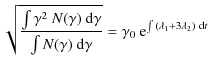
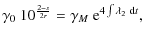
under the contrasting actions of the systematic and stochastic accelerations. An important quantity to focus on for the emission properties is the rms energy
<br>
<DIV ALIGN="CENTER">

<!-- MATH: \begin{eqnarray}
\gamma_{\rm p}&\equiv&\sqrt{\frac{\int{\gamma^2~ N(\gamma)~ {\rm d}\gamma}}{\int{ N(\gamma)~ {\rm d}\gamma}}}=\gamma_0~ {\rm e}^{\int{(\lambda_1+3\lambda_2)~{\rm d}t}} \nonumber \\
&=&\gamma_0~ {10}^{\frac{2-s}{2r}}
 =\gamma_{M}~{\rm e}^{{4\int{\lambda_2~{\rm d}t}}},
\end{eqnarray} -->

<TABLE ALIGN="CENTER" CELLPADDING="0" WIDTH="100%">
<TR VALIGN="MIDDLE"><TD NOWRAP ALIGN="RIGHT">&nbsp;&nbsp;&nbsp;&nbsp;&nbsp;&nbsp;&nbsp;&nbsp;&nbsp;&nbsp;&nbsp;&nbsp;&nbsp;&nbsp;&nbsp;&nbsp;&nbsp;&nbsp;&nbsp;&nbsp;&nbsp;&nbsp;&nbsp;&nbsp;&nbsp;&nbsp;&nbsp;<IMG
 WIDTH="17" HEIGHT="28" ALIGN="MIDDLE" BORDER="0"
 SRC="img61.png"
 ALT="$\displaystyle {\gamma_{\rm p}}$"></td>
<TD ALIGN="CENTER" NOWRAP><IMG
 WIDTH="13" HEIGHT="15" ALIGN="BOTTOM" BORDER="0"
 SRC="img253.png"
 ALT="$\textstyle \equiv$"></td>
<TD ALIGN="LEFT" NOWRAP><IMG
 WIDTH="210" HEIGHT="71" ALIGN="MIDDLE" BORDER="0"
 SRC="img254.png"
 ALT="$\displaystyle \sqrt{\frac{\int{\gamma^2~ N(\gamma)~ {\rm d}\gamma}}{\int{ N(\gamma)~ {\rm d}\gamma}}}=\gamma_0~ {\rm e}^{\int{(\lambda_1+3\lambda_2)~{\rm d}t}}$"></td>
<TD WIDTH=10 ALIGN="RIGHT">
&nbsp;</td></tr>
<TR VALIGN="MIDDLE"><TD NOWRAP ALIGN="RIGHT">&nbsp;</td>
<TD ALIGN="CENTER" NOWRAP>=</td>
<TD ALIGN="LEFT" NOWRAP><IMG
 WIDTH="144" HEIGHT="40" ALIGN="MIDDLE" BORDER="0"
 SRC="img255.png"
 ALT="$\displaystyle \gamma_0~ {10}^{\frac{2-s}{2r}}
=\gamma_{M}~{\rm e}^{{4\int{\lambda_2~{\rm d}t}}},$"></td>
<TD WIDTH=10 ALIGN="RIGHT">
(B.7)</td></tr>
</TABLE></DIV><BR CLEAR="ALL"><p></p>
which is also the position for the peak of the distribution 
<!-- MATH: $\gamma^2~ N(\gamma)$ -->
<IMG
 WIDTH="47" HEIGHT="30" ALIGN="MIDDLE" BORDER="0"
 SRC="img229.png"
 ALT="$\gamma^2~N(\gamma)$">.

<p>
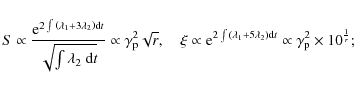
We have already derived in Appendix <a href="/articles/aa/full_html/2009/36/aa12237-09/aa12237-09.html#calcoli">A</a> the shapes of the spectra (synchrotron, and IC in both the Thomson and KN regimes) emitted by the distribution given in Eq. (<a href="/articles/aa/full_html/2009/36/aa12237-09/aa12237-09.html#logpar1">3</a>); here we stress the time dependence of their main spectral features. We can write for the synchrotron emission<A NAME="tex2html15"
 HREF="#foot2365"><sup><IMG  ALIGN="BOTTOM" BORDER="1" ALT="[*]" SRC="/icons/foot_motif.png"></sup></A>
<br><p></p>
<DIV ALIGN="CENTER">

<!-- MATH: \begin{equation}
S\propto \frac{{\rm e}^{2\int{\left({\lambda_1+3\lambda_2}\right){\rm d}t}}}{\sqrt{\int{\lambda_2~{\rm d}t}}}\propto \gamma_{\rm p}^2\sqrt{r},\quad
\xi\propto {\rm e}^{2\int{\left({\lambda_1+5\lambda_2}\right){\rm d}t}}\propto\gamma_{\rm p}^2\times 10^{\frac{1}{r}} ;
\end{equation} -->

<TABLE WIDTH="100%" ALIGN="CENTER">
<TR VALIGN="MIDDLE"><TD ALIGN="CENTER" NOWRAP><A NAME="fluxsincro"></A><IMG
 WIDTH="354" HEIGHT="89"
 SRC="img258.png"
 ALT="\begin{displaymath}
S\propto \frac{{\rm e}^{2\int{\left({\lambda_1+3\lambda_2}\r...
...ght){\rm d}t}}\propto\gamma_{\rm p}^2\times 10^{\frac{1}{r}} ;
\end{displaymath}"></td>
<TD WIDTH=10 ALIGN="RIGHT">
(B.8)</td></tr>
</TABLE>
</DIV><BR CLEAR="ALL"><p></p>
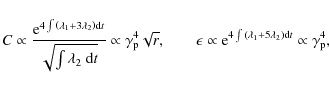
for IC emission we have in the Thomson regime
<br><p></p>
<DIV ALIGN="CENTER">

<!-- MATH: \begin{equation}
C\propto \frac{{\rm e}^{4\int{\left({\lambda_1+3\lambda_2}\right){\rm d}t}}}{\sqrt{\int{\lambda_2~{\rm d}t}}}\propto\gamma_{\rm p}^4\sqrt{r},\qquad
\epsilon\propto {\rm e}^{4\int{\left({\lambda_1+5\lambda_2}\right){\rm d}t}}\propto\gamma_{\rm p}^4,
\end{equation} -->

<TABLE WIDTH="100%" ALIGN="CENTER">
<TR VALIGN="MIDDLE"><TD ALIGN="CENTER" NOWRAP><IMG
 WIDTH="329" HEIGHT="89"
 SRC="img259.png"
 ALT="\begin{displaymath}C\propto \frac{{\rm e}^{4\int{\left({\lambda_1+3\lambda_2}\ri...
...\lambda_1+5\lambda_2}\right){\rm d}t}}\propto\gamma_{\rm p}^4,
\end{displaymath}"></td>
<TD WIDTH=10 ALIGN="RIGHT">
(B.9)</td></tr>
</TABLE>
</DIV><BR CLEAR="ALL"><p></p>
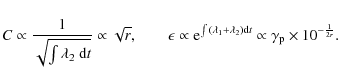
and in the extreme KN regime
<br><p></p>
<DIV ALIGN="CENTER">

<!-- MATH: \begin{equation}
C\propto  \frac{1}{\sqrt{\int{\lambda_2~{\rm d}t}}}\propto \sqrt{r},\qquad
\epsilon\propto {\rm e}^{\int{\left({\lambda_1+\lambda_2}\right){\rm d}t}}\propto\gamma_{\rm p}\times 10^{-\frac{1}{2r}}.
\end{equation} -->

<TABLE WIDTH="100%" ALIGN="CENTER">
<TR VALIGN="MIDDLE"><TD ALIGN="CENTER" NOWRAP><A NAME="fluxICKN"></A><IMG
 WIDTH="338" HEIGHT="84"
 SRC="img260.png"
 ALT="\begin{displaymath}
C\propto \frac{1}{\sqrt{\int{\lambda_2~{\rm d}t}}}\propto \s...
...ight){\rm d}t}}\propto\gamma_{\rm p}\times 10^{-\frac{1}{2r}}.
\end{displaymath}"></td>
<TD WIDTH=10 ALIGN="RIGHT">
(B.10)</td></tr>
</TABLE>
</DIV><BR CLEAR="ALL"><p></p>
Note that during flares, since 
<!-- MATH: $\lambda_1\gg \lambda_2$ -->
<IMG
 WIDTH="50" HEIGHT="26" ALIGN="MIDDLE" BORDER="0"
 SRC="img261.png"
 ALT="$\lambda_1\gg \lambda_2$">,
we expect the curvature to vary so little that we can therefore approximatively write 
<!-- MATH: $S\propto\xi$ -->
<IMG
 WIDTH="35" HEIGHT="26" ALIGN="MIDDLE" BORDER="0"
 SRC="img262.png"
 ALT="$S\propto\xi$">
(see main text).

<p>
Now we focus the above relations for the simple case of time independent <IMG
 WIDTH="16" HEIGHT="26" ALIGN="MIDDLE" BORDER="0"
 SRC="img236.png"
 ALT="$\lambda_1$">
and <IMG
 WIDTH="17" HEIGHT="26" ALIGN="MIDDLE" BORDER="0"
 SRC="img237.png"
 ALT="$\lambda_2$">,
when 
<!-- MATH: $\int{\lambda_{1,2}~ {\rm d}t}\approx\lambda_{1,2}~ t$ -->
<IMG
 WIDTH="95" HEIGHT="32" ALIGN="MIDDLE" BORDER="0"
 SRC="img263.png"
 ALT="$\int{\lambda_{1,2}~ {\rm d}t}\approx\lambda_{1,2}~ t$">;
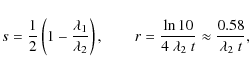
then we have
<br><p></p>
<DIV ALIGN="CENTER">

<!-- MATH: \begin{equation}
s=\frac{1}{2}\left( {1-\frac{\lambda_1}{\lambda_2}}\right),\qquad
r=\frac{\ln{10}}{4~\lambda_2~t}\approx  \frac{0.58}{\lambda_2~t},
\end{equation} -->

<TABLE WIDTH="100%" ALIGN="CENTER">
<TR VALIGN="MIDDLE"><TD ALIGN="CENTER" NOWRAP><A NAME="curvvstime"></A><IMG
 WIDTH="249" HEIGHT="72"
 SRC="img264.png"
 ALT="\begin{displaymath}
s=\frac{1}{2}\left( {1-\frac{\lambda_1}{\lambda_2}}\right),\...
...\frac{\ln{10}}{4~\lambda_2~t}\approx \frac{0.58}{\lambda_2~t},
\end{displaymath}"></td>
<TD WIDTH=10 ALIGN="RIGHT">
(B.11)</td></tr>
</TABLE>
</DIV><BR CLEAR="ALL"><p></p>
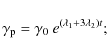
while for the rms energy we have
<br><p></p>
<DIV ALIGN="CENTER">

<!-- MATH: \begin{equation}
\gamma_{\rm p}=\gamma_0 ~{e}^{\left({\lambda_1+3\lambda_2}\right)t};
\end{equation} -->

<TABLE WIDTH="100%" ALIGN="CENTER">
<TR VALIGN="MIDDLE"><TD ALIGN="CENTER" NOWRAP><A NAME="r.m.s."></A><IMG
 WIDTH="107" HEIGHT="54"
 SRC="img265.png"
 ALT="\begin{displaymath}
\gamma_{\rm p}=\gamma_0 ~{e}^{\left({\lambda_1+3\lambda_2}\right)t};
\end{displaymath}"></td>
<TD WIDTH=10 ALIGN="RIGHT">
(B.12)</td></tr>
</TABLE>
</DIV><BR CLEAR="ALL"><p></p>
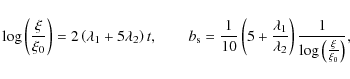
so for the peak frequency and the spectral curvature we have
<br><p></p>
<DIV ALIGN="CENTER">

<!-- MATH: \begin{equation}
\log{\left({\frac{\xi}{\xi_0}}\right)}={2 \left({\lambda_1+5\lambda_2}\right)t}, \qquad b_{\rm s} = \frac{1}{10}\left({5+\frac{\lambda_1}{\lambda_2}}\right)
\frac{1}{\log{\left({\frac{\xi}{\xi_0}}\right)}},
\end{equation} -->

<TABLE WIDTH="100%" ALIGN="CENTER">
<TR VALIGN="MIDDLE"><TD ALIGN="CENTER" NOWRAP><A NAME="curvvsxi"></A><IMG
 WIDTH="350" HEIGHT="79"
 SRC="img266.png"
 ALT="\begin{displaymath}
\log{\left({\frac{\xi}{\xi_0}}\right)}={2 \left({\lambda_1+5...
...a_2}}\right)
\frac{1}{\log{\left({\frac{\xi}{\xi_0}}\right)}},
\end{displaymath}"></td>
<TD WIDTH=10 ALIGN="RIGHT">
(B.13)</td></tr>
</TABLE>
</DIV><BR CLEAR="ALL"><p></p>
where <IMG
 WIDTH="15" HEIGHT="26" ALIGN="MIDDLE" BORDER="0"
 SRC="img267.png"
 ALT="$\xi_0$">
is a normalization frequency. It is seen that soon after the injection the curvature <IMG
 WIDTH="14" HEIGHT="26" ALIGN="MIDDLE" BORDER="0"
 SRC="img26.png"
 ALT="$b_{\rm s}$">
(proportional to <I>r</I>) <EM>drops</EM> rapidly, then progressively <EM>decreases</EM> more and more gently, while the peak frequency still <EM>increases</EM>.

<p>
The value of <IMG
 WIDTH="17" HEIGHT="26" ALIGN="MIDDLE" BORDER="0"
 SRC="img237.png"
 ALT="$\lambda_2$">
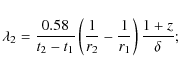
can be evaluated from observing the synchrotron spectral curvatures <I>b</I><SUB>2</SUB> and <I>b</I><SUB>1</SUB> at two times <I>t</I><SUB>2</SUB> and <I>t</I><SUB>1</SUB>, respectively (recall that 
<!-- MATH: $b_{\rm s}\approx r/5$ -->
<IMG
 WIDTH="51" HEIGHT="26" ALIGN="MIDDLE" BORDER="0"
 SRC="img227.png"
 ALT="$b_{\rm s} \approx r/5$">); denoting with <I>t</I><SUB>2</SUB> - <I>t</I><SUB>1</SUB> this time interval, we have
<br><p></p>
<DIV ALIGN="CENTER">

<!-- MATH: \begin{equation}
\lambda_2=\frac{0.58}{{t_2 - t_1}}\left( {\frac{1}{r_2}-\frac{1}{r_1}}\right) \frac{1+z}{\delta};
\end{equation} -->

<TABLE WIDTH="100%" ALIGN="CENTER">
<TR VALIGN="MIDDLE"><TD ALIGN="CENTER" NOWRAP><IMG
 WIDTH="178" HEIGHT="72"
 SRC="img268.png"
 ALT="\begin{displaymath}\lambda_2=\frac{0.58}{{t_2 - t_1}}\left( {\frac{1}{r_2}-\frac{1}{r_1}}\right) \frac{1+z}{\delta};
\end{displaymath}"></td>
<TD WIDTH=10 ALIGN="RIGHT">
(B.14)</td></tr>
</TABLE>
</DIV><BR CLEAR="ALL"><p></p>
on the other hand, form observing the related synchrotron peaks <IMG
 WIDTH="15" HEIGHT="26" ALIGN="MIDDLE" BORDER="0"
 SRC="img269.png"
 ALT="$\xi_2$">
and <IMG
 WIDTH="14" HEIGHT="26" ALIGN="MIDDLE" BORDER="0"
 SRC="img270.png"
 ALT="$\xi_1$">,
the value of <IMG
 WIDTH="16" HEIGHT="26" ALIGN="MIDDLE" BORDER="0"
 SRC="img236.png"
 ALT="$\lambda_1$">
can be evaluated as
<br><p></p>
<DIV ALIGN="CENTER">

<!-- MATH: \begin{equation}
\lambda_1=\left[{\frac{1}{2\left({t_2 - t_1}\right)}\ln{\left( {\frac{\xi_2}{\xi_1}}\right)}-\frac{2.88}{{t_2 - t_1}}
\left( {\frac{1}{r_2}-\frac{1}{r_1}}\right)}\right] \frac{1+z}{\delta}\cdot
\end{equation} -->

<TABLE WIDTH="100%" ALIGN="CENTER">
<TR VALIGN="MIDDLE"><TD ALIGN="CENTER" NOWRAP><IMG
 WIDTH="312" HEIGHT="72"
 SRC="img271.png"
 ALT="\begin{displaymath}\lambda_1=\left[{\frac{1}{2\left({t_2 - t_1}\right)}\ln{\left...
...{1}{r_2}-\frac{1}{r_1}}\right)}\right] \frac{1+z}{\delta}\cdot
\end{displaymath}"></td>
<TD WIDTH=10 ALIGN="RIGHT">
(B.15)</td></tr>
</TABLE>
</DIV><BR CLEAR="ALL"><p></p>
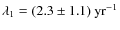
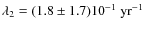
For example, in the case of Mrk&nbsp;501 in the states of 7 and 16 April 1997, we obtain (on assuming 
<!-- MATH: $B\approx\mbox{const.}$ -->
<IMG
 WIDTH="61" HEIGHT="26" ALIGN="MIDDLE" BORDER="0"
 SRC="img272.png"
 ALT="$B\approx\mbox{const.}$">)

<!-- MATH: $\lambda_1 = (2.3\pm 1.1)\mbox{ yr}^{-1}$ -->
<IMG
 WIDTH="120" HEIGHT="30" ALIGN="MIDDLE" BORDER="0"
 SRC="img273.png"
 ALT="$\lambda_1 = (2.3\pm 1.1)\mbox{ yr}^{-1}$">
and 
<!-- MATH: $\lambda_2 = (1.8\pm 1.7){10}^{-1}\mbox{ yr}^{-1}$ -->
<IMG
 WIDTH="144" HEIGHT="31" ALIGN="MIDDLE" BORDER="0"
 SRC="img274.png"
 ALT="$\lambda_2 = (1.8\pm 1.7){10}^{-1}\mbox{ yr}^{-1}$">,
corresponding to acceleration times 
<!-- MATH: $\tau_1=1/\lambda_1=(4.3\pm 2.0){10}^{-1}\mbox{ yr}$ -->
<IMG
 WIDTH="176" HEIGHT="31" ALIGN="MIDDLE" BORDER="0"
 SRC="img275.png"
 ALT="$\tau_1=1/\lambda_1=(4.3\pm 2.0){10}^{-1}\mbox{ yr}$">
and 
<!-- MATH: $\tau_2=1/\lambda_2=(5.5\pm 5.0)\mbox{ yr}$ -->
<IMG
 WIDTH="149" HEIGHT="26" ALIGN="MIDDLE" BORDER="0"
 SRC="img276.png"
 ALT="$\tau_2=1/\lambda_2=(5.5\pm 5.0)\mbox{ yr}$">.
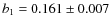
Note that with the current data the evaluations of <IMG
 WIDTH="16" HEIGHT="26" ALIGN="MIDDLE" BORDER="0"
 SRC="img236.png"
 ALT="$\lambda_1$">
and <IMG
 WIDTH="17" HEIGHT="26" ALIGN="MIDDLE" BORDER="0"
 SRC="img237.png"
 ALT="$\lambda_2$">
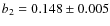
turn out to be affected by uncertainties considerably larger than the single curvatures 
<!-- MATH: $b_1=0.161\pm 0.007$ -->
<IMG
 WIDTH="111" HEIGHT="26" ALIGN="MIDDLE" BORDER="0"
 SRC="img277.png"
 ALT="$b_1=0.161\pm 0.007$">
and 
<!-- MATH: $b_2=0.148\pm 0.005$ -->
<IMG
 WIDTH="110" HEIGHT="26" ALIGN="MIDDLE" BORDER="0"
 SRC="img278.png"
 ALT="$b_2=0.148\pm 0.005$">.

<p>
If the total energy available to the jet is limited (e.g., by the BZ limit, see text) we expect that 
<!-- MATH: $\int{{\rm d}t~\lambda_1}$ -->
<IMG
 WIDTH="43" HEIGHT="32" ALIGN="MIDDLE" BORDER="0"
 SRC="img279.png"
 ALT="$\int{{\rm d}t~\lambda_1}$">
and 
<!-- MATH: $\int{{\rm d}t~\lambda_2}$ -->
<IMG
 WIDTH="42" HEIGHT="32" ALIGN="MIDDLE" BORDER="0"
 SRC="img280.png"
 ALT="$\int{{\rm d}t~\lambda_2}$">
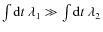
cannot grow indefinitely, but are to attain a <EM>limiting</EM> value. At low energies where 
<!-- MATH: $\int{{\rm d}t~\lambda_1}\gg\int{{\rm d}t~\lambda_2}$ -->
<IMG
 WIDTH="103" HEIGHT="32" ALIGN="MIDDLE" BORDER="0"
 SRC="img281.png"
 ALT="$\int{{\rm d}t~\lambda_1}\gg\int{{\rm d}t~\lambda_2}$">
holds, we have 
<!-- MATH: $S\propto \xi$ -->
<IMG
 WIDTH="35" HEIGHT="26" ALIGN="MIDDLE" BORDER="0"
 SRC="img262.png"
 ALT="$S\propto\xi$">
and 
<!-- MATH: $C\propto \epsilon$ -->
<IMG
 WIDTH="35" HEIGHT="26" ALIGN="MIDDLE" BORDER="0"
 SRC="img282.png"
 ALT="$C\propto \epsilon$">
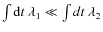
as before; at higher energies when 
<!-- MATH: $\int{{\rm d}t~\lambda_1}$ -->
<IMG
 WIDTH="43" HEIGHT="32" ALIGN="MIDDLE" BORDER="0"
 SRC="img279.png"
 ALT="$\int{{\rm d}t~\lambda_1}$">
reaches its limit, 
<!-- MATH: $\int{{\rm d}t~\lambda_1}\ll\int{dt~\lambda_2}$ -->
<IMG
 WIDTH="103" HEIGHT="32" ALIGN="MIDDLE" BORDER="0"
 SRC="img283.png"
 ALT="$\int{{\rm d}t~\lambda_1}\ll\int{dt~\lambda_2}$">
holds, leading to 
<!-- MATH: $S\propto \xi^{0.6}$ -->
<IMG
 WIDTH="49" HEIGHT="30" ALIGN="MIDDLE" BORDER="0"
 SRC="img109.png"
 ALT="$S\propto \xi^{0.6}$">
and 
<!-- MATH: $C\propto \epsilon^{0.6}$ -->
<IMG
 WIDTH="48" HEIGHT="30" ALIGN="MIDDLE" BORDER="0"
 SRC="img284.png"
 ALT="$C\propto \epsilon^{0.6}$">.
Eventually also 
<!-- MATH: $\int{{\rm d}t~\lambda_2}$ -->
<IMG
 WIDTH="42" HEIGHT="32" ALIGN="MIDDLE" BORDER="0"
 SRC="img280.png"
 ALT="$\int{{\rm d}t~\lambda_2}$">
reaches its limit, and both the fluxes and the peak frequencies cannot grow any more.

<p>

<h2 class="sec"><a name="SECTION000110000000000000000"></a><A NAME="constraints"></A>
Appendix C: Prefactors for Eqs. (<a href="/articles/aa/full_html/2009/36/aa12237-09/aa12237-09.html#prima">4</a>)-(<a href="/articles/aa/full_html/2009/36/aa12237-09/aa12237-09.html#ultima">13</a>)
</h2>

<p>
The HSZ SSC model is, as stated before, characterized by five parameters: the rms particle energy 
<!-- MATH: $\gamma_{\rm p}$ -->
<IMG
 WIDTH="17" HEIGHT="26" ALIGN="MIDDLE" BORDER="0"
 SRC="img13.png"
 ALT="$\gamma _{\rm p}$">,
the particle density <I>n</I>, the magnetic field <I>B</I>, the size of the emitting region <I>R</I> and the beaming factor <IMG
 WIDTH="10" HEIGHT="26" ALIGN="MIDDLE" BORDER="0"
 SRC="img29.png"
 ALT="$\delta$">.
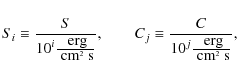
So the model may be constrained by five observables that we denote with
<br><p></p>
<DIV ALIGN="CENTER">

<!-- MATH: \begin{equation}
S_i\equiv\frac{S}{{10}^{i}\frac{\mbox{ erg}}{\mbox{ cm}^2\mbox{ s}}} ,
\qquad
C_j\equiv\frac{C}{{10}^{j}\frac{\mbox{ erg}}{\mbox{ cm}^2\mbox{ s}}},
\end{equation} -->

<TABLE WIDTH="100%" ALIGN="CENTER">
<TR VALIGN="MIDDLE"><TD ALIGN="CENTER" NOWRAP><IMG
 WIDTH="237" HEIGHT="77"
 SRC="img285.png"
 ALT="\begin{displaymath}S_i\equiv\frac{S}{{10}^{i}\frac{\mbox{ erg}}{\mbox{ cm}^2\mbo...
...iv\frac{C}{{10}^{j}\frac{\mbox{ erg}}{\mbox{ cm}^2\mbox{ s}}},
\end{displaymath}"></td>
<TD WIDTH=10 ALIGN="RIGHT">
(C.1)</td></tr>
</TABLE>
</DIV><BR CLEAR="ALL"><p></p><br><p></p>
<DIV ALIGN="CENTER">

<!-- MATH: \begin{equation}
\xi_k\equiv\frac{\xi}{{10}^{k}\mbox{ Hz}} ,
\qquad
\epsilon_h\equiv\frac{\epsilon}{{10}^{h}\mbox{ Hz}} ,
\end{equation} -->

<TABLE WIDTH="100%" ALIGN="CENTER">
<TR VALIGN="MIDDLE"><TD ALIGN="CENTER" NOWRAP><IMG
 WIDTH="197" HEIGHT="68"
 SRC="img286.png"
 ALT="\begin{displaymath}\xi_k\equiv\frac{\xi}{{10}^{k}\mbox{ Hz}} ,
\qquad
\epsilon_h\equiv\frac{\epsilon}{{10}^{h}\mbox{ Hz}} ,
\end{displaymath}"></td>
<TD WIDTH=10 ALIGN="RIGHT">
(C.2)</td></tr>
</TABLE>
</DIV><BR CLEAR="ALL"><p></p>
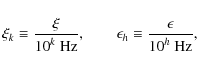
where the indexes <I>i</I>,<I>j</I>,<I>k</I>,<I>h</I> 
express the normalizations demonstrated below; in addition, we denote with 
<!-- MATH: $\Delta t_{\rm d}$ -->
<IMG
 WIDTH="22" HEIGHT="26" ALIGN="MIDDLE" BORDER="0"
 SRC="img287.png"
 ALT="$\Delta t_{\rm d}$">
the time in days for the source variations,  and with <I>D</I> the distance of the source in&nbsp;Gpc.

<p>
In the Thomson regime we find
<br>
<DIV ALIGN="CENTER">

<!-- MATH: \begin{eqnarray}
B &=&1.04\times 10^{-1}\nonumber\\
&&\times\left[{{b}^{\frac{1}{8}}~{D}^{-\frac{1}{2}}~{\left({1+z}\right)}^{\frac{1}{2}}~
{\xi_{14}}^{3}{C_{-11}}^{\frac{1}{4}}~{\Delta t_{\rm d}}^{\frac{1}{2}}~
{\epsilon_{22}}^{-\frac{3}{2}}~{S_{-11}}^{-\frac{1}{2}}}\right]\mbox{ G}
\\
\delta&=&13.5 \nonumber\\
&&\times\left[{{D}^{\frac{1}{2}}~{b}^{-\frac{1}{8}}~{\left({1+z}\right)}^{\frac{1}{2}} ~
{\epsilon_{22}}^{\frac{1}{2}}~{S_{-11}}^{\frac{1}{2}}~
{\xi_{14}}^{-1}~{C_{-11}}^{-\frac{1}{4}}{\Delta t_{\rm d}}^{-\frac{1}{2}}}\right]
\\
R&=&3.50\times 10^{16} \nonumber \\
&&\times\left[{{D}^{\frac{1}{2}} {b}^{-\frac{1}{8}}{\left({1\!+\!z}\right)}^{-\frac{1}{2}}~
{\epsilon_{22}}^{\frac{1}{2}}{S_{-11}}^{\frac{1}{2}}~{\Delta t_{\rm d}}^{\frac{1}{2}}~
{\xi_{14}}^{-1}~{C_{-11}}^{-\frac{1}{4}}}\right]\mbox{ cm}
\\
n&=&5.74 \times \left[{b}^{\frac{1}{8}}~{D}^{\frac{1}{2}}~{\left({1+z}\right)}^{\frac{1}{2}}\times 10^{\left({\frac{1}{5b}-1}\right)}~
{\xi_{14}}^{2}\right.
\nonumber\\
&&\times\left.{C_{-11}}^{\frac{5}{4}}~
{\epsilon_{22}}^{-\frac{3}{2}}~{S_{-11}}^{-\frac{3}{2}}~{\Delta t_{\rm d}}^{-\frac{1}{2}}\right]\mbox{ cm}^{-3}
\\
\gamma_{\rm p}&=&2.74\times 10^3~\left[{ {10}^{\frac{1}{2}\left({1-\frac{1}{5b}}\right)}~
{\epsilon_{22}}^{\frac{1}{2}}~{\xi_{14}}^{-\frac{1}{2}}}\right].

\end{eqnarray} -->

<TABLE ALIGN="CENTER" CELLPADDING="0" WIDTH="100%">
<TR VALIGN="MIDDLE"><TD NOWRAP ALIGN="RIGHT">&nbsp;&nbsp;&nbsp;&nbsp;&nbsp;&nbsp;&nbsp;&nbsp;&nbsp;&nbsp;&nbsp;&nbsp;&nbsp;&nbsp;&nbsp;&nbsp;&nbsp;&nbsp;&nbsp;&nbsp;&nbsp;&nbsp;&nbsp;&nbsp;&nbsp;&nbsp;&nbsp;&nbsp;&nbsp;&nbsp;&nbsp;&nbsp;&nbsp;&nbsp;&nbsp;&nbsp;&nbsp;&nbsp;&nbsp;&nbsp;&nbsp;<I>B</I></td>
<TD ALIGN="CENTER" NOWRAP>=</td>
<TD ALIGN="LEFT" NOWRAP><IMG
 WIDTH="76" HEIGHT="35" ALIGN="MIDDLE" BORDER="0"
 SRC="img288.png"
 ALT="$\displaystyle 1.04\times 10^{-1}$"></td>
<TD WIDTH=10 ALIGN="RIGHT">
&nbsp;</td></tr>
<TR VALIGN="MIDDLE"><TD NOWRAP ALIGN="RIGHT">&nbsp;</td>
<td>&nbsp;</td>
<TD ALIGN="LEFT" NOWRAP><IMG
 WIDTH="323" HEIGHT="37" ALIGN="MIDDLE" BORDER="0"
 SRC="img289.png"
 ALT="$\displaystyle \times\left[{{b}^{\frac{1}{8}}~{D}^{-\frac{1}{2}}~{\left({1+z}\ri...
...}{2}}~
{\epsilon_{22}}^{-\frac{3}{2}}~{S_{-11}}^{-\frac{1}{2}}}\right]\mbox{ G}$"></td>
<TD WIDTH=10 ALIGN="RIGHT">
(C.3)</td></tr>
<TR VALIGN="MIDDLE"><TD NOWRAP ALIGN="RIGHT"><IMG
 WIDTH="11" HEIGHT="28" ALIGN="MIDDLE" BORDER="0"
 SRC="img66.png"
 ALT="$\displaystyle {\delta}$"></td>
<TD ALIGN="CENTER" NOWRAP>=</td>
<TD ALIGN="LEFT" NOWRAP>13.5</td>
<TD WIDTH=10 ALIGN="RIGHT">
&nbsp;</td></tr>
<TR VALIGN="MIDDLE"><TD NOWRAP ALIGN="RIGHT">&nbsp;</td>
<td>&nbsp;</td>
<TD ALIGN="LEFT" NOWRAP><IMG
 WIDTH="311" HEIGHT="37" ALIGN="MIDDLE" BORDER="0"
 SRC="img290.png"
 ALT="$\displaystyle \times\left[{{D}^{\frac{1}{2}}~{b}^{-\frac{1}{8}}~{\left({1+z}\ri...
...xi_{14}}^{-1}~{C_{-11}}^{-\frac{1}{4}}{\Delta t_{\rm d}}^{-\frac{1}{2}}}\right]$"></td>
<TD WIDTH=10 ALIGN="RIGHT">
(C.4)</td></tr>
<TR VALIGN="MIDDLE"><TD NOWRAP ALIGN="RIGHT"><I>R</I></td>
<TD ALIGN="CENTER" NOWRAP>=</td>
<TD ALIGN="LEFT" NOWRAP><IMG
 WIDTH="73" HEIGHT="35" ALIGN="MIDDLE" BORDER="0"
 SRC="img291.png"
 ALT="$\displaystyle 3.50\times 10^{16}$"></td>
<TD WIDTH=10 ALIGN="RIGHT">
&nbsp;</td></tr>
<TR VALIGN="MIDDLE"><TD NOWRAP ALIGN="RIGHT">&nbsp;</td>
<td>&nbsp;</td>
<TD ALIGN="LEFT" NOWRAP><IMG
 WIDTH="325" HEIGHT="37" ALIGN="MIDDLE" BORDER="0"
 SRC="img292.png"
 ALT="$\displaystyle \times\left[{{D}^{\frac{1}{2}} {b}^{-\frac{1}{8}}{\left({1\!+\!z}...
...m d}}^{\frac{1}{2}}~
{\xi_{14}}^{-1}~{C_{-11}}^{-\frac{1}{4}}}\right]\mbox{ cm}$"></td>
<TD WIDTH=10 ALIGN="RIGHT">
(C.5)</td></tr>
<TR VALIGN="MIDDLE"><TD NOWRAP ALIGN="RIGHT"><I>n</I></td>
<TD ALIGN="CENTER" NOWRAP>=</td>
<TD ALIGN="LEFT" NOWRAP><IMG
 WIDTH="240" HEIGHT="39" ALIGN="MIDDLE" BORDER="0"
 SRC="img293.png"
 ALT="$\displaystyle 5.74 \times \left[{b}^{\frac{1}{8}}~{D}^{\frac{1}{2}}~{\left({1+z...
...}^{\frac{1}{2}}\times 10^{\left({\frac{1}{5b}-1}\right)}~
{\xi_{14}}^{2}\right.$"></td>
<TD WIDTH=10 ALIGN="RIGHT">
&nbsp;</td></tr>
<TR VALIGN="MIDDLE"><TD NOWRAP ALIGN="RIGHT">&nbsp;</td>
<td>&nbsp;</td>
<TD ALIGN="LEFT" NOWRAP><IMG
 WIDTH="222" HEIGHT="39" ALIGN="MIDDLE" BORDER="0"
 SRC="img294.png"
 ALT="$\displaystyle \times\left.{C_{-11}}^{\frac{5}{4}}~
{\epsilon_{22}}^{-\frac{3}{2...
...S_{-11}}^{-\frac{3}{2}}~{\Delta t_{\rm d}}^{-\frac{1}{2}}\right]\mbox{ cm}^{-3}$"></td>
<TD WIDTH=10 ALIGN="RIGHT">
(C.6)</td></tr>
<TR VALIGN="MIDDLE"><TD NOWRAP ALIGN="RIGHT"><IMG
 WIDTH="17" HEIGHT="28" ALIGN="MIDDLE" BORDER="0"
 SRC="img61.png"
 ALT="$\displaystyle {\gamma_{\rm p}}$"></td>
<TD ALIGN="CENTER" NOWRAP>=</td>
<TD ALIGN="LEFT" NOWRAP><IMG
 WIDTH="216" HEIGHT="39" ALIGN="MIDDLE" BORDER="0"
 SRC="img295.png"
 ALT="$\displaystyle 2.74\times 10^3~\left[{ {10}^{\frac{1}{2}\left({1-\frac{1}{5b}}\right)}~
{\epsilon_{22}}^{\frac{1}{2}}~{\xi_{14}}^{-\frac{1}{2}}}\right].$"></td>
<TD WIDTH=10 ALIGN="RIGHT">
(C.7)</td></tr>
</TABLE></DIV><BR CLEAR="ALL"><p></p>
For the extreme KN regime we obtain
<br>
<DIV ALIGN="CENTER">

<!-- MATH: \begin{eqnarray}
B&=&1.72\times 10^{-2} \nonumber \\
&&\times\left[{{D}^{\frac{2}{5}}{b}^{\frac{1}{10}}{(1+z)}^{-\frac{2}{5}}
{\xi_{18}}^{\frac{2}{5}}{S_{-10}}^{\frac{2}{5}}
{\epsilon_{26}}^{-\frac{8}{5}}{C_{-11}}^{-\frac{1}{5}}{\Delta t_{\rm d}}^{-\frac{2}{5}}}\right]\mbox{ G}
\\
\delta&=&4.21
\times\left[{D}^{\frac{2}{5}}~{b}^{-\frac{1}{10}}~
{10}^{\frac{4}{5}\left({\frac{1}{5b}-1}\right)}~
{(1+z)}^{\frac{3}{5}}~
{\epsilon_{26}}^{\frac{2}{5}}\right.\nonumber\\
&&\times \left.
{S_{-10}}^{\frac{2}{5}}~
{\xi_{18}}^{-\frac{3}{5}}~{C_{-11}}^{-\frac{1}{5}}~{\Delta t_{\rm d}}^{-\frac{2}{5}}\right]
\\
R&=&1.09~ {10}^{16} 
\times\left[{D}^{\frac{2}{5}}~{b}^{-\frac{1}{10}}\times 10^{\frac{4}{5}\left({\frac{1}{5b}-1}\right)}~{(1+z)}^{-\frac{2}{5}}~
{\epsilon_{26}}^{\frac{2}{5}}
\right.\nonumber\\
&&\times \left.
{S_{-10}}^{\frac{2}{5}}~{\Delta t_{\rm d}}^{\frac{3}{5}}~
{\xi_{18}}^{-\frac{3}{5}}~{C_{-11}}^{-\frac{1}{5}}\right]\mbox{ cm}
\\
n&=&952 
\times\left[{b}^{\frac{1}{5}}~{D}^{-\frac{4}{5}}\times 10^{\frac{13}{5}\left({1-\frac{1}{5b}}\right)}~{(1+z)}^{\frac{4}{5}}~
{\xi_{18}}^{\frac{11}{5}}~{C_{-11}}^{\frac{7}{5}}~
{\epsilon_{26}}^{-\frac{4}{5}}
\right.\nonumber\\
&&\times \left.
{S_{-10}}^{-\frac{9}{5}}~{\Delta t_{\rm d}}^{-\frac{1}{5}}\right]\mbox{ cm}^{-3}
\\
\gamma_{\rm p}&=&6.07\times 10^{5}\times\left[{b}^{\frac{1}{10}}~{D}^{-\frac{2}{5}}\times 10^{\frac{3}{10}\left({1-\frac{1}{5b}}\right)}~{(1+z)}^{\frac{2}{5}}~
{\xi_{18}}^{\frac{3}{5}}~{\epsilon_{26}}^{\frac{3}{5}}
\right.\nonumber\\
&&\times \left.
{C_{-11}}^{\frac{1}{5}}~{\Delta t_{\rm d}}^{\frac{2}{5}}~
{S_{-10}}^{-\frac{2}{5}}\right].

\end{eqnarray} -->

<TABLE ALIGN="CENTER" CELLPADDING="0" WIDTH="100%">
<TR VALIGN="MIDDLE"><TD NOWRAP ALIGN="RIGHT">&nbsp;&nbsp;&nbsp;&nbsp;&nbsp;&nbsp;&nbsp;&nbsp;&nbsp;&nbsp;&nbsp;&nbsp;&nbsp;&nbsp;&nbsp;&nbsp;&nbsp;&nbsp;&nbsp;&nbsp;&nbsp;&nbsp;&nbsp;&nbsp;&nbsp;&nbsp;&nbsp;&nbsp;&nbsp;&nbsp;&nbsp;&nbsp;&nbsp;&nbsp;&nbsp;&nbsp;&nbsp;&nbsp;&nbsp;&nbsp;&nbsp;<I>B</I></td>
<TD ALIGN="CENTER" NOWRAP>=</td>
<TD ALIGN="LEFT" NOWRAP><IMG
 WIDTH="76" HEIGHT="35" ALIGN="MIDDLE" BORDER="0"
 SRC="img296.png"
 ALT="$\displaystyle 1.72\times 10^{-2}$"></td>
<TD WIDTH=10 ALIGN="RIGHT">
&nbsp;</td></tr>
<TR VALIGN="MIDDLE"><TD NOWRAP ALIGN="RIGHT">&nbsp;</td>
<td>&nbsp;</td>
<TD ALIGN="LEFT" NOWRAP><IMG
 WIDTH="313" HEIGHT="37" ALIGN="MIDDLE" BORDER="0"
 SRC="img297.png"
 ALT="$\displaystyle \times\left[{{D}^{\frac{2}{5}}{b}^{\frac{1}{10}}{(1+z)}^{-\frac{2...
...}{5}}{C_{-11}}^{-\frac{1}{5}}{\Delta t_{\rm d}}^{-\frac{2}{5}}}\right]\mbox{ G}$"></td>
<TD WIDTH=10 ALIGN="RIGHT">
(C.8)</td></tr>
<TR VALIGN="MIDDLE"><TD NOWRAP ALIGN="RIGHT"><IMG
 WIDTH="11" HEIGHT="28" ALIGN="MIDDLE" BORDER="0"
 SRC="img66.png"
 ALT="$\displaystyle {\delta}$"></td>
<TD ALIGN="CENTER" NOWRAP>=</td>
<TD ALIGN="LEFT" NOWRAP><IMG
 WIDTH="248" HEIGHT="39" ALIGN="MIDDLE" BORDER="0"
 SRC="img298.png"
 ALT="$\displaystyle 4.21
\times\left[{D}^{\frac{2}{5}}~{b}^{-\frac{1}{10}}~
{10}^{\fr...
...{1}{5b}-1}\right)}~
{(1+z)}^{\frac{3}{5}}~
{\epsilon_{26}}^{\frac{2}{5}}\right.$"></td>
<TD WIDTH=10 ALIGN="RIGHT">
&nbsp;</td></tr>
<TR VALIGN="MIDDLE"><TD NOWRAP ALIGN="RIGHT">&nbsp;</td>
<td>&nbsp;</td>
<TD ALIGN="LEFT" NOWRAP><IMG
 WIDTH="183" HEIGHT="39" ALIGN="MIDDLE" BORDER="0"
 SRC="img299.png"
 ALT="$\displaystyle \times \left.
{S_{-10}}^{\frac{2}{5}}~
{\xi_{18}}^{-\frac{3}{5}}~{C_{-11}}^{-\frac{1}{5}}~{\Delta t_{\rm d}}^{-\frac{2}{5}}\right]$"></td>
<TD WIDTH=10 ALIGN="RIGHT">
(C.9)</td></tr>
<TR VALIGN="MIDDLE"><TD NOWRAP ALIGN="RIGHT"><I>R</I></td>
<TD ALIGN="CENTER" NOWRAP>=</td>
<TD ALIGN="LEFT" NOWRAP><IMG
 WIDTH="293" HEIGHT="37" ALIGN="MIDDLE" BORDER="0"
 SRC="img300.png"
 ALT="$\displaystyle 1.09~ {10}^{16}
\times\left[{D}^{\frac{2}{5}}~{b}^{-\frac{1}{10}}...
...1}{5b}-1}\right)}~{(1+z)}^{-\frac{2}{5}}~
{\epsilon_{26}}^{\frac{2}{5}}
\right.$"></td>
<TD WIDTH=10 ALIGN="RIGHT">
&nbsp;</td></tr>
<TR VALIGN="MIDDLE"><TD NOWRAP ALIGN="RIGHT">&nbsp;</td>
<td>&nbsp;</td>
<TD ALIGN="LEFT" NOWRAP><IMG
 WIDTH="201" HEIGHT="39" ALIGN="MIDDLE" BORDER="0"
 SRC="img301.png"
 ALT="$\displaystyle \times \left.
{S_{-10}}^{\frac{2}{5}}~{\Delta t_{\rm d}}^{\frac{3}{5}}~
{\xi_{18}}^{-\frac{3}{5}}~{C_{-11}}^{-\frac{1}{5}}\right]\mbox{ cm}$"></td>
<TD WIDTH=10 ALIGN="RIGHT">
(C.10)</td></tr>
<TR VALIGN="MIDDLE"><TD NOWRAP ALIGN="RIGHT"><I>n</I></td>
<TD ALIGN="CENTER" NOWRAP>=</td>
<TD ALIGN="LEFT" NOWRAP><IMG
 WIDTH="333" HEIGHT="37" ALIGN="MIDDLE" BORDER="0"
 SRC="img302.png"
 ALT="$\displaystyle 952
\times\left[{b}^{\frac{1}{5}}~{D}^{-\frac{4}{5}}\times 10^{\f...
...^{\frac{11}{5}}~{C_{-11}}^{\frac{7}{5}}~
{\epsilon_{26}}^{-\frac{4}{5}}
\right.$"></td>
<TD WIDTH=10 ALIGN="RIGHT">
&nbsp;</td></tr>
<TR VALIGN="MIDDLE"><TD NOWRAP ALIGN="RIGHT">&nbsp;</td>
<td>&nbsp;</td>
<TD ALIGN="LEFT" NOWRAP><IMG
 WIDTH="143" HEIGHT="39" ALIGN="MIDDLE" BORDER="0"
 SRC="img303.png"
 ALT="$\displaystyle \times \left.
{S_{-10}}^{-\frac{9}{5}}~{\Delta t_{\rm d}}^{-\frac{1}{5}}\right]\mbox{ cm}^{-3}$"></td>
<TD WIDTH=10 ALIGN="RIGHT">
(C.11)</td></tr>
<TR VALIGN="MIDDLE"><TD NOWRAP ALIGN="RIGHT"><IMG
 WIDTH="17" HEIGHT="28" ALIGN="MIDDLE" BORDER="0"
 SRC="img61.png"
 ALT="$\displaystyle {\gamma_{\rm p}}$"></td>
<TD ALIGN="CENTER" NOWRAP>=</td>
<TD ALIGN="LEFT" NOWRAP><IMG
 WIDTH="327" HEIGHT="37" ALIGN="MIDDLE" BORDER="0"
 SRC="img304.png"
 ALT="$\displaystyle 6.07\times 10^{5}\times\left[{b}^{\frac{1}{10}}~{D}^{-\frac{2}{5}...
...}^{\frac{2}{5}}~
{\xi_{18}}^{\frac{3}{5}}~{\epsilon_{26}}^{\frac{3}{5}}
\right.$"></td>
<TD WIDTH=10 ALIGN="RIGHT">
&nbsp;</td></tr>
<TR VALIGN="MIDDLE"><TD NOWRAP ALIGN="RIGHT">&nbsp;</td>
<td>&nbsp;</td>
<TD ALIGN="LEFT" NOWRAP><IMG
 WIDTH="146" HEIGHT="39" ALIGN="MIDDLE" BORDER="0"
 SRC="img305.png"
 ALT="$\displaystyle \times \left.
{C_{-11}}^{\frac{1}{5}}~{\Delta t_{\rm d}}^{\frac{2}{5}}~
{S_{-10}}^{-\frac{2}{5}}\right].$"></td>
<TD WIDTH=10 ALIGN="RIGHT">
(C.12)</td></tr>
</TABLE></DIV><BR CLEAR="ALL"><p></p>
<p>

<p>
<br>

</div></body></html>