<!DOCTYPE html PUBLIC "-//W3C//DTD XHTML 1.0 Transitional//EN">
<html xmlns:xlink="http://www.w3.org/1999/xlink" xmlns:mml="http://www.w3.org/1998/Math/MathML">
<link rel="stylesheet" type="text/css" href="../../../CSS_FULL/edps_full.css">
<body><div id="contenu_olm">

<!-- DOI: 10.1051/0004-6361/200912559 -->

<h2 class="sec">Online Material</h2>

<p>


<p>

<h2 class="sec"><a name="SECTION000100000000000000000"></a><A NAME="sec:app_irr"></A>
Appendix A: Photoproduct growth curves  during UV-irradiation
</h2>

<p>

<h3 class="sec2"><a name="SECTION000101000000000000000"></a>A.1 Pure CH<SUB>3</SUB>OH ice at different temperatures
</h3>

<p>
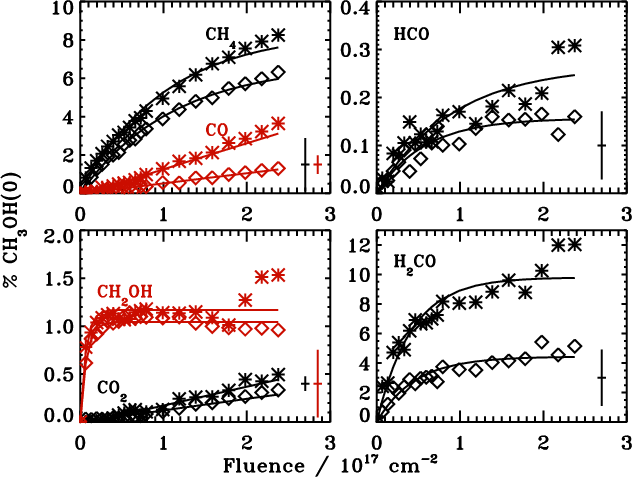
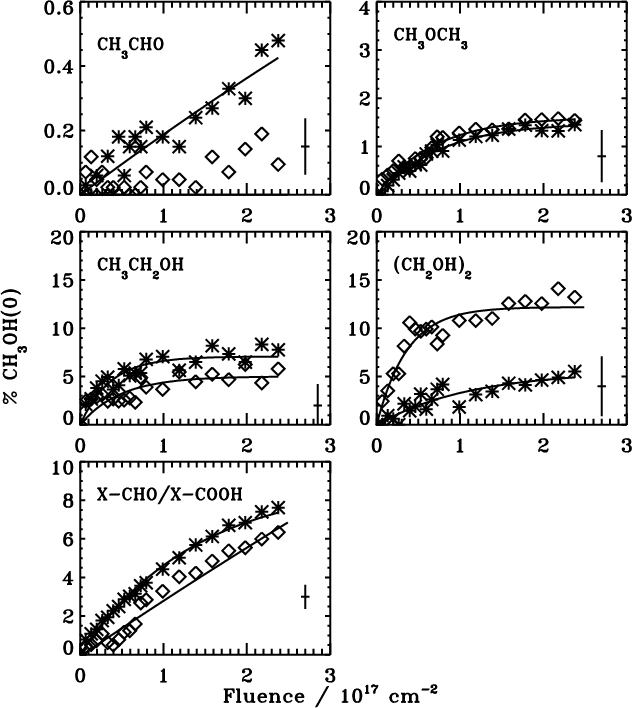
Figures <a href="/articles/aa/full_html/2009/36/aa12559-09/aa12559-09.html#fig:app_quant_simp">A.1</a> and <a href="/articles/aa/full_html/2009/36/aa12559-09/aa12559-09.html#fig:app_quant_comp">A.2</a> show the increasing abundances of photoproducts during irradiation of pure CH<SUB>3</SUB>OH&nbsp;ices at&nbsp;30 and 50&nbsp;K (experiments&nbsp;2 and&nbsp;3). The abundances are fitted as a function of UV fluence as described fully in Sect.&nbsp;<a href="/articles/aa/full_html/2009/36/aa12559-09/aa12559-09.html#sec:res_quant">3.6</a>  for 20&nbsp;K and 70&nbsp;K ices. The abundances follow the temperature trends suggested by the 20&nbsp;K and 70&nbsp;K&nbsp;ices (experiments&nbsp;1 and&nbsp;4), except possibly for CH<SUB>3</SUB>CH<SUB>2</SUB>OH, which seems to be enhanced at 30&nbsp;K compared to the other ices. This enhancement is barely significant however. The fit coefficients and uncertainties for all irradiated <IMG
 WIDTH="12" HEIGHT="14" ALIGN="BOTTOM" BORDER="0"
 SRC="img10.png"
 ALT="$\sim $">20&nbsp;L, pure CH<SUB>3</SUB>OH ices are reported in Table&nbsp;<a href="/articles/aa/full_html/2009/36/aa12559-09/aa12559-09.html#tab:fits_1">C.1</a>.

<p>
<div class="inset-old">
<table>
<tr><td><!-- init Label --><A NAME="fig:app_quant_simp">&#160;</A><!-- end Label--><A NAME="2155"></A><A NAME="figure1761"
 HREF="img96.png"><IMG
 WIDTH="100" HEIGHT="76" SRC="Timg96.png"
 ALT="\begin{figure}
\par\resizebox{9cm}{!}{\includegraphics{12559f23.eps}}
\end{figure}"></A><!-- HTML Figure number: 23 --></td>
<td class="img-txt"><span class="bold">Figure A.1:</span><p>
The evolution of small CH<SUB>3</SUB>OH photo-products with respect to UV fluence in&nbsp;% of the initial CH<SUB>3</SUB>OH ice abundance, CH<SUB>3</SUB>OH(0), in each experiment at 30&nbsp;K (stars) and 50&nbsp;K (diamonds). The relative uncertainty for each abundance is indicated in the bottom right corner. The lines are exponential fits to the abundance growths.</p></td>
</tr><tr><td colspan="2"><a href="http://dexter.edpsciences.org/applet.php?pdf_id=23&DOI=10.1051/0004-6361/200912559" target="DEXTER">Open with DEXTER</a></td></tr>

</table></div>
<p>
<div class="inset-old">
<table>
<tr><td><!-- init Label --><A NAME="fig:app_quant_comp">&#160;</A><!-- end Label--><A NAME="2157"></A><A NAME="figure1768"
 HREF="img97.png"><IMG
 WIDTH="100" HEIGHT="113" SRC="Timg97.png"
 ALT="\begin{figure}
\par\resizebox{9cm}{!}{\includegraphics{12559f24.eps}}
\end{figure}"></A><!-- HTML Figure number: 24 --></td>
<td class="img-txt"><span class="bold">Figure A.2:</span><p>
The evolution of complex CH<SUB>3</SUB>OH photo-products with respect to UV fluence in % of the initial CH<SUB>3</SUB>OH ice abundance. Otherwise as Fig.&nbsp;<a href="/articles/aa/full_html/2009/36/aa12559-09/aa12559-09.html#fig:app_quant_simp">A.1</a>.</p></td>
</tr><tr><td colspan="2"><a href="http://dexter.edpsciences.org/applet.php?pdf_id=24&DOI=10.1051/0004-6361/200912559" target="DEXTER">Open with DEXTER</a></td></tr>

</table></div>
<p>

<h3 class="sec2"><a name="SECTION000102000000000000000"></a>
A.2 High fluence experiments
</h3>

<p>
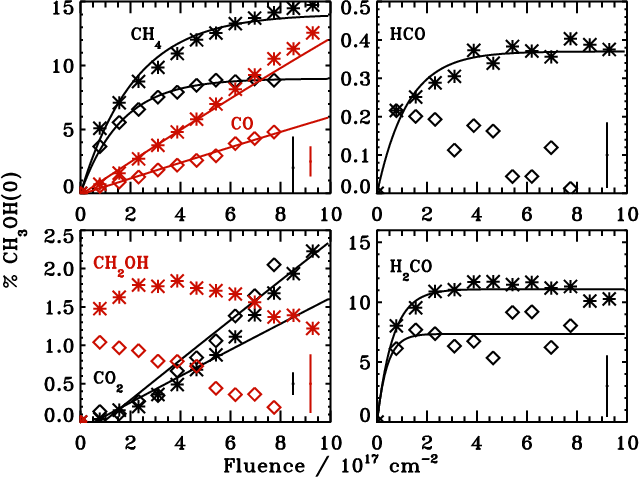
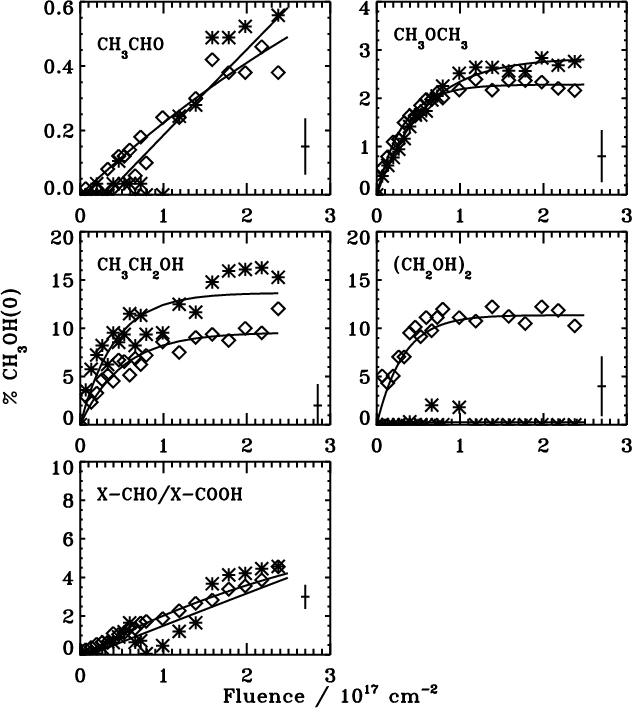
Figures <a href="/articles/aa/full_html/2009/36/aa12559-09/aa12559-09.html#fig:app_quant_simp_hf">A.3</a> and <a href="/articles/aa/full_html/2009/36/aa12559-09/aa12559-09.html#fig:app_quant_comp_hf">A.4</a> show the increasing abundances of photoproducts during irradiation at 20&nbsp;K and 50&nbsp;K with a high flux 
(experiments&nbsp;5 and&nbsp;6), together with the fitted growth curves. The first 
<!-- MATH: $2.5\times10^{17}$ -->
<IMG
 WIDTH="60" HEIGHT="30" ALIGN="MIDDLE" BORDER="0"
 SRC="img98.png"
 ALT="$2.5\times10^{17}$">&nbsp;photons&nbsp;cm<sup>-2</sup> are consistent with the low flux experiments within the experimental uncertainties. For molecules such as  CH<SUB>3</SUB>CHO that forms slowly, these experiments provide better constraints on the production rates than the low flux experiments. In contrast, molecules and fragments with high production rates are better constrained by the lower flux experiments, since they have a abundance determinations at a higher fluence resolution. The production rates of molecules that are destroyed/photodesorbed faster than they are produced at high fluences cannot be fit in these experiments. The fit coefficients of these experiments are reported in Table&nbsp;<a href="/articles/aa/full_html/2009/36/aa12559-09/aa12559-09.html#tab:fits_1">C.1</a>.

<p>
<div class="inset-old">
<table>
<tr><td><!-- init Label --><A NAME="fig:app_quant_simp_hf">&#160;</A><!-- end Label--><A NAME="2159"></A><A NAME="figure1782"
 HREF="img99.png"><IMG
 WIDTH="101" HEIGHT="76" SRC="Timg99.png"
 ALT="\begin{figure}
\par\resizebox{9cm}{!}{\includegraphics{12559f25.eps}}
\end{figure}"></A><!-- HTML Figure number: 25 --></td>
<td class="img-txt"><span class="bold">Figure A.3:</span><p>
The evolution of small CH<SUB>3</SUB>OH photo-products with respect to UV fluence in % of the initial CH<SUB>3</SUB>OH ice abundance (CH<SUB>3</SUB>OH(0)) in the two high flux/fluence experiments at 20&nbsp;K (stars) and 50&nbsp;K (diamonds). The relative uncertainty for each abundance is indicated in the bottom right corner. The lines are exponential fits to the abundance growths.</p></td>
</tr><tr><td colspan="2"><a href="http://dexter.edpsciences.org/applet.php?pdf_id=25&DOI=10.1051/0004-6361/200912559" target="DEXTER">Open with DEXTER</a></td></tr>

</table></div>
<p>
<div class="inset-old">
<table>
<tr><td><!-- init Label --><A NAME="fig:app_quant_comp_hf">&#160;</A><!-- end Label--><A NAME="2161"></A><A NAME="figure1789"
 HREF="img100.png"><IMG
 WIDTH="101" HEIGHT="113" SRC="Timg100.png"
 ALT="\begin{figure}
\par\resizebox{9cm}{!}{\includegraphics{12559f26.eps}}
\end{figure}"></A><!-- HTML Figure number: 26 --></td>
<td class="img-txt"><span class="bold">Figure A.4:</span><p>
The evolution of complex CH<SUB>3</SUB>OH photo-products with respect to UV fluence in&nbsp;% of the initial CH<SUB>3</SUB>OH ice abundance. Otherwise as 
Fig.&nbsp;<a href="/articles/aa/full_html/2009/36/aa12559-09/aa12559-09.html#fig:app_quant_simp_hf">A.3</a>.</p></td>
</tr><tr><td colspan="2"><a href="http://dexter.edpsciences.org/applet.php?pdf_id=26&DOI=10.1051/0004-6361/200912559" target="DEXTER">Open with DEXTER</a></td></tr>

</table></div>
<p>

<h3 class="sec2"><a name="SECTION000103000000000000000"></a>A.3 CH<SUB>4</SUB> and CO mixtures
</h3>

<p>
<div class="inset-old">
<table>
<tr><td><!-- init Label --><A NAME="fig:app_quant_simp_co">&#160;</A><!-- end Label--><A NAME="2164"></A><A NAME="figure1798"
 HREF="img101.png"><IMG
 WIDTH="100" HEIGHT="76" SRC="Timg101.png"
 ALT="\begin{figure}
\par\resizebox{9cm}{!}{\includegraphics{12559f27.eps}}
\end{figure}"></A><!-- HTML Figure number: 27 --></td>
<td class="img-txt"><span class="bold">Figure A.5:</span><p>
The evolution of small photo-products with respect to UV fluence in % of the initial CH<SUB>3</SUB>OH ice abundance in CH<SUB>3</SUB>OH:CO 1:1 ice mixture experiments at 30&nbsp;K (stars) and 50&nbsp;K  (diamonds).</p></td>
</tr><tr><td colspan="2"><a href="http://dexter.edpsciences.org/applet.php?pdf_id=27&DOI=10.1051/0004-6361/200912559" target="DEXTER">Open with DEXTER</a></td></tr>

</table></div>
<p>
<div class="inset-old">
<table>
<tr><td><!-- init Label --><A NAME="fig:app_quant_comp_co">&#160;</A><!-- end Label--><A NAME="2166"></A><A NAME="figure1805"
 HREF="img102.png"><IMG
 WIDTH="100" HEIGHT="113" SRC="Timg102.png"
 ALT="\begin{figure}
\par\resizebox{9cm}{!}{\includegraphics{12559f28.eps}}
\end{figure}"></A><!-- HTML Figure number: 28 --></td>
<td class="img-txt"><span class="bold">Figure A.6:</span><p>
The evolution of complex photo-products with respect to 
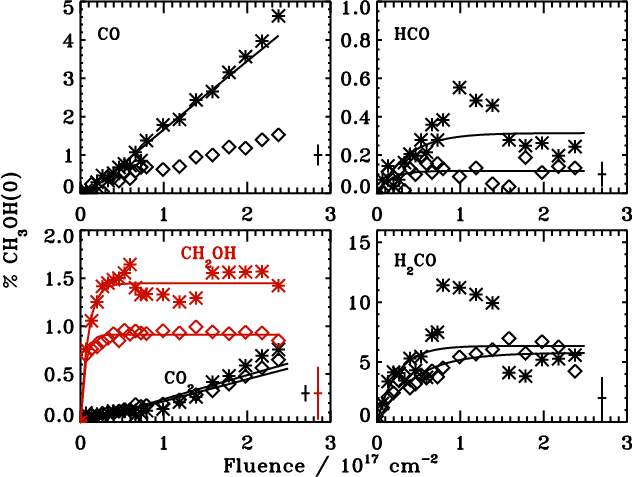
UV&nbsp;fluence in&nbsp;% of the initial CH<SUB>3</SUB>OH ice abundance in CH<SUB>3</SUB>OH:CO 1:1 ice mixture experiments at 30&nbsp;K (stars) and 50&nbsp;K  (diamonds). </p></td>
</tr><tr><td colspan="2"><a href="http://dexter.edpsciences.org/applet.php?pdf_id=28&DOI=10.1051/0004-6361/200912559" target="DEXTER">Open with DEXTER</a></td></tr>

</table></div>
<p>
<div class="inset-old">
<table>
<tr><td><!-- init Label --><A NAME="fig:app_quant_simp_ch4">&#160;</A><!-- end Label--><A NAME="2168"></A><A NAME="figure1812"
 HREF="img103.png"><IMG
 WIDTH="100" HEIGHT="76" SRC="Timg103.png"
 ALT="\begin{figure}
\par\resizebox{9cm}{!}{\includegraphics{12559f29.eps}}
\end{figure}"></A><!-- HTML Figure number: 29 --></td>
<td class="img-txt"><span class="bold">Figure A.7:</span><p>
The evolution of small photo-products with respect to UV fluence in&nbsp;% of the initial CH<SUB>3</SUB>OH ice abundance in CH<SUB>3</SUB>OH:CH<SUB>4</SUB> 1:2 ice mixture experiments at 30&nbsp;K (stars) and 50&nbsp;K  (diamonds).</p></td>
</tr><tr><td colspan="2"><a href="http://dexter.edpsciences.org/applet.php?pdf_id=29&DOI=10.1051/0004-6361/200912559" target="DEXTER">Open with DEXTER</a></td></tr>

</table></div>
<p>
<div class="inset-old">
<table>
<tr><td><!-- init Label --><A NAME="fig:app_quant_comp_ch4">&#160;</A><!-- end Label--><A NAME="2170"></A><A NAME="figure1819"
 HREF="img104.png"><IMG
 WIDTH="100" HEIGHT="113" SRC="Timg104.png"
 ALT="\begin{figure}
\par\resizebox{9cm}{!}{\includegraphics{12559f30.eps}}
\end{figure}"></A><!-- HTML Figure number: 30 --></td>
<td class="img-txt"><span class="bold">Figure A.8:</span><p>
The evolution of small photo-products with respect to UV fluence in % of the initial CH<SUB>3</SUB>OH ice abundance in CH<SUB>3</SUB>OH:CH<SUB>4</SUB> 1:2 ice mixture experiments at 30&nbsp;K (stars) and 50&nbsp;K  (diamonds). </p></td>
</tr><tr><td colspan="2"><a href="http://dexter.edpsciences.org/applet.php?pdf_id=30&DOI=10.1051/0004-6361/200912559" target="DEXTER">Open with DEXTER</a></td></tr>

</table></div>
<p>
Figures <a href="/articles/aa/full_html/2009/36/aa12559-09/aa12559-09.html#fig:app_quant_simp_co">A.5</a>-<a href="/articles/aa/full_html/2009/36/aa12559-09/aa12559-09.html#fig:app_quant_comp_ch4">A.8</a> show the increasing abundances of photoproducts during irradiation of CH<SUB>3</SUB>OH:CH<SUB>4</SUB> 1:2 and CH<SUB>3</SUB>OH:CO 1:1&nbsp;mixtures at 30&nbsp;K and 50&nbsp;K together with fitted growth curves. The temperature trends are similar to what is seen for pure CH<SUB>3</SUB>OH ice.  As suggested from the spectra in Sect.&nbsp;<a href="/articles/aa/full_html/2009/36/aa12559-09/aa12559-09.html#sec:res_depend_comp">3.3.5</a>, all HCO containing species are increased in abundance in the CO mixtures, with the exception of CH<SUB>3</SUB>CHO, which is mainly enhanced in the CH<SUB>4</SUB> ice mixture. The other two CH<SUB>3</SUB> containing species, CH<SUB>3</SUB>CH<SUB>2</SUB>OH and CH<SUB>3</SUB>OCH<SUB>3</SUB>, are also enhanced in the CH<SUB>4</SUB> mixture compared both to pure CH<SUB>3</SUB>OH and the CO ice mixture - in the CO mixtures the abundance points represent upper limits. In contrast the (CH<SUB>2</SUB>OH)<SUB>2</SUB> production is suppressed in both ice mixtures at 30&nbsp;K. The fit coefficients of these experiments and CO:CH<SUB>3</SUB>OH 1:1&nbsp;mixture irradiated at 20&nbsp;K are reported in Table&nbsp;<a href="/articles/aa/full_html/2009/36/aa12559-09/aa12559-09.html#tab:fits_2">C.2</a>.

<p>

<h2 class="sec"><a name="SECTION000110000000000000000"></a><A NAME="sec:app_warm"></A>
Appendix B: Formation and destruction curves during warm-up
</h2>

<p>

<h3 class="sec2"><a name="SECTION000111000000000000000"></a><A NAME="sec:app_warm_temp"></A>
B.1 Pure CH<SUB>3</SUB>OH at different irradiation temperatures
</h3>

<p>
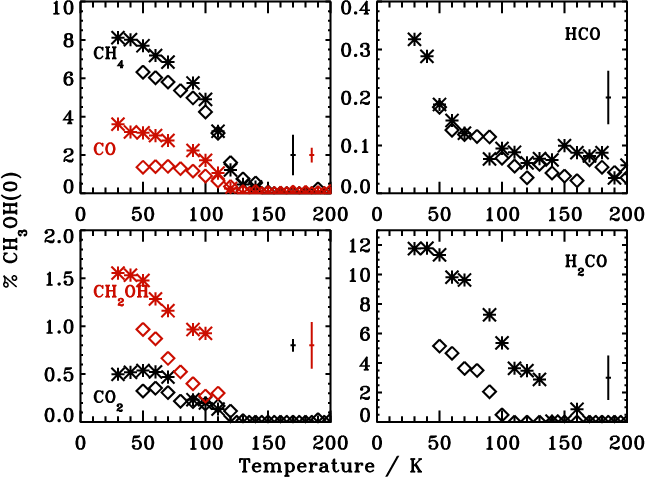
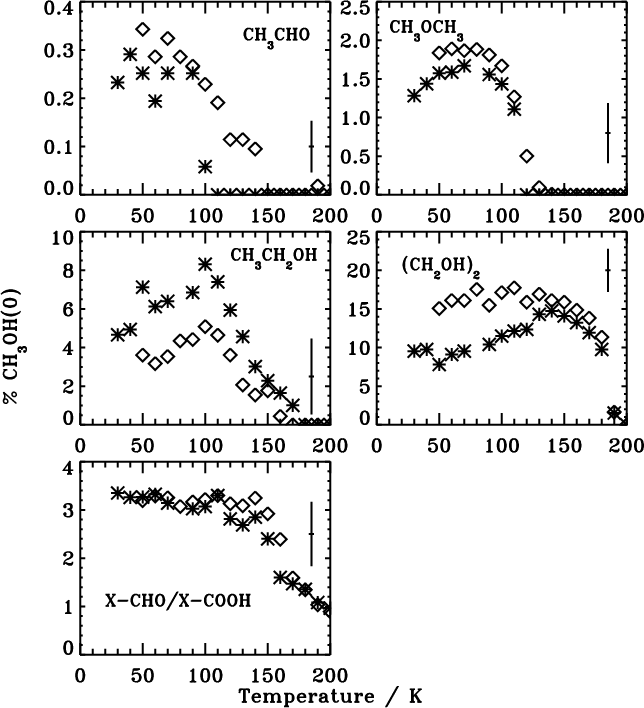
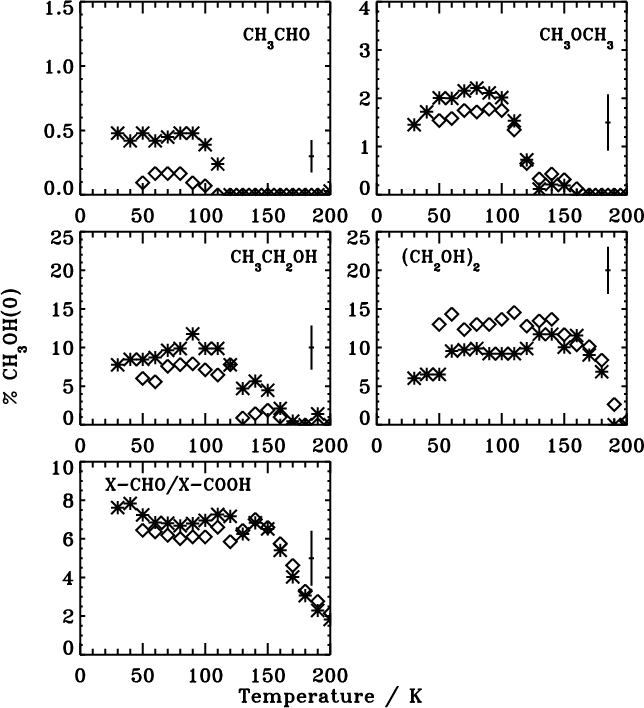
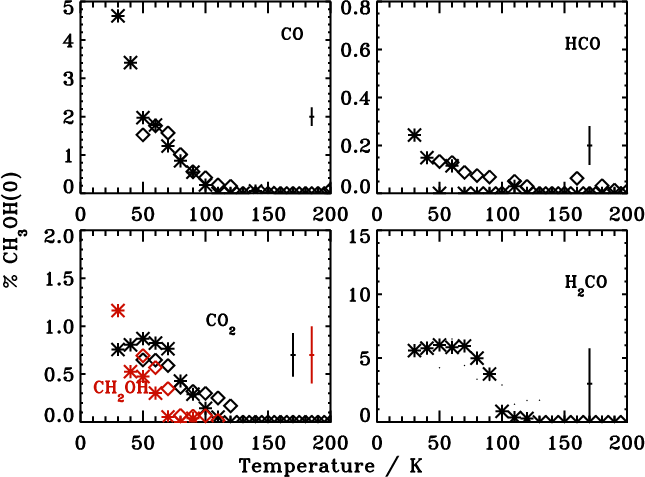
Figures <a href="/articles/aa/full_html/2009/36/aa12559-09/aa12559-09.html#fig:app_quant_simp_tpd">B.1</a> and <a href="/articles/aa/full_html/2009/36/aa12559-09/aa12559-09.html#fig:app_quant_comp_tpd">B.2</a> show the evolution of photoproduct abundances during warm-up following irradiation of pure CH<SUB>3</SUB>OH ices at&nbsp;30 and 50&nbsp;K (experiments&nbsp;2 and&nbsp;3). The abundances follow the warm-up trends suggested by the&nbsp;20 and 70&nbsp;K ices (experiments&nbsp;1 and&nbsp;4). The CH<SUB>3</SUB>CH<SUB>2</SUB>OH desorption starts at a lower temperature than in pure CH<SUB>3</SUB>CH<SUB>2</SUB>OH, suggesting that similarly to the 20&nbsp;K experiment, a substantial part of the CH<SUB>3</SUB>CH<SUB>2</SUB>OH desorbs together with CH<SUB>3</SUB>OH.

<p>
<div class="inset-old">
<table>
<tr><td><!-- init Label --><A NAME="fig:app_quant_simp_tpd">&#160;</A><!-- end Label--><A NAME="2174"></A><A NAME="figure1835"
 HREF="img105.png"><IMG
 WIDTH="102" HEIGHT="76" SRC="Timg105.png"
 ALT="\begin{figure}
\par\resizebox{9cm}{!}{\includegraphics{12559f31.eps}}
\end{figure}"></A><!-- HTML Figure number: 31 --></td>
<td class="img-txt"><span class="bold">Figure B.1:</span><p>
The evolution of small CH<SUB>3</SUB>OH photo-products with respect to UV fluence in % of the initial CH<SUB>3</SUB>OH ice abundance in pure CH<SUB>3</SUB>OH irradiation experiments at 30&nbsp;K (stars) and 50&nbsp;K (diamonds). The average uncertainties are indicated by the error bar to 
<I> the right in each panel</I>.</p></td>
</tr><tr><td colspan="2"><a href="http://dexter.edpsciences.org/applet.php?pdf_id=31&DOI=10.1051/0004-6361/200912559" target="DEXTER">Open with DEXTER</a></td></tr>

</table></div>
<p>
<div class="inset-old">
<table>
<tr><td><!-- init Label --><A NAME="fig:app_quant_comp_tpd">&#160;</A><!-- end Label--><A NAME="2176"></A><A NAME="figure1843"
 HREF="img106.png"><IMG
 WIDTH="102" HEIGHT="113" SRC="Timg106.png"
 ALT="\begin{figure}
\par\resizebox{9cm}{!}{\includegraphics{12559f32.eps}}
\end{figure}"></A><!-- HTML Figure number: 32 --></td>
<td class="img-txt"><span class="bold">Figure B.2:</span><p>
The evolution of complex CH<SUB>3</SUB>OH photo-products with respect to UV fluence in % of the initial CH<SUB>3</SUB>OH ice abundance in pure CH<SUB>3</SUB>OH irradiation experiments at 30&nbsp;K (stars) and 50&nbsp;K (diamonds). The average uncertainties are indicated by the error bar to <I> the right in each panel</I>.</p></td>
</tr><tr><td colspan="2"><a href="http://dexter.edpsciences.org/applet.php?pdf_id=32&DOI=10.1051/0004-6361/200912559" target="DEXTER">Open with DEXTER</a></td></tr>

</table></div>
<p>

<h3 class="sec2"><a name="SECTION000112000000000000000"></a>B.2 CH<SUB>4</SUB> and CO mixtures
</h3>

<p>
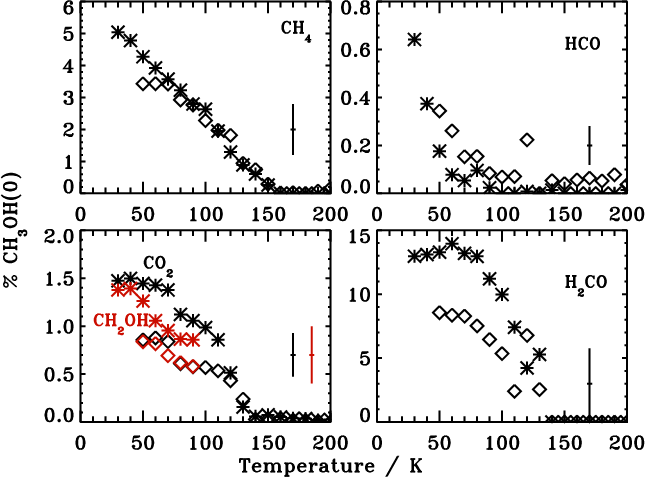
The warm-up trends are similar in the experiments where CH<SUB>4</SUB> and CO are mixed with the CH<SUB>3</SUB>OH ice, at a 1(2):1 ratio, compared to the pure CH<SUB>3</SUB>OH experiments 
(Figs.&nbsp;<a href="/articles/aa/full_html/2009/36/aa12559-09/aa12559-09.html#fig:app_quant_simp_tpd_co">B.3</a>-<a href="/articles/aa/full_html/2009/36/aa12559-09/aa12559-09.html#fig:app_quant_comp_tpd_ch4">B.6</a>). The CH<SUB>3</SUB>-containing molecules CH<SUB>3</SUB>CHO and CH<SUB>3</SUB>CH<SUB>2</SUB>OH show a remarkable growth between&nbsp;30 and 50&nbsp;K, which is only hinted at in the pure CH<SUB>3</SUB>OH experiments, suggesting a significant build-up of CH<SUB>3</SUB> radicals in these ice mixture experiments. In contrast the (CH<SUB>2</SUB>OH)<SUB>2</SUB> formation rate is low during warm-up of the 30&nbsp;K experiments. 

<p>
<div class="inset-old">
<table>
<tr><td><!-- init Label --><A NAME="fig:app_quant_simp_tpd_co">&#160;</A><!-- end Label--><A NAME="2179"></A><A NAME="figure1854"
 HREF="img107.png"><IMG
 WIDTH="102" HEIGHT="76" SRC="Timg107.png"
 ALT="\begin{figure}
\par\resizebox{9cm}{!}{\includegraphics{12559f33.eps}}
\end{figure}"></A><!-- HTML Figure number: 33 --></td>
<td class="img-txt"><span class="bold">Figure B.3:</span><p>
The evolution of small photo-products,  in % of the initial CH<SUB>3</SUB>OH ice abundance, with respect to temperature following irradiation of CH<SUB>3</SUB>OH:CO 1:1 ice mixtures at&nbsp;30 (stars) and 50&nbsp;K (diamonds). The average uncertainties are indicated by the error bar <I> to the right in each panel</I>.</p></td>
</tr><tr><td colspan="2"><a href="http://dexter.edpsciences.org/applet.php?pdf_id=33&DOI=10.1051/0004-6361/200912559" target="DEXTER">Open with DEXTER</a></td></tr>

</table></div>
<p>
<div class="inset-old">
<table>
<tr><td><!-- init Label --><A NAME="fig:app_quant_comp_tpd_co">&#160;</A><!-- end Label--><A NAME="2181"></A><A NAME="figure1862"
 HREF="img108.png"><IMG
 WIDTH="102" HEIGHT="113" SRC="Timg108.png"
 ALT="\begin{figure}
\par\resizebox{9cm}{!}{\includegraphics{12559f34.eps}}
\end{figure}"></A><!-- HTML Figure number: 34 --></td>
<td class="img-txt"><span class="bold">Figure B.4:</span><p>
The evolution of small photo-products,  in % of the initial CH<SUB>3</SUB>OH ice abundance, with respect to temperature following irradiation of CH<SUB>3</SUB>OH:CH<SUB>4</SUB> 1:2 ice mixtures at&nbsp;30 (stars) and 50&nbsp;K (diamonds). The average uncertainties are indicated by the error bar <I> to the right in each panel</I>.</p></td>
</tr><tr><td colspan="2"><a href="http://dexter.edpsciences.org/applet.php?pdf_id=34&DOI=10.1051/0004-6361/200912559" target="DEXTER">Open with DEXTER</a></td></tr>

</table></div>
<p>
<div class="inset-old">
<table>
<tr><td><!-- init Label --><A NAME="fig:app_quant_simp_tpd_ch4">&#160;</A><!-- end Label--><A NAME="2183"></A><A NAME="figure1870"
 HREF="img109.png"><IMG
 WIDTH="102" HEIGHT="76" SRC="Timg109.png"
 ALT="\begin{figure}
\par\resizebox{9cm}{!}{\includegraphics{12559f35.eps}}
\end{figure}"></A><!-- HTML Figure number: 35 --></td>
<td class="img-txt"><span class="bold">Figure B.5:</span><p>
The evolution of small photo-products,  in % of the initial CH<SUB>3</SUB>OH ice abundance, with respect to temperature following irradiation of CH<SUB>3</SUB>OH:CO 1:1 ice mixtures at&nbsp;30 (stars) and 50&nbsp;K (diamonds). The average uncertainties are indicated by the error bar <I> to the right in each panel</I>.</p></td>
</tr><tr><td colspan="2"><a href="http://dexter.edpsciences.org/applet.php?pdf_id=35&DOI=10.1051/0004-6361/200912559" target="DEXTER">Open with DEXTER</a></td></tr>

</table></div>
<p>
<div class="inset-old">
<table>
<tr><td><!-- init Label --><A NAME="fig:app_quant_comp_tpd_ch4">&#160;</A><!-- end Label--><A NAME="2185"></A><A NAME="figure1878"
 HREF="img110.png"><IMG
 WIDTH="102" HEIGHT="113" SRC="Timg110.png"
 ALT="\begin{figure}
\par\resizebox{9cm}{!}{\includegraphics{12559f36.eps}}
\end{figure}"></A><!-- HTML Figure number: 36 --></td>
<td class="img-txt"><span class="bold">Figure B.6:</span><p>
The evolution of small photo-products,  in % of the initial CH<SUB>3</SUB>OH ice abundance, with respect to temperature following irradiation of CH<SUB>3</SUB>OH:CH<SUB>4</SUB> 1:2 ice mixtures at&nbsp;30 (stars) and 50&nbsp;K (diamonds). The average uncertainties are indicated by the error bar to <I> the right in each panel</I>.</p></td>
</tr><tr><td colspan="2"><a href="http://dexter.edpsciences.org/applet.php?pdf_id=36&DOI=10.1051/0004-6361/200912559" target="DEXTER">Open with DEXTER</a></td></tr>

</table></div>
<p>

<h2 class="sec"><a name="SECTION000120000000000000000"></a><A NAME="sec:app_coeff"></A>
Appendix C: Formation rate parameters
</h2>

<p>
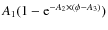
The production of simple and complex molecules during UV irradiation is parameterized with 
<!-- MATH: $A_1(1-{\rm e}^{-A_2\times(\phi-A_3)})$ -->
<IMG
 WIDTH="108" HEIGHT="30" ALIGN="MIDDLE" BORDER="0"
 SRC="img111.png"
 ALT="$A_1(1-{\rm e}^{-A_2\times(\phi-A_3)})$">
for 13 of the experiments, where <I>A</I><SUB>1</SUB> correspond to the equilibrium abundance in % of the initial CH<SUB>3</SUB>OH abundance, <I>A</I><SUB>2</SUB> is the fluence offset in 10<sup>17</sup>&nbsp;cm<sup>-2</sup> before production starts and <I>A</I><SUB>3</SUB> describes the formation and destruction rates in fluence space in 10<sup>-17</sup>&nbsp;cm<sup>2</sup> 
(Tables&nbsp;<a href="/articles/aa/full_html/2009/36/aa12559-09/aa12559-09.html#tab:fits_1">C.1</a> and&nbsp;<a href="/articles/aa/full_html/2009/36/aa12559-09/aa12559-09.html#tab:fits_2">C.2</a>). The experiments include all pure 6-20&nbsp;ML CH<SUB>3</SUB>OH experiments irradiated with the normal flux setting, two 20&nbsp;ML pure CH<SUB>3</SUB>OH experiments irradiated with the higher flux setting, and all ice mixture experiments except for the CH<SUB>3</SUB>OH:CO 1:10&nbsp;experiment. The 1:10&nbsp;experiment is excluded since the formation of any molecules is too low to detect during irradiation itself. The fitted experiments are numbered as in Table&nbsp;<a href="/articles/aa/full_html/2009/36/aa12559-09/aa12559-09.html#tab:ph_exps">1</a>. 

<p>
It is important to note  that the fitted formation ``cross sections'' cannot be used directly in astrophysical models, but rather should be used to compare models of the experiments with the experimental results. The quoted uncertainties in the tables are the fit error and do not include systematic uncertainties, in particular the conversion error between integrated band strength and abundances of <IMG
 WIDTH="12" HEIGHT="14" ALIGN="BOTTOM" BORDER="0"
 SRC="img10.png"
 ALT="$\sim $">20% and the fluence uncertainty of <IMG
 WIDTH="12" HEIGHT="14" ALIGN="BOTTOM" BORDER="0"
 SRC="img10.png"
 ALT="$\sim $">30%.

<p>
<A NAME="tab:fits_1"></A><p class="inset-old"><a href="/articles/aa/full_html/2009/36/aa12559-09/tableC.1.html"><span class="bold">Table C.1:</span></a>&#160;&#160;
Photoproduct crosssection coefficents for pure CH<SUB>3</SUB>OH experiments 1-6 as listed in Table&nbsp;1.</p>
<p>
<A NAME="tab:fits_2"><p class="inset-old"><a href="/articles/aa/full_html/2009/36/aa12559-09/tableC.2.html"><span class="bold">Table C.2:</span></a>&#160;&#160;
Photoproduct crosssection coefficents for ice mixture experiments 7-11, 13, 14 as listed in Table 1.</p>
<p>

<p>
<br>

</div></body></html>