 |
Figure 1:
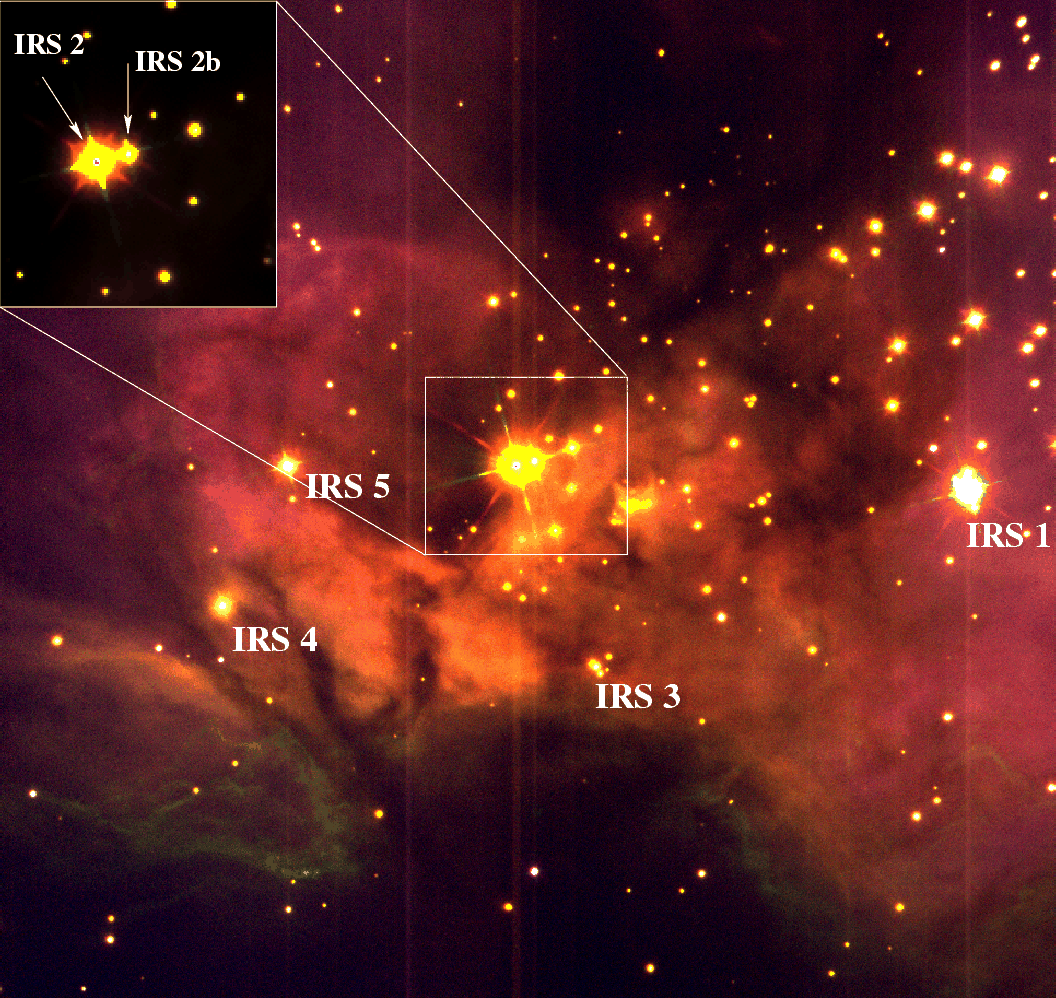
Composite of three narrow-band images of the central
region of NGC 2024 obtained with NTT/SOFI (blue: P ;
red:
Br ;
red:
Br ;
green: H2). North is up and East to the left; the image
size is ;
green: H2). North is up and East to the left; the image
size is
 (at the distance of NGC2024 this corresponds
to
(at the distance of NGC2024 this corresponds
to
 pc). The upper left panel zooms in on the region
around IRS2: about 5'' to the north-west we find IRS2b, the
ionizing star of NGC 2024. Also some previously proposed
candidate ionizing stars are indicated. The vertical stripes are
instrumental artifacts caused by the brightest stars. pc). The upper left panel zooms in on the region
around IRS2: about 5'' to the north-west we find IRS2b, the
ionizing star of NGC 2024. Also some previously proposed
candidate ionizing stars are indicated. The vertical stripes are
instrumental artifacts caused by the brightest stars. |
| Open with DEXTER | |
In the text
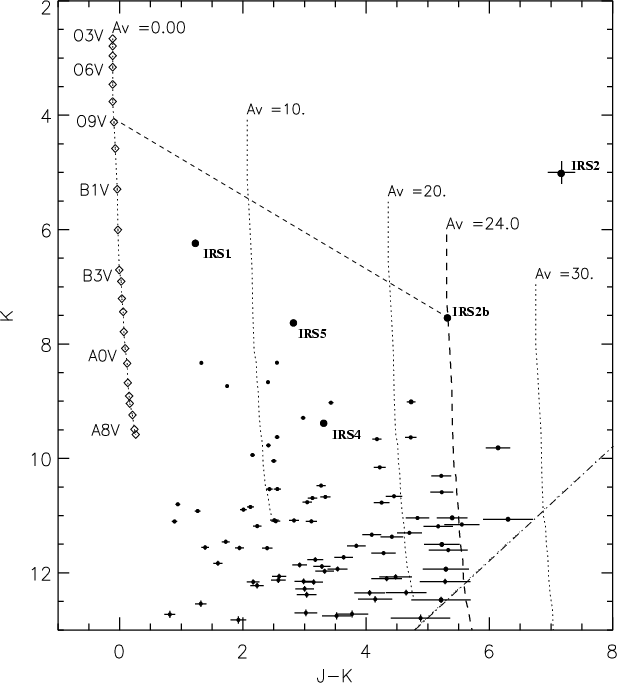 |
Figure 2: Color-magnitude diagram of the brightest stars in the central region of NGC 2024. The vertical (dotted) lines indicate the position of the main sequence for different amounts of visual extinction (AV). The magnitudes are obtained through narrow-band observations. The diagonal (dashed) line is the dereddening line of IRS2b, demonstrating that IRS2b is the intrinsically brightest star of the embedded population. IRS2 (saturated in K) probably is a B star with a strong infrared excess due to a circumstellar disk (Lenorzer et al. 2003). The dashed-dotted line is the detection limit in (J-K) following from the detection limits in J and K. |
| Open with DEXTER | |
In the text
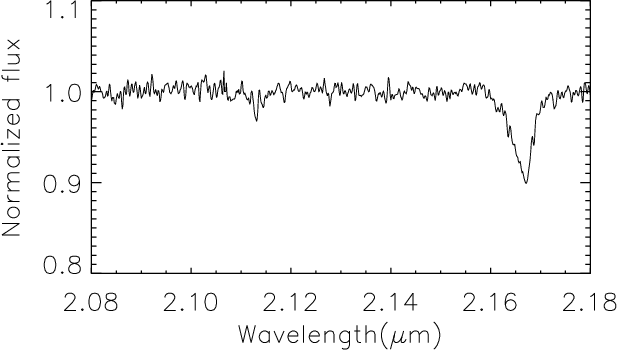 |
Figure 3:
K-band spectrum of IRS2b, obtained with VLT/ISAAC, showing
He I 2.1127, 2.1138  m and Br 2.166 m in absorption. m and Br 2.166 m in absorption. |
| Open with DEXTER | |
In the text
![\begin{figure}
\par\includegraphics[width=17cm,clip]{H4248F4.eps}
\end{figure}](/articles/aa/full/2003/22/aah4248/img32.gif) |
Figure 4:
Left: the upper part of the theoretical HRD. The shaded region
indicates the position of IRS2b for which all observational
constraints on L and
 are fulfilled. The diagonal
area represents the constraint provided by the observed K-band
magnitude. The K-band spectrum implies that
are fulfilled. The diagonal
area represents the constraint provided by the observed K-band
magnitude. The K-band spectrum implies that
 K. Also shown are the theoretical evolutionary tracks and isochrones from Lejeune & Schaerer (2001).
Right: the same region of the HRD as shown in the left
panel, but now including the regions in the HRD capable to produce Q0 and Q1 for comparison. K. Also shown are the theoretical evolutionary tracks and isochrones from Lejeune & Schaerer (2001).
Right: the same region of the HRD as shown in the left
panel, but now including the regions in the HRD capable to produce Q0 and Q1 for comparison. |
| Open with DEXTER | |
In the text