![[*]](/icons/foot_motif.gif)
A&A 404, 249-254 (2003)
DOI: 10.1051/0004-6361:20030301
A. Bik1 - A. Lenorzer1 - L. Kaper1 - F. Comerón 2 - L. B. F. M. Waters 1,3 - A. de Koter 1 - M. M. Hanson4
1 - Astronomical Institute "Anton Pannekoek'',
University of Amsterdam, Kruislaan 403, 1098 SJ Amsterdam,
The Netherlands
2 - European Southern Observatory, Karl-Schwarzschild
Strasse 2, Garching-bei-München, 85748, Germany
3 - Instituut voor Sterrenkunde, Katholieke Universiteit Leuven,
Celestijnenlaan 200B, 3001 Heverlee, Belgium
4 - University of Cincinnati, Cincinnati, OH 45221-0011, USA
Received 16 September 2002 / Accepted 21 February 2003
Abstract
We propose the late-O, early-B star IRS2b as the ionizing
source of the Flame Nebula (NGC 2024). It
has been clear that such a hot, massive star must be present in this
heavily obscured region, and now it has been identified. New
near-infrared photometry shows that IRS2b is the most luminous and
hottest star in the young star cluster embedded in the center of
NGC 2024. The near-infrared observations (
 )
cover
)
cover  90% of the H II region detected in radio continuum
radiation, making the probability very low that the ionizing star is
not present in the field. A K-band spectrum of IRS2b obtained with
ISAAC on the Very Large Telescope indicates that the spectral
type of IRS2b is in the range O8 V - B2 V. Additional arguments
indicate that its spectral type is likely closer to O8 than to B2.
The corresponding amount of ionizing radiation is consistent with
published radio continuum and recombination line observations.
90% of the H II region detected in radio continuum
radiation, making the probability very low that the ionizing star is
not present in the field. A K-band spectrum of IRS2b obtained with
ISAAC on the Very Large Telescope indicates that the spectral
type of IRS2b is in the range O8 V - B2 V. Additional arguments
indicate that its spectral type is likely closer to O8 than to B2.
The corresponding amount of ionizing radiation is consistent with
published radio continuum and recombination line observations.
Key words: stars: early-type - ISM: HII regions - ISM: individual objects: NGC 2024 - infrared: stars
Just east of  Ori and north-east of the Horsehead
Nebula, NGC 2024 (Flame Nebula)
appears in visible light as a bright nebula of which the
central part is obscured by a thick dust lane. The central region of
NGC 2024 is also a bright source of radio continuum emission
and recombination lines (Krügel et al. 1982; Barnes et al. 1989), indicating the
presence of an ionizing star of spectral type O9-O9.5. The heavy
obscuration by dust is the reason why, contrary to M42
(O'dell 2001) and many other visible H II regions, the
exciting star(s) of NGC 2024 have not been identified. Near-
and mid-infrared observations have revealed the presence of a young
star cluster in the core of NGC 2024
(Barnes et al. 1989; Lada et al. 1991; Comerón et al. 1996; Haisch et al. 2001). Several candidates
for the ionizing source of NGC 2024 have been proposed
(Grasdalen 1974; Barnes et al. 1989), but none of these candidates
are able to produce the observed radio continuum emission.
Ori and north-east of the Horsehead
Nebula, NGC 2024 (Flame Nebula)
appears in visible light as a bright nebula of which the
central part is obscured by a thick dust lane. The central region of
NGC 2024 is also a bright source of radio continuum emission
and recombination lines (Krügel et al. 1982; Barnes et al. 1989), indicating the
presence of an ionizing star of spectral type O9-O9.5. The heavy
obscuration by dust is the reason why, contrary to M42
(O'dell 2001) and many other visible H II regions, the
exciting star(s) of NGC 2024 have not been identified. Near-
and mid-infrared observations have revealed the presence of a young
star cluster in the core of NGC 2024
(Barnes et al. 1989; Lada et al. 1991; Comerón et al. 1996; Haisch et al. 2001). Several candidates
for the ionizing source of NGC 2024 have been proposed
(Grasdalen 1974; Barnes et al. 1989), but none of these candidates
are able to produce the observed radio continuum emission.
We are carrying out a systematic survey of the stellar content of compact and ultra-compact H II regions, with the aim to detect and study deeply embedded, newly-born massive stars. Our ultimate goal is to better understand the earliest phases in the life of the most massive stars. In this context we have obtained deep near-infrared images of a sample of compact H II regions, including NGC 2024 (Kaper et al. 2003). Subsequent K-band spectroscopy of the candidate ionizing stars has resulted in the determination of their spectral types (Bik et al. 2003).
Here we describe how we have identified the long-sought-for ionizing star of NGC 2024. In Sect. 2 we present near-infrared, narrow-band images of this region, as well as a K-band spectrum of the candidate ionizing star IRS2b. In Sect. 3 we derive the physical properties of this star. In the last section we present our conclusions and compare the derived properties of IRS2b with alternative, previously proposed candidates.
Near-infrared images of the central region of NGC 2024 were
obtained with SOFI mounted on ESO's New Technology Telescope
(NTT) at La Silla on February 6, 1999; the seeing was 0.7''. We used
narrow-band filters centered on strong nebular emission lines
(P 1.28
1.28  m, H2 2.12 m, Br
 2.16 m), and two narrow-band continuum filters in the J and K-band (1.21 and 2.09 m). The latter were chosen to measure the J and K magnitude of
the embedded stars, avoiding the contamination by nebular emission
lines.
2.16 m), and two narrow-band continuum filters in the J and K-band (1.21 and 2.09 m). The latter were chosen to measure the J and K magnitude of
the embedded stars, avoiding the contamination by nebular emission
lines.
Nine frames of 20 s each were taken on source and 9 frames with a 2 s exposure per frame were obtained to measure the sky background. The observations were reduced using standard infrared imaging data reduction procedures with IRAF.
Pointsources were detected by adding the frames in the J and K continuum filters, and running DAOPHOT (Stetson 1987) on the resulting frame. The photometry was obtained as follows: aperture photometry with a large aperture was performed on the image of the standard star and of bright, isolated stars in the image field. This allowed us to set up a network of bright secondary standards in the image field. Then, aperture photometry with a small aperture (3 pixel in radius), adequate for our rather crowded field, was performed on all the stars in the field. The magnitudes of these stars were determined taking those of the secondary standards as a reference.
We note that for red
sources (
 mag) the narrow-band J and K magnitudes
differ significantly from the broad-band J and
mag) the narrow-band J and K magnitudes
differ significantly from the broad-band J and  magnitudes. This
difference has been estimated by multiplying various energy
distributions with the response curves of the
filters, representing a range in (J-K) from 0 to 7. The typical
errors for (
magnitudes. This
difference has been estimated by multiplying various energy
distributions with the response curves of the
filters, representing a range in (J-K) from 0 to 7. The typical
errors for (
 on this
correction are 0.2 and 0.07 mag in J and K, respectively.
The J and K-band magnitudes used in this paper are based on narrow-band
observations. Only for the construction of the
Hertzsprung-Russell diagram (HRD, Fig. 4) the narrow-band
magnitudes are converted into broad-band magnitudes.
on this
correction are 0.2 and 0.07 mag in J and K, respectively.
The J and K-band magnitudes used in this paper are based on narrow-band
observations. Only for the construction of the
Hertzsprung-Russell diagram (HRD, Fig. 4) the narrow-band
magnitudes are converted into broad-band magnitudes.
Medium-resolution (
 )
K-band spectra of some stars in
this region were taken with ISAAC and ESO's Very Large
Telescope (VLT) at Paranal, Chile, on March 20, 2000. The spectra
were dark- and flat-field corrected, and wavelength calibrated using
standard reduction procedures. In order to correct for the sky
background the object was "nodded'' between two positions on the slit
(A and B) such that the background emission registered at position B
(when the source is at position A) is subtracted from the source plus
sky background observations at position B in the next frame, and vice
versa. Telluric absorption lines were removed using the telluric
standard star HD 39908 with spectral type A2 V observed under
identical sky conditions.
The only photospheric line (Br)
in the spectrum of the telluric star
needs to be divided out first. It turns out that the best result is
achieved when first the telluric features are removed from the
K-band spectrum of the telluric standard using a high resolution
telluric spectrum (obtained by NSO/Kitt Peak). This spectrum is taken
under completely different sky conditions, so a lot of remnants are
still visible in the corrected standard star spectrum; without this
"first-order'' telluric correction, a proper fit of Br
cannot be obtained.
The Br
line is fitted by a
combination of two exponential functions. The resulting error on the
Br
equivalent width (EW) of our target star is about 5%.
)
K-band spectra of some stars in
this region were taken with ISAAC and ESO's Very Large
Telescope (VLT) at Paranal, Chile, on March 20, 2000. The spectra
were dark- and flat-field corrected, and wavelength calibrated using
standard reduction procedures. In order to correct for the sky
background the object was "nodded'' between two positions on the slit
(A and B) such that the background emission registered at position B
(when the source is at position A) is subtracted from the source plus
sky background observations at position B in the next frame, and vice
versa. Telluric absorption lines were removed using the telluric
standard star HD 39908 with spectral type A2 V observed under
identical sky conditions.
The only photospheric line (Br)
in the spectrum of the telluric star
needs to be divided out first. It turns out that the best result is
achieved when first the telluric features are removed from the
K-band spectrum of the telluric standard using a high resolution
telluric spectrum (obtained by NSO/Kitt Peak). This spectrum is taken
under completely different sky conditions, so a lot of remnants are
still visible in the corrected standard star spectrum; without this
"first-order'' telluric correction, a proper fit of Br
cannot be obtained.
The Br
line is fitted by a
combination of two exponential functions. The resulting error on the
Br
equivalent width (EW) of our target star is about 5%.
An L-band spectrum of IRS2b, with a spectral resolution
 was obtained with VLT/ISAAC on February 22, 2002.
The data reduction was performed using an A6 II star (HD 73634)
as telluric standard. The quality of the telluric standard was not
sufficient to obtain a quantitative measurement of the hydrogen
absorption lines in the L band spectrum.
was obtained with VLT/ISAAC on February 22, 2002.
The data reduction was performed using an A6 II star (HD 73634)
as telluric standard. The quality of the telluric standard was not
sufficient to obtain a quantitative measurement of the hydrogen
absorption lines in the L band spectrum.
Figure 1 shows a composite near-infrared image of
the obscured central region of NGC 2024 (
),
centered on the bright (saturated,  )
infrared source IRS2.
Exposures in three narrow-band filters are
combined: Br,
H2 and P.
The edge of the
molecular cloud to the south of NGC 2024 is marked by emission
produced by excited molecular hydrogen: note the clumpy filamentary
structure. The recombination lines of hydrogen (e.g. Br)
are strongest towards
the core of the embedded stellar cluster. The optical extent of the
Flame Nebula is roughly
)
infrared source IRS2.
Exposures in three narrow-band filters are
combined: Br,
H2 and P.
The edge of the
molecular cloud to the south of NGC 2024 is marked by emission
produced by excited molecular hydrogen: note the clumpy filamentary
structure. The recombination lines of hydrogen (e.g. Br)
are strongest towards
the core of the embedded stellar cluster. The optical extent of the
Flame Nebula is roughly
 ,
but at radio wavelengths NGC 2024 is only slightly larger (
,
but at radio wavelengths NGC 2024 is only slightly larger (
 )
than the field covered
by our near-infrared observations. The radio continuum radiation is
strongly concentrated towards the central part of NGC 2024, and is
expected to outline the extent of the region where hydrogen is fully
ionized.
)
than the field covered
by our near-infrared observations. The radio continuum radiation is
strongly concentrated towards the central part of NGC 2024, and is
expected to outline the extent of the region where hydrogen is fully
ionized.
In the following we demonstrate that IRS2b is the best candidate ionizing star present in the central star cluster of NGC 2024. A K-band spectrum of IRS2b is used to confirm its early spectral type. The resulting effective temperature and luminosity of IRS2b are consistent with the amount of observed radio continuum and line emission.
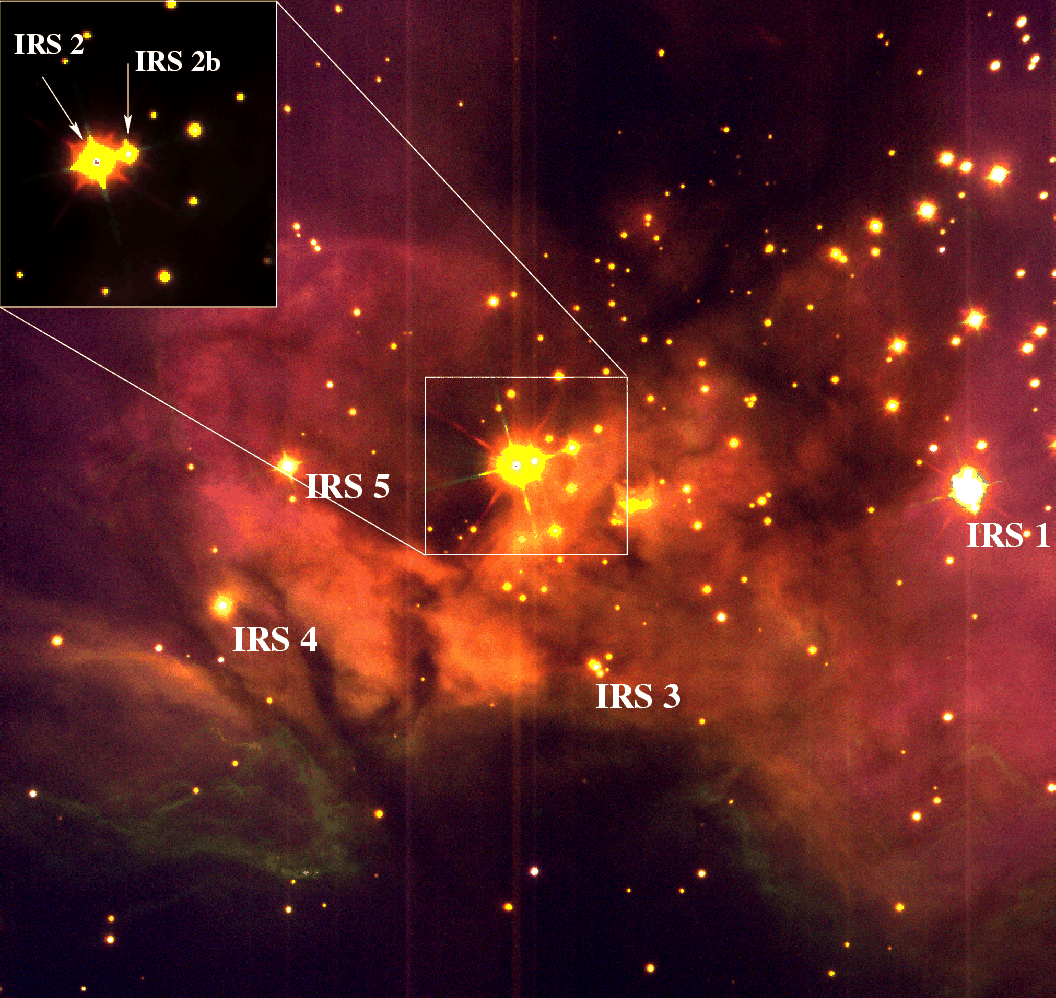 |
Figure 1:
Composite of three narrow-band images of the central
region of NGC 2024 obtained with NTT/SOFI (blue: P;
red:
Br;
green: H2). North is up and East to the left; the image
size is
(at the distance of NGC2024 this corresponds
to
 pc). The upper left panel zooms in on the region
around IRS2: about 5'' to the north-west we find IRS2b, the
ionizing star of NGC 2024. Also some previously proposed
candidate ionizing stars are indicated. The vertical stripes are
instrumental artifacts caused by the brightest stars. pc). The upper left panel zooms in on the region
around IRS2: about 5'' to the north-west we find IRS2b, the
ionizing star of NGC 2024. Also some previously proposed
candidate ionizing stars are indicated. The vertical stripes are
instrumental artifacts caused by the brightest stars. |
| Open with DEXTER | |
Due to the severe obscuration by the dust lane in front of NGC 2024, its stellar population becomes apparent at near-infrared wavelengths. The strong infrared sources IRS1-5 are the brightest objects in Fig. 1. Another bright source, IRS2b is located just 5'' north-west of IRS2 (see inset Fig. 1). The existence of IRS2b was first reported by Jiang et al. (1984) and confirmed by Nisini et al. (1994).
We detect 106 and 210 point sources down to the detection limit of 17.7 mag in J and of 16.1 mag in K, respectively. Because of the proximity of NGC 2024 (360 pc, Brown et al. 1994), its small spatial extent, its angular separation from the galactic plane, and the obscuration of background sources by the molecular cloud, we expect that nearly all of the infrared sources present in our near-infrared image are physically related to the cluster (cf. Comerón et al. 1996).
The brightest infrared source in the center of the NGC 2024 cluster is IRS2, a source that has been held responsible for the ionization of the H II region since its discovery (Grasdalen 1974). However, the physical nature of IRS2 is unclear: its K-band magnitude is too bright for a main sequence star, indicating a strong infrared excess. This excess is likely due to the presence of a dense circumstellar disk; the central star is probably a B-type star (Lenorzer et al. 2003, and below). Can we identify another, potentially hotter star that could be responsible for the ionization of the Flame Nebula?
The K vs. (J-K) color-magnitude diagram (CMD) of the stars detected in
our images is presented in Fig. 2; only the brightest
objects are shown. The dotted line indicates the position of the main
sequence (Aller et al. 1982), for different amounts of visual
extinction AV. A distance modulus of
 mag is adopted,
which corresponds to
mag is adopted,
which corresponds to
 pc (Brown et al. 1994). An anomalous
extinction law with RV = 5.5 is used, as measured by
Lee (1968). We used the parameterization of
Cardelli et al. (1989) to describe the shape of the extinction law.
This extinction law is derived for stars with
pc (Brown et al. 1994). An anomalous
extinction law with RV = 5.5 is used, as measured by
Lee (1968). We used the parameterization of
Cardelli et al. (1989) to describe the shape of the extinction law.
This extinction law is derived for stars with
 and could be different for higher amounts of
reddening. However, the dereddening of OB stars in the near infrared
is not very sensitive to the precise value of RV, as
and could be different for higher amounts of
reddening. However, the dereddening of OB stars in the near infrared
is not very sensitive to the precise value of RV, as
 for RV = 3.1 and
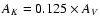 for
RV = 5.5. The slope of the near-infrared extinction law changes
very slowly with RV and the intrinsic (J-K) color of OB stars is
almost constant with spectral type and luminosity class
(Koornneef 1983).
for
RV = 5.5. The slope of the near-infrared extinction law changes
very slowly with RV and the intrinsic (J-K) color of OB stars is
almost constant with spectral type and luminosity class
(Koornneef 1983).
Figure 2 shows that the star IRS2b (
 ), when dereddened to
the main sequence, is the best candidate ionizing star in the field (neglecting IRS2) at a position consistent with a late O main sequence star.
The position of IRS2b in the CMD implies
), when dereddened to
the main sequence, is the best candidate ionizing star in the field (neglecting IRS2) at a position consistent with a late O main sequence star.
The position of IRS2b in the CMD implies
 mag (
mag (
 for RV = 3.1) if it is a main sequence star.
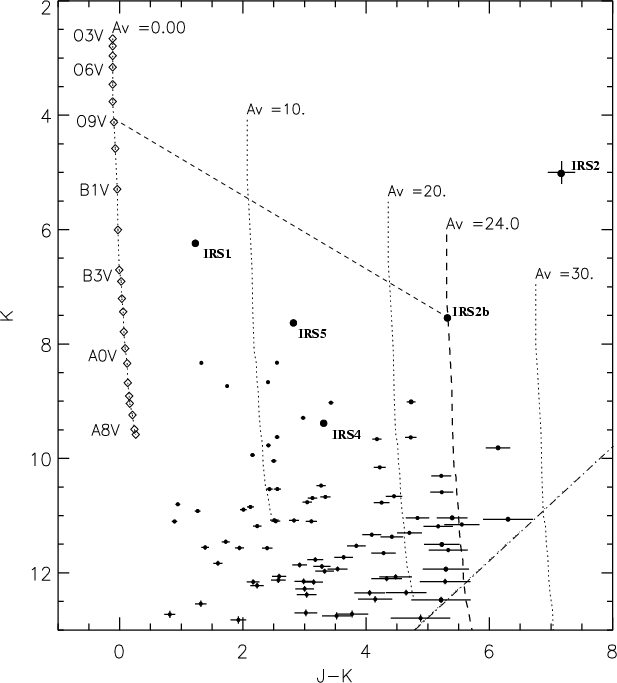 |
Figure 2: Color-magnitude diagram of the brightest stars in the central region of NGC 2024. The vertical (dotted) lines indicate the position of the main sequence for different amounts of visual extinction (AV). The magnitudes are obtained through narrow-band observations. The diagonal (dashed) line is the dereddening line of IRS2b, demonstrating that IRS2b is the intrinsically brightest star of the embedded population. IRS2 (saturated in K) probably is a B star with a strong infrared excess due to a circumstellar disk (Lenorzer et al. 2003). The dashed-dotted line is the detection limit in (J-K) following from the detection limits in J and K. |
| Open with DEXTER | |
The spectral type of IRS2b can be determined from its K-band spectrum
(Fig. 3). Hanson et al. (1996) define five K-band
spectral classes for O and early-B stars based on low-resolution
K-band spectra. Two K-band spectral classes correspond to the hottest
O stars (kO3-O4 and kO5-O6, with k denoting that the classification
is based on the K-band spectrum) which show lines of N III
(2.115 m) and C IV (2.079 m) in emission and the Br
(2.166 m) line in absorption. In the third class (kO7-O8) the
C IV line is absent and the He I (2.1128, 21137 m) lines
appear in absorption. The fourth spectral class kO9-B1 is defined as
having He I and Br
both in absorption, with the equivalent width
of Br
less than about 4 Å. This class is equivalent to a
Morgan-Keenan (MK) spectral type between O8 V and B1 V. The fifth class
(kB2-B3) shows strong Br
and He I absorption lines and is
equivalent to MK type B1 V to B2 V. The line equivalent widths (EW)
can in principle be used to determine the K-band spectral type. There
is, however, a substantial scatter in the observed EW of Br
as a
function of spectral type in the calibration stars used by
Hanson et al. (1996).
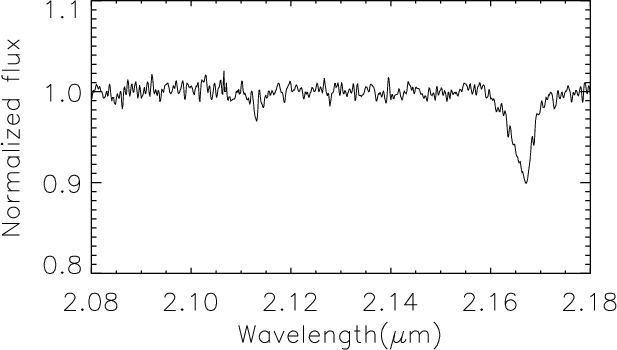 |
Figure 3:
K-band spectrum of IRS2b, obtained with VLT/ISAAC, showing
He I 2.1127, 2.1138 m and Br 2.166 m in absorption. |
| Open with DEXTER | |
IRS2b has both He I 2.113 m and Br
in absorption, with an
equivalent width of
 Å and
Å and
 Å,
respectively. The Br
EW indicates that the K-band spectral type of IRS2b is in the range kO9-B1 to kB2-B3 (MK types O8-B2). The He I line appears in absorption around spectral type O7.5, increasing its EW towards later spectral types. The He I line decreases in strength
again towards B2/B3. The relatively weak He I line in
the spectrum of IRS2b suggests that its spectral type is either close
to O8, or more towards B2/B3.
Å,
respectively. The Br
EW indicates that the K-band spectral type of IRS2b is in the range kO9-B1 to kB2-B3 (MK types O8-B2). The He I line appears in absorption around spectral type O7.5, increasing its EW towards later spectral types. The He I line decreases in strength
again towards B2/B3. The relatively weak He I line in
the spectrum of IRS2b suggests that its spectral type is either close
to O8, or more towards B2/B3.
An L-band spectrum provides a better diagnostic of its spectral type,
since it includes hydrogen Pfund lines, which are more temperature
sensitive than Br
(Lenorzer et al. 2002). The L-band spectrum we
obtained from IRS2b is of insufficient quality to measure the strength
of the absorption lines, though it is clear that they are
present. Although we are not able to provide an independent
estimate of its spectral type, the L-band spectrum rules out the
possibility that IRS2b has an infrared excess. Such an excess would
be even more dominant in the L-band, hindering the detection of photospheric lines.
Taking our measurement errors into account, we arrive at a
(conservative) estimate of the MK spectral type of IRS2b in the range
between O8 V and B2 V. This corresponds to a range in
 between 34 000 and 22 000 K (Martins et al. 2002; Aller et al. 1982).
Note, however, that the effective temperature calibration of OB stars is still a matter of debate. The derived limits on
are not very hard.
between 34 000 and 22 000 K (Martins et al. 2002; Aller et al. 1982).
Note, however, that the effective temperature calibration of OB stars is still a matter of debate. The derived limits on
are not very hard.
For every
,
the dereddened K-band magnitude can be
converted into a luminosity (adopting a distance of 363 pc). For this
calculation we use the relation between the bolometric correction and
from Vacca et al. (1996) and the (V-K) vs.
relation given by Koornneef (1983). The uncertainty in the luminosity
of IRS2b is due to the uncertainty in the distance towards
NGC 2024 and to the conversion from narrow-band to broad-band
magnitudes. The observational constraints on the location of IRS2b in
the HRD are visualized in Fig. 4 (left panel, shaded area).
![\begin{figure}
\par\includegraphics[width=17cm,clip]{H4248F4.eps}
\end{figure}](/articles/aa/full/2003/22/aah4248/img32.gif) |
Figure 4:
Left: the upper part of the theoretical HRD. The shaded region
indicates the position of IRS2b for which all observational
constraints on L and
are fulfilled. The diagonal
area represents the constraint provided by the observed K-band
magnitude. The K-band spectrum implies that
 K. Also shown are the theoretical evolutionary tracks and isochrones from Lejeune & Schaerer (2001).
Right: the same region of the HRD as shown in the left
panel, but now including the regions in the HRD capable to produce Q0 and Q1 for comparison. K. Also shown are the theoretical evolutionary tracks and isochrones from Lejeune & Schaerer (2001).
Right: the same region of the HRD as shown in the left
panel, but now including the regions in the HRD capable to produce Q0 and Q1 for comparison. |
| Open with DEXTER | |
Are these constraints on L and
of IRS2b consistent
with the observed nebular emission? The radio continuum flux of the
H II region can be used to estimate the ultraviolet flux of the
ionizing source of NGC 2024. The total radio continuum flux
at 1667 MHz derived from high-resolution radio observations
(Barnes et al. 1989) is  Jy. The number of Lyman continuum photons is
derived from the observed radio continuum flux under the assumption
that the H II region is ionization bounded and neglecting
absorption of UV radiation by dust, implying that the number of
recombinations is equal to the number of ionizations. We find that the
number of Lyman continuum photons is
Jy. The number of Lyman continuum photons is
derived from the observed radio continuum flux under the assumption
that the H II region is ionization bounded and neglecting
absorption of UV radiation by dust, implying that the number of
recombinations is equal to the number of ionizations. We find that the
number of Lyman continuum photons is
 .
The given accuracies reflect the error
in the distance quoted by Brown et al. (1994).
.
The given accuracies reflect the error
in the distance quoted by Brown et al. (1994).
Krügel et al. (1982) performed observations of the radio recombination
lines H76 and He76.
The corresponding ionized helium
fraction is 3%, which leads to
and He76.
The corresponding ionized helium
fraction is 3%, which leads to
 1046 helium
continuum photons.
1046 helium
continuum photons.
The observed number of photons capable of ionizing hydrogen (Q0) and helium (Q1) can be compared to predictions based on stellar atmosphere models of OB stars (Smith et al. 2002). If we assume that a single hot star ionizes NGC 2024, Q0 and Q1 constrain the location of the ionizing star in the HRD. In Fig. 4 (right panel), the regions which are able to produce the required amount of Q0 and Q1 are indicated by vertical and horizontal stripes, respectively. These regions overlap with the shaded region in the HRD defined by the spectral classification of IRS2b.
As shown in the previous section, an O8 star with characteristics compatible with those observed in IRS2b should be capable of producing the required amount of ionizing radiation to explain the degree of ionization of NGC 2024. To meet the constraint set by Q1, its spectral type is more likely to be late O than early B, which is supported by its position in the CMD. Note, however, that the predicted value for Q1 is not well known and depends on the selected stellar model. Although other candidate ionizing stars exist, they are not needed to provide a self-consistent solution for the ionization of NGC 2024. In the following we will discuss some of these alternatives.
If we correct for foreground extinction (cf. Fig. 2), IRS2b and IRS2 are the two brightest sources. The position of IRS2 in the CMD indicates a strong infrared excess (Lenorzer et al. 2003; Grasdalen 1974). IRS2 is associated with the ultra-compact radio source G206.543-16.347, but its physical nature is unclear. Current models suggest that ISR2 is a B star surrounded by a dense circumstellar disk responsible for the production of the infrared excess.
IRS1 (estimated spectral type B0.5V, Garrison 1968) and IRS2 have been candidate ionizing sources for a long time. Barnes et al. (1989) discovered 29 additional near-infrared sources in the Flame Nebula. In Figs. 1 and 2, the brightest of these infrared sources discovered by Barnes et al. (1989) are plotted, as well as IRS1 and IRS2. They propose that IRS1, IRS4 and IRS5, together with IRS3, provide a significant contribution to the ionizing radiation. IRS3 is not shown in the CMD, because it is not a single source, but consists of multiple stars which were not resolved by Barnes et al. (1989). As Q1 is decreasing very rapidly with later spectral type, the contribution to Q1 by the other bright stars (all later spectraltype than B0.5V) is negligible.
The radio continuum emission, however, can only be transformed into the
number of ionizing photons assuming that there is no dust included in
the H II region, and that the H II region is ionization
bounded. If these assumptions are not valid, the derived values of Q0 and Q1 are lower limits, so that a star hotter than IRS2b
might be required. In principle, such a star could be significantly
more reddened (
 mag, based on our detection limit in J)
and thus have remained undetected, especially when the amount of
extinction strongly varies with position. However, the visual
extinction we measure for the stars in the field is in the range
between
mag, based on our detection limit in J)
and thus have remained undetected, especially when the amount of
extinction strongly varies with position. However, the visual
extinction we measure for the stars in the field is in the range
between
 mag. We judge that the probability
of selectively obscuring this potentially hotter star is low.
mag. We judge that the probability
of selectively obscuring this potentially hotter star is low.
In Fig. 4 evolutionary tracks and isochrones from
Lejeune & Schaerer (2001) are plotted and the zero-age main sequence (ZAMS) is
indicated. The location of IRS2b suggests that its mass is between 15
and 25  .
Although it is not possible to determine the
age of a single star, the position of IRS2b in Fig. 4 is,
given the uncertainty in the effective temperature calibration
consistent with the age proposed
by Blaauw (1991), Brown et al. (1994) and Comerón et al. (1996).
Comerón et al. (1996) derive an age of
.
Although it is not possible to determine the
age of a single star, the position of IRS2b in Fig. 4 is,
given the uncertainty in the effective temperature calibration
consistent with the age proposed
by Blaauw (1991), Brown et al. (1994) and Comerón et al. (1996).
Comerón et al. (1996) derive an age of
 years
based on the frequency of IR excess in very low mass objects in NGC 2024 as
compared to that in Rho Ophiuchi.
years
based on the frequency of IR excess in very low mass objects in NGC 2024 as
compared to that in Rho Ophiuchi.
Acknowledgements
AB acknowledges financial support from the DFG during a two-month visit at ESO Headquaters. LK is supported by a fellowship of the Royal Academy of Arts and Sciences in The Netherlands. We would like to thank L. Decin for her help in the data reduction of the L band spectrum. We thank the anonymous referee for critical and constructive comments. NSO/Kitt Peak FTS data used here were produced by NSF/NOAO.