A&A 459, 987-1000 (2006)
DOI: 10.1051/0004-6361:20054468
A wavelet analysis of CMB time-ordered data applied to Archeops
J. F. Macías-Pérez1 -
A. Bourrachot2
1 - Laboratoire de Physique Subatomique et Cosmologie, 53 avenue des Martyrs, 38026 Grenoble Cedex, France
2 -
Laboratoire de l'Accélérateur Linéaire BP 34, Campus Orsay, 91898 Orsay Cedex, France
Received 3 November 2005 / Accepted 3 April 2006
Abstract
We present an alternative analysis of CMB time-ordered data (TOD) using a wavelet-based representation of the data time-frequency plane. We demonstrate that the wavelet transform
decorrelates 1/f-type Gaussian stationary noise and permits a simple and functional description
of locally stationary processes. In particular, this makes it possible to generalize the classical algorithms of map making and CMB power-spectrum estimation to the case of locally stationary 1/f type noise. As an example, we present a wavelet-based algorithm for the
destriping of CMB-like maps. In addition, we describe a wavelet-based analysis of the Archeops data including time-frequency visualization, wavelet destriping, and
filtering of the TOD. These filtered data were used to produce polarized maps of Galactic
dust diffuse emission. Finally,
we describe the modeling of the non-stationarity on the Archeops noise for estimating the CMB power spectrum.
Key words: cosmology: cosmic microwave background
1 Introduction
After discovery by the COBE satellite (Smoot et al. 1992), the cosmic microwave
background (CMB) temperature anisotropies have become one of the most powerful observational tests
for cosmology. Indeed, recent measurements of their angular temperature power spectrum by ground-based experiments, such as DASI (Halverson et al. 2002), CBI (Pearson et al. 2002), and VSA (Dickinson et al. 2004) and by balloon-borne experiments
such as BOOMERang (Netterfield et al. 2002), MAXIMA (Lee et al. 2001), and Archeops (Benoît et al. 2003b; Tristram et al. 2005) have provided strong
constraints on the main cosmological parameters, such as the Hubble constant H0,
the Universe total density
 ,
matter density
,
matter density
 ,
and energy density
,
and energy density
 ,
the scalar
,
the scalar  ,
and tensor
,
and tensor  spectral indexes associated to the power spectrum
of the primordial fluctuations. More recently, the satellite mission WMAP
spectral indexes associated to the power spectrum
of the primordial fluctuations. More recently, the satellite mission WMAP![[*]](/icons/foot_motif.gif) (Bennett et al. 2003)
measured both the temperature CMB angular power spectrum and the
cross correlation between temperature and polarization (Kogut et al. 2003), leading to high precision
determination of the cosmological parameters.
In the near future, the PLANCK satellite mission
will significantly improve the accuracy of measurements of the angular power spectrum of the
CMB temperature anisotropies and will also measure the CMB polarization
anisotropies. This will lead to a rather more selective test for distinguishing competing
cosmological models and to constraints on the inflationary paradigm.
(Bennett et al. 2003)
measured both the temperature CMB angular power spectrum and the
cross correlation between temperature and polarization (Kogut et al. 2003), leading to high precision
determination of the cosmological parameters.
In the near future, the PLANCK satellite mission
will significantly improve the accuracy of measurements of the angular power spectrum of the
CMB temperature anisotropies and will also measure the CMB polarization
anisotropies. This will lead to a rather more selective test for distinguishing competing
cosmological models and to constraints on the inflationary paradigm.
The analysis of the PLANCK satellite data will require both faster and more accurate
algorithms than those currently available, to deal with such large data sets containing
few 109 samples and to measure polarized fluctuation signals that are two or more orders
of magnitude smaller than temperature fluctuations. One of the most important problems
in the analysis of CMB data is characterizing the properties of the noise in the
time-ordered data (TOD), exploiting them for optimal map making, and for
reconstructing the angular power spectrum of the CMB temperature and polarization anisotropies.
The extremely large size of the data sets makes it computationally unfeasible to
directly invert the noise covariance matrix and even its storage (Borrill 1999).
This leads to the common use of Fourier techniques (Doré et al. 2001; Hivon et al. 2002; Yvon et al. 2005),
which are valid exclusively in the case of stationary and Gaussian noise for which the covariance
matrix is Toeplitz, and it is diagonalized by the Fourier transform. In the
case of PLANCK, observations will take place over two years, so
it seems reasonable to expect that the TOD noise properties will change during
the mission. Further, residuals from badly removed parasitic noises will also contribute
to the non stationarity and non Gaussianity of the TOD noise.
New promising Fourier methods (Natoli et al. 2001) based on the concept of locally stationary noise have been presented to deal with the non stationarity problem. However, they
are not adapted well to the case of residuals from parasitic signals, and they significantly reduce
the number of data samples to be used in the analysis so that the overall
instrument sensitivity also decreases. In addition, these new methods requires prior
knowledges of the zones of local stationarity on the data, but no algorithm has been proposed yet
to address this issue. In this paper, we describe a new approach to deal with non stationarity
in CMB data sets. This approach is based on simultaneous analysis
of the time and the frequency properties of noise using the wavelet and wavelet packet transforms.
By contrast to Fourier-based methods, non stationarity is naturally described by the
wavelet transform, so no cutting of the data is needed to properly define locally
stationary processes. In addition, we discuss how wavelet techniques are very useful identifying
systematics in the TOD, both visually and automatically. Application of these techniques
to the Archeops data is presented going from the simple visual inspection for classifying
the data to specifically designed algorithms to remove low-frequency components in the TOD and the remaining stripes on the Archeops maps.
Archeops is a balloon-borne
bolometer experiment that aimed at measuring the CMB temperature
anisotropy on large and small angular scales. It provided the first determination of the  spectrum from the COBE multipoles
(Smoot et al. 1992) to the first acoustic peak (Benoît et al. 2003a; Tristram et al. 2005) from
which it gave a precise determination of various cosmological
parameters, such as the total density of the Universe and the baryon
fraction (Benoît et al. 2003b). Archeops was also designed as a test
bed for Planck-HFI, so it shared the technological
design: a Gregorian off-axis telescope with a 1.5 m primary
mirror, bolometers operating at 143, 217,
353, and 545 GHz, which are cooled down at 100 mK by a 3He/4He dilution
designed to work at zero gravity, and a similar scanning strategy.
Because of this, Archeops data are expected to have common features with
Planck data with respect to random noise and systematics.
A detailed description of the instrument and its performances can be
found in Benoît et al. (2002).
spectrum from the COBE multipoles
(Smoot et al. 1992) to the first acoustic peak (Benoît et al. 2003a; Tristram et al. 2005) from
which it gave a precise determination of various cosmological
parameters, such as the total density of the Universe and the baryon
fraction (Benoît et al. 2003b). Archeops was also designed as a test
bed for Planck-HFI, so it shared the technological
design: a Gregorian off-axis telescope with a 1.5 m primary
mirror, bolometers operating at 143, 217,
353, and 545 GHz, which are cooled down at 100 mK by a 3He/4He dilution
designed to work at zero gravity, and a similar scanning strategy.
Because of this, Archeops data are expected to have common features with
Planck data with respect to random noise and systematics.
A detailed description of the instrument and its performances can be
found in Benoît et al. (2002).
The plan for this paper is the following. Section 2 introduces the wavelet
and wavelet packet transforms. Section 3 discusses the properties of the
wavelet transform of stationary Gaussian process. Section 4 deals with non
stationary noise and, in particular, locally stationary noise. Section 5
discusses a wavelet-based destriping algorithm. Finally, Sect. 6 describes
a wavelet analysis of the Archeops TOD.
In this section we give a brief overview of the discrete wavelet and wavelet packet transforms
that will be used extensively in the following sections.
2.1 The discrete wavelet transform
The discrete wavelet transform (DWT) is an orthonormal transform
 that takes a time series - TOD -
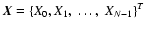 and yields a vector of N DWT coefficients
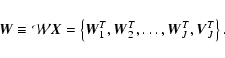 |
(1) |
The sub-vector
 contains
 wavelet coefficients associated
with scale
wavelet coefficients associated
with scale
 ,
whereas
,
whereas
 contains
 scaling
coefficients associated with scale
scaling
coefficients associated with scale
 .
These scaling coefficients are needed to compensate for the truncation of the DWT at level J.
As discussed later in this section, they account
for the smooth component of the time series that is left over by the wavelet coefficients.
Indeed, for
.
These scaling coefficients are needed to compensate for the truncation of the DWT at level J.
As discussed later in this section, they account
for the smooth component of the time series that is left over by the wavelet coefficients.
Indeed, for
 then,
then,
 is composed of a single scaling coefficient that represents the mean value of the time series.
The orthonormality condition
is composed of a single scaling coefficient that represents the mean value of the time series.
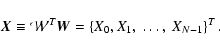
The orthonormality condition
 implies that the inverse DWT is given by
 |
(2) |
We can formally describe the DWT in terms of wavelet and scaling filters as follows. Assume
 to be
a vector of length N whose first L < N elements are the unit wavelet filter coefficients
for a given compactly supported wavelet (Daubechies 1992) and with the discrete Fourier transform (DFT)
to be
a vector of length N whose first L < N elements are the unit wavelet filter coefficients
for a given compactly supported wavelet (Daubechies 1992) and with the discrete Fourier transform (DFT)
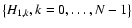 .
Then
.
Then
 is a vector of length N containing the zero-padded scaling filter coefficients for unit level,
defined via
is a vector of length N containing the zero-padded scaling filter coefficients for unit level,
defined via
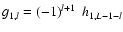 for
for
 with
DFT
with
DFT
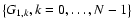 .
To obtain the level 1 wavelet
and scaling coefficients,
.
To obtain the level 1 wavelet
and scaling coefficients,  is filtered using h1 and g1 and then resampled by 2
where
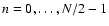 and
and
 and
and
 can be considered as high pass and low pass filters, respectively.
Therefore, the wavelet coefficients
can be considered as high pass and low pass filters, respectively.
Therefore, the wavelet coefficients
 represents the coarse component of X, and
the scaling coefficients
represents the coarse component of X, and
the scaling coefficients
 the smooth part of X.
To obtain the level 2 wavelet
the smooth part of X.
To obtain the level 2 wavelet
 and scaling
 coefficients,
is high pass and low pass filtered as before using h1
and g1 and then subsampled by 2. Finally, at level j,
and
coefficients,
is high pass and low pass filtered as before using h1
and g1 and then subsampled by 2. Finally, at level j,
and
 are given by subsampling by 2 the high pass and low pass filtering of
 using h1
and g1. Here, the time series is considered to be circular; as a consequence,
the first L-2 coefficients at each level j are affected by boundary conditions, so
their statistical properties differ from those unaffected by circularity.
This algorithm is known as the DWT pyramid algorithm (Mallat 1989).
using h1
and g1. Here, the time series is considered to be circular; as a consequence,
the first L-2 coefficients at each level j are affected by boundary conditions, so
their statistical properties differ from those unaffected by circularity.
This algorithm is known as the DWT pyramid algorithm (Mallat 1989).
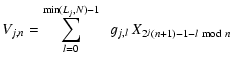
It is convenient to define equivalent
 and
and
 filters with
Lj=(2j-1)(L-1)+1 non zero elements such that
filters with
Lj=(2j-1)(L-1)+1 non zero elements such that
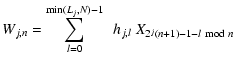 |
|
|
|
 |
|
|
(3) |
for
 .
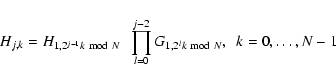
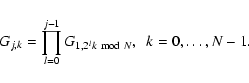
These are the inverse DFT of
.
These are the inverse DFT of
 |
(4) |
and
 |
(5) |
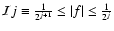
This equivalent filter representation permits a clear understanding of the overall filtering applied to the time series to obtain the wavelet and scaling coefficients at level j. Within this framework it is obvious that the coarser components of X are represented by the low j wavelet coefficients and the smoother ones by the large j wavelet coefficients and the scaling coefficients. The DWT leads to a dyadic sampling in frequency so that the wavelet coefficients are obtained by band-pass
filtering of X in the frequency interval
 for unity sampling frequency.
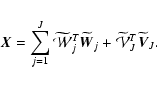
Finally, the DWT can also be represented as the decomposition of the time series into an orthonormal base
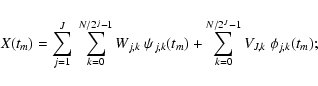 |
(6) |
therefore, the total energy is conserved as
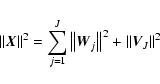 |
(7) |
where
 and
and
 are the wavelet and scaling functions, respectively.
2.2 Wavelet bases
This paper concentrates on compactly supported orthogonal wavelet bases, such as the Haar, Daubechies Coifflets, least asymmetric (also called symmlets), and best localized wavelets, which are extensively used in the statistical
community (see for example Daubechies 1992; Percival & Walden 2000; Vidakovic 1999).
Each wavelet family is defined as fulfilling a particular requirement like
for example the symmetry of the wavelet function in the case of the least asymmetric family. For each family, the width,
L, of the scaling and wavelet filters is a variable parameter, and as discussed by Lai 1995, it is
directly related to the shape of the low-pass and high-pass equivalent filters. In particular, the larger L, the closer the low and high pass filters will be to a perfect low pass and high pass filter, respectively. This will be
discussed in more detail in the following sections.
2.3 The maximal overlap DWT
The maximal overlap DWT (MODWT), also known as the non-decimated DWT or the stationary DWT, is a particularly
interesting generalization of the DWT. It allows us to keep the original sampling in time of
the time series at each level j of the wavelet transform. In addition, the MODWT is invariant with
respect to time shifting, while the DWT is not. These two properties become important when studying
the time evolution properties of the timeline.
From a mathematical point of view, level J0MODWT of a time series Xt of N data samples is a transform consisting of J0+1 vectors
 and
and
 ,
all of which have dimension N. The vector
,
all of which have dimension N. The vector
 contains the MODWT wavelet
coefficients associated with changes on the scale
while the
contains the MODWT scaling coefficients associated with
averages on the scales
contains the MODWT wavelet
coefficients associated with changes on the scale
while the
contains the MODWT scaling coefficients associated with
averages on the scales
 .
.
As for the DWT,
and
 can be calculated by
filtering Xt, namely,
can be calculated by
filtering Xt, namely,
| |
|
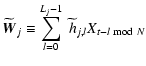 |
|
| |
|
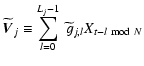 |
(8) |
 ,
where
,
where
 and
are the jth level MODWT wavelet and scaling filters. These filters are defined in terms of the DWT wavelet and scaling filters as
and
are the jth level MODWT wavelet and scaling filters. These filters are defined in terms of the DWT wavelet and scaling filters as
 and
and
 and have width
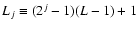 .
In practice the wavelet and scaling coefficients are not
calculated from Eq. (8) but via a pyramidal algorithm similar to the DWT
(Percival & Walden 2000; Vidakovic 1999). Note that the first
.
In practice the wavelet and scaling coefficients are not
calculated from Eq. (8) but via a pyramidal algorithm similar to the DWT
(Percival & Walden 2000; Vidakovic 1999). Note that the first
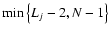 elements
in both
and
are affected by circularity
so are boundary coefficients.
elements
in both
and
are affected by circularity
so are boundary coefficients.
Unlike the DWT, the MODWT is not an orthonormal transform because at each level j the components of both
and
are not independent. Nevertheless, the MODWT is capable of producing a multi-resolution analysis of the data such that
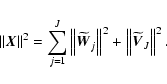 |
(9) |
Finally, the MODWT can also be expressed as matrix operations such that
 and
and
 .
The time series can then be recovered from
.
The time series can then be recovered from
Typically, the MODWT is used to represent the time evolution of the time-series
power for each scale in the analysis. As the MODWT preserves the original time
sampling for all scales, this representation is very handy and makes it easy to
compare the time evolution of very different time scales. For example
in Sect. 4.2, we use the MODWT to estimate
the time evolution function of the power spectrum of a time-modulated stationary
process. However, the use of this representation to infer the statistical
properties of the data is delicate, as the MODWT coefficients for a given
scale are artificially correlated in time by the MODWT transform itself.
2.4 The discrete wavelet packet transform
The wavelet transform as defined above is just a representation of temporal signals at different
scales j that correspond to the frequency intervals
 .
Although extremely useful and powerful, this representation is unusual from the Fourier point of view. In this respect, it is interesting to define the discrete wavelet packet transform, DWPT, by generalizing the DWT, so that
we can obtain an equipartition of the frequency domain and of the time domain similar to that given by a Windowed Fourier Transform (WFT). In simple words, the DWPT is obtained at each level j by high pass filtering with
.
Although extremely useful and powerful, this representation is unusual from the Fourier point of view. In this respect, it is interesting to define the discrete wavelet packet transform, DWPT, by generalizing the DWT, so that
we can obtain an equipartition of the frequency domain and of the time domain similar to that given by a Windowed Fourier Transform (WFT). In simple words, the DWPT is obtained at each level j by high pass filtering with
 and low pass with
 the smooth
component
in the DWT, but also high-pass and low-pass filtering the coarse
component
the smooth
component
in the DWT, but also high-pass and low-pass filtering the coarse
component
 .
.
The level j DWPT of a N=2J dimensional vector is an orthonormal transform yielding an N dimensional vector of coefficients that can be partitioned as
where each
 has dimension
Nj=2J-j and is nominally associated
with the frequency interval
has dimension
Nj=2J-j and is nominally associated
with the frequency interval
 .
Note that we define
.
Note that we define
 following previous definitions.
Together these 2j vectors divide the frequency interval
following previous definitions.
Together these 2j vectors divide the frequency interval
 into 2j intervals of equal width
 .
This leads to an equipartition both in time and frequency of the time-frequency plane similar to that produced by the WFT without explicit time partitioning.
.
This leads to an equipartition both in time and frequency of the time-frequency plane similar to that produced by the WFT without explicit time partitioning.
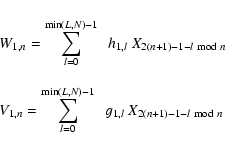
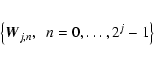
After defining Wj,n,t as the th element of
,
we can write
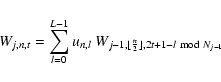 |
(10) |
for
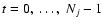 and where
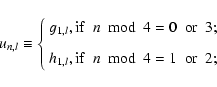 |
(11) |
and
 is
is
 if n is even, otherwise it is
 .
.
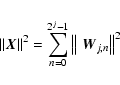
Since the DWPT is an orthonormal transform, we can use it to partition the energy in
via
where
 can be interpreted as the contribution to the energy by
frequencies in the band
can be interpreted as the contribution to the energy by
frequencies in the band
 .
As the above relationship is valid for any given level j in the interval
.
As the above relationship is valid for any given level j in the interval
 ,
we can consider that the DWPT for
is an overcomplete
representation of .
Furthermore, the basis functions associated to it constitute a sort dictionary that is commonly used for representing functions via matching pursuit techniques (Mallat & Zhang 1993).
,
we can consider that the DWPT for
is an overcomplete
representation of .
Furthermore, the basis functions associated to it constitute a sort dictionary that is commonly used for representing functions via matching pursuit techniques (Mallat & Zhang 1993).
3 Wavelet analysis of Gaussian stationary noise
The analysis of stationary Gaussian processes is traditionally performed in the Fourier domain because of the decorrelation properties of the Fourier transform. Indeed, the covariance matrix,
 ,
of stationary Gaussian distributed noise, Xt, is diagonal in Fourier space and
completely described by the noise power spectrum, PX,
,
of stationary Gaussian distributed noise, Xt, is diagonal in Fourier space and
completely described by the noise power spectrum, PX,
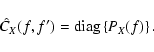 |
(12) |
This property makes it trivial to calculate the inverse of the covariance matrix and from the
point of view of CMB analysis, it considerably eases tasks like map making and
angular power spectrum estimation.
However, this feature cannot be extrapolated to non stationary Gaussian noise.
In this section, we show how the DWT can also decorrelate Gaussian stationary noise. Therefore,
we can reasonably expect it will also decorrelate non stationary Gaussian noise,
based on the localization properties of the DWT,
as discussed in the following sections.
Using Eq. (3) and assuming a stationary process Xt with auto-covariance
 |
(13) |
that depends only on  ,
we can write the correlation between non boundary wavelet coefficients as follows
,
we can write the correlation between non boundary wavelet coefficients as follows
 |
|
|
(14) |
which using the DFT transforms into
 |
|
|
(15) |
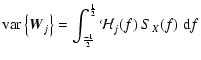
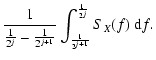
where SX (f) is the spectral density function of Xt.
Under the assumption of nominal band pass filters, Hj(f) and
 have
band-passes given by
have
band-passes given by
 and
and
 ,
which for
,
which for
 do not overlap, and thus the correlation of wavelet coefficients across scales should be negligible for a Gaussian stationary process.
Furthermore, when
 and
and
 the correlation between wavelet
coefficients reads
the correlation between wavelet
coefficients reads
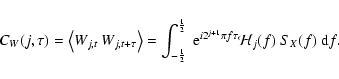 |
(16) |
Once again under the approximation of nominal band-pass filters,
we can argue that the above should be approximately zero for
 ,
when SX(f) is approximately constant in the interval
.
In other words, at each level j the wavelet coefficients
behave as uncorrelated white noise the same way Fourier coefficients do.
,
when SX(f) is approximately constant in the interval
.
In other words, at each level j the wavelet coefficients
behave as uncorrelated white noise the same way Fourier coefficients do.
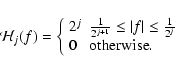
As discussed above, the transfer function of the wavelet filter
 at each level j can be well approximated by a nominal
band-pass filter taking the form
at each level j can be well approximated by a nominal
band-pass filter taking the form
 |
(17) |
Within a particular wavelet family, this approximation will be more accurate for large filter widths, L; however, the
number of boundary coefficients
 will be more important. In practice, it is always possible to find
a relatively low value of L for which the wavelet filter nearly acts like a perfect high pass on the data, such that
the decorrelation between wavelet coefficients takes place.
will be more important. In practice, it is always possible to find
a relatively low value of L for which the wavelet filter nearly acts like a perfect high pass on the data, such that
the decorrelation between wavelet coefficients takes place.
In summary, for a stationary Gaussian process Xt with spectral density
function SX (f) and under the nominal band-pass filter approximation, the wavelet
coefficients at scale j are uncorrelated with variance
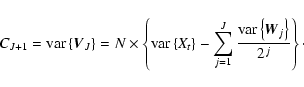
We have ignored the scaling coefficients. However, we can also calculate their variance from the rms of the timeline so that
 |
(19) |
For most CMB data sets, the noise associated to each detector timeline generally corresponds to a stationary long memory random process also known as 1/f-type noise. This kind of process
presents long term correlations in time that show up in the Fourier domain as a strong
increase in power with decreasing frequency. The specific characteristics of the noise depend closely on the detector itself as well as on the operational conditions like the temperature of the
focal plane bath, the current and intensity applied to the detector, the electronics, etc.
In general, the noise properties of any given detector are badly known and directly derived from the
data themselves. For large data sets, as would be the case for the PLANCK satellite surveyor, this
task can be extremely expensive in computation and can require fast techniques and algorithms.
In this section we show how the wavelet transform can be used to represent and study 1/f-type noise based on the previous results. The DWT has two main advantages with respect to the DFT. First, from the computational point of view, it is faster and presents no limits to the number of samples to be used as the DFT do; and second, the wavelet representation of the stationary process is more compact in terms of number of coefficients.
The simplest 1/f-type noise is the white noise that is completely uncorrelated in the time
domain and presents a flat spectral density function of the form
 |
(20) |
Under the hypothesis of nominal band-pass wavelet filters and using Eq. (18), the variance of the white noise wavelet coefficients at scale j is given by
 |
(21) |
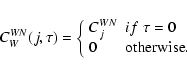
Using Eq. (16) we can show that the white noise wavelet coefficients are fully
uncorrelated at each scale j
 |
(22) |
As the white noise wavelet coefficients are also uncorrelated between different scales j and
 ,
we can state that the wavelet transform of a white noise is also
a white noise of the same spectral density function.
,
we can state that the wavelet transform of a white noise is also
a white noise of the same spectral density function.
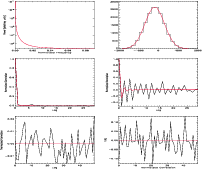 |
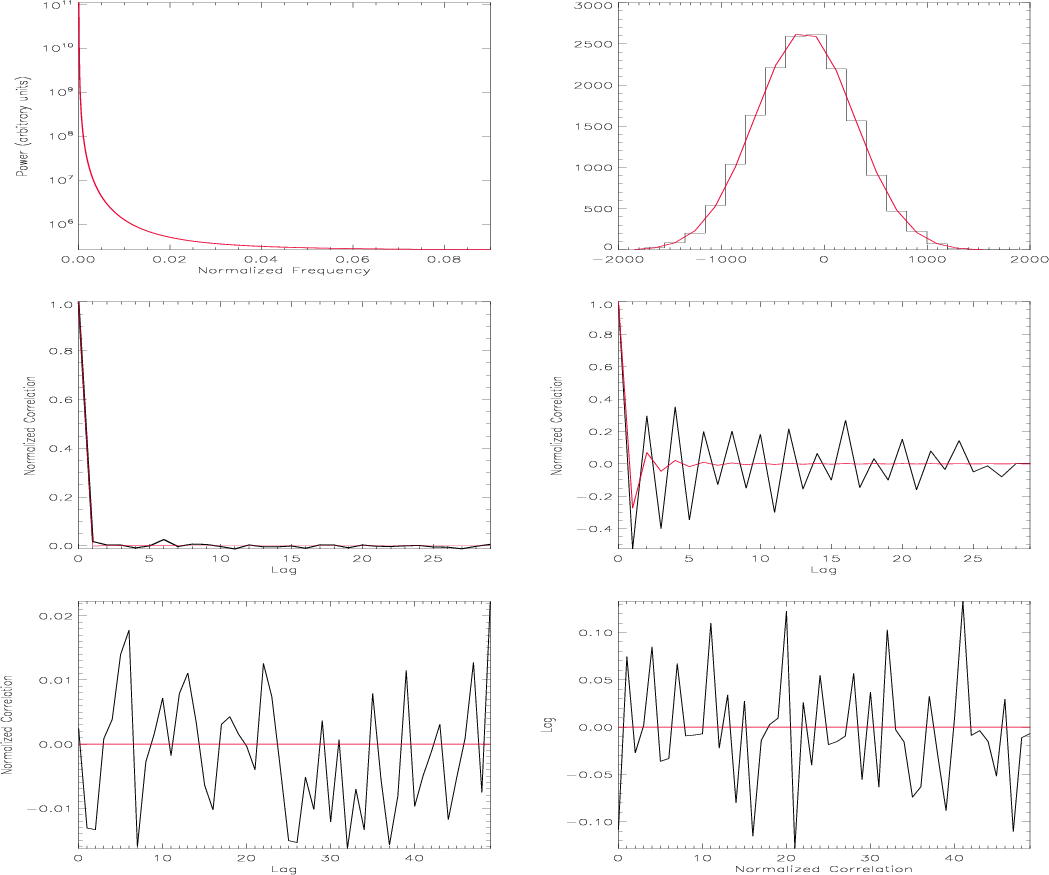
Figure 1:
From left to right and from top to bottom, input power spectrum of simulated
1/f-type noise, histogram of the simulated noise wavelet coefficients and their expected values at scale j=1, correlation of the wavelet coefficients and their expected values for scale j=1 and j=10 and cross correlation of the wavelet coefficients at j=1 and j=10 with scales j=2 and j=11 respectively. |
| Open with DEXTER |
![\begin{figure}
\par\mbox{\includegraphics[height=4.25cm,width=7.4cm,clip]{Figure...
...ludegraphics[height=4.25cm,width=7.65cm,clip]{Figures/4468f8.ps} }
\end{figure}](/articles/aa/full/2006/45/aa4468-05/Timg113.gif) |
Figure 2:
Left panel: simulated 1/f-type noise using a wavelet algorithm. Right panel: power spectrum of the wavelet simulated 1/f-type noise compared to the input power spectrum in red. |
| Open with DEXTER |
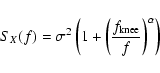
In general, the spectral density function of 1/f-type noise is represented as
 |
(23) |
where
 is known as the knee frequency. For
 the spectral density
function is dominated by the white noise term that is parametrized by
the spectral density
function is dominated by the white noise term that is parametrized by  .
In contrast,
the 1/f dominates for
.
In contrast,
the 1/f dominates for
 .
From Eq. (18)
the variance of the wavelet coefficients at level j for 1/f-type noise is given by
.
From Eq. (18)
the variance of the wavelet coefficients at level j for 1/f-type noise is given by
![\begin{displaymath}%
C^{1/f}_{j} = \left\lbrace
\begin{array}{ll}
\sigma^{2} \...
... (j+1)} \right] & {\rm if}\ \alpha > 1.
\end{array}
\right.
\end{displaymath}](/articles/aa/full/2006/45/aa4468-05/img119.gif) |
(24) |
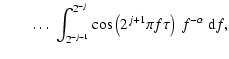
Then using Eq. (16), the correlation between wavelet coefficients is given by
| |
|
 |
|
| |
|
 |
(25) |
which is largely dominated by the white noise term so that the wavelet coefficients are quasi-uncorrelated. This equation is only valid for nominal band-pass filters. However, from a practical point of view, increasing
the number of non-zero coefficients in the wavelet filter will flatten the 1/f term in the integral leading to the desired level of decorrelation between wavelet coefficients.
To test the above statements we simulated a TOD of 1/f-type noise with 215 samples.
Figure 1 shows the input power spectrum of simulated 1/f-type noise, the histogram of the simulated noise wavelet coefficients at scale j=1,
the correlation of the wavelet coefficients and their expected values for scale j=1 and j=10, and the cross correlation
of the wavelet coefficients and their expected values at j=1 and j=10 with scales j=2 and j=11. We observe that the wavelet coefficients show a Gaussian structure. Likewise, they are quasi-decorrelated
as expected within the same scale and totally uncorrelated between scales.
3.3 Simulation of Gaussian stationary noise using wavelets
From the above we conclude that, under the nominal band-pass filter approximation,
the DWT decorrelates Gaussian stationary processes. Thus it is possible to simulate Gaussian stationary processes via its DWT (Percival et al. 2000; Vidakovic 1999) in the same way it is performed using the DFT.
Indeed we can easily simulate stationary and Gaussian time series Xt of length N=2J and spectral density function SX(f) by performing the following steps
- 1.
- Using a random-number generator, generate a vector
 containing M=4N Gaussian white noise deviates with zero mean and unit variance.
- 2.
- Integrate numerically Eq. (18) to calculate the approximate wavelet coefficient variances
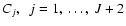 and use Eq. (19) to calculate the scaling coefficient variances.
- 3.
- Multiply the first M/2 elements of
by
 ,
the next M/4 values by
,
the next M/4 values by
 ,
and so forth, until to the final four elements, which need to be multiply by
,
and so forth, until to the final four elements, which need to be multiply by
 ,
,
,
,
 ,
,
 .
.
- 4.
- Compute the inverse DWT of the modified
vector and then randomly choose M samples from it.
The above recipe can be easily understood in terms of the wavelet covariance matrix of a Gaussian stationary time series
with N=2J samples, which due to the decorrelation property is given by
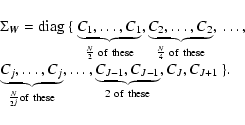 |
(26) |
The left panel of Fig. 2 shows a simulation of 1/f-type noise obtained
from the algorithm described above. In the right panel, we represent the power spectrum of the
simulated data, which agrees with the input power spectrum.
4 Locally stationary Gaussian noise
![\begin{figure}
\par\mbox{\includegraphics[height=4.25cm,width=7.2cm,clip]{Figure...
...ludegraphics[height=4.25cm,width=7.2cm,clip]{Figures/4468f10.ps} }
\end{figure}](/articles/aa/full/2006/45/aa4468-05/Timg130.gif) |
Figure 3:
From left to right, locally stationary Gaussian noise obtained from two white noises of variances 1 and 25, and its wavelet transform with wavelet coefficients
ordered from left to right for decreasing scale. |
| Open with DEXTER |
Locally stationary processes appear in many physical systems in which the mechanisms that produce
random fluctuations change slowly in time. Over given time intervals, such processes can
be approximated by a stationary one. This is the case, for example, for the variations observed in
the total noise power of some CMB detectors due to fluctuations in the focal plane temperature
as discussed in Sect. 6.1.
From the Fourier point of view we can imagine the variation in the data power spectrum with
time. We could also define locally-stationary Gaussian processes as those for which the
time-frequency plane is divided into time intervals each corresponding to a stationary process and all of which are uncorrelated between them. Notice that the above definitions
of locally-stationary processes are very general and, within the limit of infinitesimal time intervals, they lead to non-stationarity in a more general manner.
For a zero-mean random process
 ,
we can define its time evolving auto-covariance as
,
we can define its time evolving auto-covariance as
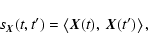 |
(27) |
which can also be expressed in terms of the distance between t and
 and the mid-point
between them:
and the mid-point
between them:
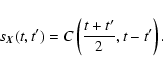 |
(28) |
Note that in this definition the covariance of a stationary process reads as
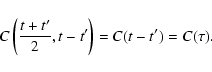 |
(29) |
For a locally stationary process, we expect that in the neighborhood of any
 ,
there exists an interval of size l(x) where the process can be approximated by a stationary one.
Therefore for any
,
there exists an interval of size l(x) where the process can be approximated by a stationary one.
Therefore for any
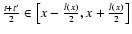
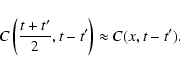 |
(30) |
If t and
are far apart and do not belong to the same interval of stationarity,
then we expect that X(t) and
 are uncorrelated. This means that for any
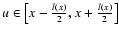 ,
if
,
if
 ,
then
,
then
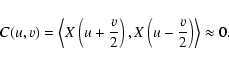 |
(31) |
In the time frequency-plane we can define a time-varying spectrum
 which would be given by the Fourier transform of the time-varying covariance
 with respect to v. For stationary processes
does not depend on time and corresponds to
the standard power spectrum. For locally-stationary processes (Mallat et al. 1998) the spectrum varies with time but is constant in time within the stationarity intervals defined above. This means that the same way the Fourier transform decorrelates Gaussian stationary processes, the windowed Fourier transform decorrelates locally stationary processes. In other words, the covariance matrix of locally-stationary Gaussian noise is diagonal in an orthogonal base given by performing a windowed Fourier transform in each stationary interval (Mallat et al. 1998). This base divides the
time-frequency plane into rectangles of the form
with respect to v. For stationary processes
does not depend on time and corresponds to
the standard power spectrum. For locally-stationary processes (Mallat et al. 1998) the spectrum varies with time but is constant in time within the stationarity intervals defined above. This means that the same way the Fourier transform decorrelates Gaussian stationary processes, the windowed Fourier transform decorrelates locally stationary processes. In other words, the covariance matrix of locally-stationary Gaussian noise is diagonal in an orthogonal base given by performing a windowed Fourier transform in each stationary interval (Mallat et al. 1998). This base divides the
time-frequency plane into rectangles of the form
where
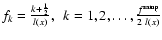 and
and
 is the sampling frequency. Note that the DWPT produces a similar decomposition of the time-frequency plane and can also be used to obtain a diagonal base for the covariance matrix of stationary Gaussian process
.
For this purpose, best-basis algorithms combining the DWPT at all available scales j have been developed (Coifman & Wickerhauser 1992; Percival & Walden 2000; Vidakovic 1999).
We will not account for them in this paper.
is the sampling frequency. Note that the DWPT produces a similar decomposition of the time-frequency plane and can also be used to obtain a diagonal base for the covariance matrix of stationary Gaussian process
.
For this purpose, best-basis algorithms combining the DWPT at all available scales j have been developed (Coifman & Wickerhauser 1992; Percival & Walden 2000; Vidakovic 1999).
We will not account for them in this paper.
In the previous section we have shown that the DWT decorrelates Gaussian stationary processes under the approximation of nominal band-pass wavelet and scaling filters. Therefore, the DWT will also decorrelate a locally-stationary Gaussian process that can be considered as a series of attached stationary Gaussian processes
that are uncorrelated between them. The same way we defined a time varying power spectrum above, we can also consider the evolution in time of the variance of the wavelet coefficients at each level j. As wavelet coefficients are
localized in time, this evolution can be computed naturally from the DWT of the data. Thus, for Gaussian locally-stationary processes, we expect the variance of the wavelet coefficients to change from one stationary
interval to another and to be constant within a given interval. This statement can be fully understood by considering Eq. (18) and accounting for the time evolution of the data power spectrum.
To clarify this issue we can use Eq. (26) to write the covariance matrix of the wavelet coefficients of a Gaussian locally-stationary process composed of two stationary time intervals
where the indexes 1 and 2 refer to each of the stationary time intervals, respectively. In summary, the DWT decorrelates Gaussian locally-stationary processes and naturally permits identification of the distinct intervals of stationarity in the data using the time evolution of the wavelet coefficient variance.
For illustration, in the left plot of Fig. 3, we show an example of a locally stationary noise given by the superposition in time of two white noises of variances 1 and 25. Its wavelet transform is traced in the right plot with the wavelet coefficients ordered from left to right for decreasing scale. We can clearly observe two distinct parts for each scale corresponding to the two white noises.
4.2 Time modulated-stationary processes
Often, the noise total power of CMB instrument detectors
changes with time due to slow fluctuations in the temperature of the focal plane bath or
drifts in the background power. In general, this leads
to locally-stationary Gaussian noise for which the power spectrum varies during the observation period but in the same way for all frequency components. Indeed, the noise total power increases and/or decreases with time,
but the shape of the power spectrum remains the same throughout the observation period.
These processes can be approximated well by a stationary Gaussian process modulated in time
(Fryzlewicz et al. 2002) which is defined by
 |
(33) |
where Yt is a Gaussian stationary process and  is a function of time. From a more physical point
of view,
represents the change in the noise total power. For convenience we consider
that the variance function
is a function of time. From a more physical point
of view,
represents the change in the noise total power. For convenience we consider
that the variance function
 is defined on (0,1) by assuming Yt has
the time-constant power spectrum of Xt as power spectrum.
Finally, notice that time-modulated processes are just a particular case of locally-stationary processes.
is defined on (0,1) by assuming Yt has
the time-constant power spectrum of Xt as power spectrum.
Finally, notice that time-modulated processes are just a particular case of locally-stationary processes.
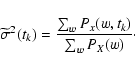
From a practical point of view, the above model is quite handy because only
has to be estimated from the data. Simple, although biased, estimates of
can be obtained by comparing the non time-dependent power
spectrum of the time series PX(w) to power spectra,
Px(w,tk) calculated at different but connected time intervals during the observation period
 |
(34) |
This estimate leads to the approximation of
by a step-function so that the time intervals have to be chosen especially to represent the shape of
as well as possible.
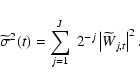
In contrast, using the MODWT is possible to easily obtain unbiased estimates
of
(Fryzlewicz et al. 2002) from
 |
(35) |
The extra factor 2-j can be easily understood from the normalization factor introduced in the
definition of the MODWT wavelet and scaling filters when deduced from the DWT ones. Few more comments on Eq. (35) are needed. First,
is not defined on (0,1) and has to be renormalized to be compared to the Fourier estimate. Second, as discussed in Sect. 2.3, the
MODWT is not an orthonormal transform and, for each scale j, the MODWT coefficients
are artificially correlated in time by the MODWT transform itself. However, this does not bias or limit the estimation of
as
we consider that all scales evolve in the same way in time so we are only interested in
smooth time variations.
Third, the MODWT estimate is not consistent, so it
has to be smeared out to reduce its variance. Finally, we could obtain an unbiased estimator from
the DWT in a similar manner but its construction is more complex due to the time undersampling performed by the DWT as the levels increase.
In summary, the time-modulated stationary model for random processes can be very interesting when dealing with Gaussian locally-stationary CMB time series that present time evolution in the noise total power but not
in their power spectrum shape. Indeed, once estimates for the function are available, the simulation of such processes is reduced to simulating a stationary Gaussian process from the power spectrum of Xt, which is then multiplied by that function.
Moreover, the covariance matrix of such processes can be approximated well in the wavelet space as shown in the following subsection.
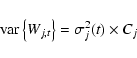
Based on the definition of time modulated-stationary processes and on the
properties of the wavelet coefficients for stationary and locally stationary processes, we can also define time modulated-stationary wavelet processes as those for which the variance of the wavelets coefficients at level j has the form
 |
(36) |
where Cj is a constant and
 is a function of time. Notice that this definition also accounts
for the time modulated-stationary processes for which the different
functions are a consequence of the undersampling performed in the DWT.
is a function of time. Notice that this definition also accounts
for the time modulated-stationary processes for which the different
functions are a consequence of the undersampling performed in the DWT.
As in the above definition we have supposed the wavelet coefficients are uncorrelated. Their covariance matrix takes a diagonal form:
where tjk represents the kth time sample of the level j DWT.
4.4 Statistical analysis of CMB data sets with locally stationary noise
Often, in the time-domain processing of CMB data sets (subtracting systematics
and optimal map making), we have to deal with the inversion of the noise covariance matrix.
In general, we consider the noise to be Gaussian and stationary or piece-wise stationary,
so that the noise correlation matrix is diagonal in Fourier space. Therefore, this can
be trivially inverted for each piece of data.
Above, we have shown that the covariance matrix of correlated Gaussian
and non stationary time-modulated noise (in particular, locally stationary) is
diagonal in the wavelet space and can be described simply
by a set of coefficients Cj, where j is the wavelet scale index, modulated
by a time-dependent function
.
Therefore, the inversion of this
matrix is also trivial in wavelet space.
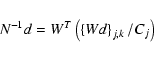
If we consider maximum likelihood algorithms such as optimal map making,
the resolution of the system involves terms in the form N-1d where N is the noise
correlation matrix and d a data vector. In Fourier space we perform this operation by first
taking the Fourier transform of d, then dividing it by the diagonal terms of the Fourier
representation of N and finally transforming back to real space. Equivalently, in the
wavelet case we can write for the stationary case
 |
(38) |
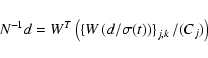
where W represents the direct DWT, WT the inverse wavelet transform,
and Cj are the variances of the wavelet coefficients of the noise wavelet transform.
In the same way for non stationary time-modulated noise, we can write
 |
(39) |
where
is the time modulation function.
In general the noise covariance matrix is not known and has to be estimated directly from the
data. For the stationary case, this is simple since we only need to compute the variance
of the wavelet coefficients for each of the different scales. For non stationary time
modulated noise, we can have a very good approximation using Eq. (36) by first computing the variance of
the wavelet coefficients assuming stationary noise and then computing
the time modulation function from the global evolution of the
wavelet coefficients.
The top panel of Fig. 4 shows the global
time variation of the noise of one of the Archeops bolometers that decreases
with time (a complete description of the Archers data is presented in
Sect. 6). We overplot
the time modulation function, ,
as determined from the
data following
the above technique. Finally, the bottom panel of the figure shows the
global time variation of a simulation of the Archeops noise. This was
obtained by multiplying by a realization of a stationary Gaussian noise produced
as described in Sect. 3.3. In red we overplot the estimated for the simulation that behaves like the one estimated from the data.
Notice that this kind of non stationary simulation of the noise in the Archeops data
was used when computing the Archeops CMB angular power spectrum in Benoît et al. (2003a).
![\begin{figure}
\par\includegraphics[height=9cm,width=7.8cm,clip]{Figures/4468f11.ps} \end{figure}](/articles/aa/full/2006/45/aa4468-05/Timg162.gif) |
Figure 4:
Top: reconstructed time modulation function
of the Archeops noise in bolometer 217K04. Bottom: time modulation function
for a non-stationary simulation of the Archeops noise in bolometer 217K04. |
| Open with DEXTER |
5 Wavelet destriping
Data from CMB experiments are commonly limited by intrinsic 1/f-type noise in the
detectors. For experiments with a circular scanning strategy like Archeops, WMAP, and
Planck, the 1/f-type noise shows up like stripes in the sky maps. The techniques used
to remove those stripes are in general called destriping algorithms
(Efstathiou 2005; Keihänen et al. 2004; Maino et al. 2002; Poutanen et al. 2004; Revenu et al. 2000; Sbarra et al. 2003).
These are based both on the statistical properties of 1/f-type noise and on the fact that
the noise is not coherently projected in the maps, in contrast to the sky signal.
In the previous sections we have shown that the wavelet transform nearly diagonalizes
the covariance matrix of 1/f-type noise. This allows us to design a destriping algorithm
based on the wavelet transform.
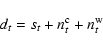
We assume that the time domain data for a typical CMB experiment can be written as
 |
(40) |
where st is the sky signal, and  and
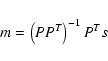
and  are a white and a correlated (color) noise component, respectively. A simple coaddition map of the sky m,
can be formed from the time series data s as follows
are a white and a correlated (color) noise component, respectively. A simple coaddition map of the sky m,
can be formed from the time series data s as follows
 |
(41) |
where Pt,p is a pointing matrix defined to be 1 if at time t the
instrument was pointing to the position of pixel p on the sky and 0 otherwise.
This equation holds for any pixelization scheme of the sky.
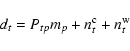
Thus, we can rewrite Eq. (40) as
 |
(42) |
Ptp mp defines a TOD formed from the deprojection of the sky map mand therefore in the following we can compute its DWT in 1D.
The main purpose of a destriping algorithm is simply to remove or significantly reduce the contribution from the correlated noise. This is obtained by maximizing the likelihood function,  ,
over the noise and the sky signal defined by the sky map m.
We can characterize the correlated noise
using its wavelet transform
,
over the noise and the sky signal defined by the sky map m.
We can characterize the correlated noise
using its wavelet transform
 |
(43) |
for which the wavelet coefficients are Gaussian distributed and quasi-uncorrelated.
We can then write the likelihood function as follows
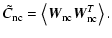
where
 and
and
 are the covariance matrices in wavelet space of the correlated and white noise, respectively:
| |
|
 |
(46) |
| |
|
 |
(47) |
Notice that for our assumptions both matrices are diagonal.
By taking the log of the likelihood function (45), we obtain
whose minimization with respect to  and
and
 leads to the following system of equations:
that can be combined into
 |
|
|
(54) |
The solution to this system of equations can be found using iterative methods
and in particular we use a conjugate gradient method (Press et al. 1996).
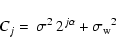
For 1/f-type noise, the variance of the wavelet coefficients at level j is given by
 |
(55) |
where
 is the white noise variance and
 is
the variance of the correlated part, with
is
the variance of the correlated part, with  being the 1/f exponent
as described in Eq. (23).
being the 1/f exponent
as described in Eq. (23).
When the noise dominates the sky signal, we can extract the noise
parameters
 ,
,
and
directly from the data
itself via Monte Carlo Markov chain methods (Wada & Ito 2000).
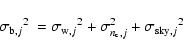
When the signal contribution cannot be neglected, the data wavelet variance
is given by
,
,
and
directly from the data
itself via Monte Carlo Markov chain methods (Wada & Ito 2000).
When the signal contribution cannot be neglected, the data wavelet variance
is given by
 |
(56) |
where
 and
and
 can be iteratively evaluated
from the data using a template of the sky signal that is improved at each
iteration. From the wavelet transforms of the template and the data we then obtain
can be iteratively evaluated
from the data using a template of the sky signal that is improved at each
iteration. From the wavelet transforms of the template and the data we then obtain
 |
|
|
(57) |
![\begin{figure}
\par\includegraphics[height=4.4cm,width=7.2cm,clip]{Figures/4468f12.ps}\end{figure}](/articles/aa/full/2006/45/aa4468-05/Timg197.gif) |
Figure 5:
Baseline reconstruction on simulated Archeops data using a wavelet based
destriping algorithm. In black we trace the simulated Archeops TOD. We overplot the reconstructed baseline in blue, green and red for the first, second, and third steps of
the algorithm, respectively. |
| Open with DEXTER |
The wavelet destriping was applied to simulated Archeops TOD at 545 GHz
with 3  221 samples.
We considered two main components in the data, Galactic dust emission, and 1/f-type noise.
For the former we used the template for the Galactic dust emission scaled down to
545 GHz provided by Finkbeiner et al. (1999). The 1/f-type noise properties were deduced
from the Archeops data.
221 samples.
We considered two main components in the data, Galactic dust emission, and 1/f-type noise.
For the former we used the template for the Galactic dust emission scaled down to
545 GHz provided by Finkbeiner et al. (1999). The 1/f-type noise properties were deduced
from the Archeops data.
We proceeded in three main steps. First of all, we estimated the lowest frequency components
of the data from its wavelet decomposition and subtracted it. Secondly, we improved this estimation
by solving Eq. (54) iteratively, starting with largest scales and progressively adding smaller and smaller scales. Finally, we computed an approximation to the signal, st, by thresholding the previous destriped map and deprojecting it into the time domain. We then, applied step two to the residuals, dt-st.
![\begin{figure}
\par\includegraphics[height=3.85cm,width=7.3cm,clip]{Figures/4468...
...\includegraphics[height=3.85cm,width=7.3cm,clip]{Figures/4468f14.ps}\end{figure}](/articles/aa/full/2006/45/aa4468-05/Timg199.gif) |
Figure 6:
Top panel: destriped map of the simulated Archeops data at 545 GHz using the wavelet destriping algorithm. Bottom panel: residual stripes on the destriped map above. |
| Open with DEXTER |
Figure 5 shows the simulated Archeops TOD at 545 GHz.
We overplot the reconstructed noise, low-frequency components for steps one, two and
three. We notice that we improve the estimated baseline in step three significantly
reducing the stripes in the maps as shown in Fig. 6, where
we represent the destriped map in the top panel and the residual stripes in the bottom panel.
6 Time-frequency visualization and analysis of the Archeops TOD
In the previous sections we concentrated on the wavelet description of random Gaussian processes.
We studied the decorrelation properties of the DWT and their application to the statistical
analysis of CMB data sets and in particular to the destriping
of CMB maps. From the point of view of CMB data analysis this is very useful
but not all we can obtain from the wavelet transform. Actually, the most important
property of wavelets is their simultaneous localization of time and frequency.
In this respect, wavelet analysis
and, in particular, the DWPT are fundamental tools for data visualization and characterization.
The CMB time series dt is in general a linear combination of signals, both galactic and
cosmological in origin,
of systematics effects likeatmospheric contamination, parasitic noises, electromagnetic contamination, and/or glitches and of random Gaussian noise
 |
|
|
(58) |
These components are different in nature and they present different time and frequency properties. For example, the cosmological and galactic signals only depend on the position of the sky observed, which is fully given by the instrument
pointing. By contrast, the atmospheric signal depends both on the sky position and on the
time evolution of the atmospheric conditions. Further, other systematic effects vary mainly with time and in general are related
to physical phenomena in the detector surroundings. Finally, the noise component is intrinsic to each detector
and is often of 1/f-type, Gaussian and locally-stationary. Since, the cosmological signal, the CMB emission, is much weaker in the time domain than all other components, these have to be identified, characterized, and removed with a high
degree of precision before extracting the CMB anisotropies power spectrum.
6.1 Time-frequency analysis of the Archeops data
![\begin{figure}
\par\includegraphics[height=8.7cm,width=7.7cm,clip]{Figures/4468f15.ps}\end{figure}](/articles/aa/full/2006/45/aa4468-05/Timg201.gif) |
Figure 7:
Top: time-frequency analysis of the TOD of the 217K04 Archeops bolometer using
the DWPT. Bottom: time-frequency analysis of the expected Galactic emission in the TOD of the 217K04 Archeops bolometer using the DWPT. See text for details. |
| Open with DEXTER |
In the following we present the most relevant issues in the wavelet analysis of the Archeops data set. A more detailed description of the Archeops data and its processing can be found in Macías-Pérez et al. (2005).
To simplify further discussions, we assume only four main components in the Archeops timelines: CMB emission, galactic and atmospheric emissions, unidentified systematics, and Gaussian noise.
The top panel of Fig. 7 shows the DWPT
time-frequency representation of a typical Archeops detector signal. We observe mainly two components that dominate
at high and low frequencies. The low-frequency signal that varies significantly with time is mainly
given by galactic emission, as shown by the bottom panel of the same figure where we represent the expected galactic emission for that detector. The circular scanning strategy of Archeops is such that we cross the Galactic plane perpendicularly during most of the
observation time, so the galactic emission shows
up as a spike in time. In contrast the scanning direction in the last hours of flight is
collinear to the Galactic plane, and the galactic emission then becomes broader in the time direction, although
we can still observe very few frequency spikes related to intense and compact regions of the Galactic plane. The nearly time-fixed
structures observed at low frequency - although they look very much as 1/f noise - are due to systematics that are mainly dominated by atmospheric emission.
![\begin{figure}
\par\includegraphics[height=8.7cm,width=7.7cm,clip]{Figures/4468f16.ps}\end{figure}](/articles/aa/full/2006/45/aa4468-05/Timg202.gif) |
Figure 8:
Top: time-frequency analysis of the TOD of the 217T04 Archeops bolometer using
the DWPT. Bottom: time-frequency analysis of the expected Galactic emission in the TOD of the 217T04 Archeops bolometer using the DWPT. See text for details. |
| Open with DEXTER |
The high frequency signal corresponds to the white noise of the detector whose power is artificially raised with increasing frequency when deconvolving from the bolometer time constant. We observe that the noise decreases smoothly
with time showing a clear non-stationary behavior. Indeed, as time passed during the flight, the bolometer temperature
decreased, therefore reducing the bolometer intrinsic noise. A detailed wavelet description and modeling of the
non-stationarity of the Archeops noise is presented in the following subsection.
The top panel of Fig. 8 shows the DWPT of the worst Archeops bolometer (217T04) both in terms of noise and systematics. As above we plot the DWPT of the expected Galactic signal for this bolometer in the bottom panel. We observe that the DWPT of 217T04 presents, as above, the Galactic and atmospheric components at low frequencies and a time varying noise at high frequency. However,
it is dominated by a strong time-varying signal
in the frequency range 25 to 35 Hz. This signal is not observed in the data presented above so can
be identified clearly as residuals from unknown systematic effects. We can, therefore, characterize
the quality of the Archeops bolometers data just by visual inspection and identify
which of them are badly affected by systematics. We have used this technique to identify, in terms of sensitivity and low level of systematics, the best Archeops bolometers for constructing the
Archeops sky maps.
![\begin{figure}
\par\includegraphics[height=9cm,width=7.8cm,clip]{Figures/4468f17.ps}\end{figure}](/articles/aa/full/2006/45/aa4468-05/Timg203.gif) |
Figure 9:
Top: average power spectrum of the TOD of the 217K04 Archeops bolometer
as a function of frequency computed from its DWPT. Bottom: time evolution of the
power spectrum of the TOD of the 217K04 Archeops bolometer computed from its DWPT. |
| Open with DEXTER |
The Archeops cryostat radically increased temperature when taking off
and then cooled down slowly to achieve a nominal temperature of 95 mK for the last ten hours of flight. That produced a fair decrease in the noise power with time, which is the cause of the non stationarity of the Archeops bolometer noise. To account for this non stationarity, we modeled Archeops noise as a time-modulated stationary wavelet process, as it can be considered as locally (piece-wise) stationary
noise with slowly time-varying power but for the first two hours of flight.
Following Sects. 4.2 and 4.4
we have computed the function for each of the Archeops bolometers. The top panel in
Fig. 9 shows the mean wavelet power as a function of frequency for the
the Archeops bolometer 217K04. The bottom panel shows the reconstructed function for the same bolometer.
From these two quantities we can produce non-stationary simulations of the Archeops noise as shown in Fig. 4. These non stationary simulations of the Archeops bolometer noise
were used to determine the angular power spectrum of the noise in the Archeops maps that were needed for computing the Archeops CMB angular power spectrum in Benoît et al. (2003a) via a MASTER-like algorithm.
![\begin{figure}
\par\includegraphics[height=8.2cm,width=4.3cm,angle=90,clip]{Figu...
...graphics[height=8.2cm,width=4.3cm,angle=90,clip]{Figures/4468f19.ps}\end{figure}](/articles/aa/full/2006/45/aa4468-05/Timg204.gif) |
Figure 10:
Top: wavelet destriped map of the Archeops 545 GHz after one iteration of the
algorithm described in Sect. 5. Bottom: wavelet destriped map of
the Archeops 545 GHz after two iteration of the algorithm. |
| Open with DEXTER |
We applied the wavelet destriping algorithm presented
in Sect. 5 to the Archeops data at 545 GHz. When working with
the simulated Archeops data, we only considered two main components, Galaxy emission
and 1/f-type noise. As shown above, for the Archeops data we also need to consider
the atmospheric emission at low frequencies which mimic a 1/f-type but is not Gaussian-distributed.
To overcome this problem, we first estimated and then removed a very low-frequency
baseline in the data. After that,
we applied two iterations of the wavelet destriping algorithm as described in Sect. 5.
The results are presented in Fig. 10. The top figure corresponds to the
destriped map after one iteration of the algorithm. Residual stripes dominate the right top corner
of the map. These are significantly reduced by the second iteration at shown in the lower plot.
It is important to notice that destriping allows us to recover the diffuse Galactic emission
on the Gemini region (middle left of the figure).
The wavelet destriping algorithm presented here is mainly based on the minimization of the variance
per pixel in the final map. As discussed in Bourrachot (2004) and Macías-Pérez et al. (2005) this approach
is not optimal for the Archeops data because of the atmospheric emission. A better approach is to
minimize the ratio in the map between the variance perpendicular and parallel to the scanning direction,
 .
The generalization of the wavelet destriping algorithm
to this latter approach is straight forward. As its implementation is much harder than when
considering Gabor atoms as base functions, it has not being considered for the analysis of the
Archeops data. However, despite the simpler approach, the quality wavelet destriped maps can
be compared to that of the final destriped maps used for the Archeops analysis (Macías-Pérez et al. 2005).
.
The generalization of the wavelet destriping algorithm
to this latter approach is straight forward. As its implementation is much harder than when
considering Gabor atoms as base functions, it has not being considered for the analysis of the
Archeops data. However, despite the simpler approach, the quality wavelet destriped maps can
be compared to that of the final destriped maps used for the Archeops analysis (Macías-Pérez et al. 2005).
As shown above, the Archeops destriped maps contain residual stripes that need to be removed
before any scientific analysis of the data. In general these stripes are superposed on the
sky signal of interest, and so careful filtering is needed. As the Galactic signal
in the Archeops maps is spike-like, any filtering will produce ringing in the final maps.
To overcome these problems, we developed a wavelet-based detrending algorithm.
First of all, we mask the Galactic signal and obtain a first approximation of
the low frequency components of the data by fitting them to a base of Gabor atoms.
Then, we use the fitted data to interpolate over the Galactic mask. Finally,
via a wavelet denoising algorithm we obtain the trends on the interpolated data, which are then removed
before map making. For denoising we use a wavelet thresholding algorithm limited to
the few first smaller scales, typically up to j=9 when working with 6-million data
samples.
Figure 11 shows the performance of the detrending algorithm in
the time domain. We plot the interpolation to the data obtained by fitting Gabor atoms
and the baseline obtained via the wavelet algorithm. We observe clearly that the
wavelet baseline manages to follow the accidents on the data much better reducing both
the residual stripes and the ringing in the final maps. The bottom panel of Fig. 12
represents the wavelet filtered map at 353 GHz, which can be compared to the Fourier-filtered map in the top panel of the figure. In the wavelet-filtered maps, the residual stripes and ringing are much
less. Moreover, the diffuse structure of the Galactic emission is better preserved. Notice that
the wavelet filtered maps at 353 GHz were used for the determination of the polarization of
the diffuse Galactic dust emission with Archeops (Benoît et al. 2004).
![\begin{figure}
\par\includegraphics[height=4cm,width=7cm,clip]{Figures/4468f20.ps}\end{figure}](/articles/aa/full/2006/45/aa4468-05/Timg206.gif) |
Figure 11:
Performance of the wavelet filtering in the 353 GHz Archeops data. In orange we trace
the reconstructed data baseline using a fit to a base of Gabor atoms. In blue we represent
the reconstructed baseline using the wavelet detrending algorithm. |
| Open with DEXTER |
![\begin{figure}
\par\includegraphics[height=8.25cm,width=4.3cm,angle=90,clip]{Fig...
...raphics[height=8.25cm,width=4.3cm,angle=90,clip]{Figures/4468f22.ps}\end{figure}](/articles/aa/full/2006/45/aa4468-05/Timg207.gif) |
Figure 12:
Top: fourier-filtered map of the Archeops 353 GHz data. Bottom: wavelet-filtered
map of the of the Archeops 353 GHz data. See text for details. |
| Open with DEXTER |
7 Conclusions
Because of their simultaneous time and frequency localization
properties, the DWT, the MODWT, and the DWPT are very important tools for analyzing TOD from CMB experiments. They allow us to trace the evolution in time of the data power spectrum and to easily identify systematic effects on the data.
The DWT permits a compact representation of Gaussian stationary noise. Indeed, it decorrelates
Gaussian 1/f-type noise, which is common in the detectors of CMB experiments. Within
the wavelet description, the covariance matrix of Gaussian 1/f-type noise is diagonal, as is the case in Fourier space. This allows us to efficiently and accurately simulate Gaussian 1/f-type noise using wavelets. Moreover, the DWT transform permits a straightforward description of locally
stationary Gaussian noise via the time evolution of the variance of the
wavelet coefficients but with a diagonal covariance matrix. A particular case of this is the
time-modulated Gaussian noise for which the time evolution is common to all the wavelet scales.
The above properties allow us to generalize the Fourier-space algorithms for fast optimal
map making and maximum likelihood determination of the CMB angular power spectrum to the
wavelet space, including both stationary and locally stationary Gaussian noise. In this end,
we have developed a wavelet-based destriping algorithm, which reduce significantly the level
of stripes in the maps both in simulated and true Archeops data. Even though this
algorithm is based on a simple approach to minimization of the variance per pixel, the results
obtained can be compared to those from more precise destriping algorithms.
As a test, we performed a full wavelet analysis of the Archeops data. The visualization and
careful study of the time-frequency space via the DWPT allowed us to clearly identify systematics
and to characterize the quality of the data. Further, we proceeded to the careful wavelet modeling
of the locally stationary noise in the Archeops data. This modeling allowed us to obtain
via simulations the angular power spectrum of the Archeops noise needed for estimating
the CMB angular power spectrum with Archeops (Benoît et al. 2003a). We applied the wavelet destriping algorithm to the Archeops data obtaining encouraging results. Finally, we have
developed a detrending algorithm based on a wavelet denoising of the data. This algorithm
applied to the Archeops destriped data significantly reduce the residual stripes on the
final maps and introduces very little ringing. The wavelet detrended Archeops maps at
353 GHz were used to determine the polarized diffuse emission from Galactic
dust (Benoît et al. 2004).
Acknowledgements
Fist of all, we would like to thank the Archeops collaboration for allowing us to analyze the
Archeops data and to present the results in here.
We also thank B. Vidakovic, D. B. Percival, and X. Desert for very useful discussions during the
writing of this paper.
- Bennett, C. L., Halpern,
M., Hinshaw, G., et al. 2003, ApJ, 148, 1 [NASA ADS] [CrossRef] (In the text)
- Benoît,
A., Ade, P., Amblard, A., et al. 2002, Astropart. Phys., 17,
101 [NASA ADS] [CrossRef] (In the text)
- Benoît, A.,
Ade, P., Amblard, A., et al. 2003a, A&A, 399, L25 [EDP Sciences] [NASA ADS] [CrossRef] (In the text)
-
Benoît, A., Ade, P., Amblard, A., et al. 2003b, A&A, 399,
L19 [EDP Sciences] [NASA ADS] [CrossRef] (In the text)
- Benoît,
A., Ade, P., Amblard, A., et al. 2004, A&A, 424, 571 [EDP Sciences] [NASA ADS] [CrossRef] (In the text)
- Borrill, J. 1999, In
Proceedings of the 5th European SGI/Cray MPP Workshop, Bologna,
Italy [arXiv:astro-ph/9911389]
(In the text)
-
Bourrachot, A. 2004, Ph.D. Thesis, Université Paris XI, UFR
scientifique d'Orsay
(In the text)
- Coifman, R.
R., & Wickerhauser, M. V. 1992, IEEE Transactions on
Information Theory, 38, 713 [CrossRef] (In the text)
- Daubechies, I.
1992, Ten Lectures on wavelets, Philadelphia: SIAM
(In the text)
- Dickinson, C.,
Battye, R. A., Carreira, P., et al. 2004, MNRAS, 353, 732 [NASA ADS] [CrossRef] (In the text)
- Doré, O., et
al. 2001, A&A, 374, 538 [NASA ADS] (In the text)
-
Efstathiou, G. 2005, MNRAS, 356, 1549 [NASA ADS] [CrossRef] (In the text)
- Finkbeiner, D., Davis, M.,
& Schlegel, D. 1999, ApJ, 524, 867 [NASA ADS] [CrossRef] (In the text)
-
Fryzlewicz, P., Van Bellegem, S., & von Sachs, R. 2002,
Université Catholique de Louvain, discussion paper 0208
(In the text)
- Halverson, N. W.,
et al. 2002, MNRAS, 586, 38 (In the text)
- Hivon, E., Górski,
K. M., Netterfield, C. B., et al. 2002, ApJ, 567, 2 [NASA ADS] [CrossRef] (In the text)
-
Keihänen, E., Kurki-Suonio, H., Poutanen, T., Maino, D., &
Burigana, C. 2004, A&A, 428, 287 [EDP Sciences] [NASA ADS] [CrossRef] (In the text)
- Kogut, A., Spergel,
D. N., & Barnes, C. 2003, ApJS, 148, 161 [NASA ADS] [CrossRef] (In the text)
- Lai, M.-J. 1995,
IEEE Transactions on Signal Processing, 43, 2203 [CrossRef] (In the text)
- Lee, A. T., Ade,
P., Balbi, A., et al. 2001, ApJ, 561, L1 [NASA ADS] [CrossRef] (In the text)
-
Macías-Pérez, J. F., et al. 2006, A&A, accepted
(In the text)
- Maino, D.,
Burigana, C., Górski, K. M., Mandolesi, N., & Bersanelli,
M. 2002, A&A, 387, 356 [EDP Sciences] [NASA ADS] [CrossRef] (In the text)
- Mallat,
S. G. 1989, IEEE Transactions on Pattern Analysis and Machine
intelligence, 11, 674 [NASA ADS] [CrossRef] (In the text)
-
Mallat, S. G., & Zhang, Z. 1993, IEEE Transactions on Signal
Processing, 41(12), 3397
(In the text)
- Mallat,
S. G., Papanicolau, G., & Zhang, Z. 1998, Annals of Statistics,
26(1), 1
(In the text)
-
Natoli, P., de Gasperis, G., Gheller, C. & Vittorio, N., 2001,
A&A, 372,346-356
(In the text)
- Netterfield, C.
B., Ade, P. A. R., Bock, J. J., et al. 2002, ApJ, 571, 604 [NASA ADS] [CrossRef] (In the text)
- Pearson, T. J., et
al. 2002, 200th AAS, Meeting, BAAS, 34, 949
(In the text)
- Percival D. B.,
& Walden, A. T. 2000, Wavelet Methods for time series analysis
(Cambridge University Press)
(In the text)
- Percival,
D. B., Sardy, S., & Davison, A. C. 2000, Wavestrapping Time
Series: Adaptive Wavelet-based Bootstrapping in Non-Linear and
non-stationary Signal Processing (Cambridge University Press)
(In the text)
- Poutanen,
T., Maino, D., Kurki-Suonio, H., Keihänen, E., & Hivon, E.
2004, MNRAS, 353, 43 [NASA ADS] [CrossRef] (In the text)
- Press, W. H.,
Vetterling, W. T., Teukolsky, S. A., & Flannery, B. P. 1996,
Numerical Recipes in C.
(In the text)
- Revenu, B.,
Kim, A., Ansari, R., et al. 2000, A&A, 142, 499 [NASA ADS] (In the text)
- Sbarra, C.,
Carretti, E., Cortiglioni, S., et al. 2003, A&A, 401, 1215 [EDP Sciences] [NASA ADS] [CrossRef] (In the text)
- Smoot, G. F.,
Bennett, C. L., Kogut, A., et al. 1992, ApJ, 396, L1 [NASA ADS] [CrossRef] (In the text)
- Tristram, M.,
Patanchon, G., Macías-Pérez, J. F., et al. 2005, A&A,
436, 785 [EDP Sciences] [NASA ADS] [CrossRef] (In the text)
-
Vidakovic, B. 1999, Statistical modeling by Wavelets
(In the text)
- Wada, S., &
Ito, N. 2000, DSP 2000 Workshop
(In the text)
- Yvon, D., & Mayet,
F. 2005, A&A, 436, 729 [EDP Sciences] [NASA ADS] [CrossRef] (In the text)
Copyright ESO 2006

![\begin{figure}
\par\mbox{\includegraphics[height=4.25cm,width=7.4cm,clip]{Figure...
...ludegraphics[height=4.25cm,width=7.65cm,clip]{Figures/4468f8.ps} }
\end{figure}](/articles/aa/full/2006/45/aa4468-05/img113.gif)
![\begin{figure}
\par\mbox{\includegraphics[height=4.25cm,width=7.2cm,clip]{Figure...
...ludegraphics[height=4.25cm,width=7.2cm,clip]{Figures/4468f10.ps} }
\end{figure}](/articles/aa/full/2006/45/aa4468-05/img130.gif)
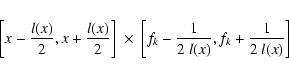
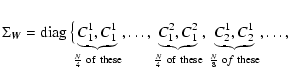
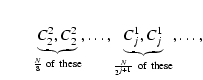
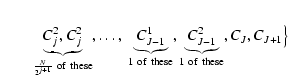
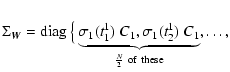
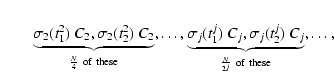
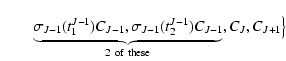
![\begin{figure}
\par\includegraphics[height=9cm,width=7.8cm,clip]{Figures/4468f11.ps} \end{figure}](/articles/aa/full/2006/45/aa4468-05/img162.gif)



![$\displaystyle \exp\left[-\frac{1}{2} \left(
\vec{W}_{\rm w}^T {\tilde C}_{\rm w...
...+
\vec{W}_{\rm nc}^T {\tilde C}_{\rm nc}^{-1} \vec{W}_{\rm nc} \right) \right],$](/articles/aa/full/2006/45/aa4468-05/img173.gif)

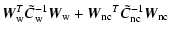




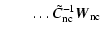
![\begin{figure}
\par\includegraphics[height=4.4cm,width=7.2cm,clip]{Figures/4468f12.ps}\end{figure}](/articles/aa/full/2006/45/aa4468-05/img197.gif)
![\begin{figure}
\par\includegraphics[height=3.85cm,width=7.3cm,clip]{Figures/4468...
...\includegraphics[height=3.85cm,width=7.3cm,clip]{Figures/4468f14.ps}\end{figure}](/articles/aa/full/2006/45/aa4468-05/img199.gif)
![\begin{figure}
\par\includegraphics[height=8.7cm,width=7.7cm,clip]{Figures/4468f15.ps}\end{figure}](/articles/aa/full/2006/45/aa4468-05/img201.gif)
![\begin{figure}
\par\includegraphics[height=8.7cm,width=7.7cm,clip]{Figures/4468f16.ps}\end{figure}](/articles/aa/full/2006/45/aa4468-05/img202.gif)
![\begin{figure}
\par\includegraphics[height=9cm,width=7.8cm,clip]{Figures/4468f17.ps}\end{figure}](/articles/aa/full/2006/45/aa4468-05/img203.gif)
![\begin{figure}
\par\includegraphics[height=8.2cm,width=4.3cm,angle=90,clip]{Figu...
...graphics[height=8.2cm,width=4.3cm,angle=90,clip]{Figures/4468f19.ps}\end{figure}](/articles/aa/full/2006/45/aa4468-05/img204.gif)
![\begin{figure}
\par\includegraphics[height=4cm,width=7cm,clip]{Figures/4468f20.ps}\end{figure}](/articles/aa/full/2006/45/aa4468-05/img206.gif)
![\begin{figure}
\par\includegraphics[height=8.25cm,width=4.3cm,angle=90,clip]{Fig...
...raphics[height=8.25cm,width=4.3cm,angle=90,clip]{Figures/4468f22.ps}\end{figure}](/articles/aa/full/2006/45/aa4468-05/img207.gif)