![\begin{figure}
\par\includegraphics[width=17.8cm,clip]{8103fig1.eps}
\end{figure}](/articles/aa/full/2008/14/aa8103-07/img136.gif) |
Figure 1:
Actual shapes of non-thermal f-b and f-f spectra for different temperature regimes and non-thermal electron parameters. Note that the cool, hot and ultra-hot totals are almost identical and the dashed curves nearly indistinguishable for
 keV. keV. |
| Open with DEXTER | |
In the text
![\begin{figure}
\par\includegraphics[width=17.5cm,clip]{8103fig2.eps}
\end{figure}](/articles/aa/full/2008/14/aa8103-07/img137.gif) |
Figure 2: Photon flux ratio of non-thermal f-b to f-f emission for different temperature regimes and parameters. Line styles have the same meaning as in Fig. 1. |
| Open with DEXTER | |
In the text
![\begin{figure}
\par\includegraphics[width=12cm,clip]{8103fig3.eps}
\end{figure}](/articles/aa/full/2008/14/aa8103-07/img138.gif) |
Figure 3:
Spatially localised spectra from a loop with the 2002 April 14 event plasma parameters for two values of  .
The left plot shows a very
distinct iron edge at .
The left plot shows a very
distinct iron edge at  22 keV 22 keV
 and a much
less predominant oxygen edge at 15 keV
and a much
less predominant oxygen edge at 15 keV
 ,
whereas the
second plot shows very distinct oxygen (21 keV
)
and iron (28 keV) edges. This shows the value of recombination as an
diagnostic. The ``edges'' appear to be of finite slope because of the finite (1 keV) resolution used. ,
whereas the
second plot shows very distinct oxygen (21 keV
)
and iron (28 keV) edges. This shows the value of recombination as an
diagnostic. The ``edges'' appear to be of finite slope because of the finite (1 keV) resolution used. |
| Open with DEXTER | |
In the text
![\begin{figure}
\par\includegraphics[width=17cm,clip]{8103fig4.eps}
\end{figure}](/articles/aa/full/2008/14/aa8103-07/img139.gif) |
Figure 4:
The spectral components for 4 different
hypothetical situations. We show these spectra by varying the parameters around the results in
the Veronig & Brown (2004) paper that analyses the coronal thick target 2002
April 14 event. In all cases we keep the same values of
 , ,
 keV and T=19.6 MK.
Plot A is for the thick-target coronal case with the actual
event parameters keV and T=19.6 MK.
Plot A is for the thick-target coronal case with the actual
event parameters
 according to Veronig and Brown.
Plot B was obtained for the same event parameters
but with
according to Veronig and Brown.
Plot B was obtained for the same event parameters
but with  reduced 25 times to make the loop collisionally thin above
10 keV and with footpoint emission occulted. The injection rate is the
same as Plot A so the density fraction of fast electrons is 25 times
higher. The non-thermal emission is down by 25 times while the thermal is down by a factor of 625.
Plot C is the same as B but with cold thick target
footpoints included. The cold footpoint emission (motsly f-f) is dominant.
Plot D is the same as C, but with an injection rate reduced by a factor
of 25 so that the density fraction of fast electrons is the same as in Plot A.
Evidently the detectability of the f-b contribution and of associated
features in F(E) is sensitive to plasma parameters and observing
conditions/geometry.
reduced 25 times to make the loop collisionally thin above
10 keV and with footpoint emission occulted. The injection rate is the
same as Plot A so the density fraction of fast electrons is 25 times
higher. The non-thermal emission is down by 25 times while the thermal is down by a factor of 625.
Plot C is the same as B but with cold thick target
footpoints included. The cold footpoint emission (motsly f-f) is dominant.
Plot D is the same as C, but with an injection rate reduced by a factor
of 25 so that the density fraction of fast electrons is the same as in Plot A.
Evidently the detectability of the f-b contribution and of associated
features in F(E) is sensitive to plasma parameters and observing
conditions/geometry. |
| Open with DEXTER | |
In the text
![\begin{figure}
\par\includegraphics[width=8cm,clip]{8103fig5.eps}
\end{figure}](/articles/aa/full/2008/14/aa8103-07/img158.gif) |
Figure 5:
Spectral components for a resolution of 0.01 keV. The f-b edges of all elements involved are clearly noticeable. The parameters are T = 19.6 MK,
keV and
.
This plot can be compared to Plot A of Fig. 4, which has the same parameters but for 1 keV binning resolution. |
| Open with DEXTER | |
In the text
![\begin{figure}
\par\includegraphics[width=8cm,clip]{8103fig6.eps}
\end{figure}](/articles/aa/full/2008/14/aa8103-07/img159.gif) |
Figure 6:
Fractional error (
 )
in G (Eq. (25)) as
discussed in Sect. 5 for
E* = 5, 10, 20 keV respectively for a shifted power-law due to inference of G from H
ignoring the presence of recombination. )
in G (Eq. (25)) as
discussed in Sect. 5 for
E* = 5, 10, 20 keV respectively for a shifted power-law due to inference of G from H
ignoring the presence of recombination. |
| Open with DEXTER | |
In the text
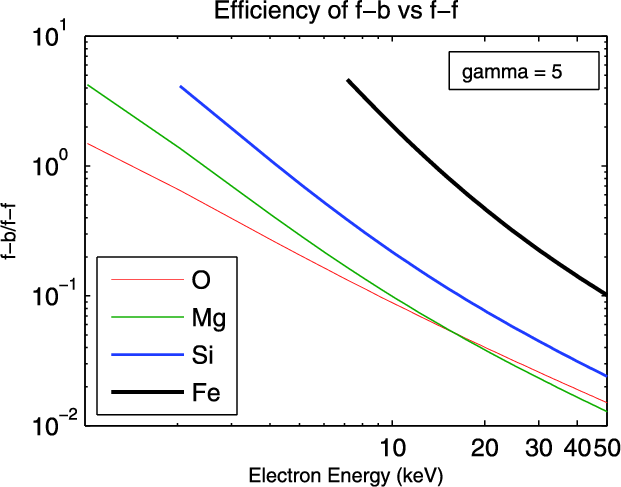 |
Figure A.1: The f-b electron efficiency compared to f-f for the 4 elements discussed in Appendix A. It is evident from the graph that, if present, highly ionised Fe is the most efficient source of f-b HXRs in terms of the F(E) needed followed by Si, O and Mg. |
| Open with DEXTER | |
In the text
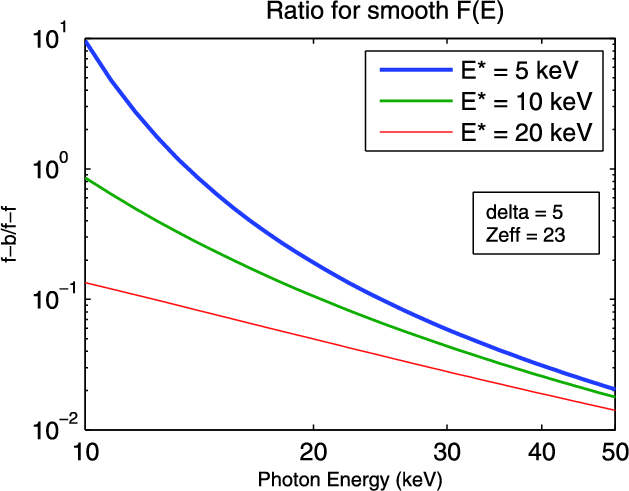 |
Figure A.2:
The
 as discussed in Appendix A and Eq. (A.5). It is the ratio of
  to
to  for the
smooth
for the
smooth
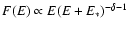 for
E*=5, 10, 20 keV
respectively.
for
E*=5, 10, 20 keV
respectively. |
| Open with DEXTER | |
In the text
![\begin{figure}
\par\includegraphics[width=17cm,clip]{8103fig9.eps}
\end{figure}](/articles/aa/full/2008/14/aa8103-07/img205.gif) |
Figure B.1:
Non-thermal f-f and f-b spectra for the thick
target case (Eqs. (B.11) and (B.12)) shown for 2 different temperatures: 20 MK that is pertinent to events such as the 2002 April 14 event and 10 MK, which is more in the range of ``microflare'' temperatures. It is
interesting to note the three distinct energy regimes for the f-b
spectrum, namely:
 .
Clearly f-b is very important in the 10-50 keV range,
precisely where albedo issues are also important. .
Clearly f-b is very important in the 10-50 keV range,
precisely where albedo issues are also important. |
| Open with DEXTER | |
In the text