A&A 481, 507-518 (2008)
DOI: 10.1051/0004-6361:20078103
Non-thermal recombination - a neglected source of flare hard X-rays and fast electron diagnostic
J. C. Brown - P. C. V. Mallik
Department of Physics and Astronomy, University of
Glasgow, Glasgow G12 8QQ, UK
Received 17 June 2007 / Accepted 27 January 2008
Abstract
Context. Flare Hard X-rays (HXRs) from non-thermal electrons are commonly treated as solely bremsstrahlung (free-free = f-f), recombination (free-bound = f-b) being neglected. This assumption is shown to be substantially in error, especially in hot sources, mainly due to recombination onto Fe ions.
Aims. We analyse the effects on HXR spectra
 and electron diagnostics by including non-thermal recombination onto heavy elements in our model.
Methods. Using Kramers hydrogenic cross sections with effective
 ,
we calculate f-f and f-b spectra for power-law electron spectra within both thin and thick target limits and for Maxwellians with summation over all important ions.
,
we calculate f-f and f-b spectra for power-law electron spectra within both thin and thick target limits and for Maxwellians with summation over all important ions.
Results. We find that non-thermal electron recombination, especially onto Fe, must, in general, be included with f-f for reliable spectral interpretation, when the HXR source is hot, such as occulted loops containing high ions of Fe (f-b cross-section  Z4). The f-b contribution is greatest when the electron spectral index
  is large and any low energy cut-off
  is small, because the electron flux spectrum F(E) emitting f-b photon energy
  is
is
 (VZ is the ionisation potential) and not
 as for f-f. The f-b spectra recombination edges mean a cut-off
in F(E) appears as an HXR feature at
as for f-f. The f-b spectra recombination edges mean a cut-off
in F(E) appears as an HXR feature at
 ,
offering an
diagnostic. For thick target sources, the presence of
appears as edges in
,
offering an
diagnostic. For thick target sources, the presence of
appears as edges in
 ,
not in
,
but it is still detectable. Including f-b lowers the F(E) needed for prescribed HXR fluxes greatly in some cases; and even when small, it seriously distorts F(E) as inferred by inversion or forward fitting of
based on f-f alone.
,
not in
,
but it is still detectable. Including f-b lowers the F(E) needed for prescribed HXR fluxes greatly in some cases; and even when small, it seriously distorts F(E) as inferred by inversion or forward fitting of
based on f-f alone.
Conclusions. The f-b recombination from non-thermal electrons can be an important contributor to HXR spectra, so it should be included in spectral analyses, especially for hot sources. Accurate results will require use of better cross sections than ours and consideration of source ionisation structure.
Key words: atomic processes - Sun: corona - Sun: flares - Sun: X-rays, gamma rays
1 Introduction
Ever since their first detection (Arnoldy et al. 1968;
Kane & Andersen 1970), flare hard X-ray (HXR) bursts
(photon energies
 keV or so) have been recognised as
an important diagnostic of electron acceleration and propagation
(e.g. Brown 1971; Lin & Schwartz 1987; Johns & Lin 1992). The
large electron flux and power
imply they play a
substantial role in flare energy budgets and pose challenges for
electron acceleration mechanisms (see recent reviews by, e.g. Vilmer
et al. 2003; Brown 2005; MacKinnon 2006). Recent copious high resolution HXR spectral data from the RHESSI mission (Lin
et al. 2002) have created the possibility of detailed reconstruction
of source electron spectra (following Brown 1971) offering important
constraints on the electron energy budget and acceleration processes
(Piana et al. 2003; Conway et al. 2003;
Massone et al. 2004; Kontar et al. 2005, 2006; Brown et al. 2006).
keV or so) have been recognised as
an important diagnostic of electron acceleration and propagation
(e.g. Brown 1971; Lin & Schwartz 1987; Johns & Lin 1992). The
large electron flux and power
imply they play a
substantial role in flare energy budgets and pose challenges for
electron acceleration mechanisms (see recent reviews by, e.g. Vilmer
et al. 2003; Brown 2005; MacKinnon 2006). Recent copious high resolution HXR spectral data from the RHESSI mission (Lin
et al. 2002) have created the possibility of detailed reconstruction
of source electron spectra (following Brown 1971) offering important
constraints on the electron energy budget and acceleration processes
(Piana et al. 2003; Conway et al. 2003;
Massone et al. 2004; Kontar et al. 2005, 2006; Brown et al. 2006).
In inferring electron flux spectra F(E), the HXR radiation
mechanism has always been taken to be f-f collisional bremsstrahlung
of fast electron impacts with atoms and ions, gyrosynchrotron and
inverse Compton radiation being negligible at these energies for
solar magnetic and radiation fields (Korchak 1971). Though included
for thermal electrons in hot (a few keV) plasma, f-b recombination
radiation from non-thermals seems to have been assumed negligible
other than in a preliminary study by Landini et al. (1973). In view of the importance of details in the
photon spectrum
(photons s-1 kev-1) for
accurate reconstruction of F(E), we re-examine this assumption,
and conclude (cf. Mallik & Brown 2007) that it is not valid under
some conditions, which quite commonly exist in some flare HXR source
regions.
It is not the intention of this paper to analyse precisely the
theoretical recombination radiation spectrum from fast electrons
under conditions (e.g. ionisation structure) for specific flares
which are typically both inhomogeneous and time dependent. Rather we
give approximate theoretical estimates of how important it may be
relative to bremsstrahlung under various limiting conditions.
Specifically, we compare the two in the simplest, Kramers,
cross-section approximations, for limiting cases of plasma
ionisation. The recombination emission rate per electron is very
sensitive to the ionic charge, being Z4AZ (Kramers 1923)
per plasma proton for hydrogenic ions of charge  and number
abundance AZ. Thus the emitted f-b flux and spectrum depend
strongly on the ionisation state, hence the temperature, of the
plasma where the fast electrons recombine. In practice this will
involve several ionisation stages of several target plasma species
(since Z4AZ may be large even for small abundance AZ), which
will vary along the paths of the electrons and be time dependent.
and number
abundance AZ. Thus the emitted f-b flux and spectrum depend
strongly on the ionisation state, hence the temperature, of the
plasma where the fast electrons recombine. In practice this will
involve several ionisation stages of several target plasma species
(since Z4AZ may be large even for small abundance AZ), which
will vary along the paths of the electrons and be time dependent.
The paper is organised as follows. In Sect. 2 we briefly discuss
relevant processes and the cross-section approximations we use, and
obtain expressions for the total continuum photon spectral
contributions
 expected from an electron flux spectrum F(E) from f-f and from f-b processes. In Sect. 3, we compare
these for a power-law F(E) with low cut off at
expected from an electron flux spectrum F(E) from f-f and from f-b processes. In Sect. 3, we compare
these for a power-law F(E) with low cut off at
 and for a
shifted power-law, and discuss implications for flare electron
spectra and energy budgets under several limiting plasma ionisation
assumptions. In Sect. 4 we look at thermal and non-thermal components to show how the relative
importance of each contribution depends on conditions in the flare
by varying parameters around those for a specific real event.
Section 5 discusses the effect of including the f-b contribution on
inverse problem inference of F(E) from
while Sect. 6 summarises our conclusions and suggests directions for future
work. Details of some of the equations are given in Appendix A. In Appendix B we discuss the total emission spectra from
extended volumes for thin target, collisional thick target and
thermal cases.
and for a
shifted power-law, and discuss implications for flare electron
spectra and energy budgets under several limiting plasma ionisation
assumptions. In Sect. 4 we look at thermal and non-thermal components to show how the relative
importance of each contribution depends on conditions in the flare
by varying parameters around those for a specific real event.
Section 5 discusses the effect of including the f-b contribution on
inverse problem inference of F(E) from
while Sect. 6 summarises our conclusions and suggests directions for future
work. Details of some of the equations are given in Appendix A. In Appendix B we discuss the total emission spectra from
extended volumes for thin target, collisional thick target and
thermal cases.
In this section, we discuss only local emissivities
(photons cm-3 s-1 per unit
). Relativistic
and directivity effects are disregarded (
 )
since the f-b/f-f ratio is largest at low E. Then, if target
atom/ion type t has density nt and the fast electron flux
spectrum is F(E) (electrons s-1 cm-2 per unit E),
for a collisional radiation process is
)
since the f-b/f-f ratio is largest at low E. Then, if target
atom/ion type t has density nt and the fast electron flux
spectrum is F(E) (electrons s-1 cm-2 per unit E),
for a collisional radiation process is
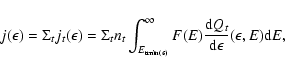 |
(1) |
where d
 is the relevant cross-section
per unit
for target species t and the integral is over
the range of electron energies relevant to species t.
is the relevant cross-section
per unit
for target species t and the integral is over
the range of electron energies relevant to species t.
In the case of f-f (bremsstrahlung), d
is
essentially the same for any state of ionisation of an atomic
species Z (Koch & Motz 1959), and the t summation in (1) need only
be carried out over elements Z to give, for element abundances AZ (by number relative to hydrogen), and total proton (p + H)
density  ,
,
 |
(2) |
where d
 is the bremsstrahlung
cross-section for element Z and
is the bremsstrahlung
cross-section for element Z and
 since any
free-free transition can only yield a maximum
since any
free-free transition can only yield a maximum
 .
The
bremsstrahlung cross-section per nucleus Z scales as Z2 and
can be written
.
The
bremsstrahlung cross-section per nucleus Z scales as Z2 and
can be written
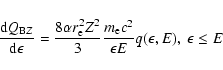 |
(3) |
(and zero for
 ). Here
 is the fine
structure constant and
is the fine
structure constant and
 the classical electron
radius, while
the classical electron
radius, while
 is the ratio of the actual cross
section to the Kramers cross section (Kramers 1923), which is the
factor in front of q. While this is only a first approximation,
not suitable for accurate absolute spectral inversion/reconstruction
algorithms (Brown 2005), it will be adequate for the present purpose
of comparing f-f with f-b emission, which we also treat in the
Kramer's approximation. Then (2) and (3) give, for bremsstrahlung,
is the ratio of the actual cross
section to the Kramers cross section (Kramers 1923), which is the
factor in front of q. While this is only a first approximation,
not suitable for accurate absolute spectral inversion/reconstruction
algorithms (Brown 2005), it will be adequate for the present purpose
of comparing f-f with f-b emission, which we also treat in the
Kramer's approximation. Then (2) and (3) give, for bremsstrahlung,
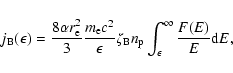 |
(4) |
where
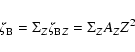 |
(5) |
is the heavy element correction for bremsstrahlung, with
 for
the solar coronal abundances we use - see later.
for
the solar coronal abundances we use - see later.
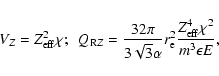
The situation here is more complicated. Firstly, 2-body radiative
recombination (we neglect 3-body recombination) of a free electron
of energy E to a bound level m of energy -V(Z,i,m) in ionic
stage i yields a photon energy ,
which, apart from
quantum uncertainty, is unique, namely:
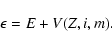 |
(6) |
That is, when a fast electron does recombine, all of its kinetic
energy E plus V goes into a photon of that energy, in
contrast to bremsstrahlung where photons of all energies
 are emitted.
Furthermore, for each element Z, there is a range of Z+1 distinct
ion stages i each with its own distinct set of energy levels (m)
and a set of Z,i,m-dependent recombination cross-sections. Thus
recombination collisions of a mono-energetic beam with a
multi-species plasma gives rise to a set of delta-function-like
spectral features at all energies (6) corresponding to elements Z,
ionic stages i and levels m . For a continuous electron
spectrum, this yields a continuum photon spectrum that is a sum of
an infinite series of energy-shifted electron flux contributions.
In contrast to bremsstrahlung it does not involve an integral over a
continuum of electron energies.
For a general plasma the basic particle type ``t'' onto which
recombination occurs is level m of ion stage i of element Zwith recombination cross-section differential in
for that t:
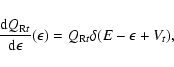 |
(7) |
where
 is the total radiative recombination cross-section
for species t and
is the total radiative recombination cross-section
for species t and
 is the delta-function in energy such
that
is the delta-function in energy such
that
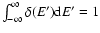 .
Then the total
recombination emission spectrum for electron flux spectrum F(E) is
.
Then the total
recombination emission spectrum for electron flux spectrum F(E) is
where At is the numerical abundance of species t relative to
.
The forms for
,
for general t, are complicated and
have to be calculated numerically, as do the values of At when
individual ionisation states are considered. However, in the Kramers
approximation (with unit Gaunt factors) there is an analytic
expression for hydrogenic ions, which we will use to estimate
d
 compared with d
 ,
namely, for
recombination onto level m of the hydrogenic ion of element Z(Kramers 1923; Andersen et al. 1992; Hahn 1997)
,
namely, for
recombination onto level m of the hydrogenic ion of element Z(Kramers 1923; Andersen et al. 1992; Hahn 1997)
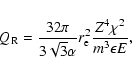 |
(9) |
where
 is the hydrogen ionisation potential.
Table 1:
Elements with
their coronal abundances and ionisation potentials at
 K.
K.
For an element in its highest purely hydrogenic ion state the
emissivity spectrum would then be
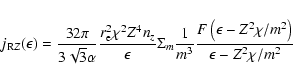 |
(10) |
with the m summation over
 ,
since
recombination to level m yields only photons of
,
since
recombination to level m yields only photons of
 .
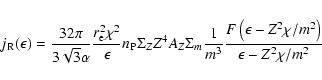
If the source were so hot that all atoms were almost fully
ionised the total for all Z would be, in this approximation,
.
If the source were so hot that all atoms were almost fully
ionised the total for all Z would be, in this approximation,
 |
(11) |
for element abundances AZ, with the same m summation limits.
In reality even super-hot coronal flare temperatures are not high
enough to equal the ultra-hot K needed to almost fully ionise
all elements into their hydrogenic states, especially Fe, which is
crucial in having by far the highest value of A4 - see Table 1. Consequently, to deal accurately with  for real flare data,
we would have to take into account the actual ionisation state of
the flare plasma, which varies with time and location (being
radically different in loop tops from loop footpoints), and actual
forms of
for real flare data,
we would have to take into account the actual ionisation state of
the flare plasma, which varies with time and location (being
radically different in loop tops from loop footpoints), and actual
forms of
 for non-hydrogenic ion stages.
For our purpose of making first estimates we make the following
simplifying approximations:
Under these conditions, Eq. (11) becomes
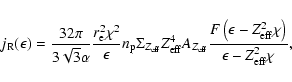 |
(13) |
where
 with
with
 the
fraction of atoms of element Z in ionic state
the
fraction of atoms of element Z in ionic state
 .
.
Table 2:
Ionic species of iron at 20 MK.
Note that, since there is no integration over E here,
if F(E) contains a sharp feature at an electron energy E*, such
as a low or high E cut-off, this will appear in the recombination
contribution to the photon spectrum
as a series of
sharp features at photon energies
 for every
ion Z present. The same is true for broad features like smooth bumps or dips. This is in contrast with the bremsstrahlung
contribution, in which such features are smoothed out by integration
over E. Thus, even if
for every
ion Z present. The same is true for broad features like smooth bumps or dips. This is in contrast with the bremsstrahlung
contribution, in which such features are smoothed out by integration
over E. Thus, even if
 ,
it may have an important effect
in inferring F(E) from
since this essentially
involves differentiating
(Sect. 5).
,
it may have an important effect
in inferring F(E) from
since this essentially
involves differentiating
(Sect. 5).
The heavy element correction for bremsstrahlung,
 ,
is almost independent of ionisation state (since
the bremsstrahlung cross sections for atoms and ions of the same Zare essentially the same), being
for solar
abundances. On the other hand
,
is almost independent of ionisation state (since
the bremsstrahlung cross sections for atoms and ions of the same Zare essentially the same), being
for solar
abundances. On the other hand
 depends on the number of empty ion levels available for
recombination. The importance of fast electron recombination
radiation thus depends on the state of ionisation of the plasma in
which the fast electrons are moving, which is primarily a function
of plasma temperature T.
depends on the number of empty ion levels available for
recombination. The importance of fast electron recombination
radiation thus depends on the state of ionisation of the plasma in
which the fast electrons are moving, which is primarily a function
of plasma temperature T.
In Table 1 we show the values of Z,
 ,
,
 ,
VZ for various elements/ions whose
,
VZ for various elements/ions whose
 is large enough to be significant, if the
element is sufficiently ionised. With
is large enough to be significant, if the
element is sufficiently ionised. With
 for
FeXXVI, Fe is by far the most important if conditions are such that
it is highly ionised. The kT where maximum ionisation of an ion
stage is reached is typically of the order
for
FeXXVI, Fe is by far the most important if conditions are such that
it is highly ionised. The kT where maximum ionisation of an ion
stage is reached is typically of the order
 to
to
 .
In Table 2 we show more detailed values for several
stages of ionisation of Fe (XXII-XXV, i.e. 21+ to 24+) with the
appropriate
.
In Table 2 we show more detailed values for several
stages of ionisation of Fe (XXII-XXV, i.e. 21+ to 24+) with the
appropriate
 for each of
these Fe ionic states for the typical coronal flare case of
for each of
these Fe ionic states for the typical coronal flare case of
 K. These are taken from Arnaud & Raymond (1992)
as are the actual ionisation fractions we adopt later (Sect. 4)
for the temperatures of the real flare we consider.
K. These are taken from Arnaud & Raymond (1992)
as are the actual ionisation fractions we adopt later (Sect. 4)
for the temperatures of the real flare we consider.
The radiative recombination coefficients give
,
which differ
slightly from the Z values, as mentioned in Sect. 2.3. For the
2002 April 14 event, to which we return later, the peak flare
temperature was 19.6 MK, 
 of the iron appearing as Fe XXII
(Fe21+),
of the iron appearing as Fe XXII
(Fe21+),  in the Fe XXIII (Fe22+) state,
 appearing as Fe XXIV and
  as Fe XXV. The
respective
values are 21.98, 22.61, 23.20 and 23.77.
as Fe XXV. The
respective
values are 21.98, 22.61, 23.20 and 23.77.
Broadly speaking in typical flare/micro-flare conditions we
can consider the following T regimes:
- at
 K (``cold'') even H and other low
 ions are neutral so
 for all Z.
This would be typical of very dense cool chromospheric thick target
footpoints relevant to deeply penetrating electrons;
for all Z.
This would be typical of very dense cool chromospheric thick target
footpoints relevant to deeply penetrating electrons;
- for
 K (``cool'') the predominant elements ionised are H, O, Mg, Si giving
 .
This is most relevant to upper
chromospheric dense warm plasma reached by moderate energy thick
target electrons;
.
This is most relevant to upper
chromospheric dense warm plasma reached by moderate energy thick
target electrons;
- at
 K (``hot'') Fe is well ionised up to about Fe XXV giving
 .
.
This is relevant to the hot ``coronal'' loop regime, hence either to
(i) typical upper (SXR) flare loops of moderate density (thin
target) whose HXR emission is seen in isolation either by HXR
spectroscopic imaging or volume integrated but with the cool
footpoints occulted because they are over the solar limb; or (ii)
cases of coronal thick target loops (Veronig & Brown 2004) where
the upper loop density suffices to stop the fast electrons
collisionally.
To estimate how the fast electron recombination
 compares with bremsstrahlung
,
we first
consider the commonly studied case of a power-law with a low energy
cut-off
compares with bremsstrahlung
,
we first
consider the commonly studied case of a power-law with a low energy
cut-off
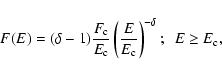 |
(14) |
where  is the total electron flux at
 .
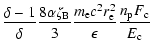
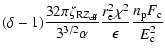
Then, from
Eqs. (4) and (14), we obtain for f-f emission
.
Then, from
Eqs. (4) and (14), we obtain for f-f emission
while for f-b emission from an ion of effective charge
,
where
 |
(17) |
So the total for all relevant
is
![\begin{displaymath}j_{\rm R}(\epsilon) = \Sigma_{Z_{\rm eff}\ge [(\epsilon-E_{\rm c})/\chi]^{1/2}}
j_{{\rm R}Z_{\rm eff}}(\epsilon).
\end{displaymath}](/articles/aa/full/2008/14/aa8103-07/img117.gif) |
(18) |
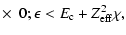
For this truncated power-law case, the ratio of f-b to f-f
emissivity is
where each term in the summation is zero at
 .
.
For
 (keV). In pure ionised H
(
(keV). In pure ionised H
(
 this is only
  at 10 keV.
This rather small value of
at 10 keV.
This rather small value of  must be the origin of the conventional wisdom that f-b can be
ignored compared to f-f emission at HXR energies. However, this
notion neglects several crucial facts:
must be the origin of the conventional wisdom that f-b can be
ignored compared to f-f emission at HXR energies. However, this
notion neglects several crucial facts:
- At high coronal flare temperatures, where all elements are highly ionised,
in plasmas of cosmic chemical abundances, heavy elements are the
main contributors to the A4 sum. For the extreme ultra-hot
case of near-total ionisation of all Z, and for modern solar coronal
abundances the
 factor is
 61.2, mainly due to Fe as discussed in Sect. 2.4 - see
Tables 1 and 2. Note that Fe coronal abundance, for example, has been assumed to be 2.9 times photospheric Fe abundance (Feldman et al. 1992). Even higher factors of about 4 have been suggested (Dennis, personal communication).
61.2, mainly due to Fe as discussed in Sect. 2.4 - see
Tables 1 and 2. Note that Fe coronal abundance, for example, has been assumed to be 2.9 times photospheric Fe abundance (Feldman et al. 1992). Even higher factors of about 4 have been suggested (Dennis, personal communication).
- At lower
the contribution from each
rises steeply
to a sharp recombination edge at
,
where the flux can be
large, especially if
is small and
large.
- At the edge, the [ ] factor in Eq. (19) goes to
![$[1+Z_{\rm eff}^2\chi/E_{\rm c}]^{\delta+1}$](/articles/aa/full/2008/14/aa8103-07/img128.gif) .
This is because the flux of
electrons emitting recombination photons of energy
is not
the flux of those at
.
This is because the flux of
electrons emitting recombination photons of energy
is not
the flux of those at
 ,
as for bremsstrahlung, but of those at
,
as for bremsstrahlung, but of those at
 .
Consequently
is not negligible
even at
.
Consequently
is not negligible
even at
 .
For fully ionised Fe alone, this factor is
.
For fully ionised Fe alone, this factor is
 (keV)
(keV)
![$]^{\delta+1}$](/articles/aa/full/2008/14/aa8103-07/img133.gif) ,
which, for
,
which, for  and at
 keV, is 64, 11.4, 5.5 for
 ,
20, 30 keV
respectively. Even for lower stage Fe ions (e.g. XXV), common in
flare coronal loops, evidently recombination must be a significant
contributor to the HXR emission in those parts of the flare.
,
20, 30 keV
respectively. Even for lower stage Fe ions (e.g. XXV), common in
flare coronal loops, evidently recombination must be a significant
contributor to the HXR emission in those parts of the flare.
![\begin{figure}
\par\includegraphics[width=17.8cm,clip]{8103fig1.eps}
\end{figure}](/articles/aa/full/2008/14/aa8103-07/Timg136.gif) |
Figure 1:
Actual shapes of non-thermal f-b and f-f spectra for different temperature regimes and non-thermal electron parameters. Note that the cool, hot and ultra-hot totals are almost identical and the dashed curves nearly indistinguishable for
 keV. keV. |
| Open with DEXTER |
![\begin{figure}
\par\includegraphics[width=17.5cm,clip]{8103fig2.eps}
\end{figure}](/articles/aa/full/2008/14/aa8103-07/Timg137.gif) |
Figure 2:
Photon flux ratio of non-thermal f-b to f-f emission for different temperature regimes and parameters. Line styles have the same meaning as in
Fig. 1. |
| Open with DEXTER |
![\begin{figure}
\par\includegraphics[width=12cm,clip]{8103fig3.eps}
\end{figure}](/articles/aa/full/2008/14/aa8103-07/Timg138.gif) |
Figure 3:
Spatially localised spectra from a loop with the 2002 April 14 event plasma parameters for two values of .
The left plot shows a very
distinct iron edge at 22 keV
 and a much
less predominant oxygen edge at 15 keV
and a much
less predominant oxygen edge at 15 keV
 ,
whereas the
second plot shows very distinct oxygen (21 keV
)
and iron (28 keV) edges. This shows the value of recombination as an
diagnostic. The ``edges'' appear to be of finite slope because of the finite (1 keV) resolution used. ,
whereas the
second plot shows very distinct oxygen (21 keV
)
and iron (28 keV) edges. This shows the value of recombination as an
diagnostic. The ``edges'' appear to be of finite slope because of the finite (1 keV) resolution used. |
| Open with DEXTER |
![\begin{figure}
\par\includegraphics[width=17cm,clip]{8103fig4.eps}
\end{figure}](/articles/aa/full/2008/14/aa8103-07/Timg139.gif) |
Figure 4:
The spectral components for 4 different
hypothetical situations. We show these spectra by varying the parameters around the results in
the Veronig & Brown (2004) paper that analyses the coronal thick target 2002
April 14 event. In all cases we keep the same values of
 ,
keV and T=19.6 MK.
Plot A is for the thick-target coronal case with the actual
event parameters ,
keV and T=19.6 MK.
Plot A is for the thick-target coronal case with the actual
event parameters
 according to Veronig and Brown.
Plot B was obtained for the same event parameters
but with
reduced 25 times to make the loop collisionally thin above
10 keV and with footpoint emission occulted. The injection rate is the
same as Plot A so the density fraction of fast electrons is 25 times
higher. The non-thermal emission is down by 25 times while the thermal is down by a factor of 625.
Plot C is the same as B but with cold thick target
footpoints included. The cold footpoint emission (motsly f-f) is dominant.
Plot D is the same as C, but with an injection rate reduced by a factor
of 25 so that the density fraction of fast electrons is the same as in Plot A.
Evidently the detectability of the f-b contribution and of associated
features in F(E) is sensitive to plasma parameters and observing
conditions/geometry.
according to Veronig and Brown.
Plot B was obtained for the same event parameters
but with
reduced 25 times to make the loop collisionally thin above
10 keV and with footpoint emission occulted. The injection rate is the
same as Plot A so the density fraction of fast electrons is 25 times
higher. The non-thermal emission is down by 25 times while the thermal is down by a factor of 625.
Plot C is the same as B but with cold thick target
footpoints included. The cold footpoint emission (motsly f-f) is dominant.
Plot D is the same as C, but with an injection rate reduced by a factor
of 25 so that the density fraction of fast electrons is the same as in Plot A.
Evidently the detectability of the f-b contribution and of associated
features in F(E) is sensitive to plasma parameters and observing
conditions/geometry. |
| Open with DEXTER |
N.B. All spectrum figures in this paper (except Fig. 5) have been plotted for a bin-width of 1 keV to match RHESSI's spectral resolution. However, in Fig. 5 we use 0.01 keV resolution so as to compare it with Plot A of Fig. 4 to see how f-b edges would look if they were observed at a higher resolution. The 1 keV binning smears out a lot of the edges of different elements that are clearly noticeable in
Fig. 5. Hence in Figs. 3 and 4, the edges are not ``infinitely'' steep as they should be; this is evident in Fig. 5 where they do look ``infinitely'' steep due to the finer resolution. Also important to note is that the features seen in
Figs. 3-5 are recombination edges and not spectral lines. None of the figures in this paper includes spectral lines - leaving them out shows more clearly where f-b edges exist in the HXR continuum.
In Fig. 1 we show for
 the actual spectral shapes
for
the actual spectral shapes
for
 keV respectively in plasmas of normal solar coronal abundances, which are: ultra-hot
(
K; Fe is nearly fully ionised), hot (
K; Fe well ionised up to Fe XXV) and cool (T = 106 K; elements up to Si are almost fully ionised).
In Fig. 2 we show the ratios
keV respectively in plasmas of normal solar coronal abundances, which are: ultra-hot
(
K; Fe is nearly fully ionised), hot (
K; Fe well ionised up to Fe XXV) and cool (T = 106 K; elements up to Si are almost fully ionised).
In Fig. 2 we show the ratios
 for the ultra-hot, hot and ``cool'' cases, respectively.
The following key features of the hot thin target situation are
apparent from these figures:
for the ultra-hot, hot and ``cool'' cases, respectively.
The following key features of the hot thin target situation are
apparent from these figures:
- The peak non-thermal f-b contribution, in each hot or ultra-hot case shown,
adds at least 50% to the usual f-f one and in some cases
(
 keV) is up to 10 times greater (1000% increase)
even when only ions up to Fe XXV are present. This is essentially
due to the high abundance of Fe - much higher than thought when
recombination spectra were first discussed (Culhane 1969;
Culhane & Acton 1970). In Appendix A we evaluate the efficiency with which f-b yields HXRs compared to f-f, and also derive the ratio
for the case of a smooth F(E) with no cut-off. This proves, that in a hot enough plasma, far less electrons and power are needed than is found when only f-f is included and that, for smooth F(E),
is largest for large
and low E spectral roll-over.
keV) is up to 10 times greater (1000% increase)
even when only ions up to Fe XXV are present. This is essentially
due to the high abundance of Fe - much higher than thought when
recombination spectra were first discussed (Culhane 1969;
Culhane & Acton 1970). In Appendix A we evaluate the efficiency with which f-b yields HXRs compared to f-f, and also derive the ratio
for the case of a smooth F(E) with no cut-off. This proves, that in a hot enough plasma, far less electrons and power are needed than is found when only f-f is included and that, for smooth F(E),
is largest for large
and low E spectral roll-over.
- In the ``cool'' case (
 K) of elements
up to Si almost fully ionised, the f-b contribution is smaller but not in
general negligible. For example, in the bottom left panel of Fig. 1
(
keV), f-b is about 30% of f-f at 15 keV
energies. This is amply large enough to have a major impact on
inferring F(E) by inversion or by forward fitting (Sect. 5).
K) of elements
up to Si almost fully ionised, the f-b contribution is smaller but not in
general negligible. For example, in the bottom left panel of Fig. 1
(
keV), f-b is about 30% of f-f at 15 keV
energies. This is amply large enough to have a major impact on
inferring F(E) by inversion or by forward fitting (Sect. 5).
- In hot plasma, Fe is by far the most important contributor of
recombination radiation.
- The peak ratio of f-b to f-f increases as
is increased
and/or
is decreased. This is because f-b photons of energy
are emitted by electrons of energy E-V which have flux
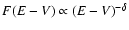 which is greatest when the minimum
 is smallest, V is largest and the steepness greatest.
- Recombination edges are apparent for the elements with the
highest values of
 - Fe, Si, Mg and O and at
energies
- Fe, Si, Mg and O and at
energies
 ,
thereby creating the
possibility of finding the location of a low energy cut-off should one exist.
,
thereby creating the
possibility of finding the location of a low energy cut-off should one exist.
- The harder asymptotic
 for f-f compared with
 for f-b (Eqs. (15) and (16)) results in an
upward ``knee'' in the total spectrum clearly visible in Fig. 1 for
keV but also present for higher
outside the
range of the figure. This could be an important signature
in data of a substantial f-b contribution.
for f-b (Eqs. (15) and (16)) results in an
upward ``knee'' in the total spectrum clearly visible in Fig. 1 for
keV but also present for higher
outside the
range of the figure. This could be an important signature
in data of a substantial f-b contribution.
While the edge locations and the spectral shape
trends will be roughly right, our use of the hydrogenic
and
approximations, and adoption of unit Gaunt factors, mean
that these curves/analytic forms can only be used for approximate
quantitative fitting of real data. As far as we are aware (Kaastra,
personal communication) the Gaunt factors, rates etc. have only ever
been systematically evaluated for Maxwellian F(E) and sometimes
for forms which can be written as sums of these (such as pure
power-laws with no cut-off), and some occasional consideration of
specific non-thermal spectra (e.g. Landini et al. 1973). Comparison of our Maxwellian results, in
the unit Gaunt factor Kramers approximation, with those of
Culhane for the same parameters shows the necessary corrections in
the Maxwellian case to be significant for quantitative comparison
with real data. In addition, in real cases the non-thermal emission
will always be superposed on thermal contributions (especially
important for the very hot plasmas of special interest here) and
also in many cases on a thick target non-thermal contribution
(unless this is from occulted footpoints), from the flare volume as a
whole. In Appendix B we derive the generalisation of the above equations to the various cases involved in real flares, viz. finite volume thin targets, Maxwellian plasmas and thick targets for use in Sect. 4, where we evaluate the sum of all these contributions for a specific case.
We saw above and in the appendices that the most favourable conditions for a substantial
recombination contribution are when the maximum possible amount of the
observable HXR source is a hot plasma (e.g. loop) at SXR
temperatures. High density maximises the emission measure but may
make the source/loop collisionally thick and smear recombination
edge spectral signatures of low energy cut offs. So an optimal case
could be a loop which is just tenuous enough to be collisionally thin
and for which the cool dense thick target footpoints are occulted.
(Footpoint removal by imaging is limited by RHESSI's dynamic range).
Such sources will have a strong HXR source in the coronal loop. One
such event was adopted as a basis for a case study, starting from
the real event parameters. This was the 2002 April 14 event, which
Veronig & Brown (2004) showed to be a hot, dense, collisionally
thick loop with a strong coronal HXR source and no footpoints up to
at least 60 keV. Thus the hot coronal source of non-thermal f-b
emission was not diluted by cold footpoint thick target f-f emission
though the f-b edges were smeared because the hot loop itself slowed
the fast electrons to rest. In Fig. 3 we show the theoretical spectrum from a hypothetical resolved part of the coronal loop for two
values. We have evaluated the theoretical
thermal, non-thermal and the whole volume hypothetical total
 (from Sects. 2, 3 and Appendix B) for
such a loop, based on our approximate Kramers expressions, in three
loop parameter regimes (Fig. 4):
(from Sects. 2, 3 and Appendix B) for
such a loop, based on our approximate Kramers expressions, in three
loop parameter regimes (Fig. 4):
The upward ``knee'' apparent in Figs. 4A, B at around 40 keV due
to the transition from a f-b to a f-f dominated spectrum (cf. Sect. 3 and Fig. 3) is rarely seen in data but may be present in
some events (Conway et al. 2003). A statistical survey of a
large sample of events should shed light on conditions where
non-thermal f-b is important. Also note that an upward ``knee''is present at the transition from a thermal- to a non-thermal-dominated spectrum. The position of this knee depends on the plasma temperature and may interfere with the f-b to f-f ``knee'', which depends mainly on the
parameter. Hence, although for certain parametric conditions one may be able to notice two separate upward ``knees'', if
is low and T is high, the ``knees'' may occur at
similar
and may not be distinguishable in real data.
We note again that, since even the thin target  involves an
integral over E while
does not, any sharp features in F(E)would be smoothed out in the bremsstrahlung contribution to the
photon spectrum but not in the recombination contribution.
Consequently, an important way to study the effect of including f-b on
the required properties of F(E) is to consider it as an inverse
problem (Craig & Brown 1986) to infer F(E) from
observed
.
Here we consider the following experiment for the
thin target case. (Thick target and thermal cases always involve even
greater error magnification - Brown & Emslie 1988). Generate the
total
including f-b as well as f-f from a specified
F1(E) and evaluate the F2(E) which would be erroneously
inferred by solving the inverse problem ignoring the presence of
the f-b term, as is currently done in all HXR data analysis, whether
by inversion or forward fitting.
involves an
integral over E while
does not, any sharp features in F(E)would be smoothed out in the bremsstrahlung contribution to the
photon spectrum but not in the recombination contribution.
Consequently, an important way to study the effect of including f-b on
the required properties of F(E) is to consider it as an inverse
problem (Craig & Brown 1986) to infer F(E) from
observed
.
Here we consider the following experiment for the
thin target case. (Thick target and thermal cases always involve even
greater error magnification - Brown & Emslie 1988). Generate the
total
including f-b as well as f-f from a specified
F1(E) and evaluate the F2(E) which would be erroneously
inferred by solving the inverse problem ignoring the presence of
the f-b term, as is currently done in all HXR data analysis, whether
by inversion or forward fitting.
![\begin{figure}
\par\includegraphics[width=8cm,clip]{8103fig6.eps}
\end{figure}](/articles/aa/full/2008/14/aa8103-07/Timg159.gif) |
Figure 6:
Fractional error (
 )
in G (Eq. (25)) as
discussed in Sect. 5 for
E* = 5, 10, 20 keV respectively for a shifted power-law due to inference of G from H
ignoring the presence of recombination. )
in G (Eq. (25)) as
discussed in Sect. 5 for
E* = 5, 10, 20 keV respectively for a shifted power-law due to inference of G from H
ignoring the presence of recombination. |
| Open with DEXTER |
By (4) and (11) the total f-f + f-b emission spectrum d
 from a homogeneous volume V can be written
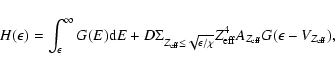 |
(20) |
where
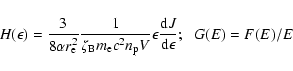 |
(21) |
and D is as given in Eq. (A.2). If we ignore the second
(recombination) term in Eq. (20), as has always been done in
the past, for the Kramers f-f term, the inverse is just (Brown &
Emslie 1988)
 |
(22) |
The neglect of the second term can be thought of as an ``error''
 in our data and if we apply inversion formula (22) to this ``data'', ignoring the recombination ``error'' we get a resulting error
 in the inferred G given by
It is at once clear that any sharp change in
i.e. in
H(E), such as the presence of f-b edges, however small, can have a
very large effect on the inferred F2(E). (If the inverse problem
is addressed for more realistic smoother forms of f-f cross section
than Kramers, the ``error magnification'' is in general even larger -
Brown & Emslie 1988; Piana et al. 2000.) For a power law Fwith cut off around say 20 keV, analytically speaking this
expression gives infinite negatives in
 at the spectral
edges around 30 keV (for Fe). However when smoothed over a few keV
and added to the f-f term the result would be a ``wiggle'' in the F(E) solution in the 30-40 keV range. This is just where enigmatic
features have been reported in some RHESSI spectra and variously
attributed to the effects of photospheric albedo (Kontar et al. 2006), possibly pulse pile up (Piana et al. 2003), or a
high value of
(Zhang & Huang 2004).
at the spectral
edges around 30 keV (for Fe). However when smoothed over a few keV
and added to the f-f term the result would be a ``wiggle'' in the F(E) solution in the 30-40 keV range. This is just where enigmatic
features have been reported in some RHESSI spectra and variously
attributed to the effects of photospheric albedo (Kontar et al. 2006), possibly pulse pile up (Piana et al. 2003), or a
high value of
(Zhang & Huang 2004).
Another case providing insight is that of a smooth shifted power-law
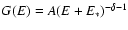 ,
which has no edges though the
corresponding F(E) has a smooth peak at
,
which has no edges though the
corresponding F(E) has a smooth peak at
 .
In this
case the fractional error in G due to applying (22) ignoring the
recombination term can be expressed as
.
In this
case the fractional error in G due to applying (22) ignoring the
recombination term can be expressed as
![\begin{displaymath}\frac{\Delta G(E)}{G(E)} \!=\! (\delta+1)\frac{D}{E+E_*}\Sigm...
...}}\left[\frac{1}{1-V_{Z_{\rm eff}}/(E+E_*)}\right]^{\delta+2},
\end{displaymath}](/articles/aa/full/2008/14/aa8103-07/img172.gif) |
(24) |
where each term in the
sum is zero for
 .
.
In the case of recombination onto Fe XXV alone (hot plasma),
this gives for ,
![\begin{displaymath}\frac{\Delta G}{G}\approx \frac{10 ~ \rm keV}{E+E_*}\left[1-7 ~
{\rm keV}/(E+E_*)\right]^{-7},
\end{displaymath}](/articles/aa/full/2008/14/aa8103-07/img174.gif) |
(25) |
which is shown in Fig. 6 for
E*=5,10,20 keV.
Evidently errors due to neglect of recombination can be large
at low E. The reason is that the
recombination contribution
to the bremsstrahlung solution for G(E) at E comes from the slope of G, and not just G itself and at
 not at E.
Figure 6 is similar to Fig. A.2 because
not at E.
Figure 6 is similar to Fig. A.2 because
 .
.
This error has very serious consequences for past
analyses of HXR flare spectra, at least in cases where a significant
hot dense coronal loop is involved. For example, the f-b emission
spectrum is most important at lower energies (5-30 keV or so),
depending on the plasma temperature T and low energy electron cut-off or roll-over
 and is steeper than the free-free. This
will offset some of the spectral flattening caused around such
energies by photospheric albedo (Alexander & Brown 2003;
Kontar et al. 2005) resulting in underestimation of the albedo contribution and
hence of the downward beaming of the fast electrons. This fact would
weaken the finding of Kontar & Brown (2006) that the electrons are
near isotropic, in contradiction of the usual thick target
description, but for the fact that the flares they used had rather
hard spectra and substantial footpoint emission - conditions where
the f-b correction should be rather small. Nevertheless it
illustrates that care is needed to ensure f-b emission is properly
considered.
and is steeper than the free-free. This
will offset some of the spectral flattening caused around such
energies by photospheric albedo (Alexander & Brown 2003;
Kontar et al. 2005) resulting in underestimation of the albedo contribution and
hence of the downward beaming of the fast electrons. This fact would
weaken the finding of Kontar & Brown (2006) that the electrons are
near isotropic, in contradiction of the usual thick target
description, but for the fact that the flares they used had rather
hard spectra and substantial footpoint emission - conditions where
the f-b correction should be rather small. Nevertheless it
illustrates that care is needed to ensure f-b emission is properly
considered.
Finally, recognising the presence of the f-b contribution, one can
in fact convert integral Eq. (20) into a
differential/functional equation for F(E) by differentiation,
namely
 |
(26) |
which is a wholly new class of functional equation in need of
exploration.
It is clear from our findings that ignoring non-thermal f-b
contribution as negligible, as has been done in the past, is
erroneous. Even if we ignore coronal enhancement of element abundances, and use photospheric abundances, f-b contribution can be very significant. In certain flaring regions, especially in dense-hot
coronal sources or occulted loop-top events, fast electron
recombination can be of vital importance in analysing data properly
and in inferring electron spectra and energy budgets. It can have a
major influence on inferred electron spectra both as an inverse
problem and also in forward fitting parameters, including the
important potential to find and evaluate low-energy electron
cut-offs, which are vital to flare energy budgets. While
incorporating f-b into spectral fitting procedures will make it
considerably more complicated, an advantage is that the f-b, unlike
the f-f, contribution retains its
signatures of any
sharp features in F(E).
A major consequence of the low energy f-b contribution is that, to
fit an actual photon spectrum, less electrons are needed, than in
f-f only modelling, at the low E end, which is where most of the
power in F(E) lies. For example, if we consider the case
keV and ionisation up to Fe XXV, then we see
from Figs. 1 and 2 that inclusion of f-b increases j by a factor
of 2-10 in the 15-20 keV range for  -5. Thus, to get a
prescribed j in that range we need only
-5. Thus, to get a
prescribed j in that range we need only  as many
electrons as inferred from f-f emission only.
as many
electrons as inferred from f-f emission only.
We also note that the importance of non-thermal f-b emission is
greatest when non-thermal electrons are present at low E and with
large
such as in microflares with ``hard'' XRs in the few to
ten KeV range (Krucker et al. 2002). Such low energy electrons
have short collisional mfps and so are more likely to emit mainly in
hot coronal regions, if accelerated there. Microflares are therefore
important cases for inclusion of f-b.
Before we conduct any precise fitting of F(E), involving the f-b
contribution, to real data (e.g. from RHESSI) and include it in
software packages it will be important to include, for both f-b and
f-f, more accurate cross-sections with Gaunt factors etc. and
ionisation fractions as functions of plasma temperature. By doing this, it
will be possible to show, for certain events, how vital
recombination is and to improve our understanding of electron
spectra and their roles in flares. However, our Kramers results
already bring out the fact that recombination should not be ignored
in the future, and that it may be invaluable in some cases as a
diagnostic of the presence or otherwise of electron spectral
features.
Acknowledgements
This work was supported by a PPARC Rolling Grant and UC Berkeley
Visitor funds (J.C.B.) and by a Dorothy Hodgkin's Scholarship (P.C.V.M.).
Helpful discussions with A. Caspi, H. S. Hudson, A. G. Emslie and J.
Kasparova are much appreciated, as are the helpful suggestions of the referee (S. Krucker).
In Sects. 3.1 and 3.2, we predicted the
 from a power-law F(E) and found
that the
contribution could sometimes be more important than
.
It is of interest therefore, to consider the following
question. If one observes a power-law
from a power-law F(E) and found
that the
contribution could sometimes be more important than
.
It is of interest therefore, to consider the following
question. If one observes a power-law
 above some
 ,
what electron
flux
,
what electron
flux
 would be needed to generate it in a plasma of solar abundances purely by
non-thermal electron recombination on ion
as compared with
the
would be needed to generate it in a plasma of solar abundances purely by
non-thermal electron recombination on ion
as compared with
the
 required to do so purely by f-f bremsstrahlung? If we write, from Eq. (15), the
latter as
required to do so purely by f-f bremsstrahlung? If we write, from Eq. (15), the
latter as
 then the former has to be, by
Eq. (16),
then the former has to be, by
Eq. (16),
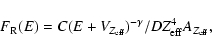 |
(A.1) |
where
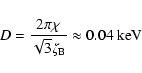 |
(A.2) |
and the ratio measuring recombination efficiency relative to bremsstrahlung is
![\begin{displaymath}\frac{F_{\rm B}(E)}{F_{\rm R}(E)}=\gamma
Z_{\rm eff}^4A_{Z_{\rm eff}}\frac{D}{E}[1+V_{Z_{\rm eff}}/E]^{\gamma},
\end{displaymath}](/articles/aa/full/2008/14/aa8103-07/img189.gif) |
(A.3) |
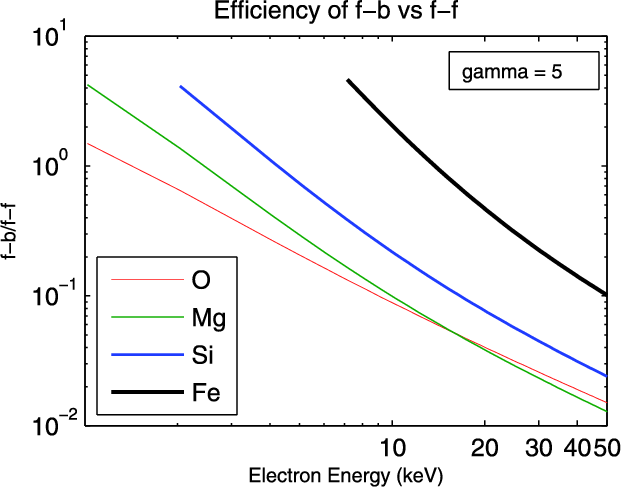
which we show in Fig. A.1 for  in terms of each of the dominant f-b contributions
from fully ionised O, Mg, Si and Fe respectively while the f-f is for all elements. Evidently
non-thermal recombination could be dominant over bremsstrahlung up
to many 10 s of keV as the most efficient HXR source if the electrons are
emitted entirely in a plasma hot enough (
in terms of each of the dominant f-b contributions
from fully ionised O, Mg, Si and Fe respectively while the f-f is for all elements. Evidently
non-thermal recombination could be dominant over bremsstrahlung up
to many 10 s of keV as the most efficient HXR source if the electrons are
emitted entirely in a plasma hot enough (
 MK) for
elements up to Fe 24+ to be ionised and is significant even at lower temperatures.
MK) for
elements up to Fe 24+ to be ionised and is significant even at lower temperatures.
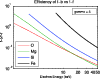 |
Figure A.1:
The f-b electron efficiency compared to f-f for the 4 elements discussed in Appendix A. It is evident from the graph
that, if present, highly ionised Fe is the most efficient
source of f-b HXRs in terms of the F(E) needed followed by Si, O
and Mg. |
| Open with DEXTER |
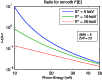 |
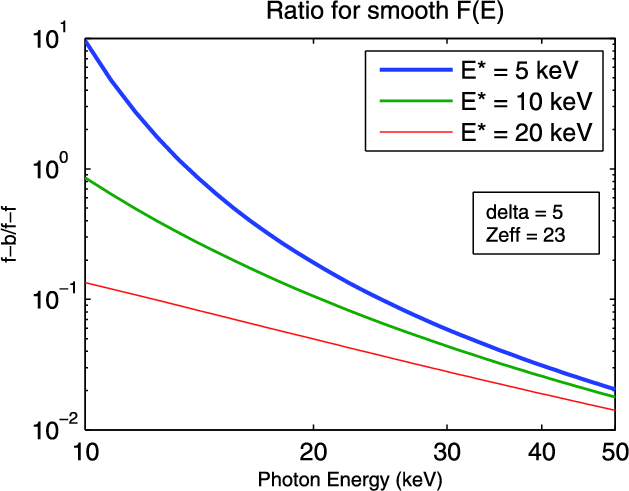
Figure A.2:
The
 as discussed in Appendix A and Eq. (A.5). It is the ratio of
to
for the
smooth
as discussed in Appendix A and Eq. (A.5). It is the ratio of
to
for the
smooth
 for
E*=5, 10, 20 keV
respectively.
for
E*=5, 10, 20 keV
respectively. |
| Open with DEXTER |
In terms of the total required electron fluxes
 above
energy E1, the ratio is
above
energy E1, the ratio is
which is about 10 for Fe, 0.25 for Si and 0.1 for Mg and O at
E1=10 keV.
At higher electron energies (
 keV), O becomes more efficient than Mg, as can be seen
in Fig. A.1, because of the combined effects of the A4 factor and the term containing VZ.
keV), O becomes more efficient than Mg, as can be seen
in Fig. A.1, because of the combined effects of the A4 factor and the term containing VZ.
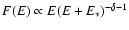
All of the above results are for F(E) with a sharp cut off .
To illustrate how the appearance of
is modified by
inclusion of f-b as well as f-f for a smooth F(E), a simple case to
evaluate is
,
which behaves as
 at
at  but has a smooth roll-over at
 .
It is simple to show that the resulting
.
It is simple to show that the resulting
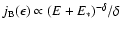 for f-f alone and
that the ratio of f-b to f-f in this case is, for ion
alone,
for f-f alone and
that the ratio of f-b to f-f in this case is, for ion
alone,
which is shown in Fig. A.2 for ,
 and
E*=5, 10, 20 keV. We see again that
is largest for
large
and for small E*.
and
E*=5, 10, 20 keV. We see again that
is largest for
large
and for small E*.
![\begin{figure}
\par\includegraphics[width=17cm,clip]{8103fig9.eps}
\end{figure}](/articles/aa/full/2008/14/aa8103-07/Timg205.gif) |
Figure B.1:
Non-thermal f-f and f-b spectra for the thick
target case (Eqs. (B.11) and (B.12)) shown for 2 different temperatures: 20 MK that is pertinent to events such as the 2002 April 14 event and 10 MK, which is more in the range of ``microflare'' temperatures. It is
interesting to note the three distinct energy regimes for the f-b
spectrum, namely:
 .
Clearly f-b is very important in the 10-50 keV range,
precisely where albedo issues are also important. .
Clearly f-b is very important in the 10-50 keV range,
precisely where albedo issues are also important. |
| Open with DEXTER |
Here we extend the above results on local emissivities
to estimate total spectral emission rate
(photons s-1 per unit )
from extended flare volumes as required for real flare data.
A thin target is one in which F(E) is not significantly modified
by energy losses or gains over the volume. For a loop of half length L, transverse area A, volume 2AL and density ,
the total emission rate
spectra contributions
 are for a power law F(E) with a low energy cut-off, by Eq. (15),
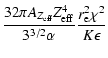
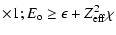
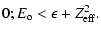
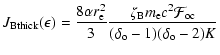
and by Eq. (16),
where the summation is over all
![$Z_{\rm eff} \le (\epsilon-E_{\rm c}]^{1/2}$](/articles/aa/full/2008/14/aa8103-07/img213.gif) .
These spectral shapes
are of course just the same as
the thin target j forms, scaled by the plasma volume.
.
These spectral shapes
are of course just the same as
the thin target j forms, scaled by the plasma volume.
Both f-f and f-b emissions are included in the standard analyses
(e.g. Mewe et al. 1987; Dere et al. 1996) of isothermal
hot plasma contributions to flare spectra, using full cross sections
and ionisation balance expressions. It is therefore surprising that
f-b is omitted from calculations of non-thermal emission, especially
at low ,
where electrons of comparable energy are present
in both thermal and non-thermal populations. In applying our study
of the non-thermal f-b to real data we wish to include thermal
emission as it is important at energies under about 20 keV and so
dilutes the visibility of non-thermal contributions. In order to
treat the thermal and non-thermal j consistently and allow
meaningful comparisons we use the expressions for the thermal jrelevant to the Kramers cross sections just as in the non-thermal
case - but see remarks previously and below concerning Gaunt factors
and absolute accuracy of our results.
For an isothermal plasma the local Maxwellian electron flux spectrum
is
![\begin{displaymath}F_{\rm therm}(E)=\left[\frac{8}{\pi m_{\rm e}}\right]^{1/2}
\frac{E}{(kT)^{3/2}}n_{\rm p}\exp~(-E/kT),
\end{displaymath}](/articles/aa/full/2008/14/aa8103-07/img214.gif) |
(B.3) |
which, by Eq. (4), gives for the thermal bremsstrahlung emission
from a uniform loop
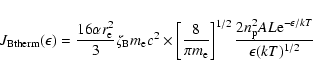 |
(B.4) |
and for the recombination
 |
|
|
(B.5) |
These results can be compared with those of Culhane (1969);
Culhane & Acton (1970) who were among the first to explicitly
address the X-ray spectrum from hot coronal plasmas. Using the
Kramers cross sections is essentially equivalent to setting to unity
all Gaunt factors in their expressions. When we do so, the
 dependences of our
 are
identical to theirs - e.g.
are
identical to theirs - e.g.
 is independent
of ,
the only difference being that our
is independent
of ,
the only difference being that our
 is
much larger (in absolute value) than theirs, mainly because they
used the very much lower value of AZ for Fe believed at that
time. Examination of the
dependences of Culhane's
Gaunt factors shows that they affect quite significantly both the
f-f and the f-b spectra from a Maxwellian F(E) and we should
expect the same to be true for non-thermal F(E) like power-laws.
Thus, any accurate absolute comparison of predictions with data will
require incorporation of appropriate g,G. However, these do not
affect the absolute orders of magnitude of
nor the dependencies on
is
much larger (in absolute value) than theirs, mainly because they
used the very much lower value of AZ for Fe believed at that
time. Examination of the
dependences of Culhane's
Gaunt factors shows that they affect quite significantly both the
f-f and the f-b spectra from a Maxwellian F(E) and we should
expect the same to be true for non-thermal F(E) like power-laws.
Thus, any accurate absolute comparison of predictions with data will
require incorporation of appropriate g,G. However, these do not
affect the absolute orders of magnitude of
nor the dependencies on
 etc., nor the locations of
edges. So, for the present purpose of demonstrating the importance
of f-b, the Kramers expressions will suffice.
etc., nor the locations of
edges. So, for the present purpose of demonstrating the importance
of f-b, the Kramers expressions will suffice.
In the thick target case, j evolves in space along with the energy
losses of the electrons. To find j locally one uses the continuity
equation (Brown 1972) and then integrates over volume to get J.
However, to get the whole volume J, it is actually simpler (Brown
1971) to start with the electron injection rate spectrum
 electrons/s per unit injection energy
  and use the
expression
and use the
expression
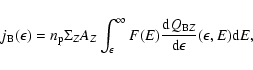
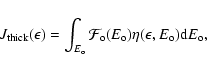 |
(B.6) |
where
 is the total number of photons per unit
emitted by an electron of energy
as it decays in
energy. For purely collisional losses
is the total number of photons per unit
emitted by an electron of energy
as it decays in
energy. For purely collisional losses
 with
with
 ,
e being the electronic charge and
,
e being the electronic charge and  the Coulomb
Logarithm. Then
the Coulomb
Logarithm. Then
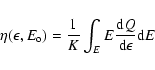 |
(B.7) |
for the relevant radiation cross section d
 .
Note that
this assumes H to be uniformly and fully ionised along the electron
path. For partially ionised H the energy loss constant K is
reduced but this situation is not relevant to our hot source
situations.
.
Note that
this assumes H to be uniformly and fully ionised along the electron
path. For partially ionised H the energy loss constant K is
reduced but this situation is not relevant to our hot source
situations.
For our Kramers d
f-f and f-b expressions (3), (7) and (9), the resulting expressions, in the case where
 are uniform along the path, Eq. (B.7) gives
and
For a power-law injection rate spectrum
of spectral index
 ,
viz
,
viz
![\begin{displaymath}{\cal F}_{\rm o}(E_{\rm o}) = (\delta_{\rm o}-1)\frac{{\cal
F...
..._{\rm oc}}\right]^{-\delta_{\rm o}}; E_{\rm o} \ge E_{\rm oc},
\end{displaymath}](/articles/aa/full/2008/14/aa8103-07/img241.gif) |
(B.10) |
where
 is the total rate above low energy cut-off
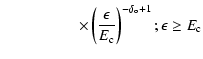
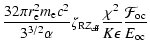
 ,
the expressions for the non-thermal emission spectra are
then by Eq. (B.6)
,
the expressions for the non-thermal emission spectra are
then by Eq. (B.6)
and, for ion
,
For the case of a cold thick target footpoint the total
 can be almost as small as 1 if only hydrogen and some low
elements are ionised and even zero if T<8000 K or so (there being
almost no charged ions present). In these sources the f-b
contribution is negligible or at most a very small correction. For a
collisonally thick hot loop
is, however, very much higher.
can be almost as small as 1 if only hydrogen and some low
elements are ionised and even zero if T<8000 K or so (there being
almost no charged ions present). In these sources the f-b
contribution is negligible or at most a very small correction. For a
collisonally thick hot loop
is, however, very much higher.
The main distinction of these hot thick target spectra compared to
hot thin targets is that the decay of all electrons to zero energy
means that the signature of the cut off
in the injection
spectrum appears not as a discontinuity in
but only in
its gradient
.
This gradient break is very noticeable
in Fig. B.1 at energy
 .
So, even in the thick
target case, spectral diagnosis of any
present is possible.
The recombination edges themselves appear at the relevant ionisation
energies
.
So, even in the thick
target case, spectral diagnosis of any
present is possible.
The recombination edges themselves appear at the relevant ionisation
energies
 ,
these being from thick target electrons
decelerated to zero E. These non-thermal recombination spectral
edges are then down in the energy regime below 10 keV which is
complicated by Fe lines etc., making the interpretation of
,
these being from thick target electrons
decelerated to zero E. These non-thermal recombination spectral
edges are then down in the energy regime below 10 keV which is
complicated by Fe lines etc., making the interpretation of
 there, and of the lines, more difficult.
- Andersen, L.
H., Pan, G-Y., & Schmidt, H. T. 1992, J. Phys., B, 25, 277
(In the text)
- Arnaud, M., &
Raymond, J. 1992, ApJ, 398, 394 [NASA ADS] [CrossRef]
(In the text)
- Arnoldy, R. L.,
Kane, S. R., & Winckler, J. R. 1968, ApJ, 151, 711 [NASA ADS] [CrossRef]
(In the text)
- Brown, J. C. 1971,
Sol. Phys., 18,489
(In the text)
- Brown, J. C. 1972,
Sol. Phys., 26, 441 [NASA ADS] [CrossRef]
(In the text)
- Brown, J. C. 2005,
Solar Magnetic Phenomena, Proceedings of the 3rd Summerschool and
Workshop held at the Solar Observatory Kanzelh ohe, K arnten,
Austria, August 25-September 5, 2003, ed. A. Hanslmeier, A.
Veronig, & M. Messerotti, Astronomy and Astrophysics Space
Science Library, 320 (Dordrecht, The Netherlands: Springer), 87,
87
(In the text)
- Brown, J. C., &
Emslie, A. G. 1988, ApJ, 331, 164 [CrossRef]
(In the text)
- Brown, J. C., Emslie,
A. G., Holman, G. E., et al. 2006, ApJ, 643, 523 [NASA ADS] [CrossRef]
(In the text)
- Conway, A. J.,
Brown, J. C., Eves, B. A. C., & Kontar, E. P. 2003, A&A,
407, 725 [NASA ADS] [CrossRef] [EDP Sciences]
(In the text)
- Craig, I. J. D.,
& Brown, J. C. 1986, Inverse Problems in Astronomy (New York
and London: IoPP Adam Hilger)
(In the text)
- Culhane, J. L.
1969, MNRAS, 144, 375 [NASA ADS]
(In the text)
- Culhane, J. L.,
& Acton, L. W. 1970, MNRAS, 151, 141 [NASA ADS]
(In the text)
- Dere, K. P., Landi, E.,
Mason, H. E., Monsignori Fossi, B. C., & Young, P. R. 1997,
A&AS, 125, 149 [NASA ADS] [CrossRef] [EDP Sciences]
- Erdos, A., Mezzorani,
G., & Quarati, P. 1993, Phys. Rev. A, 48,452
- Feldman, U.,
Mandelbaum, P., Seely, J. L., Doschik, G. A., & Garsky, H.
1992, ApJ, 81, 387 [NASA ADS] [CrossRef]
(In the text)
- Hahn, Y. 1997, Rep.
Prog. Phys., 60, 691 [NASA ADS] [CrossRef]
(In the text)
- Hahn, Y., & Krstic,
P. 1994, J. Phys., B 27, L509
(In the text)
-
Johns-Krull, C., & Lin, R. P. 1992, Sol. Phys., 137, 121 [NASA ADS] [CrossRef]
-
Kasparová, J., Kontar, E. P., & Brown, J. C. 2007,
A&A, 466, 705 [NASA ADS] [CrossRef] [EDP Sciences]
- Koch, H. W., &
Motz, J. W. 1959, Rev. Mod. Phys., 31, 4 [CrossRef], 920
(In the text)
- Kontar, E. P.,
Emslie, A. G., Piana, M., Massone, A. M., & Brown, J. C. 2005,
Sol. Phys., 226, 137 [CrossRef]
(In the text)
- Kontar, E. P.,
MacKinnon, A. L., Schwartz, R. A., & Brown, J. C. 2006,
A&A, 446, 1157 [NASA ADS] [CrossRef] [EDP Sciences]
(In the text)
- Korchak, A. A.
1971, Sol. Phys., 18, 284 [NASA ADS] [CrossRef]
(In the text)
- Kramers, H. A.
1923, Phil. Mag., 46, 836
(In the text)
- Krucker, S.,
Christe, S., Lin, R. P., Hurford, G. J., & Schwartz, R. A.
2002, Sol. Phys., 210, 445 [NASA ADS] [CrossRef]
(In the text)
- Landini, M.,
Monsignori, F. B. C., & Pallavicini, R. 1973, Sol. Phys., 29,
93 [NASA ADS] [CrossRef]
(In the text)
- Lin, R. P., &
Schwartz, R. A. 1987, ApJ, 312, 462 [NASA ADS] [CrossRef]
(In the text)
- Lin, R. P., Dennis, B.
R., Hurford, G. J., et al. 2002, Sol. Phys., 210, 3 [NASA ADS] [CrossRef]
(In the text)
- MacKinnon, A.
L. 2006, in Solar Eruptions and Energetic Particles, ed. N.
Gopalswamy, R. Mewaldt, & J. Torsti, AGU Geophysical Monograph,
165, 157
(In the text)
- Mallik, P. C. V.,
& Brown, J. C. 2007, RAS NAM (Preston), Abstract P20.6
(In the text)
- Massone, A. M.,
Emslie, A. G., Kontar, E. P., et al. 2004, ApJ, 613, 1233 [NASA ADS] [CrossRef]
(In the text)
- Mewe, R., Lemen, J. R.,
& van den Oord, G. H. J. 1986, A&AS, 65, 511 [NASA ADS]
- Piana, M., Massone,
A. M., Kontar, E. P., et al. 2003, ApJ, 595 , L127
(In the text)
- Piana, M., Barrett,
R. K., Brown, J. C., & McIntosh, S. W. 2000, Inverse Problems,
15, 1469 [NASA ADS] [CrossRef]
(In the text)
- Veronig, A.,
& Brown, J. C. 2004, ApJ, 603, L117 [NASA ADS] [CrossRef]
(In the text)
- Vilmer, N.,
MacKinnon, A. L., Trottet, G., & Barat, C. 2003, A&A, 412,
865 [NASA ADS] [CrossRef] [EDP Sciences]
(In the text)
- Zhang, J., &
Huang, G. L. 2004, Sol. Phys., 219, 135 [NASA ADS] [CrossRef]
(In the text)
Copyright ESO 2008



 as given by exact calculations
such as those of Arnaud & Raymond (
as given by exact calculations
such as those of Arnaud & Raymond ( we include here only recombination
to m=1 (in the sense of the lowest empty level of the ion - hydrogenic with
we include here only recombination
to m=1 (in the sense of the lowest empty level of the ion - hydrogenic with
 though extending to lower
energies with edges at
though extending to lower
energies with edges at
 .
These should be included
in quantitative data fitting.
.
These should be included
in quantitative data fitting.

![$\displaystyle \times ~~\left[\frac{\epsilon}{E_{\rm c}}\right]^{-\delta};
\epsilon \ge E_{\rm c}$](/articles/aa/full/2008/14/aa8103-07/img110.gif)


![$\displaystyle \times ~~\left[\frac{\epsilon-Z_{\rm eff}^2\chi}{E_{\rm c}}
\right]^{-\delta-1}; \epsilon \ge E_{\rm c}+Z_{\rm eff}^2\chi$](/articles/aa/full/2008/14/aa8103-07/img114.gif)

![$\displaystyle \frac{j_{\rm R}(\epsilon)}{j_{\rm B}(\epsilon)} \frac{2\pi\delta}...
...}}}{\zeta_{\rm B}}\left[1-\frac{Z_{\rm eff}^2\chi}{\epsilon}\right]^{-\delta-1}$](/articles/aa/full/2008/14/aa8103-07/img119.gif)

![$\displaystyle \frac{0.25(\delta/5)}{\epsilon\rm (keV)}\Sigma
_{Z_{\rm eff}^2>(\...
...}}{\zeta_{\rm B}}\left[1-\frac{Z_{\rm eff}^2\chi}{\epsilon}\right]^{-\delta-1},$](/articles/aa/full/2008/14/aa8103-07/img121.gif)
![\begin{figure}
\par\includegraphics[width=17.8cm,clip]{8103fig1.eps}
\end{figure}](/articles/aa/full/2008/14/aa8103-07/img136.gif)
![\begin{figure}
\par\includegraphics[width=17.5cm,clip]{8103fig2.eps}
\end{figure}](/articles/aa/full/2008/14/aa8103-07/img137.gif)
![\begin{figure}
\par\includegraphics[width=12cm,clip]{8103fig3.eps}
\end{figure}](/articles/aa/full/2008/14/aa8103-07/img138.gif)
![\begin{figure}
\par\includegraphics[width=17cm,clip]{8103fig4.eps}
\end{figure}](/articles/aa/full/2008/14/aa8103-07/img139.gif)
 cm;
cm;
 cm2;
cm2;
 cm-3;
cm-3;
 cm-2;
cm-2;
 s-1 above E1= 25 keV. The total J is dominated by thermal f-b and f-f at low
  is down by a factor of 625. Somewhere between this and the first
case should be the optimum condition for seeing maximum f-b
contribution.
is down by a factor of 625. Somewhere between this and the first
case should be the optimum condition for seeing maximum f-b
contribution.
![\begin{figure}
\par\includegraphics[width=8cm,clip]{8103fig5.eps}
\end{figure}](/articles/aa/full/2008/14/aa8103-07/img158.gif)

![\begin{figure}
\par\includegraphics[width=8cm,clip]{8103fig6.eps}
\end{figure}](/articles/aa/full/2008/14/aa8103-07/img159.gif)




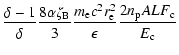
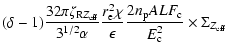
![$\displaystyle \frac{\gamma-1}{\gamma-2}
Z_{\rm eff}^4
A_{Z_{\rm eff}}\frac{D}{E_1}[1+V_{Z_{\rm eff}}/E_1]^{\gamma-1}$](/articles/aa/full/2008/14/aa8103-07/img196.gif)
![$\displaystyle 0.02
Z_{\rm eff}^4A_{Z_{\rm eff}}\frac{10~\rm keV}{E_1}[1+V_{Z_{\rm eff}}/E_1]^{\gamma-1},$](/articles/aa/full/2008/14/aa8103-07/img197.gif)
![\begin{displaymath}\nonumber \Psi_{\rm smooth} = \frac{D\zeta_{Z_{\rm eff}}}{\ep...
...\left[1-\frac{Z_{\rm eff}^2}{\epsilon+E_*}\right]^{-\delta-1},
\end{displaymath}](/articles/aa/full/2008/14/aa8103-07/img203.gif)
![\begin{figure}
\par\includegraphics[width=17cm,clip]{8103fig9.eps}
\end{figure}](/articles/aa/full/2008/14/aa8103-07/img205.gif)

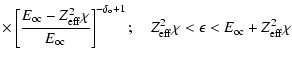
![$\displaystyle \times \left[\frac{\epsilon}{E_{\rm c}}\right]^{-\delta};
\epsilon \ge E_{\rm c}$](/articles/aa/full/2008/14/aa8103-07/img209.gif)




![$\displaystyle \times \left[\frac{E_{\rm o}}{\epsilon}-1\right]; \epsilon \le E_{\rm o}$](/articles/aa/full/2008/14/aa8103-07/img234.gif)


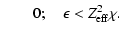
![$\displaystyle \qquad\qquad\quad\times \left[(\delta_{\rm o}-1)\frac{E_{\rm c}}{\epsilon}-(\delta_{\rm o}-2)\right]; \epsilon < E_{\rm c}$](/articles/aa/full/2008/14/aa8103-07/img246.gif)

![$\displaystyle \displaystyle\times\left[\frac{\epsilon-Z_{\rm eff}^2\chi}{E_{\rm...
...}\right]^{-\delta_{\rm o} + 1}; \quad
\epsilon \ge E_{\rm oc}+Z_{\rm eff}^2\chi$](/articles/aa/full/2008/14/aa8103-07/img249.gif)