


Fig. 2.
Download original image
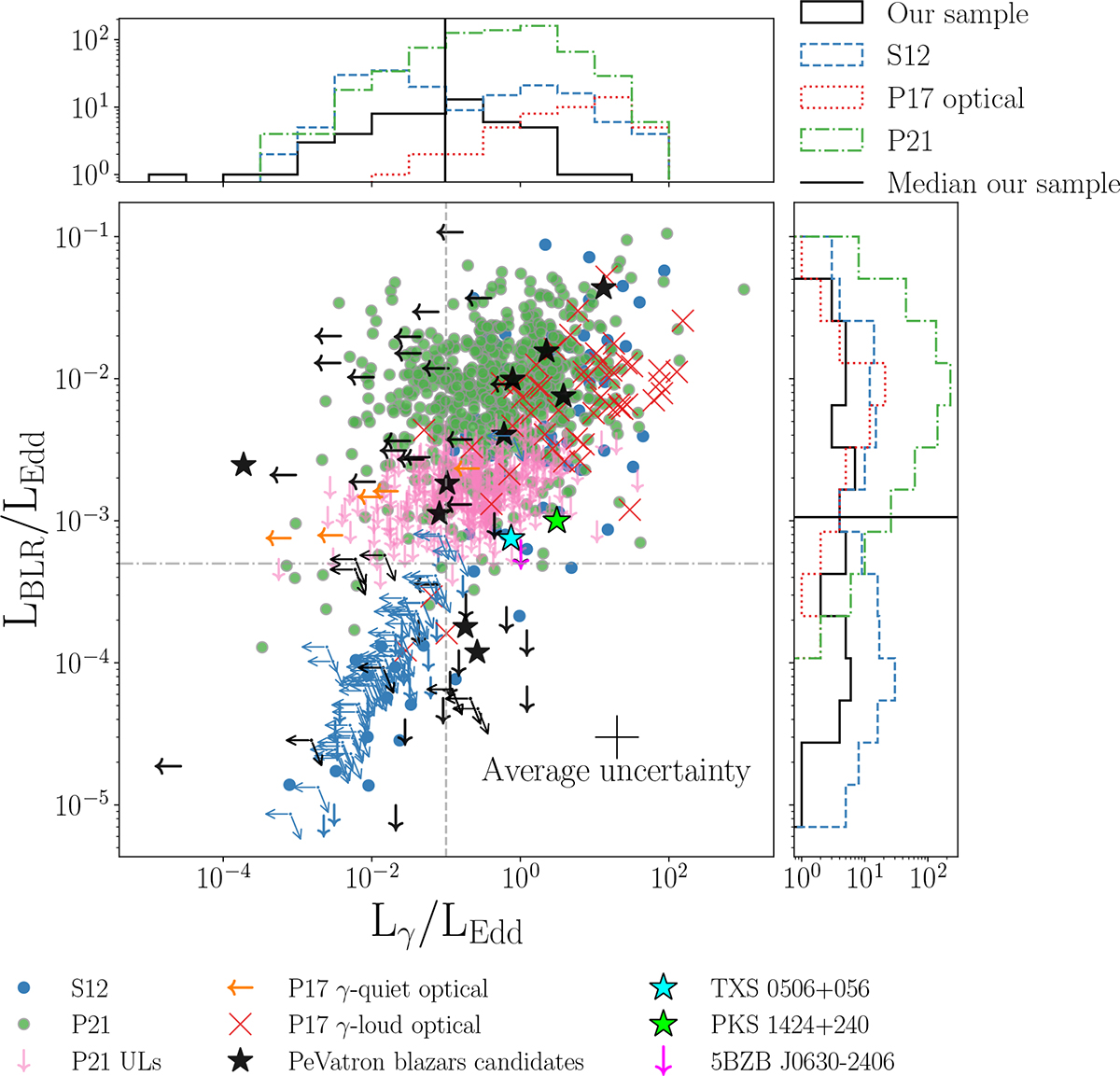
LBLR/LEdd (accretion regime proxy) vs. Lγ/LEdd (power of the jet proxy) of the candidate PeVatron blazars (black). The three blue FSRQs (masquerading BL Lacs) TXS 0506+056, PKS 1424+240, and 5BZB J0630-2406 that were previously identified as promising neutrino-emitter blazar candidates are highlighted in cyan, lime, and magenta, respectively (see Sect. 6.3). As a comparison, the plot also shows the samples of S12, P17, and P21 (see Sect. 3.2). For P17, we plot the subsample with properties analyzed through optical spectroscopy. The arrows represent upper limits on either one or both of the shown quantities (see also Appendix C). The dotted gray lines represent the boundaries for the different accretion efficiencies, respectively LBLR/LEdd ∼ 5 × 10⁻⁴ and Lγ/LEdd ∼ 0.1 (Ghisellini et al. 2011b; Sbarrato et al. 2012). On the sides are the histograms of the corresponding quantities for all the samples, excluding all the upper limits. Here the black solid lines represent the median values for the candidate PeVatron blazars.
Current usage metrics show cumulative count of Article Views (full-text article views including HTML views, PDF and ePub downloads, according to the available data) and Abstracts Views on Vision4Press platform.
Data correspond to usage on the plateform after 2015. The current usage metrics is available 48-96 hours after online publication and is updated daily on week days.
Initial download of the metrics may take a while.