


Fig. 4
Download original image
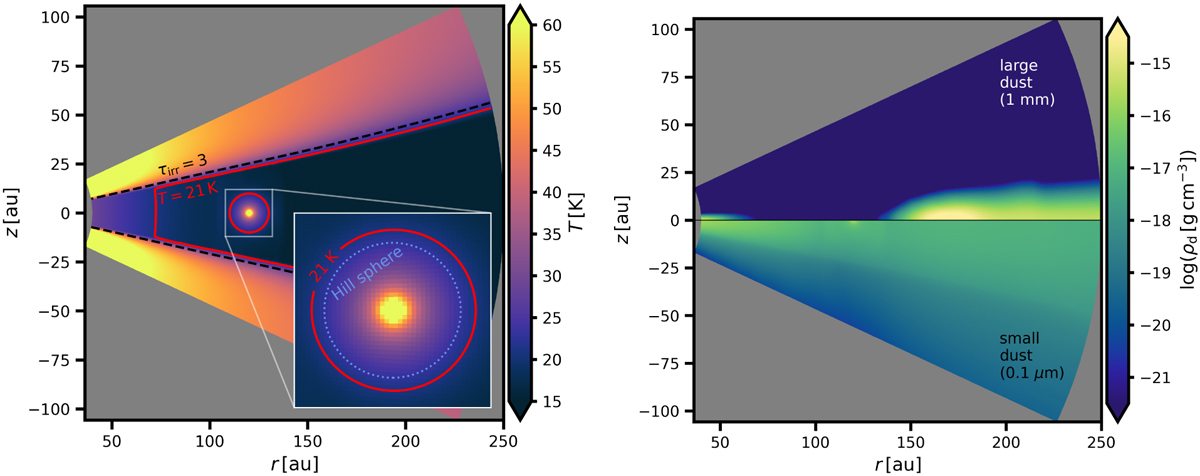
Meridional profile of the disk temperature (left) and the volume density of small (right, bottom half) and large dust grains (right, upper half). The displayed plane coincides with the location of the planet. The temperature map also shows the isosurfaces at which T=21 K (solid red curve) and the optical depth to stellar irradiation becomes τirr=3 (dashed black curve). The width of the inset, in which we also mark the Hill sphere of the planet (dotted blue curve), is 24 au. The accreting planet heats its surroundings and maintains a bubble within which T>21 K and the freeze-out of CO molecules is prevented, unlike in the majority of the disk interior.
Current usage metrics show cumulative count of Article Views (full-text article views including HTML views, PDF and ePub downloads, according to the available data) and Abstracts Views on Vision4Press platform.
Data correspond to usage on the plateform after 2015. The current usage metrics is available 48-96 hours after online publication and is updated daily on week days.
Initial download of the metrics may take a while.