


Fig. 5
Download original image
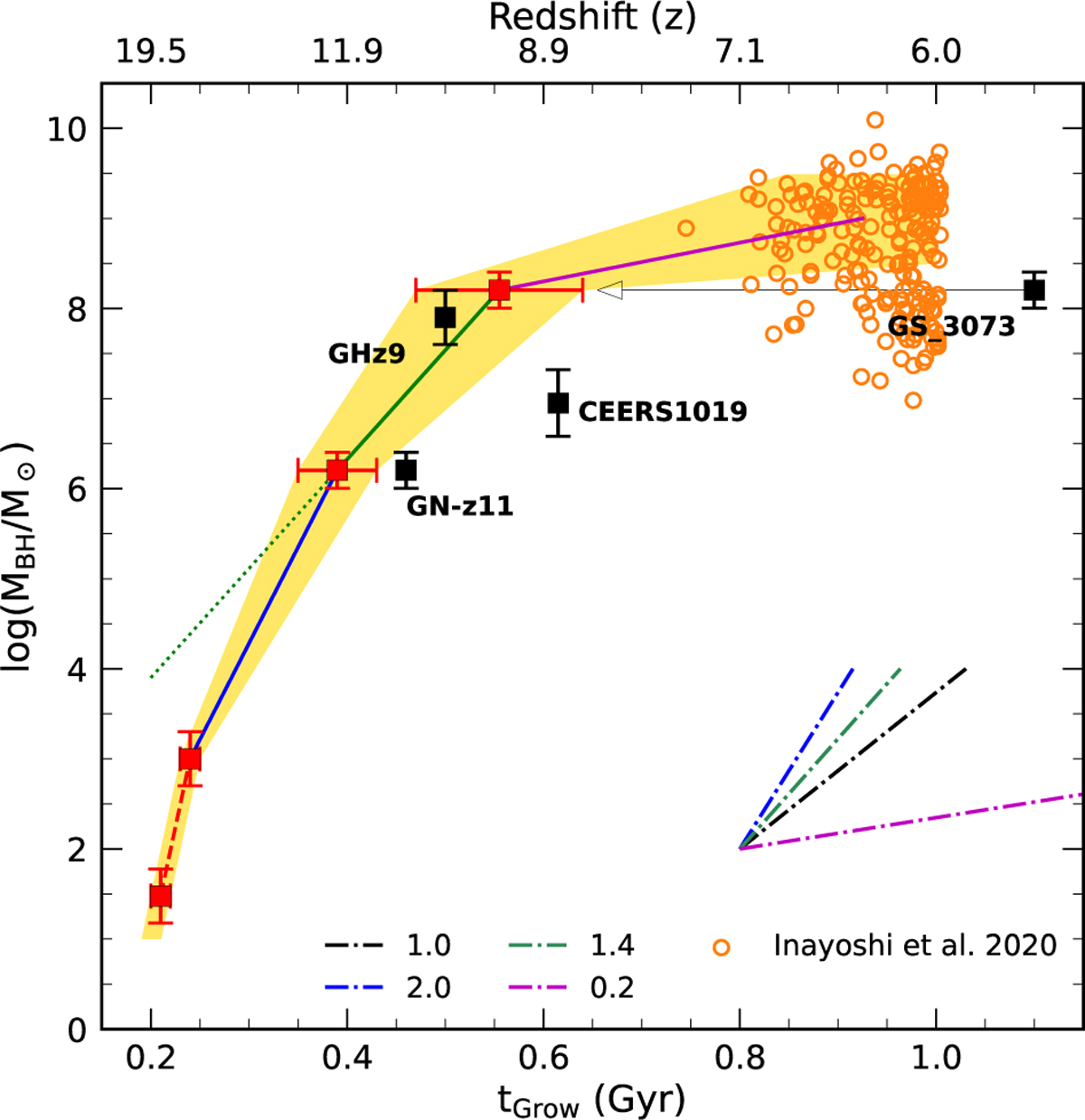
Schematic view of the growth of the seed BH through the GN-z11 and GS_3073 masses up to the masses at z=6–7 (Inayoshi et al. 2020). The black squares show the BH masses versus the age of the Universe corresponding to the redshifts of the four systems in Table 1. We fix the zero age of the NSC formation at z=19.5 and age of the Universe of ~200 Myr. The initial masses for the BH evolution are in the range allowed for stellar BH remnants (in this plot 30 M⊙), and we assume dynamical merging to form a 1000 M⊙ seed during the first 30 Myr after their formation (dynamical evolution is represented by the red dotted line). We plot the systems GN-z11 and GS_3073 as red squares at the ages found in this work (plus the 200 Myr of the zero point of ages), based on the N/O and C/O versus O/H abundances of GS_3073, and on the idea that they correspond to pure AGB ejecta, in a NSC system evolution resembling ω Cen. GN-z11 is obviously very close to its redshift age, while the horizontal arrow shows the shift to the growing-age location of GS_3073. The accretion evolution is represented by the yellow band. The lines connecting the 1000 M⊙ seed and the average locations of GN-z11, GS_3073 and the quasars at z=6–7 give a qualitative idea of the mass growing rates. The slope for constant accretion rates equal to α times the Eddington mass accretion, with α=0.2, 1, 1.4 and 2 are shown for a qualitative comparison with the slope of the segments connecting the objects. The dotted green line extrapolates back in time the line α ≃ 1.4 connecting the locations of GN-z11 and GS_3073, and shows that an initial seed of ~104 M⊙ needs a uniform super-Eddington rate till the mass of GS_3073.
Current usage metrics show cumulative count of Article Views (full-text article views including HTML views, PDF and ePub downloads, according to the available data) and Abstracts Views on Vision4Press platform.
Data correspond to usage on the plateform after 2015. The current usage metrics is available 48-96 hours after online publication and is updated daily on week days.
Initial download of the metrics may take a while.