


Fig. 1
Download original image
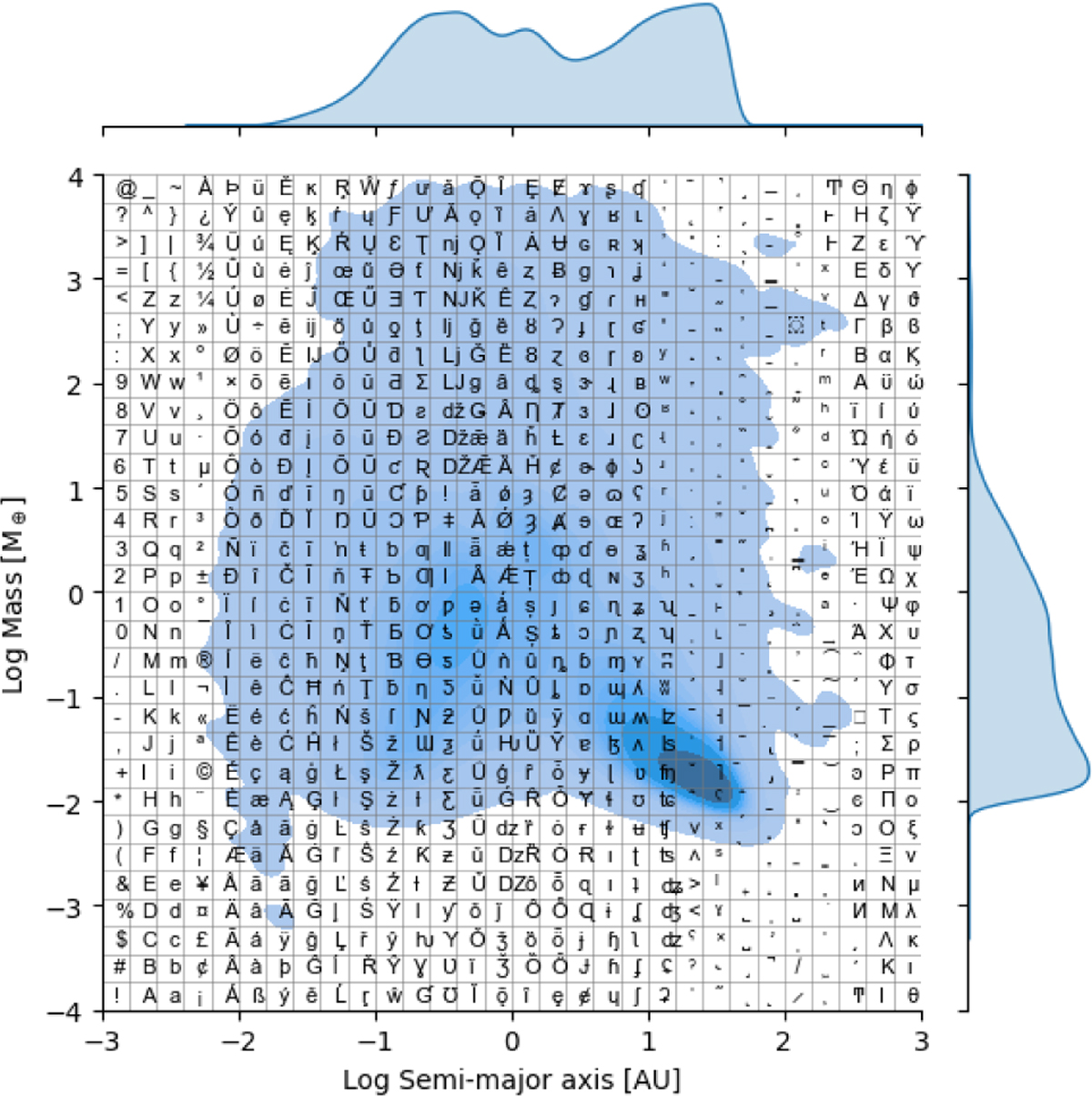
Example of the uniform encoding grid of N2 rectangles (with N = 30) used to encode the planets over the logarithm of the mass and semi-major axis of the planets. For each rectangle, we attribute a unique Unicode character, in order to encode a planet lying inside. In blue the density distribution is shown for the population of the 25 000 planetary systems used to train the model. The levels correspond to fractions of 0.0001, 0.001, 0.01, 0.1, 0.2, 0.3, 0.4, 0.5, 0.6, 0.7, 0.8, 0.9, and 1. Note that if two planets (from the same system) are located in the same rectangle, they are encoded as two identical characters.
Current usage metrics show cumulative count of Article Views (full-text article views including HTML views, PDF and ePub downloads, according to the available data) and Abstracts Views on Vision4Press platform.
Data correspond to usage on the plateform after 2015. The current usage metrics is available 48-96 hours after online publication and is updated daily on week days.
Initial download of the metrics may take a while.