


Fig. 1
Download original image
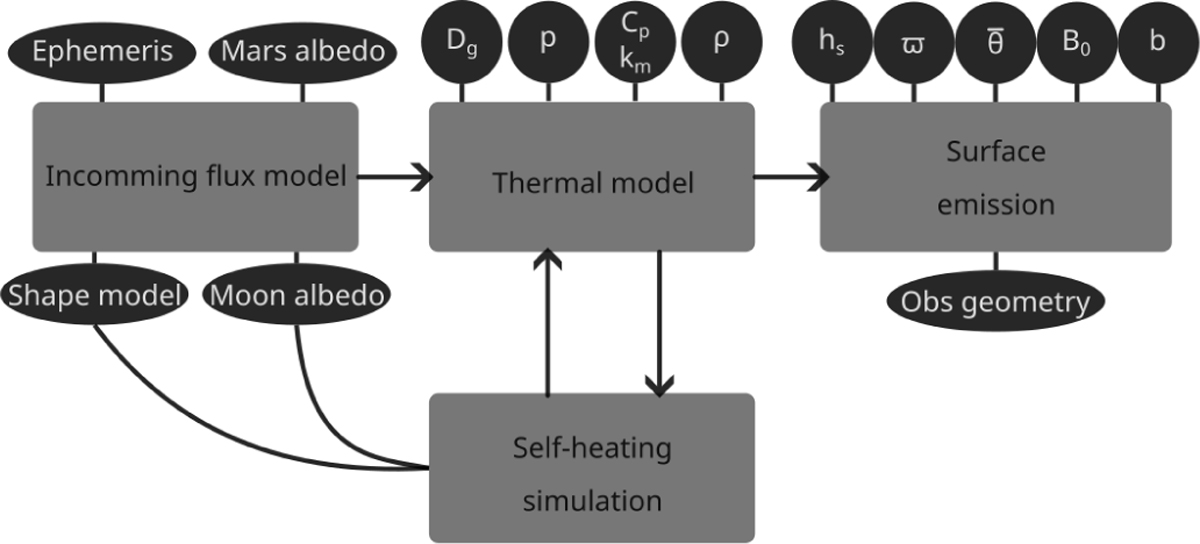
Simple schematic of the model pipeline. The surface incoming flux is first computed in order to derive the surface temperature based on the ephemeris, the Mars albedo mosaic from Christensen et al. (2001), the shape model of the targeted moon, and its albedo. The self-heating is computed iteratively after a first run of the thermal model until the convergence is reached, reinjecting the previous estimation to compute the new surface temperature. The thermal model takes the grain size Dg, the surface porosity p and density ρ, and the non-porous thermal conductivity km and specific heat Cp as inputs. Eventually the surface thermal emission is computed for a rough surface knowing the single scattering albedo (SSA) ϖ; the surface Hapke’s average slope angle ![$\[\bar{\theta}\]$](/articles/aa/full_html/2025/09/aa52601-24/aa52601-24-eq1.png) ; the opposition effect amplitude B0 and angular width parameter hs; the phase function asymmetry parameter b; and the geometry of observation regrouping i, e, and ϕ for the incidence, observation, and phase angle, respectively. This thermal emission is to be used as a reference to remove the emission component in the spectra.
; the opposition effect amplitude B0 and angular width parameter hs; the phase function asymmetry parameter b; and the geometry of observation regrouping i, e, and ϕ for the incidence, observation, and phase angle, respectively. This thermal emission is to be used as a reference to remove the emission component in the spectra.
Current usage metrics show cumulative count of Article Views (full-text article views including HTML views, PDF and ePub downloads, according to the available data) and Abstracts Views on Vision4Press platform.
Data correspond to usage on the plateform after 2015. The current usage metrics is available 48-96 hours after online publication and is updated daily on week days.
Initial download of the metrics may take a while.