


Fig. 1.
Download original image
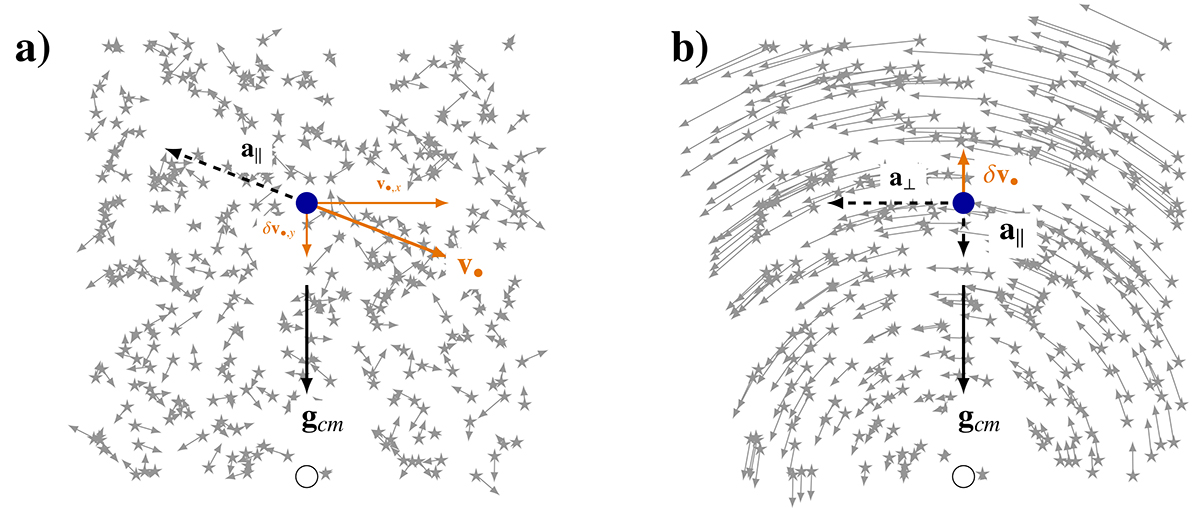
Sketch of gravitational accelerations for two different situations. The panels show a massive body (blue dot) orbiting among stars, and the system’s barycentre at the bottom is the focus of the global gravitational acceleration gcm (open circle). The mean field acceleration gives rise to a velocity component δv• along the vertical y-axis. In panel (a), a massive perturber moves at some velocity v• in an isotropic field of stars; the result of the polarisation of the stellar orbits is a net dynamical friction force a∥, parallel but in the opposite sense to v•. In panel (b), the massive body is ejected from the origin at a velocity δv• pointing upwards. It orbits in a strongly anisotropic (rotating) stellar field and slows down due to the steady negative acceleration gcm. However, dynamical friction now contributes two terms, one a∥ as before, and a second one, a⊥, orthogonal to δv•. That non-zero component due to the streaming stars causes a steady transfer of angular momentum to the perturber. We refer to this second component as dynamical traction acting on the perturber.
Current usage metrics show cumulative count of Article Views (full-text article views including HTML views, PDF and ePub downloads, according to the available data) and Abstracts Views on Vision4Press platform.
Data correspond to usage on the plateform after 2015. The current usage metrics is available 48-96 hours after online publication and is updated daily on week days.
Initial download of the metrics may take a while.