


Fig. 15.
Download original image
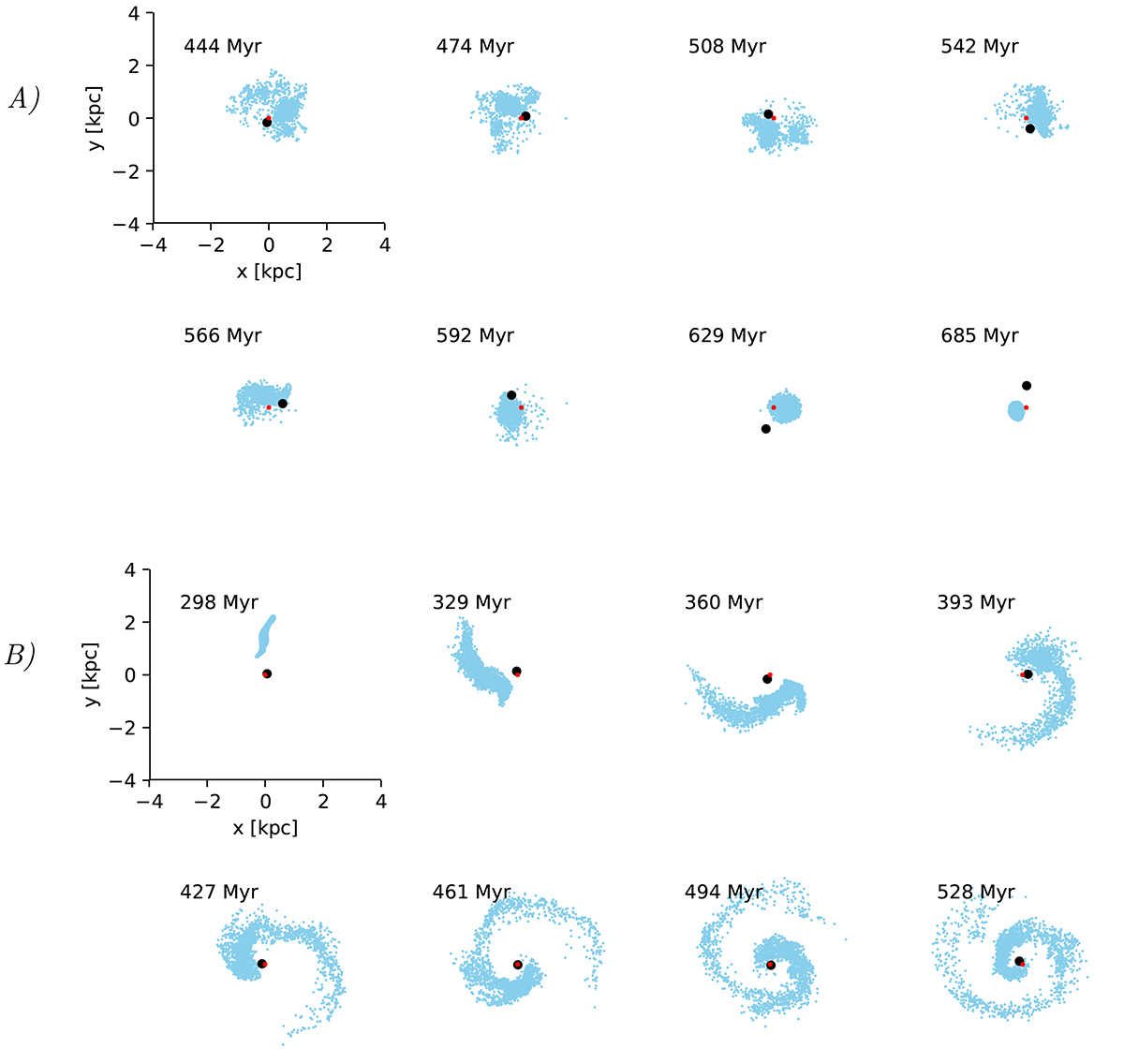
Two examples of the interaction between the central BH and stellar sub-structures. In (A, top row), when the background spherical Isochrone potential is partially frozen, the disc stars form clumps of higher mass and binding energy. Such structures may dislodge the BH. This two-stage instability then grows as the BH extracts angular momentum from the flow of rotating stars around the centre. In (B, bottom row) the situation for a self-gravitating disc plus isochrone potential means that the clumps are much less massive and of a lower binding energy. In that case, a clump will dissolve in the strong tidal field of the BH. The centre of coordinates is indicated with a red dot. (See text for more details).
Current usage metrics show cumulative count of Article Views (full-text article views including HTML views, PDF and ePub downloads, according to the available data) and Abstracts Views on Vision4Press platform.
Data correspond to usage on the plateform after 2015. The current usage metrics is available 48-96 hours after online publication and is updated daily on week days.
Initial download of the metrics may take a while.